What if reality is just a cultural construct you can break through? Pearce's New Age classic reveals how our "cosmic egg" of rationality limits human potential. Republished for new generations, this mind-bending journey into consciousness continues to inspire seekers of expanded awareness and creative transformation.
Joseph Chilton Pearce (1926-2016) was the visionary author of The Crack in the Cosmic Egg: Challenging Constructs of Mind and Reality and a world-renowned expert in human consciousness and child development. Published in 1971, this groundbreaking work explores psychology, mysticism, and the nature of reality, drawing on insights from Carl Jung, Teilhard de Chardin, and Carlos Castaneda to challenge the boundaries of conventional thought.
Pearce held degrees from the College of William and Mary and Indiana University, and served as a faculty member at the Jung Institute in Switzerland. For over 35 years, he lectured at Harvard, Oxford, Stanford, and Columbia, and was a certified HeartMath trainer and member of the Institute of HeartMath's Scientific Advisory Board. His other influential works include the national bestseller Magical Child, The Biology of Transcendence, and Evolution's End.
The Crack in the Cosmic Egg was praised as "important in a rare genre" by Publishers Weekly and shaped the thought of an entire generation with its revolutionary insights into expanding human potential.
The Crack in the Cosmic Egg by Joseph Chilton Pearce is a groundbreaking exploration of human consciousness and the limitations we place on our perception of reality. Published in 1971 as Pearce's primary work, the book challenges fundamental constructs of mind and reality, examining how our beliefs and cultural conditioning shape what we consider possible. It invites readers to question fixed worldviews and explore expanded states of awareness.
Joseph Chilton Pearce (1926-2016) was an iconoclastic author, lecturer, and scholar who spent nearly five decades probing the mysteries of human consciousness. Before writing The Crack in the Cosmic Egg, Pearce taught college humanities and served in the U.S. Army Air Corps during World War II. His work synthesized insights from psychology, anthropology, biology, and physics to challenge conventional thinking about human potential and the nature of reality.
The Crack in the Cosmic Egg appeals to seekers, philosophers, consciousness researchers, and anyone questioning conventional reality constructs. Readers interested in human potential, paradigm shifts, transpersonal psychology, and the intersection of science and spirituality will find Pearce's work particularly valuable. The book is ideal for those ready to examine their fundamental assumptions about consciousness, perception, and the boundaries of human experience.
The Crack in the Cosmic Egg remains a seminal work in consciousness studies, recognized as Joseph Chilton Pearce's most influential contribution. Its controversial perspectives sparked decades of discussion about reality, belief systems, and human potential. For readers seeking to expand their understanding of consciousness beyond mechanistic models, Pearce's synthesis of scientific and mystical insights offers a transformative intellectual journey that continues to resonate decades after its 1971 publication.
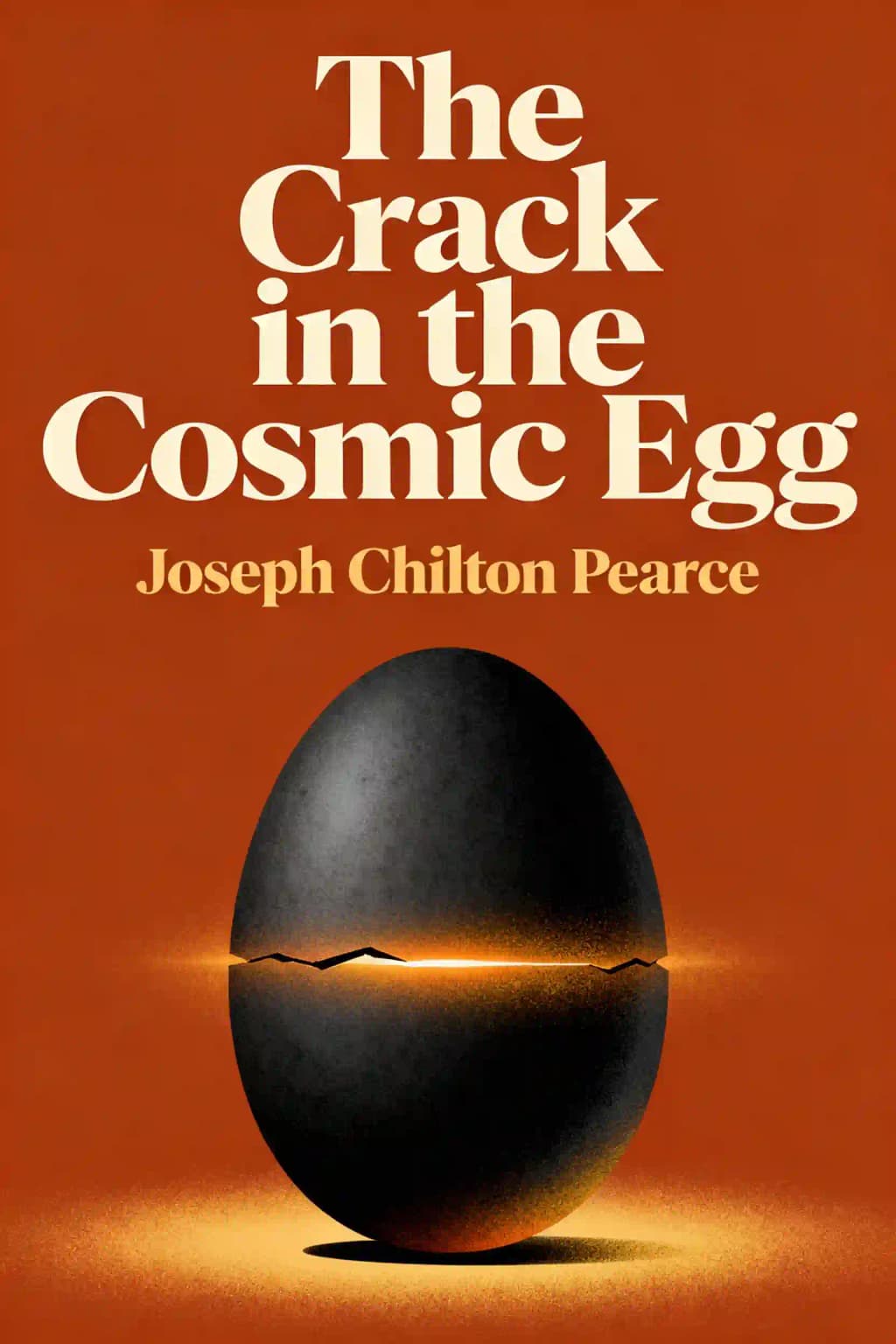
The "crack in the cosmic egg" metaphor represents breaks in our fixed constructs of reality—moments when our established belief systems show fissures, allowing new possibilities to emerge. Joseph Chilton Pearce uses this image to describe how consciousness can transcend self-imposed limitations. The "cosmic egg" symbolizes our enclosed worldview, while the "crack" represents opportunities to shatter confining paradigms and access expanded awareness beyond cultural conditioning.
The Crack in the Cosmic Egg presents several core concepts: reality is largely constructed by our beliefs and cultural programming; human consciousness has untapped potential beyond conventional understanding; our perception of what's "possible" limits our actual capabilities; and challenging fixed mental constructs opens pathways to transcendent experiences. Pearce synthesizes insights from science, mysticism, and anthropology to argue that humans can deliberately reshape their experience of reality.
The Crack in the Cosmic Egg by Joseph Chilton Pearce challenges conventional reality by questioning whether our agreed-upon worldview represents objective truth or collective conditioning. Pearce examines how cultural beliefs, language, and social structures create a shared "reality tunnel" that limits human potential. He explores phenomena like extraordinary human capacities, altered states, and mystical experiences that defy mainstream scientific materialism, suggesting our consensus reality is far more malleable than commonly believed.
Joseph Chilton Pearce's The Crack in the Cosmic Egg investigates consciousness as a participatory phenomenon rather than passive observation. The book examines how mind actively constructs experience, exploring the interplay between biology, culture, and perception. Pearce draws from multiple disciplines—psychology, physics, anthropology—to present consciousness as having latent capacities for transcendence that remain dormant under conventional conditioning, arguing that awareness itself shapes the reality we perceive.
Following The Crack in the Cosmic Egg, Joseph Chilton Pearce authored influential works including:
He also wrote Exploring the Crack in the Cosmic Egg, From Magical Child to Magical Teen, and co-authored Magical Parent, Magical Child with Michael Mendizza.
The Crack in the Cosmic Egg is considered controversial because Joseph Chilton Pearce challenges mainstream scientific materialism and questions fundamental cultural assumptions about consciousness and reality. His willingness to examine mystical experiences, extraordinary human capacities, and non-Western paradigms alongside Western science positioned him as an iconoclast. Pearce fearlessly critiqued how contemporary American culture constrains human potential, often confronting established academic and medical orthodoxies with alternative perspectives.
The Crack in the Cosmic Egg laid the conceptual foundation for Joseph Chilton Pearce's subsequent work on child development and human potential. His exploration of how cultural conditioning limits consciousness informed his later emphasis on preserving children's innate capacities through attachment parenting, natural birthing, and imaginative play. Pearce's understanding that reality constructs are learned helped him advocate for child-rearing practices that nurture rather than constrain the "unfolding" of children's intelligence and creative competence.
The Crack in the Cosmic Egg aligns closely with transpersonal psychology's emphasis on expanded states of consciousness and spiritual experiences. Joseph Chilton Pearce later spoke at the seventh annual Transpersonal Psychology conference in India, demonstrating the book's influence on this field. His synthesis of mystical, scientific, and psychological perspectives contributed to transpersonal psychology's mission of integrating spiritual dimensions into understanding human consciousness, exploring territories beyond ego-based awareness.
Siente el libro a través de la voz del autor
Convierte el conocimiento en ideas atractivas y llenas de ejemplos
Captura ideas clave en un instante para un aprendizaje rápido
Disfruta el libro de una manera divertida y atractiva
Reality isn't fixed but malleable, shaped by our beliefs and expectations.
Our questions shape the answers we receive.
Our expectations don't just influence outcomes - they actively shape and create them.
Thinking itself emerges as a powerful shaping force in reality.
The mythos - our imaginative understanding - invariably leads the logos - our rational understanding.
Desglosa las ideas clave de The crack in the cosmic egg en puntos fáciles de entender para comprender cómo los equipos innovadores crean, colaboran y crecen.
Experimenta The crack in the cosmic egg a través de narraciones vívidas que convierten las lecciones de innovación en momentos que recordarás y aplicarás.
Pregunta cualquier cosa, elige tu estilo de aprendizaje y co-crea ideas que realmente resuenen contigo.

Creado por exalumnos de la Universidad de Columbia en San Francisco
"Instead of endless scrolling, I just hit play on BeFreed. It saves me so much time."
"I never knew where to start with nonfiction—BeFreed’s book lists turned into podcasts gave me a clear path."
"Perfect balance between learning and entertainment. Finished ‘Thinking, Fast and Slow’ on my commute this week."
"Crazy how much I learned while walking the dog. BeFreed = small habits → big gains."
"Reading used to feel like a chore. Now it’s just part of my lifestyle."
"Feels effortless compared to reading. I’ve finished 6 books this month already."
"BeFreed turned my guilty doomscrolling into something that feels productive and inspiring."
"BeFreed turned my commute into learning time. 20-min podcasts are perfect for finishing books I never had time for."
"BeFreed replaced my podcast queue. Imagine Spotify for books — that’s it. 🙌"
"It is great for me to learn something from the book without reading it."
"The themed book list podcasts help me connect ideas across authors—like a guided audio journey."
"Makes me feel smarter every time before going to work"
Creado por exalumnos de la Universidad de Columbia en San Francisco

Obtén el resumen de The crack in the cosmic egg como PDF o EPUB gratis. Imprímelo o léelo sin conexión en cualquier momento.
Have you ever considered that what you call "reality" might be more like a cosmic egg-a shell of beliefs, expectations, and cultural assumptions that both protects and limits you? This is the revolutionary premise of Joseph Chilton Pearce's mind-bending work. The cosmic egg isn't just a poetic metaphor-it's the comprehensive framework through which we perceive and interact with the world, formed through years of cultural conditioning, language acquisition, and social programming. What makes this concept so profound is that we rarely question this framework; we mistake our constructed version of reality for objective reality itself. When we observe the world, we do so through layers of accumulated beliefs that color everything we see. This filtering process begins in infancy and continues throughout our lives. We become "reality-adjusted" to our particular time, place, and culture, creating a circular system of self-validation. What if our most fundamental assumptions about what's possible are simply constructs we've been taught to accept? What if the boundaries between possible and impossible are more permeable than we've been led to believe?
Beneath our rational thinking exists another mode of consciousness - what psychologists call "autistic thinking" or cognitive scientists term "thinking for the left hand." This primal mode operates below awareness, processing information in ways that defy conventional logic while accessing deeper patterns. Our worldview emerges from the creative tension between these modes, preventing both autistic dissolution and blind conformity to social convention. Consciousness represents just a segment of our larger awareness, filtered through what Aldous Huxley called the "reducing valve" of our nervous system. This valve selects specific events from a continuum of possibilities, allowing through only what serves survival and social functioning. Sensory deprivation experiments provide compelling evidence of how we construct reality: subjects deprived of sensory input hallucinate complete experiences. Miners trapped underground for days reported identical hallucinations, including doorways rimmed in blue light. Similar phenomena occur in isolation tanks, polar expeditions, and space missions - suggesting our experience of reality is actively constructed rather than passively received.
Have you ever experienced a "Eureka!" moment? These breakthroughs follow a pattern: questions planted in the autistic mode of thinking germinate beyond conscious awareness but in ground prepared by it. The passionate pursuit of a question eventually reveals its answer. Hamilton's Quaternion Theory "happened to him" while crossing a bridge after fifteen years of pursuit. Einstein described similar illuminations. Even religious conversions like Augustine's follow this pattern - passionate questions yielding their answers. Our questions shape the answers we receive, and our worldviews determine what we perceive. The unconscious autistic realm exists beyond true or false distinctions. The rational mind creates value through limitation, shaping formlessness into fact. Fire-walking ceremonies dramatically demonstrate belief reshaping reality. Researchers documented Indian fakirs walking on 1400C fires without injury - hot enough to melt aluminum. In one case, a skeptical professor walked unharmed while holding the fakir's hand, suggesting the protection extends beyond the practitioner. These phenomena challenge our assumptions about biological necessities, showing how belief can restructure reality through intense desire, detachment from convention, unwavering commitment, preparation, and breakthrough conviction.
What if science invents ways of grouping events rather than discovering pre-existing truths? Bronowski equated scientific thought with artistic thinking, while Teilhard de Chardin suggested a dynamic interrelation where what something is becomes influenced by what we think it is. Science emerged from religious belief that God's rational creation must be accessible to reason. Early scientists developed methods for "objective" agreement by imposing order-focusing on events fitting their rational framework while ignoring others. Atomic theory illustrates this process-from ancient Greeks through Newton to Dalton, who transformed imaginary concepts into mathematical correlations. Despite positivists dismissing atoms as unobservable, persistent belief eventually led to evidence, requiring enormous commitment of resources and collective belief. Modern explanations for fire-walking fail to account for many documented cases. Fire-walkers don't discover exceptions to physical laws-they temporarily create them through complete commitment to a different reality structure. This suggests physical laws may be strong tendencies that can be transcended rather than absolute imperatives.
Trance states reveal how mind shapes reality. Ernest Hilgard's Stanford research found that about twenty percent of people can experience deep trance states, enabling remarkable phenomena - bloodless wounds healing rapidly, superhuman strength, and measurable physiological changes like increased blood sugar after imaginary meals. Childhood experience determines trance capability. Adults who enter deep trance typically had parents who read to them, engaged in fantasy play, and helped them navigate back to ordinary reality. This establishes a psychological threshold between imaginative and concrete thinking, allowing adults to temporarily suspend ordinary reality without losing grounding. In therapeutic trance, the hypnotist guides the process through which the autistic mind - the realm of pure possibility - forms new patterns. The subject, having suspended usual reality testing, draws upon their perceptual background to respond to suggestions. Trance states essentially repeat the process through which world views originally form, demonstrating how fluid our reality constructs become in certain consciousness states.
Pearce contrasts two approaches to the crack in the cosmic egg through don Juan (documented by Castaneda) and Jesus of Nazareth. Both view the world as an arbitrary construct alterable through mental activity. Don Juan sees ordinary reality as just one possibility among endless alternatives. The warrior explores multiple realities because life is about restructuring reality in freely-synthesized ways. Though death ultimately prevails, living by opening reality's possibilities is the only meaningful path. Jesus, conversely, restructures events within ordinary reality, using non-ordinary reality only to serve the ordinary world. His approach creates a new "editorial hierarchy of mind" to catalyze solutions when our blindnesses lead to dilemmas. While don Juan creates private worlds for personal adventure, Jesus establishes shared interventions in the common domain. Both systems require surrender to a father-figure who enlarges one's conceptual framework. Both produce unique events unavailable to non-committed individuals. Agreement between participants is essential - Jesus could only create non-ordinary events when hearers surrendered their mental hierarchy to him.
The crack in the cosmic egg represents deeper engagement with reality's true nature, not escape from it. By recognizing our minds' creative role in shaping experience, we access possibilities beyond cultural programming. The dragons and priests warning us away exist only as manifestations of our fear and doubt. Our longing for the ultimate is itself the ultimate. There is no absolute "out there" - we must claim and become what we seek. As Walt Whitman noted after imagining exploring celestial bodies: "No, we but level that lift to rise and go beyond." What if you questioned the boundaries of your cosmic egg? What if accepted limitations are merely constructs waiting to be reimagined? True freedom may lie not in discovering external truth, but in recognizing your role in creating reality. The crack is always there, waiting for you to notice and step through.