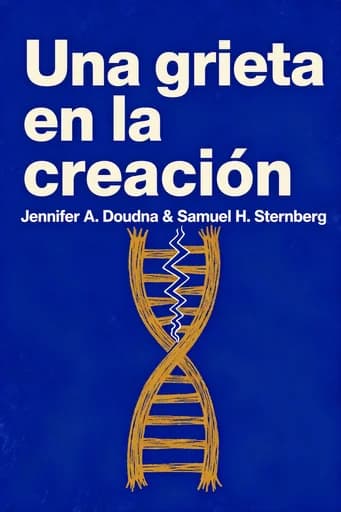
Nobel Prize-winning scientist Jennifer Doudna reveals CRISPR, humanity's most powerful gene-editing tool that could cure diseases or create designer babies. Bill Gates calls it "the most important biological advance since DNA sequencing." Will we use this godlike power responsibly?
Jennifer A. Doudna, Nobel Prize-winning biochemist and CRISPR pioneer, co-authored A Crack in Creation: Gene Editing and the Unthinkable Power to Control Evolution with Samuel H. Sternberg. Sternberg is a Columbia University biochemist and was formerly a graduate student in Doudna's lab.
This groundbreaking science book explores CRISPR-Cas9’s revolutionary potential in genetics, medicine, and evolution while grappling with ethical dilemmas. These themes are rooted in Doudna’s career-defining discovery and Sternberg’s expertise in RNA biochemistry.
Doudna’s work is further chronicled in Walter Isaacson’s bestselling biography The Code Breaker, and she’s featured in the documentary Human Nature, discussing CRISPR’s societal impacts. A professor at UC Berkeley and Howard Hughes Medical Institute investigator, Doudna has shaped global conversations about genetic engineering through TED Talks and policy forums. Sternberg contributes regularly to scientific publications and public science education.
A Crack in Creation became a New York Times bestseller, translated into 15+ languages, and was hailed by the Guardian as “required reading for every concerned citizen.”
A Crack in Creation explores the discovery of CRISPR-Cas9, a revolutionary gene-editing tool that enables precise DNA modification. Co-authored by Nobel laureate Jennifer Doudna, the book blends scientific insight with ethical discussions, detailing CRISPR’s potential to cure diseases, alter ecosystems, and reshape human evolution. Doudna also reflects on her personal journey and the moral responsibilities of wielding this transformative technology.
This book is ideal for science enthusiasts, bioethics scholars, and readers curious about genetic engineering’s societal impacts. Doudna’s accessible writing makes complex concepts understandable for non-experts, while researchers will appreciate the firsthand account of CRISPR’s development and its implications for future innovations.
Yes. The book offers a rare combination of cutting-edge science storytelling and ethical introspection. Reviewers praise Doudna’s clear explanations of CRISPR mechanics and her balanced analysis of controversies like “designer babies” and ecological risks. While some critique its personal anecdotes, the work remains essential for understanding gene editing’s promise and perils.
CRISPR-Cas9 functions as a molecular “scissors” derived from bacterial immune systems. The Cas9 enzyme cuts DNA at specific locations guided by RNA, allowing scientists to delete, replace, or repair genetic sequences. Doudna explains this process through analogies, likening CRISPR to a word processor for genomes.
Doudna highlights risks like unintended genetic mutations, unequal access to therapies, and heritable human genome edits. She advocates for global dialogue to prevent misuse, emphasizing the need for regulations to balance innovation with safety.
The book underscores teamwork’s importance, detailing Doudna’s pivotal partnership with Emmanuelle Charpentier and contributions from labs worldwide. These collaborations accelerated CRISPR’s development, illustrating how collective scientific effort drives breakthroughs.
The metaphor reflects CRISPR’s dual nature: a “crack” represents both the tool’s precision in editing DNA and the irreversible fissures it could create in ecosystems or human ethics. Doudna uses this imagery to caution against unchecked experimentation.
Unlike The Gene by Siddhartha Mukherjee, which covers broader genetics history, Doudna’s memoir offers an insider perspective on CRISPR’s discovery. It prioritizes ethical dilemmas over technical minutiae, making it more accessible for general audiences.
Some reviewers argue the book oversimplifies CRISPR’s social justice implications, focusing more on individual responsibility than systemic inequities. Others note its optimistic tone contrasts with more cautionary CRISPR analyses.
Raised in Hawaii and trained under Nobel laureates Jack Szostak and Thomas Cech, Doudna’s curiosity-driven approach shines through. Her interdisciplinary experiences—from RNA research to CRISPR—inform the book’s blend of memoir and science communication.
As CRISPR therapies enter clinical trials and global debates on germline editing intensify, Doudna’s insights remain critical. The book provides foundational knowledge for evaluating emerging applications like climate-resistant crops and ethical frameworks for AI-integrated bioengineering.
“We now hold the power to rewrite life’s code.”
This line encapsulates CRISPR’s revolutionary potential and the moral weight of controlling evolution. Doudna uses it to urge caution alongside optimism.
Siente el libro a través de la voz del autor
Convierte el conocimiento en ideas atractivas y llenas de ejemplos
Captura ideas clave en un instante para un aprendizaje rápido
Disfruta el libro de una manera divertida y atractiva
With this awesome power comes profound questions about how far we should go.
Viruses make effective vectors because they've evolved to efficiently infiltrate cells and insert their DNA.
CRISPR research had evolved from loose observations to a unified theory of microbial adaptive immunity.
What implications this might have for humans, none of the researchers yet knew.
Desglosa las ideas clave de A Crack in Creation en puntos fáciles de entender para comprender cómo los equipos innovadores crean, colaboran y crecen.
Experimenta A Crack in Creation a través de narraciones vívidas que convierten las lecciones de innovación en momentos que recordarás y aplicarás.
Pregunta cualquier cosa, elige tu estilo de aprendizaje y co-crea ideas que realmente resuenen contigo.

Creado por exalumnos de la Universidad de Columbia en San Francisco
"Instead of endless scrolling, I just hit play on BeFreed. It saves me so much time."
"I never knew where to start with nonfiction—BeFreed’s book lists turned into podcasts gave me a clear path."
"Perfect balance between learning and entertainment. Finished ‘Thinking, Fast and Slow’ on my commute this week."
"Crazy how much I learned while walking the dog. BeFreed = small habits → big gains."
"Reading used to feel like a chore. Now it’s just part of my lifestyle."
"Feels effortless compared to reading. I’ve finished 6 books this month already."
"BeFreed turned my guilty doomscrolling into something that feels productive and inspiring."
"BeFreed turned my commute into learning time. 20-min podcasts are perfect for finishing books I never had time for."
"BeFreed replaced my podcast queue. Imagine Spotify for books — that’s it. 🙌"
"It is great for me to learn something from the book without reading it."
"The themed book list podcasts help me connect ideas across authors—like a guided audio journey."
"Makes me feel smarter every time before going to work"
Creado por exalumnos de la Universidad de Columbia en San Francisco

Obtén el resumen de A Crack in Creation como PDF o EPUB gratis. Imprímelo o léelo sin conexión en cualquier momento.
In the summer of 2015, biochemist Jennifer Doudna found herself at the epicenter of a scientific earthquake she helped trigger. CRISPR-Cas9, a revolutionary gene-editing technology, had emerged from her laboratory work on bacterial immune systems to become humanity's most precise tool for rewriting the code of life. Unlike previous genetic engineering methods that were expensive, time-consuming, and required specialized expertise, CRISPR offered unprecedented simplicity and precision. Imagine being able to edit DNA as easily as you might edit a document on your computer - deleting harmful mutations, correcting genetic errors, or potentially adding new traits. This wasn't just another laboratory breakthrough; it represented humanity's newfound ability to direct our own evolution. What does it mean when we can rewrite the very blueprint that makes us human? The implications stretch from curing devastating genetic diseases to potentially creating designer babies with enhanced traits. Through Doudna's journey from curious scientist to reluctant prophet, we witness the birth of perhaps the most significant biological revolution in human history - one that promises tremendous benefits but also forces us to confront profound ethical questions about how far we should go in rewriting the code of life.
Bacteria evolved CRISPR as an immune system against viruses, storing viral DNA snippets as molecular "wanted posters" to identify and destroy invaders. A single teaspoon of seawater contains more viruses than New York City's population, with trillions of viral infections occurring globally each second. Doudna and Charpentier discovered CRISPR could be reprogrammed to cut any DNA sequence. The breakthrough came when Martin Jinek simplified the system to two components: the Cas9 protein "scissors" and a guide RNA director - successfully cutting jellyfish DNA with precision. CRISPR's adoption was explosive. Within months, researchers had edited genes across multiple species, from human cells to fruit flies. By 2014, the technology had expanded to larger mammals and crops. Genetic modifications in mice that once took years could now be completed in a month, with multiple genes edited simultaneously. Through Addgene, a nonprofit organization, CRISPR plasmids became available worldwide for $65 each, with 60,000 CRISPR-related materials distributed to over 80 countries in 2015 alone - making the technology truly global.
CRISPR's precision has revolutionized agriculture beyond traditional GMOs. While conventional modification involved random gene insertion, CRISPR enables single-letter accuracy - like editing specific words in a book. Chinese scientists demonstrated this by altering wheat genes for mildew resistance. Other achievements include non-browning mushrooms, herbicide-resistant crops, and efforts to protect oranges and bananas from diseases. In livestock, CRISPR enables creating muscular animals by disabling the myostatin gene, similar to Belgian Blue cattle's natural mutations. Applications include female-only chickens for egg farms and disease-resistant cattle. University of Missouri researchers created pigs immune to PRRSV - a virus costing the pork industry $500 million annually. Scientists are using CRISPR to "humanize" pig organs by removing rejection triggers and viruses, potentially helping the 100,000 Americans awaiting transplants, where 22 die daily from lack of donors. This redesign of nature raises questions about the boundaries between correction and enhancement, environmental impact, and who determines beneficial genetic changes.
CRISPR brings unprecedented hope for genetic disease treatment. In sickle cell disease, Harvard researchers demonstrated how CRISPR can correct the single-letter mutation affecting millions by replacing a faulty "A" with the correct "T." The field divides between somatic cell editing (modifying non-reproductive cells) and germline editing (changing inheritable DNA). Somatic editing poses fewer ethical concerns as changes remain with the treated individual. Three CRISPR therapeutic companies have already gone public. CRISPR is transforming cancer treatment through immunotherapy, engineering immune cells to fight tumors. In 2015, one-year-old Layla Richards became the first person saved by gene editing, using engineered T cells to cure her leukemia. While "off-target" effects - where CRISPR cuts unintended DNA sequences - remain a challenge, researchers are developing solutions through improved algorithms, testing, and precise delivery methods. With potential applications spanning cancer, HIV, and genetic disorders like Alzheimer's, ALS, and Tay-Sachs, CRISPR could transform medicine. Given that 10% of humans are born with potentially treatable genetic conditions, its impact could be revolutionary.
In spring 2014, when an entrepreneur approached Doudna's lab about creating the first "CRISPR baby," the ethical implications of human germline editing became urgent - raising questions about permanently altering future generations' genetic heritage. The debate intensified in April 2015 after Chinese scientists published CRISPR experiments on human embryos, targeting beta-thalassemia in 86 non-viable embryos. The results were concerning: only 5% contained intended mutations, with many showing off-target effects and mosaic patterns. Professional organizations and the Obama administration opposed clinical applications, with the NIH refusing funding. U.S. intelligence agencies even classified genome editing as a potential weapon of mass destruction. While technical hurdles will be overcome, ethical questions persist: When is germline editing justified? The strongest cases involve parents who both carry the same recessive disorder or one with a dominant disorder, guaranteeing affected children. Most scenarios, however, involve genetic risks rather than certainties, with alternatives like preimplantation genetic diagnosis available. For parents facing devastating genetic diseases, preventing conditions like cystic fibrosis seems an obvious choice. Yet germline editing affects countless future descendants who cannot consent to these modifications.
Germline editing raises two key ethical concerns. First, disease prevention capabilities could expand into enhancement-focused editing for traits like strength and reduced sleep needs. While complex traits like intelligence remain unreachable, the line between prevention and enhancement grows increasingly unclear. Second, initial access by wealthy families risks creating an inherited "gene gap." Though technologies typically become more accessible over time, genetic modifications pass to all descendants - potentially splitting society along both economic and biological lines. Global regulation remains fragmented, with countries ranging from outright bans to unclear policies. The U.S. restricts clinical applications through FDA oversight rather than legislation. This inconsistency may drive "medical tourism" to more permissive regions. Unlike natural evolution's slow progression, we now control genetic changes directly. This unprecedented power to alter our species' trajectory represents one of humanity's greatest responsibilities - demanding thoughtful consideration of its use.
We stand at an unprecedented crossroads in human history. For the first time, we possess the ability to direct our own evolution - to eliminate genetic diseases, enhance our capabilities, and potentially create new forms of life. CRISPR promises tremendous benefits: eradicating genetic diseases, developing cancer treatments, and creating climate-resilient crops. Yet the same technology that could eliminate suffering could also deepen inequality and fundamentally alter human nature. The decisions we make now will echo through generations. Will we use CRISPR with wisdom and restraint, or will market forces drive us toward a genetically stratified future? Unlike previous technological revolutions, we can still shape how gene editing will transform our species. The power to rewrite life's code demands humility and respect for nature's complexity. The human genome isn't simply a collection of independent parts but an intricate system shaped by millions of years of evolution. CRISPR's legacy will depend not on the technology's capabilities, but on whether we guide its transformation with wisdom, justice, and compassion.