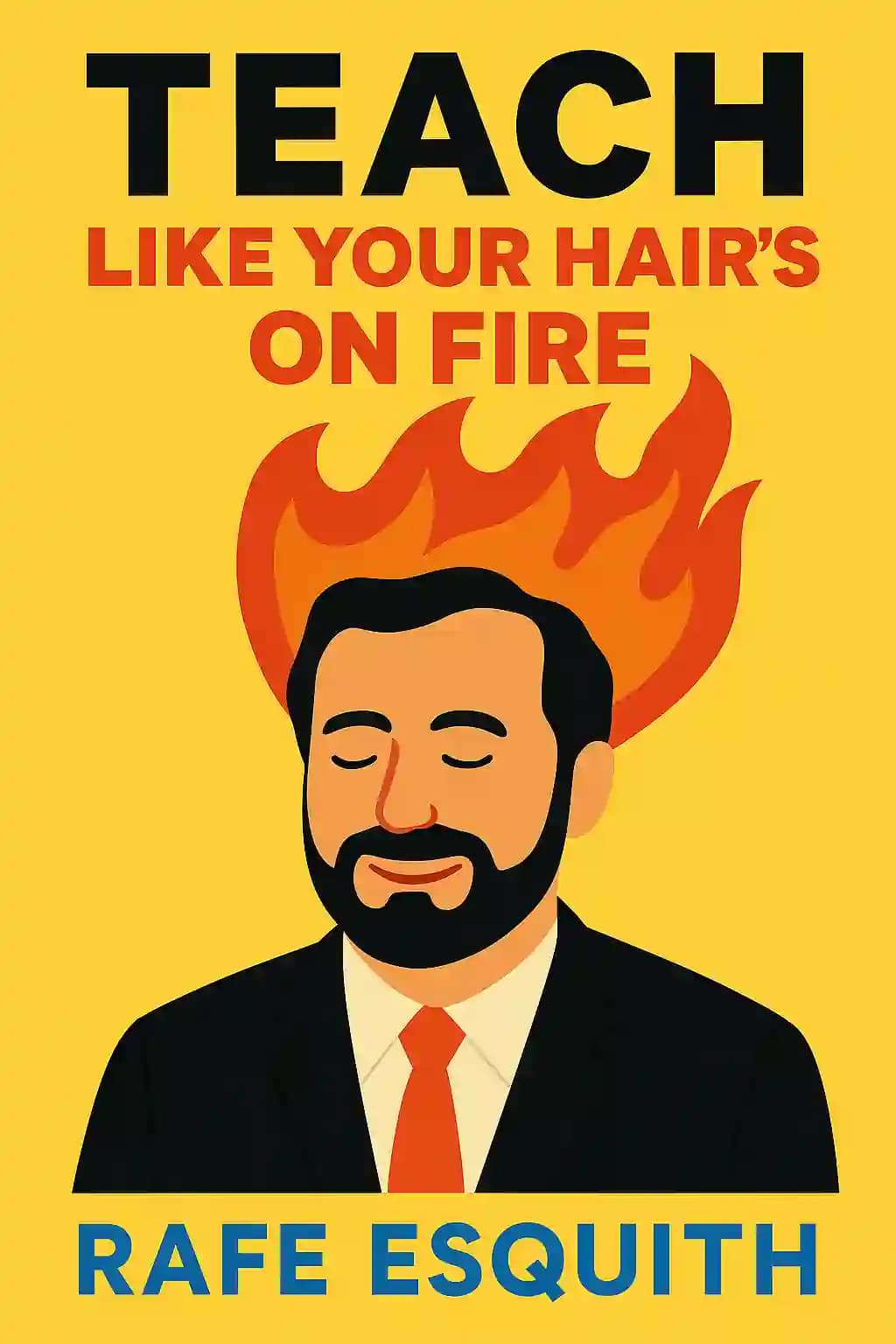
Teach Like Your Hair's on Fire
The Methods and Madness Inside Room 56
Resumen de Teach Like Your Hair's on Fire
In "Teach Like Your Hair's on Fire," Rafe Esquith - dubbed "a genius and a saint" by The New York Times - revolutionizes education by prioritizing passion over standardized testing. His classroom economy and character-building methods have inspired thousands to reignite their teaching spark.
Temas clave en Teach Like Your Hair's on Fire
- moral development levels
- trust-based classroom
- character education
- eliminating student fear
- high expectations teaching
Citas de Teach Like Your Hair's on Fire
There are no shortcuts. Practice is the only way to get better.
Frightening children into compliance achieves nothing worthwhile.
Broken trust is irreparable.
Children accept tough teachers but despise unfair ones.
Schools have lost sight of why we read.
Personajes en Teach Like Your Hair's on Fire
- Rafe EsquithThe author and dedicated teacher of Room 56
- The Hobart ShakespeareansEsquith's fifth-grade students in Los Angeles
- Lawrence KohlbergPsychologist who developed the Six Levels of Moral Development
Sobre el Autor
Sobre el autor de Teach Like Your Hair's on Fire
Rafe Esquith, author of Teach Like Your Hair’s on Fire, is an award-winning educator renowned for his transformative methods in urban classrooms.
A Los Angeles native and longtime fifth-grade teacher at Hobart Elementary School, Esquith built his career empowering students from low-income immigrant families, 90% of whom lived below the poverty line. His book blends memoir and practical guidance, emphasizing rigorous academics, character development, and Shakespearean performance—a hallmark of his classroom.
Esquith’s accolades include the National Medal of Arts (the first classroom teacher to receive this honor), Oprah’s Use Your Life Award, and recognition from the Dalai Lama. He expanded his insights in earlier works like There Are No Shortcuts and Real Talk for Real Teachers, cementing his status as a leading voice in education reform.
Featured on NPR and in the documentary The Hobart Shakespeareans, Esquith’s students have performed at London’s Globe Theatre and consistently ranked in the top 10% nationally in standardized testing. The book’s title originates from a classroom chemistry experiment mishap, symbolizing his unwavering dedication to student success.
Descargar resumen de Teach Like Your Hair's on Fire
Obtén el resumen de Teach Like Your Hair's on Fire como PDF o EPUB gratis. Imprímelo o léelo sin conexión en cualquier momento.
Preguntas Frecuentes Sobre Este Libro
Teach Like Your Hair's on Fire by Rafe Esquith details innovative teaching strategies from his 30+ years at Hobart Elementary, a Los Angeles school serving low-income immigrant students. The book emphasizes trust-based classrooms, character development, and fostering lifelong learning through real-world examples like Shakespeare plays and music integration.
Educators, parents, and administrators seeking practical classroom methods or inspiration for nurturing student potential will benefit. It’s particularly relevant for teachers in under-resourced schools aiming to combine academic rigor with life skills like responsibility and critical thinking.
Yes—it offers actionable strategies (e.g., the “Six Levels of Moral Development”) and motivational insights for creating engaged, self-driven learners. Readers praise its blend of idealism and practicality, with examples like students voluntarily attending 12-hour school days to master advanced material.
Adapted from Lawrence Kohlberg’s framework, the levels guide students from basic rule-following (“Don’t get in trouble”) to ethical internalization (“I have a personal code”). Esquith uses this system to teach decision-making beyond rewards/punishments, fostering integrity in academics and life.
Esquith prioritizes trust over fear, summarized by his mottos: “Be nice, work hard” and “There are no shortcuts.” He rejects punitive discipline, instead nurturing student autonomy through high expectations, passion-driven lessons, and real-world projects like managing a classroom economy.
The book advocates for student self-governance via shared values rather than rigid rules. Esquith’s “Level VI” behavior standard encourages intrinsic motivation, while techniques like peer accountability and reflective journals build responsibility without traditional discipline.
Key quotes include:
- “Be nice, work hard.” (core classroom mantra)
- “There are no shortcuts to true excellence.” (emphasis on sustained effort)
- “Kids don’t rise to low expectations.” (argument for challenging all students)
Some argue Esquith’s methods require unrealistic time commitments (e.g., 12-hour school days) or question their scalability in less-supportive environments. However, the book acknowledges these challenges while offering adaptable principles for incremental change.
Unlike tactical manuals like The First Days of School, Esquith’s book blends memoir with philosophical frameworks. It shares The Book Whisperer’s focus on passion but adds socioeconomic context, addressing trauma and poverty in urban education.
Its emphasis on resilience, equity, and holistic learning aligns with modern educational priorities like social-emotional development and post-pandemic recovery. The Hobart Shakespeareans’ success with immigrant students also resonates amid ongoing debates about inclusive pedagogy.
Esquith intertwines ethics with academics—e.g., students manage a $1,000/year classroom budget to learn financial responsibility. He also uses literature (e.g., To Kill a Mockingbird) to explore empathy and moral dilemmas, reinforcing “doing the right thing when no one is watching”.
A hallmark of Esquith’s approach, this yearlong project has fifth graders performing unabridged Shakespeare plays. The program builds literacy, teamwork, and confidence, with alumni performing at London’s Globe Theatre and winning national academic awards.
Start small:
- Replace punitive rules with shared values contracts.
- Integrate one passion project (e.g., a class novel or math music video).
- Use “thinking time” journals for reflection instead of detention.
- *The First Days of School by Harry Wong (practical routines).
- Grit by Angela Duckworth (perseverance research).
- The Book Whisperer by Donalyn Miller (reading engagement strategies).