Capítulo 1
When Female Friendship Defies a World Not Made for It
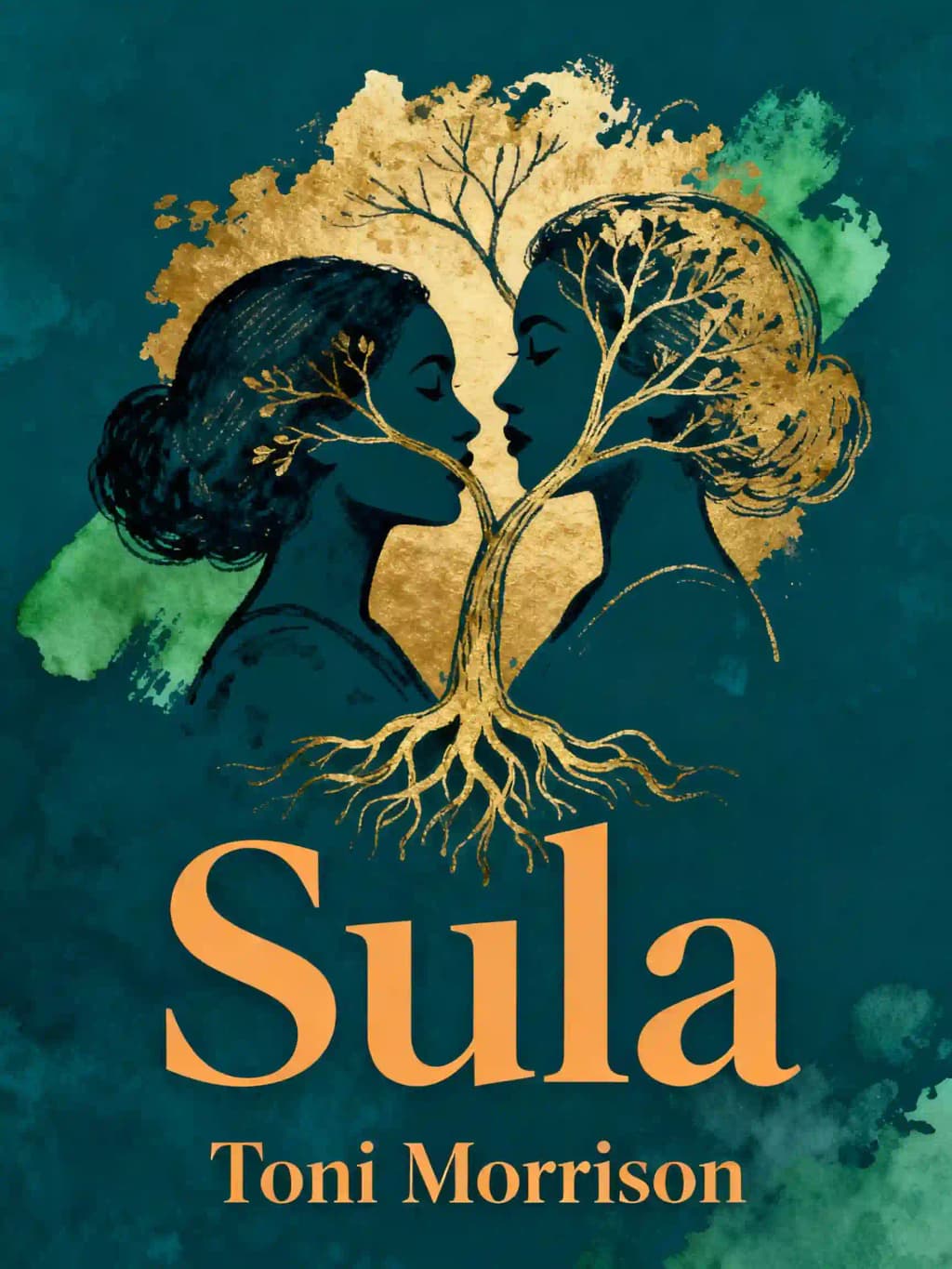
Toni Morrison's "Sula" has quietly transformed American literature since its publication in 1973, though it rarely receives the same spotlight as her Pulitzer Prize-winning "Beloved." Oprah Winfrey once called it "one of the most moving books I've ever read," while Barack Obama included Morrison's works among those that helped shape his worldview. The novel's exploration of Black female friendship outside patriarchal constraints was revolutionary for its time, emerging from the civil rights and women's liberation movements of the late 1960s. Morrison wrote it as a struggling single mother in Queens, drawing from what she called "an atmosphere where women found freedom to explore and create when nobody was minding us." What makes "Sula" enduringly relevant is its unflinching examination of how society responds to women who refuse to conform-a theme that resonates powerfully even fifty years later as we continue to wrestle with questions of female autonomy, community responsibility, and what it means to be "good" in a world that narrowly defines goodness.
Capítulo 2
A Community Bound by Geography and Struggle
The Bottom, a Black neighborhood in the hills above the fictional town of Medallion, Ohio, exists as a physical manifestation of racial injustice. Its very name emerges from a cruel joke-a white farmer promised freedom and "bottom land" to his slave, only to give him the hilly, difficult terrain above the town, claiming it was "the bottom of heaven." This bitter irony sets the stage for a community bound together by shared oppression yet divided by internal hierarchies and judgments.
Life in the Bottom unfolds with vivid sensory detail-the smell of cooking from open windows, the sounds of children playing in dusty streets, the sight of women sitting on porches watching the world go by. Morrison doesn't romanticize this segregated community but shows its complexity: the church ladies with their rigid morality, the men gathering at Irene's Palace of Cosmetology to share stories, the children inventing games amid poverty. The Bottom's residents create meaning and beauty despite their circumstances, developing intricate social codes and community rituals.
Economic reality shapes everything in the Bottom. When construction begins on a tunnel that could provide desperately needed jobs, Black men are passed over in favor of white workers, Greeks, and Italians. This rejection becomes a festering wound in the community's psyche. Jude Greene, who marries Nel Wright, embodies this disappointment: "More than anything in the world he wanted to build that tunnel... Not just for the money but to be able to say 'I helped build that tunnel.'" When denied this opportunity, he seeks validation through marriage instead, believing "the two of them together would make one Jude."
The community's response to hardship oscillates between solidarity and judgment. They rally around families during tragedies yet ostracize those who violate unwritten rules. This contradiction becomes most apparent in their treatment of Sula Peace upon her return-her independence and sexuality representing a threat to the community's carefully maintained social order. As Morrison writes, "Their conviction of Sula's evil changed them in accountable yet mysterious ways... They began to cherish their husbands and wives, protect their children, repair their homes and in general band together against the devil in their midst."
The Bottom ultimately disappears, sacrificed for a golf course that serves the white community below-a final injustice that completes the cycle begun with that original deceptive "gift" of land. Through this physical erasure, Morrison powerfully illustrates how Black communities have repeatedly been built, sustained through internal strength, and then dismantled when their space becomes valuable to white interests.
Capítulo 3
Shadrack and National Suicide Day: Confronting Mortality
Shadrack returns from World War I fundamentally broken, his psyche shattered by witnessing a fellow soldier's head blown off while the body continued running. This horrific image-the sudden, arbitrary separation of consciousness from physical existence-becomes the defining trauma of his life. In the veterans' hospital, he fixates on his hands, believing they're growing monstrously, symbolizing his disconnection from his own body. When finally released with $217 and official papers, he wanders disoriented until arrested for vagrancy. It's only when seeing his "definitively black face" reflected in a toilet bowl that he finally recognizes himself as real.
His creation of National Suicide Day emerges as a brilliant, twisted response to unprocessed trauma. Every January 3rd beginning in 1920, Shadrack parades through the Bottom with a cowbell and hangman's rope, announcing the one day when people could kill themselves or others, making the rest of the year "safe." This ritual represents his desperate attempt to contain chaos-to give death boundaries and predictability when his war experience proved it has none.
Morrison writes with devastating clarity: "It had to do with making a place for fear as a way of controlling it." This insight illuminates not just Shadrack's personal coping mechanism but broader human attempts to ritualize our deepest terrors. Initially frightening to the townspeople, National Suicide Day gradually weaves itself into the fabric of Bottom life, becoming a reference point in everyday conversation-"the way the Fourth of July was, or Christmas."
Shadrack's isolation is both physical and psychological. Living in his grandfather's dilapidated shack by the river, selling fish twice weekly and drinking the rest of the time, he exists at the community's margins. Yet his madness has boundaries the townspeople come to understand and even rely upon. His ritual becomes a container for the community's unspoken fears-a designated time and place for acknowledging the precariousness of Black life in America.
The novel's climax in 1941, when residents unexpectedly join Shadrack's parade and march to their deaths in the tunnel collapse, represents the terrible fruition of his prophecy. After decades of announcing death's inevitability, he stands silently on the riverbank as it claims his neighbors, "having forgotten his song and his rope." This moment powerfully suggests that attempts to contain death ultimately fail-that the very systems we create to manage our fears can lead us toward destruction.
Shadrack's connection to Sula runs deeper than their brief encounters suggest. Both are outsiders who refuse conventional roles, both carry birthmarks that the community reads as signs of difference, and both understand something essential about life's fragility that others deny. Their parallel journeys suggest that true sanity might sometimes look like madness in a world built on comforting illusions.
Capítulo 4
Eva Peace: Sacrifice, Control, and Terrible Love
Eva Peace stands as one of literature's most complex maternal figures-a woman who both saves and destroys her children through acts of terrible love. After her husband BoyBoy abandons her with three small children and no resources, she makes an unfathomable sacrifice: she leaves her children with a neighbor, returns eighteen months later with one leg missing and enough money to buy a house. The community whispers that she placed her leg on a railroad track for insurance money or sold it to a hospital-theories Eva neither confirms nor denies. This ambiguity surrounding her physical sacrifice establishes the pattern of her motherhood: protection through drastic, sometimes violent means.
The Peace household under Eva's rule becomes a chaotic haven for "a steady stream of misfits, stray cats, threadbare relatives, and neighborhood winos." From her wheelchair in her third-floor bedroom, Eva presides over this domain with imperious authority, summoning people with a small bell and dispensing both charity and judgment. Despite her physical limitation, she maintains absolute control through the force of her personality. As Morrison writes, "Fewer than nine people had ever seen the stump, and when the prosthesis was attached, she could walk, albeit with a limp. But she chose not to do that often. Instead she planted herself in a rocking chair on wheels and moved about the house by pushing the chair with a long pole."
Eva's most shocking act-dousing her drug-addicted son Plum with kerosene and burning him alive-reveals the terrible extremes of her maternal philosophy. When Hannah confronts her about killing Plum, Eva's response is chilling in its conviction: "He was a man, girl, a man. I didn't have that much room. I kept him alive till he couldn't live no more." She perceives his addiction as a regression to infancy-"He wanted to crawl back in my womb"-and decides death is preferable to watching him diminish. This horrific mercy killing represents Eva's refusal to witness her son's slow self-destruction, preferring to end it on her terms.
The relationship between Eva and her daughter Hannah reveals generational patterns of emotional distance. Hannah famously asks, "Mama, did you ever love us?" Eva's outraged response-recounting how she kept them alive through desperate measures-defines love as survival rather than affection: "What you talkin' 'bout did I love you? You settin' here with your healthy-ass self and you want to know if I loved you?" Yet when Hannah catches fire in the yard, Eva throws herself from a second-story window trying to save her daughter, demonstrating that beneath her hardness lies profound attachment.
Eva's conflict with her granddaughter Sula culminates in their confrontation after Sula's return to Medallion. When Eva accuses Sula of watching Hannah burn without helping, Sula responds with cold defiance. Their power struggle ends with Sula having Eva committed to a nursing home-a reversal that sees the once-powerful matriarch rendered helpless. This act represents Sula's rejection of the sacrificial maternal model Eva embodies, refusing to be bound by obligation or guilt.
Through Eva Peace, Morrison explores how trauma and necessity can transform love into something unrecognizable yet undeniable-a force that preserves life even as it sometimes destroys it.
Capítulo 5
Nel and Sula: When Friendship Becomes Identity
The friendship between Nel Wright and Sula Peace forms the novel's emotional core-a bond so profound it transcends conventional categories of relationship. Their connection begins in childhood, two twelve-year-old girls drawn together by complementary needs: Nel escaping her mother's suffocating respectability, Sula finding structure amid her family's chaos. Morrison writes, "Their meeting was fortunate, for it let them use each other to grow on. Daughters of distant mothers and incomprehensible fathers...they found in each other's eyes the intimacy they were looking for."
This friendship creates a space where both girls can exist fully. Walking home from school, they transform mundane surroundings into magical landscapes, "stripping the bark from twigs, tracing letters in the dirt, or just looking at their feet as they criss-crossed each other." In these moments, they experience a freedom unavailable elsewhere in their lives-freedom from others' expectations and judgments. Morrison captures this liberation beautifully: "In the safe harbor of each other's company they could afford to abandon the ways of other people and concentrate on their own perceptions of things."
The drowning of Chicken Little marks a pivotal moment in their relationship. After Sula accidentally lets the boy slip from her hands into the river, Nel provides calm reassurance: "Sh, sh. Don't, don't. You didn't mean it. It ain't your fault." This shared secret binds them more tightly, creating an intimacy built on mutual protection. At the funeral, they stand apart physically but remain psychologically connected, their clasped hands eventually relaxing "until they were holding hands in the usual way."
Their paths diverge when Nel marries Jude Greene at seventeen while Sula leaves the Bottom for ten years. Nel embraces conventional womanhood-wife, mother, church member-finding identity in these roles. Sula pursues education and experience, returning with sophisticated clothes and radical independence. Yet their reunion initially bridges this gap, rekindling their essential connection. Nel reflects that being with Sula was "like getting the use of an eye back, having a cataract removed."
The friendship shatters when Nel discovers Sula and Jude having sex. Beyond the betrayal itself, what wounds Nel most deeply is losing both her husband and her friend simultaneously-the two relationships that defined her sense of self. Morrison writes, "The loss of Jude was the loss of her own self...but the loss of her friend was nothing but pure pain." This double abandonment leaves Nel adrift, forcing her to construct an identity based solely on respectability and motherhood.
The novel's most powerful revelation comes in its final pages when Nel visits Eva in the nursing home. Eva's accusation-"Tell me how you killed that little boy"-forces Nel to confront her complicity in Chicken Little's death. Walking home afterward, Nel finally understands that her decades of grief weren't primarily about losing Jude but about losing Sula: "All that time, I thought I was missing Jude." Her cry of recognition-"We was girls together"-acknowledges the friendship's centrality to her identity.
Through Nel and Sula, Morrison explores how female friendship can be both sanctuary and battlefield-a relationship with the power to form, sustain, and shatter our sense of self in ways romantic relationships rarely match.
Capítulo 6
The Birthmark: Symbol of Otherness and Identity
Sula's birthmark-a stemmed rose above her eye-functions as the novel's most potent symbol, constantly changing in appearance and meaning as different characters interpret it. This physical marking becomes a canvas onto which the community projects its fears, desires, and judgments, while simultaneously representing Sula's essential difference from those around her.
When first introduced, the birthmark appears simply as "a stemmed rose" or "a tadpole" over Sula's eye. As a child, it marks her as distinctive but not threatening. However, after Sula's return to the Bottom as an adult, the community's perception of the birthmark transforms dramatically. Depending on who's looking, it resembles different things: "Hannah's ashes marking her," "a snake," "a copperhead," "a rattlesnake," or "a stemmed rose." These shifting interpretations reflect the viewers' attitudes toward Sula herself-those who fear her see something dangerous and poisonous, while those with more neutral perspectives see something natural or even beautiful.
The birthmark's significance intensifies after Sula sleeps with Nel's husband Jude. Nel notices that "the birthmark over her eye was getting darker and looked more and more like a stem and rose," suggesting that Sula's betrayal has somehow enhanced or clarified her essential nature. When Mr. Finley chokes to death upon seeing Sula, the community takes this as confirmation that her birthmark truly is "Hannah's ashes marking her"-a physical manifestation of her mother's fiery death and Sula's supposed evil.
For Sula herself, the birthmark represents her fundamental separation from conventional society. Unlike Nel, who can blend into community expectations, Sula's very face announces her difference. This visible otherness parallels her refusal to conform to expectations for Black women of her era-she doesn't marry, have children, join the church, or demonstrate proper deference. The birthmark becomes both burden and liberation, marking her as someone who cannot hide her true nature even if she wanted to.
Ajax, Sula's lover, provides a different interpretation. To him, the birthmark resembles a tadpole, suggesting potential and transformation rather than fixed identity. This perspective aligns with his appreciation for Sula's uniqueness-he is drawn to her precisely because she doesn't behave like other women. When he leaves her, it's partly because he senses she's beginning to want possession rather than freedom.
By the novel's end, the birthmark takes on historical significance. As Sula lies dying, she thinks about how "she had no center, no speck around which to grow," yet the birthmark suggests otherwise-it has been the constant, visible center of her identity throughout her life. After her death, the birthmark becomes part of community lore, a physical feature that helped define an era in the Bottom's history.
Through this single physical feature, Morrison explores how identity is both internally experienced and externally imposed-how the same characteristic can represent wildness, evil, beauty, or transformation depending on who's doing the seeing and what they need to see.
Capítulo 7
Sexual Freedom and Its Consequences
In the Bottom, sexuality operates as both a source of pleasure and a system of social control. Morrison presents a spectrum of female sexual expression through three generations of Peace women: Eva with her "steady stream of lovers" despite her age and missing leg; Hannah who takes men "without passion or affection" but with genuine enjoyment; and Sula who approaches sex as exploration and self-discovery rather than connection or procreation.
Hannah's casual approach to sexuality profoundly shapes young Sula's understanding of physical intimacy. Overhearing her mother say, "I love Sula. I just don't like her," Sula learns early that love and pleasure exist separately. Hannah's matter-of-fact attitude toward her needs-taking lovers in whatever space is available in the crowded house-teaches Sula that "sex was pleasant and frequent, but otherwise unremarkable." This inheritance frees Sula from viewing sexuality as sacred or transformative, allowing her to approach it experimentally rather than emotionally.
The community tolerates Hannah's promiscuity because she follows certain rules-she doesn't take other women's husbands permanently, doesn't flaunt her activities, and maintains other aspects of respectable womanhood. As Morrison writes, "Hannah simply refused to live without the attentions of a man, and after Rekus died...she had a succession of lovers, mostly the husbands of her friends and neighbors." Her sexuality exists within acceptable parameters of discretion and doesn't threaten the community's structure.
Sula's sexuality, by contrast, represents a fundamental challenge to the Bottom's social order. After returning from ten years away, she sleeps with men casually and without regard for marital status or community standards. Unlike her mother, she makes no effort to disguise her activities or soften their impact. Most shockingly to the community, she sleeps with white men-crossing a racial boundary that her neighbors find unforgivable. Morrison writes, "They insisted that all unions between white men and black women be rape; for a black woman to be willing was literally unthinkable."
The affair between Sula and Jude represents the novel's most consequential sexual transgression. By sleeping with her best friend's husband, Sula violates not just marital bonds but the deeper covenant of female friendship. Nel's discovery of their betrayal shatters her world-not just her marriage but her understanding of herself and her closest relationship. The community reads this act as confirmation of Sula's evil nature, while Sula herself seems genuinely surprised by Nel's lasting anger, asking years later, "About Jude... how long you been holding that grudge?"
Only with Ajax does Sula experience something approaching conventional desire. Their relationship begins casually but evolves into something more significant for Sula, who finds herself wanting possession for the first time: "She only wanted his fingers on her skin, his lips on her mouth, eyes, neck, breasts." When she discovers his driver's license revealing his real name (Albert Jacks), she realizes how little she knows him despite their intimacy. His departure when she begins showing signs of possessiveness confirms her fundamental aloneness.
On her deathbed, Sula reflects that "the real hell of Hell is that it is forever" and concludes that freedom-including sexual freedom-is meaningless without the context of time and consequences. This realization suggests that her lifelong experiment in unfettered sexuality has left her with profound insights but ultimate isolation.
Capítulo 8
Good and Evil: The Moral Universe of Medallion
Morrison deliberately subverts conventional morality throughout "Sula," challenging readers to question how goodness and evil are defined, particularly for Black women whose choices are already constrained by racism and sexism. The novel's moral universe operates on multiple levels-the community's judgments, the characters' self-perceptions, and Morrison's own implicit ethical framework that transcends simple categorization.
The Bottom community maintains rigid standards of acceptable behavior, particularly for women. Nel represents the embodiment of these standards-she marries appropriately, raises her children dutifully, attends church regularly, and maintains a respectable household. After Jude leaves, she becomes "one of the most thorough Christians in the town," channeling her pain into heightened conformity. The community rewards this adherence with respect and inclusion.
Sula, conversely, violates nearly every social expectation. She puts her grandmother in a nursing home, sleeps with men indiscriminately including white men, doesn't have children, doesn't attend church, and most damningly, doesn't appear to care about the community's judgment. As Morrison writes, "She was pariah, then, and knew it. Knew that they despised her and believed that they framed their hatred as disgust for the easy way she lay with men." The community's response is to transform Sula into a symbol of evil-a necessary opposite against which they can define their own goodness.
This dynamic produces unexpected consequences. Sula's presence actually improves the community: "Their conviction of Sula's evil changed them in accountable yet mysterious ways... They began to cherish their husbands and wives, protect their children, repair their homes and in general band together against the devil in their midst." Her perceived wickedness becomes a catalyst for others' virtue-mothers become more attentive, husbands more faithful, neighbors more supportive. When she dies, this moral energy dissipates, suggesting that goodness defined solely in opposition to evil lacks sustainable power.
Morrison complicates this binary through Eva's character, whose actions include both extraordinary sacrifice and shocking violence. Eva's decision to burn Plum rather than watch him deteriorate through addiction represents a terrible mercy that defies simple moral categorization. When Hannah questions whether Eva loved her children, Eva's indignant response-"What you talkin' 'bout did I love you? You settin' here with your healthy-ass self"-redefines love as survival rather than affection, challenging conventional notions of maternal goodness.
The novel's most profound moral revelation comes through Nel's final epiphany. After decades of seeing herself as the wronged party-the good wife betrayed by her husband and friend-Nel suddenly recognizes her own complicity in Chicken Little's death. Eva's accusation forces her to confront the "good feeling" she experienced watching the boy drown, the pleasure she took in witnessing someone else's power over life and death. This recognition collapses Nel's self-image as morally superior to Sula, suggesting that the true distinction between them was not goodness versus evil but self-awareness versus self-deception.
Morrison ultimately suggests that conventional morality fails to capture the complexity of human experience, particularly for those already marginalized by society. Through Sula's unapologetic independence and Nel's painful self-recognition, the novel argues for an ethics based on authenticity and honest self-examination rather than adherence to external standards designed to maintain social control.
Capítulo 9
The Weight of Memory and the Circles of Sorrow
Memory functions as both burden and illumination throughout "Sula," with characters shaped by what they remember, what they forget, and what they choose to confront. Morrison weaves personal memories with collective historical consciousness, showing how the past continues to inhabit the present in both individual lives and community experience.
Shadrack's relationship with memory exemplifies its potentially destructive power. His traumatic war experience-watching a soldier's head blown off while the body continued running-fragments his sense of reality. His creation of National Suicide Day represents an attempt to contain this memory's ongoing damage, to give boundaries to the terror it produces. Morrison writes that "he knew the smell of death and was terrified of it," suggesting that sensory memories of war remain physically present for him decades later.
For Eva, memory operates selectively as both protection and justification. She recalls with perfect clarity the desperate measures she took to feed her children after BoyBoy left, using these memories to defend her definition of maternal love. Yet she seems to have blocked any memory of exactly how she lost her leg-the physical sacrifice that saved her family remains a narrative gap, suggesting some experiences exceed even memory's capacity to contain them.
Nel and Sula's shared memory of Chicken Little's drowning binds them in complicated ways. Their different responses to this memory reveal fundamental aspects of their characters: Nel suppresses her complicity and "good feeling" during the incident, while Sula carries the active guilt of having let the boy slip from her hands. When Eva forces Nel to confront this memory decades later, asking "Tell me how you killed that little boy," Nel's carefully constructed self-image collapses under the weight of remembered truth.
The Bottom itself exists as a community built on memory-specifically, the memory of racial injustice embodied in its very name. The neighborhood originated from a white farmer's cruel joke, promising his slave "bottom land" but giving him the hilly, difficult terrain above town by claiming it was "the bottom of heaven." This foundational deception shapes the community's understanding of itself and its relationship to the white world below. When the Bottom is eventually destroyed to make way for a golf course, this represents the erasure of not just physical space but collective memory.
The novel's most powerful exploration of memory comes in its final pages as Nel walks through the cemetery where the Peace family is buried. Looking at their grave markers-PEACE 1895-1921, PEACE 1890-1923, PEACE 1910-1940, PEACE 1892-1959-Nel thinks, "They were not dead people. They were words. Not even words. Wishes, longings." This insight suggests that memory transforms the dead from people into symbols that serve the needs of the living.
Nel's culminating realization-"All that time, I thought I was missing Jude"-represents memory's potential for revelation rather than just preservation. This moment of clarity allows her to recognize that her decades of grief centered not on her husband's betrayal but on the loss of her friendship with Sula. Her cry-"We was girls together"-acknowledges the centrality of this relationship to her identity, a truth memory finally allows her to access.
Morrison's description of Nel's cry captures the novel's ultimate perspective on memory's circular nature: "It had no bottom and it had no top, just circles and circles of sorrow." This image suggests that memory doesn't progress linearly but spirals continuously, bringing us repeatedly back to essential truths we must confront to understand ourselves and our relationships with others.