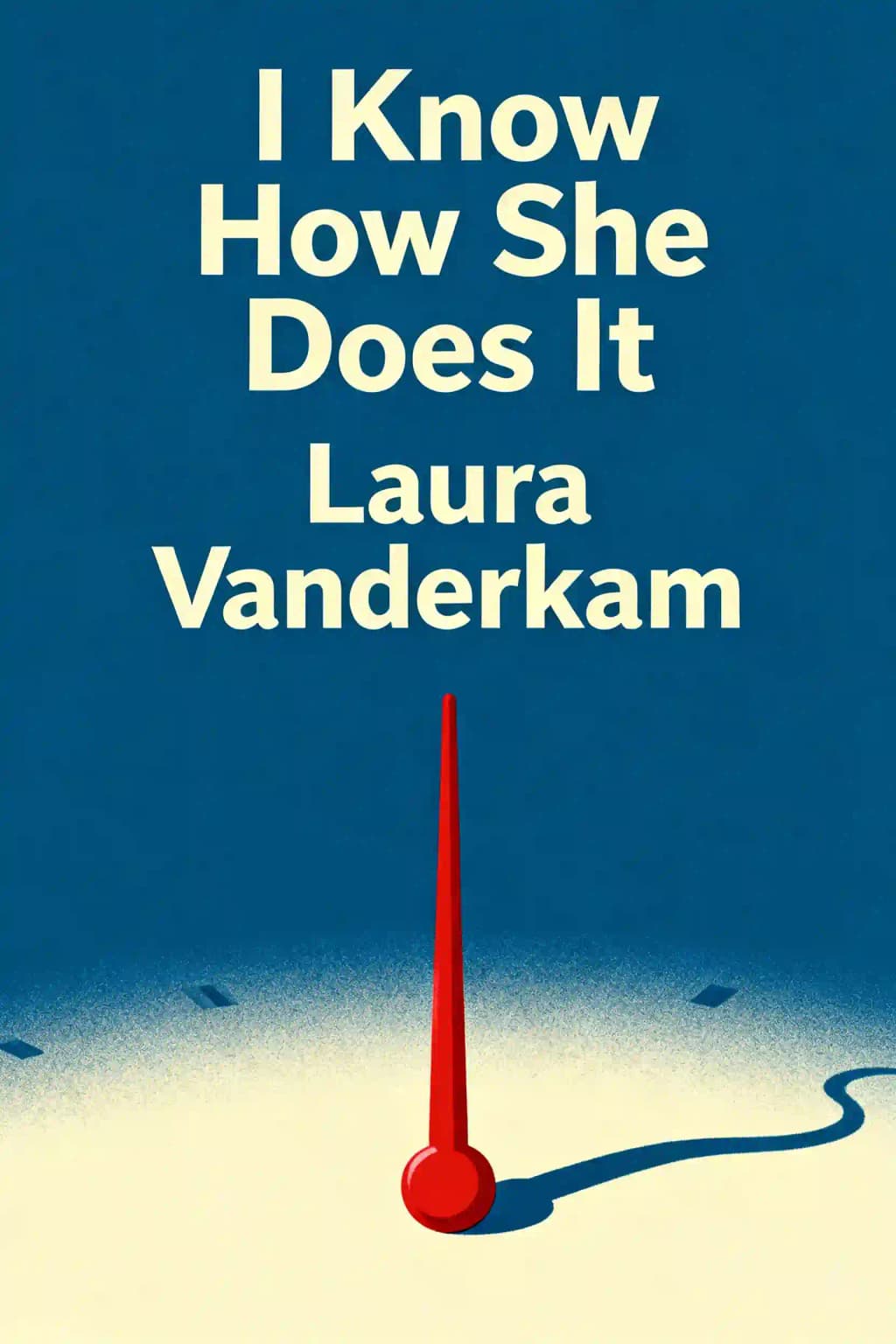
I Know How She Does It
How Successful Women Make the Most of Their Time
Resumen de I Know How She Does It
Discover how high-earning mothers balance success with life. Based on 143 time logs, Vanderkam reveals counterintuitive findings: these women average 7.7 hours of sleep and 3.3 hours of weekly exercise. Endorsed by Gretchen Rubin, who claims it transformed her calendar perspective forever.
Temas clave en I Know How She Does It
- time tracking
- 168 hour week
- mosaic project
- female executive lifestyle
- work-life integration
Citas de I Know How She Does It
I truly believe that if we can understand where our time is really going, we can live the lives we want.
Time is elastic; we lengthen it by filling it.
Quality trumps quantity.
Flexibility matters more than strict hour limits.
Be bold.
Personajes en I Know How She Does It
- Laura VanderkamAuthor and researcher of the Mosaic Project
- Vanessa ChanConsulting partner and mother used as a case study
Sobre el Autor
Sobre el autor de I Know How She Does It
Laura Vanderkam, bestselling author of I Know How She Does It and renowned time management expert, combines data-driven insights with practical strategies for achieving work-life balance.
A Princeton University graduate, Vanderkam built her expertise through years of researching how high-achieving professionals allocate their 168 weekly hours, culminating in her groundbreaking time diary study featured in this book.
Her work has appeared in The Wall Street Journal, The New York Times, and Fortune, and she co-hosts the Best of Both Worlds podcast, offering actionable advice for balancing career ambitions with personal fulfillment. Vanderkam’s influential TED Talk, “How to Gain Control of Your Free Time,” has been viewed over 5 million times, cementing her status as a leading voice in productivity literature.
Her other bestselling titles, including 168 Hours and What the Most Successful People Do Before Breakfast, provide complementary frameworks for maximizing personal and professional potential. A mother of five and avid runner, Vanderkam’s strategies are tested in real-world chaos, making her advice both relatable and scalable.
Translated into 12 languages, her books have empowered readers worldwide to rethink time scarcity and reclaim control of their schedules.
Descargar resumen de I Know How She Does It
Obtén el resumen de I Know How She Does It como PDF o EPUB gratis. Imprímelo o léelo sin conexión en cualquier momento.
Preguntas Frecuentes Sobre Este Libro
I Know How She Does It explores how successful women balance careers and personal lives through time management strategies. Based on a study of 1,001 days in the lives of professional women, Vanderkam challenges the "overwhelmed working mom" narrative, emphasizing intentional scheduling, prioritizing joy, and redefining productivity. Key concepts include time-tracking, flexible work hours, and leveraging small moments for meaningful tasks.
This book is ideal for working mothers, career-driven professionals, and anyone seeking actionable strategies to manage time effectively. It’s particularly valuable for those feeling stretched thin between work and family, as Vanderkam provides data-driven insights and real-life examples to reframe productivity without guilt.
Yes, for its evidence-based approach to time management. Vanderkam combines research with relatable anecdotes, offering tools like the "time diary" method and advocating for flexibility over rigid routines. Critics note some advice may overlook systemic workplace challenges, but the book remains a refreshing, optimistic guide for reclaiming control over schedules.
Vanderkam emphasizes tracking time to identify inefficiencies, scheduling leisure and family time first, and breaking tasks into small, manageable steps. She advocates "time-blocking" for high-priority goals and leveraging mornings for focused work. The book also highlights outsourcing non-essential tasks and embracing flexible work arrangements.
Vanderkam disputes the idea that working mothers are perpetually overwhelmed, arguing that many thrive by prioritizing what matters. She uses time diaries to show how women allocate hours to career, family, and self-care, proving it’s possible to excel without sacrificing joy. Her approach encourages readers to reject societal guilt and design their own schedules.
The "168-hour framework" (from Vanderkam’s earlier book 168 Hours) refers to optimizing the 168 hours in a week. In I Know How She Does It, she applies this by urging readers to audit their time, eliminate low-value activities, and allocate hours intentionally to professional growth, relationships, and personal well-being.
Some critics argue Vanderkam’s advice assumes privilege (e.g., flexible jobs, childcare access) and downplays systemic barriers. Others find her tone overly optimistic or repetitive. However, supporters appreciate her focus on agency and practical solutions, making it a divisive yet impactful read.
Unlike Off the Clock (focusing on leisure) or Tranquility by Tuesday (stress reduction), this book specifically targets working mothers. It builds on her time-management principles but adds a data-driven lens through real women’s schedules, offering more tactical advice for balancing career and family.
- “You have more time than you think.”
- “Busyness is not the price of success.”
- “The world won’t end if you don’t answer every email.”
These quotes reinforce Vanderkam’s themes of intentionality, rejecting perfectionism, and prioritizing meaningful tasks over false urgency.
Vanderkam’s strategies align with remote work by advocating for structured flexibility, setting boundaries between work and personal time, and using saved commuting hours for hobbies or family. Her emphasis on outcome-based productivity (vs. hours logged) resonates in hybrid work environments.
As workplace flexibility evolves, Vanderkam’s focus on customized schedules and rejecting burnout culture remains timely. The book’s principles help navigate post-pandemic work norms, AI-driven efficiency tools, and the growing demand for holistic productivity frameworks.
Pair it with Atomic Habits for habit-building, Essentialism for prioritization, or Vanderkam’s Juliet’s School of Possibilities for fictionalized time-management lessons. These reads collectively address mindset shifts, practical strategies, and balancing ambition with well-being.