Capítulo 1
When Luck Masquerades as Skill
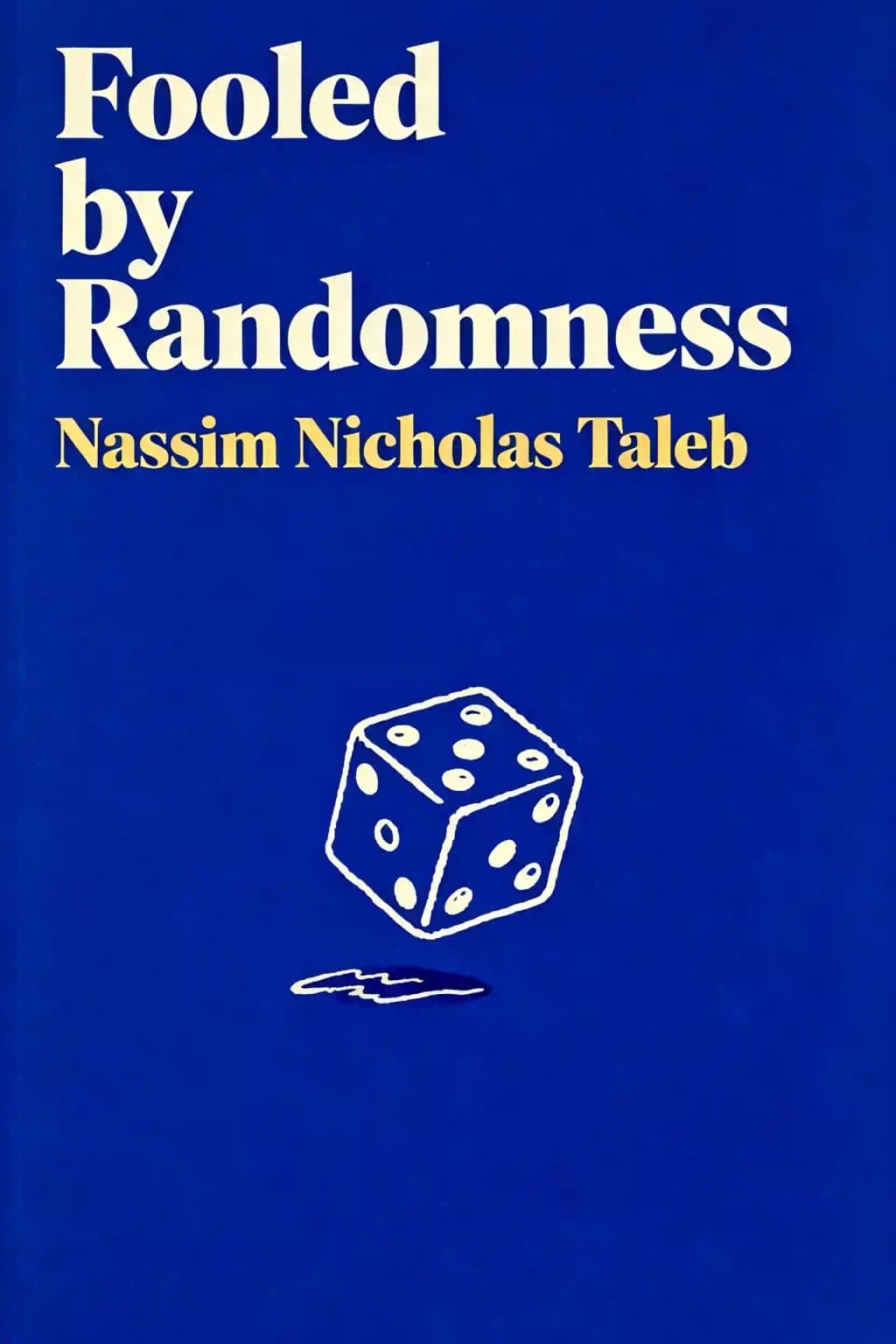
Have you ever wondered why some people seem to achieve extraordinary success while others with similar talents struggle? Or why financial markets can make someone a millionaire one day and bankrupt the next? Nassim Nicholas Taleb's groundbreaking book "Fooled by Randomness" tackles these questions head-on, revealing how we systematically misunderstand the role of chance in our lives. First published in 2001 and expanded in 2004, this cult classic became a cornerstone of modern thinking about risk and uncertainty, influencing fields from finance to psychology. Taleb's contrarian insights earned him a devoted following among intellectual heavyweights like Daniel Kahneman and Robert Shiller, while his uncompromising style made him both celebrated and controversial. Before becoming a bestselling author, Taleb was a successful options trader who made his fortune by betting against conventional wisdom-particularly during market crashes like 1987's Black Monday. His unique perspective combines the practical experience of a Wall Street trader with the theoretical depth of a philosopher-mathematician, creating a work that continues to challenge our fundamental assumptions about success, skill, and randomness.
Capítulo 2
The Lucky Fool's Dangerous Dance
At the heart of Taleb's argument lies the concept of the "lucky fool" - someone who benefits disproportionately from chance but attributes their success to skill. This confusion between luck and ability appears everywhere from business to politics, where presidents claim credit for economic recoveries they didn't create and CEOs receive enormous compensation for decisions heavily influenced by external factors.
Consider two fictional traders: Nero Tulip and John. Nero is intellectually brilliant with a doctorate in statistics, trading conservatively to ensure longevity. He makes a comfortable living but lacks the flashy wealth of his neighbor John, who drives luxury cars and lives in a mansion. John, despite his limited intellectual depth, appears vastly more successful until the market crash of 1998 wipes him out completely. What happened? John was simply taking enormous hidden risks that paid off consistently in a bull market until the inevitable catastrophe struck.
This pattern repeats across domains. Carlos, an emerging markets bond trader, accumulated wealth for years buying bonds whenever prices dipped. His strategy worked brilliantly until Russian bonds collapsed in 1998, wiping out his fortune. Both John and Carlos shared critical traits of the "acute successful randomness fool": overestimating their belief accuracy, becoming emotionally attached to positions, lacking predetermined loss plans, and refusing to use stop-losses.
The problem extends beyond finance. Even in medicine, we often confuse correlation with causation. Early morning television features alternative medicine vendors offering testimonials from "cured" patients, ignoring that these recoveries might represent spontaneous remissions that would have occurred regardless of treatment. As Carl Sagan discovered, cancer patients visiting Lourdes for holy water cures actually had lower recovery rates than the statistical average for spontaneous remissions.
Our tendency to mistake luck for skill creates dangerous feedback loops. Success, even random success, triggers biological changes. "Lucky fools" experience serotonin boosts from their wins, creating a virtuous cycle of confidence that makes them appear deserving of their wealth. Their posture changes-profitable traders walk more upright and talk more assertively. This "leadership" appearance makes others attribute their success to skill rather than luck, reinforcing the illusion.
Capítulo 3
Alternative Histories: The Hidden Reality of Risk
We cannot judge performance solely by results. We must consider what Taleb calls "alternative histories"-what would have happened if different random events had occurred. This concept is fundamental to understanding randomness yet difficult to apply in practice.
Imagine someone offering you $10 million to play Russian roulette-a revolver with one bullet in six chambers. If you survive, you receive the money. Five of six possible histories lead to wealth, one to death. The winner would receive admiration from journalists who fail to see the probability involved. The wise person understands that $10 million earned through Russian roulette fundamentally differs from $10 million earned through dentistry-though an accountant would see them as identical.
Reality is far more vicious than Russian roulette because it delivers fatal bullets infrequently, creating false security. Unlike the game where risks are clearly visible, reality's "barrel" remains hidden, allowing us to unwittingly play deadly games while calling them "low risk." We see only the winners, never the process generating outcomes.
This explains why trading superstars often rapidly revert to obscurity. In any large sample, someone will have an unusually long streak of luck. Yet the larger the deviation from the norm, the more likely it comes from luck rather than skill. This statistical principle of "regression to the mean" explains why extremely tall parents tend to have more average-sized children and why extraordinary performance rarely persists.
Using Monte Carlo simulations, Taleb demonstrates how pure randomness can create the appearance of skill. In a simulation of 10,000 fictional investment managers playing a fair game with 50% odds of making money yearly, after five years, 313 managers would show perfect track records purely by chance. Even more disturbing: a population of entirely incompetent managers (45% chance of profit, 55% chance of loss) would still produce 184 managers with five consecutive profitable years-nearly 2% appearing brilliant despite negative expected returns.
This survivorship bias-seeing only winners while ignoring losers-distorts our understanding of success. The bestseller "The Millionaire Next Door" suffers from this flaw by examining only successful wealth accumulators while ignoring those who followed similar strategies but failed. The book's conclusions depend on an unusual historical period-the greatest bull market in history. Imagine writing it in 1935 after the crash, or about investors in Russian Imperial bonds or Argentine real estate in the 1930s.
Capítulo 4
Skewness and Asymmetry: When Frequency Misleads
Asymmetry in outcomes fundamentally changes how we must interpret probabilities. When outcomes are skewed, the average no longer represents what most people experience - a reality that challenges our intuitive understanding of risk and probability. This disconnect between perception and reality becomes particularly dangerous in complex systems like financial markets and healthcare.
When diagnosed with stomach cancer in his forties, evolutionary biologist Steven Jay Gould initially received devastating news that median survival was just eight months. Further research revealed a crucial statistical insight: median (where half die before and half after eight months) differs dramatically from mean (average) survival. Those who survived the initial period often lived normal lifespans, creating profound asymmetry in outcomes. Gould himself lived another 20 years after his diagnosis, becoming a powerful example of how statistics can mislead when distributions are skewed.
In gambling terms, consider a strategy with 999/1000 chance of winning $1 and 1/1000 chance of losing $10,000. Despite the high probability of winning, the expected value is a $9 loss. The frequency of an outcome matters far less than its magnitude-a principle many fail to grasp when evaluating risks. This same pattern appears in various domains: insurance, venture capital investments, and pharmaceutical research, where rare successes can justify numerous failures.
This asymmetry explains why television financial commentators focus on frequency of correctness rather than magnitude of outcomes. They're entertainers, not risk-takers, failing to grasp that rare events with large payoffs can dominate returns despite their infrequency. Taleb's market strategy centers on "skewed bets"-seeking to profit from rare, infrequently occurring events that offer large payoffs when they happen. Consider options trading: most expire worthless, but occasional massive payoffs can more than compensate for numerous small losses.
The rare event represents the mother of all deceptions in markets. What appears stable can suddenly become catastrophic without warning. Historical examples abound: the 1987 stock market crash, the 2008 financial crisis, and the 2020 pandemic market shock. The pattern is predictable: investors pile into seemingly stable investments that show minimal volatility until an "unforeseen" event triggers panic liquidations. This cycle repeats as new traders with no memory of previous disasters enter the market, often dismissing past catastrophes as "different times."
Statistical methods fail us with asymmetric distributions. With rare events, our knowledge about their absence increases much more slowly than expected, while confirmation of their existence comes immediately upon first observation. This asymmetry in knowledge acquisition is philosophically significant and explains why conventional risk management techniques often fail catastrophically. The failure of Long-Term Capital Management in 1998 and the collapse of numerous "market-neutral" strategies during crisis periods demonstrate how models based on normal distributions can break down spectacularly when confronted with real-world asymmetries.
The implications extend beyond finance to fields like engineering, where "black swan" events can render seemingly robust systems vulnerable. The Fukushima nuclear disaster illustrated how multiple unlikely events can combine to create catastrophic outcomes, despite sophisticated risk models suggesting their virtual impossibility.
Capítulo 5
The Problem of Induction: Black Swans and Blind Spots
The problem of induction haunts all sciences but damages social sciences like economics most severely due to their higher randomness content. This challenge becomes particularly acute in fields where complex human behavior and market dynamics intersect. David Hume framed the issue through what became known as the black swan problem: no number of white swan observations proves all swans are white, but a single black swan disproves it. This elegant metaphor illustrates how thousands of consistent observations can be invalidated by a single contradictory instance.
This asymmetry in knowledge acquisition forms a cornerstone of epistemology and highlights the limitations of pure empirical observation without proper methodological structure. The financial markets provide numerous examples of this principle in action. Victor Niederhoffer's story illustrates the dangers of extreme empiricism without proper methodology. Though he challenged the scholasticism of financial theorists and discovered market anomalies through data analysis, his downfall came from relying too heavily on historical patterns. By selling naked options based on the premise "the market has never done this before," he made small profits when right but suffered catastrophic losses when wrong. His experience demonstrates how past performance can create dangerous blind spots about future possibilities.
Karl Popper resolved the problem of induction by proposing that scientific theories fall into only two categories: those known to be wrong because they've been adequately falsified, and those not yet proven wrong but exposed to potential falsification. This framework revolutionized scientific thinking by shifting focus from proof to disproof. No theory can ever be proven right-we can never know if all swans are white-but we can definitively prove a theory wrong by finding a single black swan. This approach provides a more robust foundation for scientific inquiry by acknowledging the inherent limitations of human knowledge.
Popper's falsificationism connects directly to his notion of an open society-one where no permanent truth is held to exist, allowing counter-ideas to emerge. This parallels his friend von Hayek's endorsement of capitalism as a system where prices disseminate information that socialism would suppress. Both concepts relate to handling randomness effectively by maintaining flexibility and adaptability in the face of new evidence. The market serves as a massive information processing system that can adapt to new realities faster than centralized planning ever could.
Human memory functions as an induction machine, constantly seeking patterns and causality in random events. We remember stories with logical links far more easily than random facts because causality requires less mental storage. For instance, we readily remember that "the stock market crashed because of interest rate hikes" rather than acknowledging the complex interplay of countless variables. Induction compresses many particulars into general principles, taking less room in memory while reducing the degree of detected randomness. This explains why we're so susceptible to narrative fallacies that provide comforting but often false explanations for random events. Our brains actively resist randomness, preferring to construct coherent stories even when they don't reflect reality.
The implications of these cognitive biases extend beyond individual decision-making to shape institutional policies and market behaviors. Organizations often fall prey to the same inductive fallacies, building elaborate models based on historical data while remaining blind to the possibility of unprecedented events. This systematic underestimation of uncertainty makes both individuals and institutions vulnerable to black swan events that lie outside their experience-based models.
Capítulo 6
Our Probability-Blind Brains
Our minds cannot properly process probabilistic thinking. We can only visualize one state at a time-either being in Paris or the Bahamas, never a 50/50 probability of both. When faced with a 50% chance of winning $2,000 or getting nothing, we can't imagine the mathematical expectation ($1,000); instead, one state dominates our thinking.
This limitation extends to financial decisions and medical scenarios. When Nero was told he had a 72% five-year survival rate for cancer, he couldn't think of himself as "72% alive and 28% dead"-he either visualized himself dead or cheerfully planning future ski trips. Similarly, consumers see a 75% fat-free hamburger differently than a 25% fat one, though mathematically identical.
Our emotional apparatus doesn't understand nuances-it's binary, designed for decisive action rather than probabilistic thinking. Herbert Simon proposed that we're "boundedly rational"-we stop when reaching a near-satisfactory solution rather than optimizing completely, which would require infinite time. However, Israeli researchers Kahneman and Tversky discovered our thinking process differs qualitatively from this model, revealing systematic errors in reasoning rather than mere approximations.
Their research showed that these biases don't disappear with incentives-they represent a different form of reasoning with weak probabilistic foundations. This led to the "heuristics and biases" tradition, spawning the field of behavioral finance and economics, which contradicts orthodox neoclassical economics.
Evolutionary psychologists offer a different perspective on our probabilistic reasoning difficulties. They believe the issue stems from our modern environment being different from what our brains evolved for. Our natural habitat-the environment where we spent the most generations-differs dramatically from today's world. Even looking back just 3,000 years reveals a world where information traveled slowly, people knew few others in their lifetime, and probability calculations were unnecessary. Our genes haven't changed since then, but our environment has evolved much faster than our genetic makeup.
Neurobiologists contribute another perspective with the theory of our "triune brain": the reptilian brain controlling basic functions, the limbic brain managing emotions, and the neocortex handling cognitive functions. Antonio Damasio's groundbreaking work showed that patients with damaged emotional centers but intact intelligence couldn't make even simple decisions-emotions serve as necessary "lubricants of reason" that prevent endless deliberation.
Capítulo 7
Nonlinear Life: Small Causes, Massive Effects
Life isn't merely unfair-it's nonlinearly unfair. Small advantages or random help can translate into wildly disproportionate payoffs.
Nonlinearity is illustrated by the sandpile effect: adding sand grains to a tower eventually causes complete collapse-the final grain appears responsible for destroying the entire structure. This represents a disproportionate result from a small input. These dynamics show how small differences in initial conditions lead to vastly different outcomes.
Consider actors auditioning for roles. The few winners move to Bel Air and learn luxury consumption habits, while the majority end up serving coffee at Starbucks. Though we might attribute success to superior talent, all those in the waiting room have acting skills. Fame follows its own self-reinforcing dynamic-an actor becomes known because he's already known. The initial selection might hinge on a trivial detail that matched the examiner's mood that day.
The QWERTY keyboard exemplifies how inferior solutions can dominate. Despite being deliberately designed to slow typing and prevent jamming on mechanical typewriters, QWERTY persisted through the computer age. People's habits proved too entrenched to change, creating a path-dependent outcome. The information age amplifies such unfairness-winners capture almost all customers.
While conventional probability models maintain constant odds of success with each step, Brian Arthur proposed using the Polya process to model economic success. In this model, past success increases future probability of winning, while past failure increases chances of losing. Simulations show extreme variance in outcomes-huge successes and numerous failures.
Network dynamics studies have exploded in popularity, examining how behaviors spread rapidly beyond critical thresholds. The more connected a network becomes, the higher its probability of attracting more connections-explaining why Google gets vastly more hits than obscure organizations.
Our brain is wired for linear causality, not nonlinearities. We expect steady inputs to yield proportional results, becoming demoralized when progress isn't visible. Reality rarely offers linear progression-you might study for a year learning nothing, then suddenly grasp everything in a flash. This nonlinearity explains why people cannot comprehend rare events and why few have the mental stamina to follow nonrandom paths to success.
Capítulo 8
Living with Randomness: The Stoic's Solution
Odysseus faced the sirens by having himself tied to the mast while his men's ears were filled with wax. The lesson isn't to be Odysseus-a mythological character-but rather to be like the sailors with wax-filled ears. We need emotional defenses against the seductive songs of randomness that would otherwise lead us to destruction.
Taleb's epiphany came when he realized he's not intelligent or strong enough to fight his emotions-nor should he try, as he needs them to formulate and execute ideas. He's just intelligent enough to recognize his predisposition to be fooled by randomness. His solution? Tricks like avoiding eye contact in traffic confrontations, imagining aggressive drivers as another species, and simply not reading critics' comments on his work-wax in his ears.
Even sophisticated professionals develop superstitious behaviors when faced with randomness. Early in his trading career, Taleb discovered he had developed rituals after profitable days-taking the same cab route, wearing the same tie with coffee stains. Despite his scientific training and probabilistic focus, he had unconsciously formed causal links between unrelated events.
Skinner's famous experiment with pigeons demonstrates our biological tendency to create false causal relationships. When food was delivered randomly, the birds developed elaborate "rain dance" rituals they believed caused the feeding. This reveals our hardwired difficulty in viewing events as independent.
When faced with randomness, we ultimately have only dignity as a solution-defined as following a protocol of behavior regardless of immediate circumstances. The stoic response to randomness isn't merely maintaining a "stiff upper lip" but recognizing our limited control while maintaining personal elegance.
Self-help books and sermons rarely sink in when they contradict our emotional wiring. But stoicism works because it plays on dignity and personal aesthetics encoded in our genes. The stoic approach is about maintaining elegance in the face of misfortune: dress your best on execution day; hide your cancer diagnosis to avoid pity; be courteous when losing money; never blame others for your fate; show no self-pity when abandoned. While Lady Fortuna controls much of our lives, she has no control over our behavior.
Capítulo 9
The Wisdom of Uncertainty
After a lifetime of searching, Taleb found his fundamental insight: "We favor the visible, the embedded, the personal, the narrated, and the tangible; we scorn the abstract." Everything good (aesthetics, ethics) and wrong (being fooled by randomness) seems to flow from this fundamental human tendency. This bias manifests in countless ways, from our preference for stories over statistics to our tendency to attribute success to skill rather than luck.
Randomness can sometimes protect us from our own efficiency-seeking behavior. Consider the suburban commuter at a New York dinner, constantly watching the clock to catch the 7:08 train. Without a fixed schedule, he would relax and enjoy the meal naturally. Similarly, a trader who checks portfolio values hourly might make panic-driven decisions, while one who reviews monthly might maintain better perspective. Uncertainty prevents over-optimization. Research shows that "satisficers" (who blend satisfying and maximizing) tend to be happier than "optimizers" who constantly seek higher levels of consumption and sophistication. This applies across domains - from investment strategies to life choices.
Uncertainty provides tangible informational benefits by scrambling potentially damaging messages. Consider a currency pegged to a fixed rate-the slightest downward fluctuation signals failure and triggers a self-feeding selling frenzy. But with some noise around the official band, small drops wouldn't be considered significant. This principle extends to stock markets, where circuit breakers and trading halts introduce beneficial uncertainty that prevents panic cascades. Even in personal relationships, some ambiguity can be healthier than absolute transparency.
In evolutionary terms, mild unpredictability in behavior can protect you in conflict situations. If your reaction threshold is randomized rather than predictable, adversaries cannot calculate exactly how far they can push you. A completely predictable person becomes easy to manipulate or exploit. The same applies to governments in conflicts-they must convince adversaries they might occasionally overreact disproportionately to minor provocations. This "madman theory" of deterrence was famously employed by leaders like Richard Nixon. Unpredictability serves as a powerful deterrent precisely because it introduces calculation-defeating uncertainty.
The wisdom of Solon, the ancient Greek lawgiver, encapsulates the book's central message. When visiting the legendarily wealthy King Croesus, Solon refused to call him the happiest man alive, saying happiness can only be judged at the end of life, as "the uncertain future has yet to come, with all variety of future." This wisdom was echoed more colloquially by baseball coach Yogi Berra: "it ain't over until it's over." The story of Croesus proved prophetic - he later lost his kingdom to Cyrus of Persia, demonstrating how quickly fortune can reverse.
Solon intuitively understood three profound problems: the problem of induction (the "black swan" or "rare event"), the skewness issue (frequency of success matters less if failure is catastrophic), and that achievements with little help from luck are more resistant to randomness. His insights apply to modern challenges like financial crashes, technological disruptions, and geopolitical upheavals. In a world increasingly dominated by randomness and complexity, his ancient wisdom remains our surest guide, reminding us that humility before uncertainty is the beginning of true wisdom.