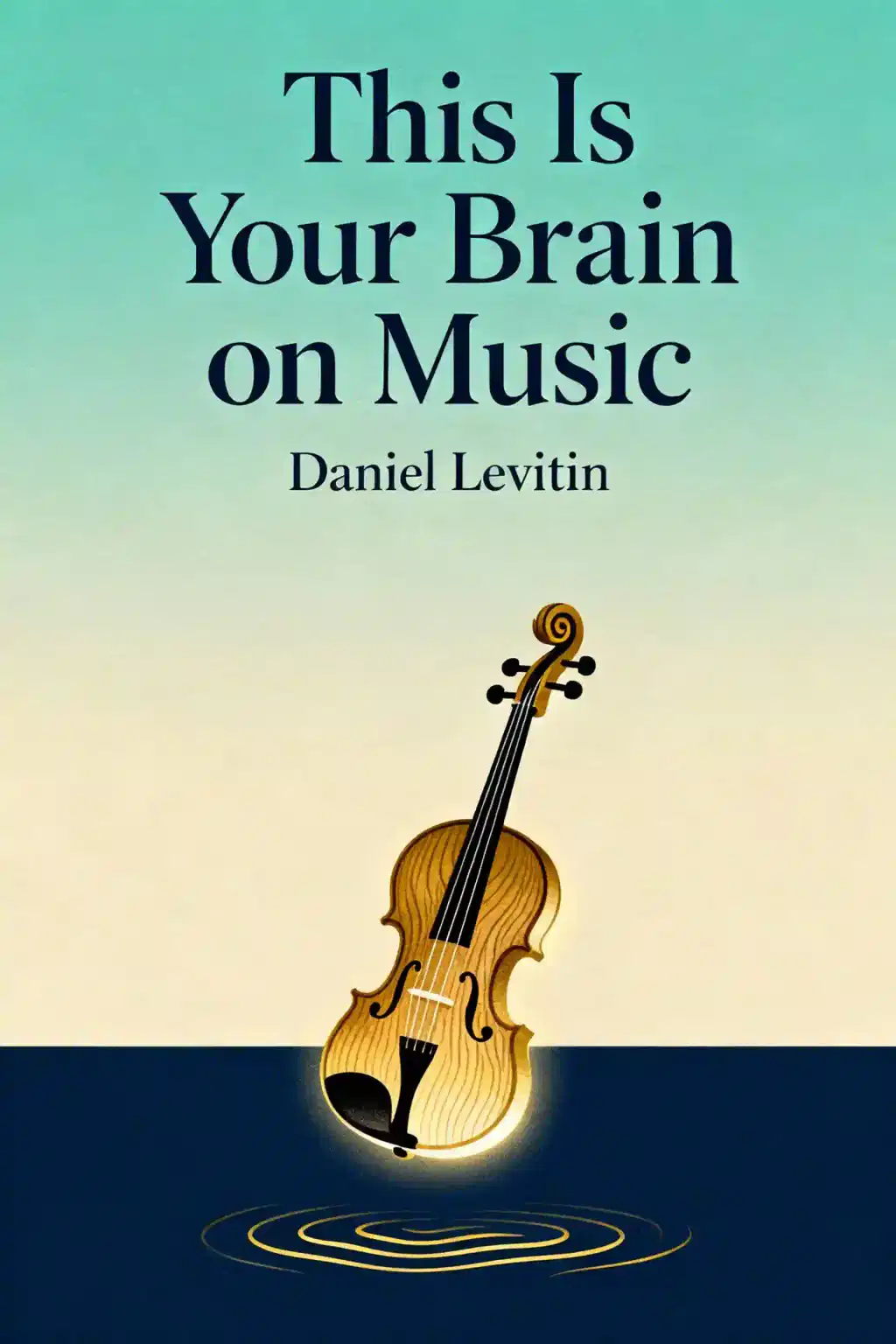
This Is Your Brain on Music: Understanding a Human Obsession

Overview of This Is Your Brain on Music
Ever wonder why music from your teen years hits differently? Neuroscientist Daniel Levitin reveals how our brains process rhythm, memory, and emotion. Recommended by Tai Lopez and using Miles Davis's "Kind of Blue" as evidence, this mind-bending exploration transforms how you'll experience every song.
- Music's neural structures evolved before language, shaping human cognition.
- Childhood music training creates lasting neural pathways for auditory processing.
- Dopamine release from music mirrors biological rewards like food and sex.
- Expertise in music requires 10,000 hours of deliberate practice, not innate talent.
- Music therapy lowers cortisol and boosts dopamine for stress relief.
- Familiar music reactivates autobiographical memories in Alzheimer's patients.
- The brain's default mode network drives musical creativity and mind-wandering.
- Rhythmic music synchronizes brain activity, fostering social cohesion and empathy.
- Personal music preferences determine therapeutic effectiveness more than genre.
- Universal musical patterns activate similar brain regions across cultures.
About the Author of This Is Your Brain on Music
Daniel Joseph Levitin is a cognitive psychologist, neuroscientist, and the bestselling author of This Is Your Brain on Music: The Science of a Human Obsession. He bridges the worlds of neuroscience and music with groundbreaking clarity.
A Stanford and University of Oregon-trained scholar, Levitin’s work explores how music shapes cognition, emotion, and behavior, drawing from his dual career as an academic and Grammy-nominated record producer for artists like Stevie Wonder and Santana. His other notable works include The Organized Mind and A Field Guide to Lies, which tackle information overload and critical thinking in the digital age.
A James McGill Professor Emeritus at McGill University and founding dean at Minerva Schools, Levitin has delivered TED Talks and appeared on NPR, BBC, and The Agenda to discuss music’s therapeutic potential. This Is Your Brain on Music, translated into 21 languages, has sold over 1.5 million copies worldwide, cementing its status as a landmark crossover work in neuroscience and culture.
FAQs About This Is Your Brain on Music
What is This Is Your Brain on Music by Daniel Levitin about?
This Is Your Brain on Music explores how music interacts with the brain, blending neuroscience, psychology, and music theory. Levitin explains how rhythm, melody, and harmony trigger emotional and cognitive responses, while addressing music’s evolutionary role in social bonding and memory. The book challenges the idea that music is an evolutionary accident, proposing it as a key driver of human development.
Who should read This Is Your Brain on Music?
Music enthusiasts, psychology students, and curious readers interested in neuroscience will find value in this book. Levitin’s accessible writing makes complex concepts like neuroanatomy and cognitive categorization engaging for non-experts, while musicians gain insights into how auditory processing shapes perception.
Is This Is Your Brain on Music worth reading?
Yes—it’s a New York Times bestseller praised for bridging science and art. While some critique uneven pacing or technical sections, most find its exploration of musical memory, emotion, and evolutionary theory compelling. Levitin’s mix of research, anecdotes, and clear explanations makes it a standout in popular science.
What are Daniel Levitin’s credentials for writing this book?
Levitin holds a PhD in cognitive psychology and a music technology minor, with peer-reviewed research in Science and Nature. Before academia, he produced albums for Stevie Wonder and Santana. This dual expertise in neuroscience and music informs the book’s interdisciplinary approach.
What are the main ideas in This Is Your Brain on Music?
- Musical Expectation: How the brain predicts notes, creating emotional tension/release.
- Memory & Emotion: Songs activate the hippocampus and amygdala, linking music to vivid memories.
- Evolutionary Role: Music may have preceded language, aiding social cohesion and mating.
How does Levitin explain the “auditory cheesecake” debate?
Levitin counters Steven Pinker’s claim that music is an evolutionary byproduct. Citing Darwin and studies on social bonding, he argues music enhanced survival by improving group coordination and emotional communication, making it central to human development.
What criticisms exist about This Is Your Brain on Music?
Some readers find explanations of music theory basics redundant, while others want deeper neuroscience. A minority note uneven transitions between personal anecdotes and scientific content. Despite this, most praise its ability to simplify complex topics.
How does Levitin connect music to memory?
He describes how songs create “neuronal imprints”—unique brain patterns formed during first listens. These activate when recalling music, making melodies powerful triggers for autobiographical memories. Studies show imagined and heard music produce nearly identical brain activity.
What real-life applications does the book suggest?
- Music Therapy: Leveraging rhythm to improve motor skills in Parkinson’s patients.
- Education: Using melody to enhance memory retention.
- Productivity: Curating background music to optimize focus.
How does This Is Your Brain on Music compare to Oliver Sacks’ Musicophilia?
While both explore music’s neural impact, Levitin focuses on universal cognitive mechanisms (e.g., expectation, categorization), whereas Sacks examines clinical case studies. Levitin’s book serves as a primer, while Sacks delves into rare neurological conditions.
What role does the cerebellum play in music perception?
Levitin highlights the cerebellum’s underappreciated role in timing and coordination during music processing. It helps predict rhythmic patterns and synchronize movement, illustrating how music engages both primal and advanced brain regions.
How does the book address musical genres and brain categorization?
The brain uses pattern recognition to classify music into genres, relying on tempo, instrumentation, and structure. Levitin ties this to Gestalt psychology principles, explaining how slight variations (e.g., key changes) don’t override genre identification.
Feel the book through the author's voice
Turn knowledge into engaging, example-rich insights
Capture key ideas in a flash for fast learning
Enjoy the book in a fun and engaging way
Characters in This Is Your Brain on Music
- Daniel LevitinAuthor, neuroscientist, and music producer
- Edgard VareseComposer who defined music as organized sound
- Miles DavisJazz musician who emphasized the space between notes
- Pierre SchaefferComposer who experimented with instrumental timbre
- Bob DylanMusician used as a case study for musical identity
Key Themes in This Is Your Brain on Music
- auditory perception
- musical cognition
- evolutionary musicology
- neurobiology of emotion
- psychoacoustics
Quotes from This Is Your Brain on Music
Expectations are at the root of much of what makes music pleasurable.
Music isn't just about the notes you play - it's about the spaces between them.
Music is simply "organized sound."
Our musical abilities may be as central to our humanity as language itself.
Explore Your Way of Learning
 Quick Summary Mode
Read or listen to This Is Your Brain on Music Summary in 9 Minutes
Break down key ideas from This Is Your Brain on Music into bite-sized takeaways to understand how innovative teams create, collaborate, and grow.

 Fun Mode
This Is Your Brain on Music Lessons Told Through 23-Min Stories
Experience This Is Your Brain on Music through vivid storytelling that turns innovation lessons into moments you'll remember and apply.
 Personalize Mode
Experience This Is Your Brain on Music in your own learning style
Ask anything, choose your learning style, and co-create insights that truly resonate with you.

From Columbia University alumni built in San Francisco
"Instead of endless scrolling, I just hit play on BeFreed. It saves me so much time."


"I never knew where to start with nonfiction—BeFreed’s book lists turned into podcasts gave me a clear path."


"Perfect balance between learning and entertainment. Finished ‘Thinking, Fast and Slow’ on my commute this week."
"Crazy how much I learned while walking the dog. BeFreed = small habits → big gains."
"Reading used to feel like a chore. Now it’s just part of my lifestyle."

"Feels effortless compared to reading. I’ve finished 6 books this month already."
"BeFreed turned my guilty doomscrolling into something that feels productive and inspiring."

"BeFreed turned my commute into learning time. 20-min podcasts are perfect for finishing books I never had time for."
"BeFreed replaced my podcast queue. Imagine Spotify for books — that’s it. 🙌"

"It is great for me to learn something from the book without reading it."
"The themed book list podcasts help me connect ideas across authors—like a guided audio journey."
"Makes me feel smarter every time before going to work"
From Columbia University alumni built in San Francisco
"Instead of endless scrolling, I just hit play on BeFreed. It saves me so much time."
"I never knew where to start with nonfiction—BeFreed’s book lists turned into podcasts gave me a clear path."
"Perfect balance between learning and entertainment. Finished ‘Thinking, Fast and Slow’ on my commute this week."
"Crazy how much I learned while walking the dog. BeFreed = small habits → big gains."
"Reading used to feel like a chore. Now it’s just part of my lifestyle."
"Feels effortless compared to reading. I’ve finished 6 books this month already."
"BeFreed turned my guilty doomscrolling into something that feels productive and inspiring."
"BeFreed turned my commute into learning time. 20-min podcasts are perfect for finishing books I never had time for."
"BeFreed replaced my podcast queue. Imagine Spotify for books — that’s it. 🙌"
"It is great for me to learn something from the book without reading it."
"The themed book list podcasts help me connect ideas across authors—like a guided audio journey."
"Makes me feel smarter every time before going to work"
"Instead of endless scrolling, I just hit play on BeFreed. It saves me so much time."
"I never knew where to start with nonfiction—BeFreed’s book lists turned into podcasts gave me a clear path."
"Perfect balance between learning and entertainment. Finished ‘Thinking, Fast and Slow’ on my commute this week."
"Crazy how much I learned while walking the dog. BeFreed = small habits → big gains."
"Reading used to feel like a chore. Now it’s just part of my lifestyle."
"Feels effortless compared to reading. I’ve finished 6 books this month already."
"BeFreed turned my guilty doomscrolling into something that feels productive and inspiring."
"BeFreed turned my commute into learning time. 20-min podcasts are perfect for finishing books I never had time for."
"BeFreed replaced my podcast queue. Imagine Spotify for books — that’s it. 🙌"
"It is great for me to learn something from the book without reading it."
"The themed book list podcasts help me connect ideas across authors—like a guided audio journey."
"Makes me feel smarter every time before going to work"
"Instead of endless scrolling, I just hit play on BeFreed. It saves me so much time."
"I never knew where to start with nonfiction—BeFreed’s book lists turned into podcasts gave me a clear path."
"Perfect balance between learning and entertainment. Finished ‘Thinking, Fast and Slow’ on my commute this week."
"Crazy how much I learned while walking the dog. BeFreed = small habits → big gains."
"Reading used to feel like a chore. Now it’s just part of my lifestyle."
"Feels effortless compared to reading. I’ve finished 6 books this month already."
"BeFreed turned my guilty doomscrolling into something that feels productive and inspiring."
"BeFreed turned my commute into learning time. 20-min podcasts are perfect for finishing books I never had time for."
"BeFreed replaced my podcast queue. Imagine Spotify for books — that’s it. 🙌"
"It is great for me to learn something from the book without reading it."
"The themed book list podcasts help me connect ideas across authors—like a guided audio journey."
"Makes me feel smarter every time before going to work"

Download Summary of This Is Your Brain on Music
Get the This Is Your Brain on Music summary as a free PDF or EPUB. Print it or read offline anytime.