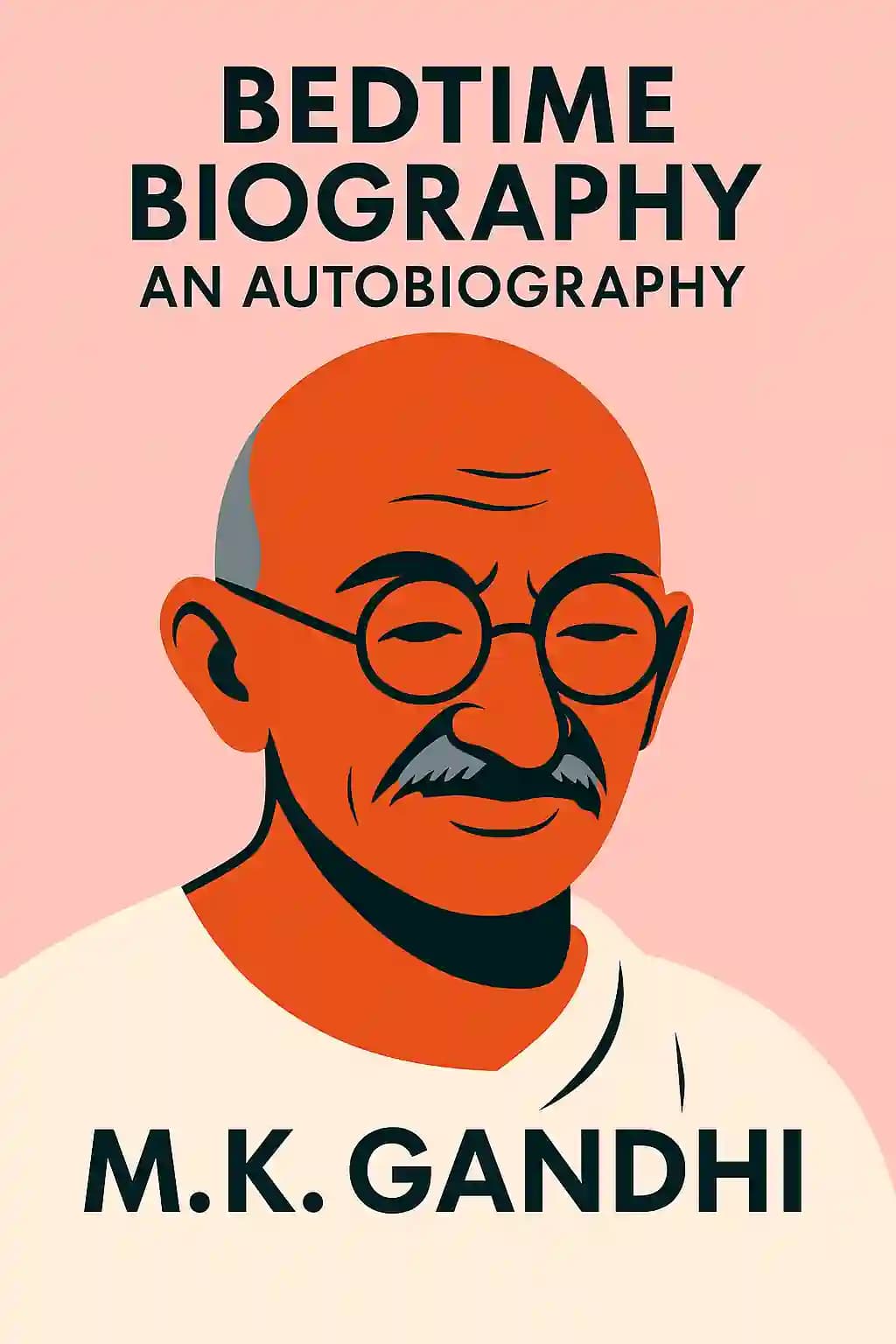
Gandhi's raw confession of moral struggles and spiritual experiments shaped nonviolent resistance worldwide. The autobiography that inspired MLK Jr. and Mandela asks: Can truth-seeking transform not just a nation, but your own soul? A revolutionary's intimate journey toward radical compassion.
Mohandas Karamchand Gandhi (M.K. Gandhi) was a preeminent leader of Indian nationalism and an advocate of nonviolent resistance. He authored Bedtime Biography: An Autobiography as a profound exploration of his spiritual evolution and political philosophy.
This memoir intertwines personal reflections on truth (satya) and ethical living with pivotal moments in India’s struggle for independence.
Trained as a lawyer in London, Gandhi honed his philosophy of satyagraha (truth-force) during two decades advocating for civil rights in South Africa before leading India’s freedom movement. His seminal works, including Hind Swaraj and Satyagraha in South Africa, further articulate his vision for self-reliance and social justice.
Recognized globally for his moral authority, Gandhi’s writings have influenced civil rights movements worldwide, with his autobiography remaining a cornerstone of political and spiritual literature, translated into over 50 languages.
Bedtime Biography: An Autobiography by M.K. Gandhi chronicles his life from childhood to his assassination in 1948, detailing his philosophy of nonviolent resistance (satyagraha), his leadership in India’s independence movement, and his experiences fighting racial injustice in South Africa. The book explores themes like truth, self-discipline, and social justice through pivotal events like the Salt March.
This book is ideal for readers interested in Gandhi’s life, historical narratives of civil rights movements, or philosophies of nonviolence and ethical living. It appeals to students of history, activists, and anyone seeking inspiration from Gandhi’s transformative journey from a privileged youth to a global symbol of peace.
Yes, the book offers profound insights into Gandhi’s principles of ahimsa (nonviolence) and swaraj (self-rule), making it a timeless guide for personal and societal change. Its blend of personal anecdotes and ideological reflections provides actionable wisdom for navigating modern challenges.
Gandhi’s 21 years in South Africa exposed him to systemic racism, catalyzing his development of satyagraha. His activism there, including organizing labor strikes and challenging discriminatory laws, laid the groundwork for his later campaigns in India, blending legal advocacy with moral resistance.
Gandhi’s Hindu faith, particularly teachings from the Bhagavad Gita, anchors his belief in truth and nonviolence. He also emphasizes interfaith respect, viewing all religions as paths to universal ethical principles, which informed his inclusive approach to social reform.
The 1930 Salt March, a 240-mile protest against British salt taxes, exemplifies Gandhi’s strategy of nonviolent civil disobedience. This event galvanized India’s independence movement and showcased the power of collective, principled resistance.
Swaraj (self-rule) advocates for individual and community empowerment through ethical autonomy and decentralized governance. Modern applications include advocating for social justice, sustainable living, and resisting systemic oppression through grassroots activism.
Critics note Gandhi’s limited discussion of his later political struggles and his idealized portrayal of poverty. Some argue the autobiography oversimplifies complex socio-political conflicts, though it remains a vital primary source for understanding his ethos.
Unlike scholarly biographies, Gandhi’s firsthand account provides intimate insights into his motivations and spiritual evolution. It prioritizes personal growth over historical analysis, making it a unique complement to external perspectives on his legacy.
Key takeaways include embracing simplicity, practicing self-discipline, and confronting injustice with courage. Gandhi’s emphasis on aligning actions with values offers a blueprint for ethical decision-making in personal and professional contexts.
Gandhi frames failures as opportunities for introspection and growth, detailing setbacks like early public speaking struggles and political defeats. His resilience underscores the importance of persistence in achieving long-term goals.
Siente el libro a través de la voz del autor
Convierte el conocimiento en ideas atractivas y llenas de ejemplos
Captura ideas clave en un instante para un aprendizaje rápido
Disfruta el libro de una manera divertida y atractiva
The right hand is already pledged to Porbandar.
The ideal of truth has grown on me since then.
Everything seemed right and proper to me then.
Animal passion had blinded me.
I began to think of my duty.
Desglosa las ideas clave de Bedtime Biography en puntos fáciles de entender para comprender cómo los equipos innovadores crean, colaboran y crecen.
Experimenta Bedtime Biography a través de narraciones vívidas que convierten las lecciones de innovación en momentos que recordarás y aplicarás.
Pregunta cualquier cosa, elige tu estilo de aprendizaje y co-crea ideas que realmente resuenen contigo.

Creado por exalumnos de la Universidad de Columbia en San Francisco
"Instead of endless scrolling, I just hit play on BeFreed. It saves me so much time."
"I never knew where to start with nonfiction—BeFreed’s book lists turned into podcasts gave me a clear path."
"Perfect balance between learning and entertainment. Finished ‘Thinking, Fast and Slow’ on my commute this week."
"Crazy how much I learned while walking the dog. BeFreed = small habits → big gains."
"Reading used to feel like a chore. Now it’s just part of my lifestyle."
"Feels effortless compared to reading. I’ve finished 6 books this month already."
"BeFreed turned my guilty doomscrolling into something that feels productive and inspiring."
"BeFreed turned my commute into learning time. 20-min podcasts are perfect for finishing books I never had time for."
"BeFreed replaced my podcast queue. Imagine Spotify for books — that’s it. 🙌"
"It is great for me to learn something from the book without reading it."
"The themed book list podcasts help me connect ideas across authors—like a guided audio journey."
"Makes me feel smarter every time before going to work"
Creado por exalumnos de la Universidad de Columbia en San Francisco

Obtén el resumen de Bedtime Biography como PDF o EPUB gratis. Imprímelo o léelo sin conexión en cualquier momento.
What transforms a timid, unremarkable boy into a force that brings an empire to its knees without firing a single shot? Mohandas K. Gandhi's journey from fearful child to global icon wasn't marked by sudden enlightenment or divine intervention. Instead, it unfolded through thousands of small, deliberate choices-each one a tiny experiment in living truthfully. His autobiography reads less like a saint's hagiography and more like a scientist's lab notebook, meticulously recording failures alongside breakthroughs. "My experiments with truth," he called them, and the phrase captures something essential: truth wasn't something Gandhi possessed but something he pursued relentlessly, often stumbling, always learning. This radical honesty about his own flaws makes his achievements all the more remarkable. We're not reading about a perfect being descending to save humanity, but about a deeply flawed human who discovered that transformation begins when we stop hiding from ourselves.
Gandhi's childhood in late 19th-century India was shaped by his father's unwavering integrity and mother's spiritual devotion. His father once saluted a nobleman with his left hand, explaining his right was "already pledged to Porbandar." His mother fasted so strictly she wouldn't eat until seeing the sun, even during monsoons when clouds hid it for days. Two stories captivated young Gandhi: Shravana, who carried his blind parents on pilgrimage, and King Harishchandra, who sacrificed everything rather than speak a single lie. Gandhi performed Harishchandra alone countless times, so moved by the king's commitment to truth it became his life's template. When a school inspector tried helping him cheat on a spelling test, the shy boy refused despite his teacher's boot pressing urgently against his leg. At thirteen, Gandhi married Kasturbai, quickly revealing his controlling nature by jealously restricting her movements. Years later, he'd recognize this as toxic possessiveness disguised as love. This conventional marriage would transform into spiritual companionship through decades of shared struggle. Gandhi's teenage years weren't marked by precocious wisdom but by ordinary temptations and moral failures. At sixteen, he began secretly eating meat, convinced it would make Indians strong enough to overthrow British rule. After his first taste of goat, Gandhi experienced nightmares of bleating animals. Yet he continued, developing a taste for the dishes even as guilt gnawed at him. Eventually, he concluded that deceiving his vegetarian parents was worse than abstaining from meat - establishing a pattern of prioritizing honesty over reform. More serious was stealing gold from his brother's armlet to repay a debt. Overwhelmed by shame, Gandhi wrote a confession to his bedridden father, requesting punishment and promising never to steal again. Instead of anger, his father responded with tears - "pearls of love," Gandhi called them, that "cleansed my heart and washed away my sin." This profound experience taught him about the power of nonviolent response to wrongdoing. His most painful failure came during his father's final illness. As a sixteen-year-old nursing his dying parent, Gandhi would leave the bedside each night to be with his pregnant wife. When his father died during one such absence, Gandhi was devastated, believing his "animal passion" had robbed him of being present for those final moments. The child born from these encounters lived only days - a consequence Gandhi interpreted as inevitable given his lustful state. These experiences reveal Gandhi not as a born saint but as someone whose greatness emerged from confronting his weaknesses through rigorous self-examination.
Gandhi arrived in South Africa in 1893 as an inexperienced lawyer. At Maritzburg station, he was forcibly ejected from first-class despite holding a valid ticket-simply because he was "colored." Shivering in the cold waiting room, Gandhi faced a pivotal choice: fight for his rights, return to India, or continue? He decided the prejudice was merely a symptom of a deeper disease he must help root out. Further indignities followed-a stagecoach driver boxed his ears and tried forcing him onto dirty sackcloth. When Gandhi refused, clinging to brass rails as the man beat him, passengers intervened: "Man, let him alone. He is right." These experiences awakened Gandhi to systemic injustice. He quickly organized the Indian community, challenging merchants on honesty, emphasizing sanitation, and urging unity across religions. When plague broke out at a nearby gold mine, Gandhi and volunteers nursed infected patients-discovering that humanitarian work satisfied him more deeply than legal success. The turning point came reading John Ruskin's "Unto This Last." The book so captivated him that he arose at dawn determined to transform his life around three principles: individual good exists in collective welfare, all honest work has equal value, and agricultural labor represents the life worth living. This led to establishing Phoenix Settlement in 1904-a community where everyone labored equally and received identical modest allowances regardless of color or nationality. By 1906, Gandhi had taken a vow of celibacy, believing it necessary for public service. This self-purification became preliminary to developing Satyagraha-"truth-force"-as a method of nonviolent resistance that would later transform India's independence struggle.
Gandhi's leadership crystallized through three pivotal campaigns that transformed suffering into moral power. The Champaran Satyagraha of 1917 began when a farmer brought Gandhi to Bihar, where indigo farmers endured the exploitative tinkathia system. When authorities ordered him to leave, Gandhi refused: "I have disregarded the order not for want of respect for lawful authority, but in obedience to the higher law of our being - the voice of conscience." His teams documented thousands of peasants' statements, building relationships with victims and authorities. The inquiry abolished tinkathia and secured refunds. In Ahmedabad, Gandhi mediated a labor dispute between mill workers and owners. When negotiations stalled, he advised workers to strike under strict conditions: no violence, no harassment of replacements, and earning bread through honest labor. When resolve weakened after two weeks, Gandhi fasted for three days until settlement. The Kheda Satyagraha emerged when crops failed but officials refused to suspend revenue collection. Gandhi advised peasants to withhold payment. Though ending in compromise, it awakened peasants politically, revealed Vallabhbhai Patel's leadership potential, and established Satyagraha as effective nonviolent resistance.
Gandhi's most revolutionary work centered on the humble spinning wheel. When establishing the Satyagraha Ashram, he introduced hand-looms to clothe the community in Indian-made cloth. This revealed systemic problems: limited weaver production, yarn shortages, and growing debt. Most critically, fine cloth required foreign yarn because Indian mills couldn't spin fine counts. Finding spinning wheels proved surprisingly difficult-workers finally discovered them in Vijapur attics. With encouragement and practical support-providing cotton and guaranteeing yarn purchase-villagers gradually resumed spinning. The first Khadi cost seventeen annas per yard, expensive but supported by friends committed to self-reliance. Gandhi recognized the spinning wheel offered employment for "semi-starved millions," particularly women who could earn supplementary income while maintaining household duties. Mill-owners questioned whether spinning wheels could compete with power machinery. Gandhi's response revealed deeper economic understanding: "Machinery has its place; it has come to stay. But it must not be allowed to displace necessary human labour." He saw the charkha as appropriate technology distributing economic power rather than concentrating it. This vision challenged Western industrialization models and anticipated contemporary concerns about sustainability, appropriate technology, and human costs of unchecked industrialization-offering a model where progress serves human dignity rather than sacrificing it.
While public campaigns captured global attention, Gandhi's most rigorous experiments occurred in the laboratory of his own body and mind. His dietary experiments evolved from vegetarianism to fruitarian diets, eventually attempting to live on nuts and uncooked foods. These weren't mere asceticism but connected physical discipline with spiritual growth. "The body was never meant to be a burden on the soul," he wrote. His most challenging experiment was brahmacharya-celibacy-adopted in 1906 at age thirty-seven. Though married with four children, Gandhi concluded family responsibilities limited his capacity for service. With Kasturbai's consent, he transformed their marriage into spiritual partnership. "Even today I am far from claiming any finality or perfection in brahmacharya," he admitted, describing it as "walking on the sword's edge." Fasting became another powerful tool, serving health, penance, and political action. When discovering moral lapses among Ashram residents, he imposed a seven-day fast upon himself: "I felt I should share the shame with them." Gandhi maintained scientific detachment, carefully documenting results and acknowledging failures. This integration of physical discipline with spiritual seeking distinguished him from traditional ascetics who rejected the world and activists who ignored inner transformation. He understood that authentic social change required personal transformation-that we cannot give to the world what we haven't cultivated within ourselves.
Gandhi deliberately ends his autobiography in 1921, noting his life thereafter "has been so public that there is hardly anything about it that people do not know." His final words reveal both humility and determination: "I am far from claiming any finality or infallibility about my conclusions," yet he maintains absolute faith that "there is no God higher than Truth" and that "the only means for the realization of Truth is Ahimsa." His legacy continues evolving through those who've adapted his methods-from Martin Luther King Jr.'s civil rights movement to climate change activism and digital resistance movements. Perhaps most profoundly, Gandhi insisted that truth must be lived rather than merely professed. "My life is my message," he famously said-a statement challenging each person to align actions with deepest values. In our world of performative virtue and decreasing accountability, his integration of public advocacy with private discipline offers a powerful alternative. His final prayer-"that God will grant me the strength and courage to free myself from my attachments"-echoes as an invitation to continue the experiments he began. We don't need to spin cloth or take vows of celibacy to embrace his core insight: changing the world begins with changing ourselves, one honest choice at a time.