Capítulo 1
A Quest for Truth: Gandhi's Spiritual and Political Journey
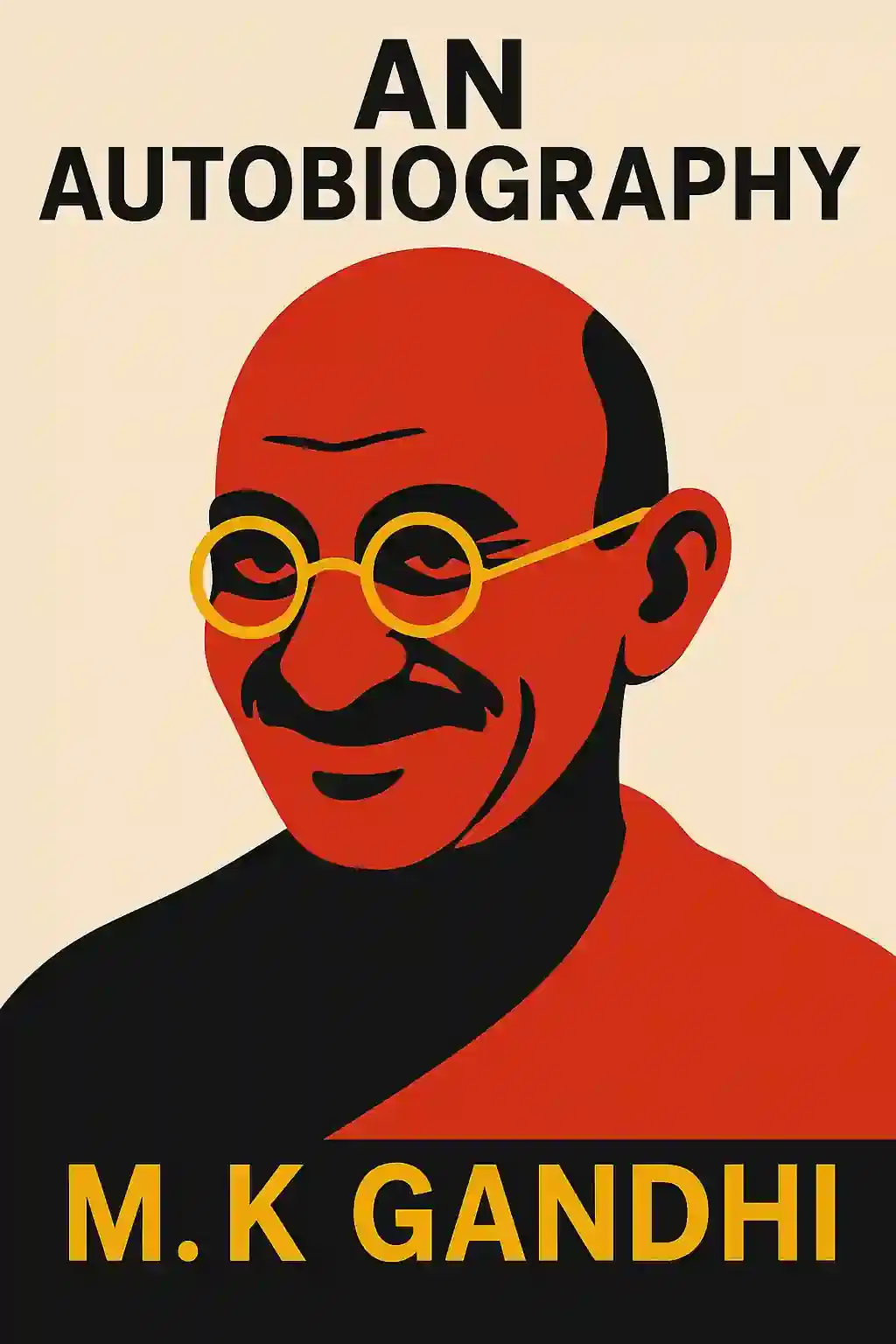
In 1869, a child was born in Porbandar who would transform not just India, but the very concept of political resistance worldwide. When Oprah Winfrey was asked which book had most influenced her life, she didn't hesitate to name Gandhi's autobiography. Even Martin Luther King Jr. credited this text with solidifying his commitment to nonviolence. Yet "The Story of My Experiments with Truth" isn't merely a political manifesto-it's an intimate spiritual diary that has sold millions of copies and been translated into more than 35 languages. Gandhi himself considered this work not a conventional autobiography but rather a record of how an ordinary man's relentless pursuit of truth can unleash extraordinary power to change the world.
Capítulo 2
From Shy Child to Determined Seeker
Gandhi's journey began in the coastal town of Porbandar, where he was born into a family with political connections but modest means. His father Kaba Gandhi served as Prime Minister in several Kathiawad states despite having no formal education, while his deeply religious mother Putlibai observed even the harshest religious vows without complaint. These parental influences-his father's incorruptibility and his mother's spiritual discipline-would shape Gandhi's character profoundly.
As a child, Gandhi was painfully shy, avoiding company and finding refuge only in books. "I would rush to school on time and run straight home afterward, fearing ridicule," he confesses. This early social anxiety seems almost unbelievable when considering the man who would later address massive crowds and negotiate with world leaders. Yet this shyness never fully disappeared-even in England, he once froze completely during a speech at the Holborn Restaurant, managing only a single sentence.
What distinguished young Gandhi was his unusual moral sensitivity. When a school inspector tested students' spelling and Gandhi misspelled "kettle," his teacher tried prompting him with his boot to copy from another student's slate. Gandhi refused, believing teachers should prevent copying, not encourage it. This commitment to personal integrity appeared alongside two formative influences: the story of Shravana, who carried his blind parents on pilgrimage, and King Harishchandra, who sacrificed everything for truth. "These tales moved me to tears and became living ideals that shaped my character," Gandhi writes.
The young Gandhi's determination to follow his own moral compass became evident when, at thirteen, he was married to Kasturbai. Reading pamphlets on conjugal duties, he developed an intense commitment to marital faithfulness. However, this admirable principle took a troubling form-he attempted to control Kasturbai's movements and restrict her independence. "I believed my wife's faithfulness was my right to enforce," he admits with remarkable candor. Their early marriage was marked by bitter quarrels as Kasturbai resisted these restrictions, taking liberties whenever possible. Only decades later would Gandhi recognize his wife as an equal partner rather than a "bondslave."
Capítulo 3
Wrestling with Temptation and Truth
Gandhi's adolescence brought experiments with rebellion that he would later deeply regret. Influenced by a physically stronger friend who insisted Indians were weak because they didn't eat meat, Gandhi began secretly consuming goat meat. "I couldn't stomach the tough goat meat and suffered nightmares afterward," he recalls. For about a year, he participated in perhaps half a dozen meat feasts, always lying to his vegetarian mother about his lack of appetite at home.
This same friendship nearly led him to infidelity when his friend took him to a brothel. "Divine mercy saved me when I found myself unable to speak or act," Gandhi writes, attributing his escape to providence rather than personal virtue. These experiences taught him the danger of negative influences and the ease with which people absorb vice over virtue.
Perhaps most poignant was his theft of gold from his brother's armlet to clear a debt. The guilt became unbearable, and Gandhi wrote a confession to his bedridden father. "When he read it, tears streamed down his face before he silently tore up the note. Those pearl-drops of love cleansed my heart completely." This experience taught Gandhi that clean confession combined with a promise never to repeat the sin constitutes the purest form of repentance-a principle that would later inform his political philosophy.
The most haunting regret of his youth came when his father was dying. While Gandhi should have been at his bedside, he was instead in his bedroom with his wife, driven by "carnal desire at such a critical hour." When called to his father's side, it was too late. "This shame has remained a blot I could never efface," he confesses, a reminder that even great souls struggle with human weakness.
Capítulo 4
England and the Search for Identity
At nineteen, Gandhi sailed for England to study law, having taken solemn vows to his mother to abstain from wine, women, and meat. His caste-people declared him an outcaste for crossing the ocean, but he remained undeterred. In London, his extreme shyness and vegetarianism initially isolated him. "I subsisted on sweets and fruits I'd brought from India," he recalls, unable to navigate dining room menus to identify meat-free dishes.
Gandhi's attempts to become an "English gentleman" reveal both humor and pathos. He spent extravagantly on fashionable clothes-a nineteen-shilling hat, a ten-pound evening suit, and a gold watch-chain. He even paid for dancing lessons (3), French instruction, and violin lessons (3). "I wasted time daily arranging my tie and hair before mirrors," he admits. Eventually, he recognized the folly of these superficial pursuits, though his dress fastidiousness persisted for years.
More significantly, England deepened Gandhi's religious explorations. Though born Hindu, he had received little formal religious education. In London, he encountered theosophists who introduced him to the Bhagavad Gita through Sir Edwin Arnold's translation. "I felt ashamed to admit I had read it neither in Sanskrit nor Gujarati," he confesses. The Gita would later become his daily companion and the book he valued most for knowledge of Truth.
He also explored Christianity, finding the Sermon on the Mount deeply resonant with the Gita's teachings. However, he couldn't accept that salvation came only through Christianity or that Jesus was God's only incarnate son. "If God had sons, weren't we all His children?" he reasoned. His religious explorations extended to Carlyle's writings on prophets and even atheism, though having "crossed the Sahara of atheism" already, it held no appeal.
Capítulo 5
South Africa and the Birth of Satyagraha
After returning to India as a qualified barrister, Gandhi struggled to establish a practice. When offered work in South Africa for a year, he eagerly accepted the opportunity. This "temporary" assignment would last twenty-one years and transform him from a shy, conventional lawyer into a political leader and spiritual innovator.
In South Africa, Gandhi immediately encountered racial discrimination. On his first journey to Pretoria, he was forcibly removed from a first-class train compartment despite having a valid ticket. Later, a white policeman kicked him off a footpath near President Kruger's home. Rather than responding with anger, Gandhi analyzed these experiences systematically, recognizing them as symptoms of a deeper disease of color prejudice.
The turning point came in 1906 when the Transvaal government proposed legislation requiring all Indians to register and provide fingerprints. Gandhi called a mass meeting where Indians took an oath to resist this law nonviolently, even at the cost of imprisonment or death. Initially calling this approach "passive resistance," Gandhi soon sought a new term that better captured its active, principled nature. Maganlal Gandhi coined "Sadagraha" (truth-firmness), which Gandhi modified to "satyagraha"-insistence on truth.
This philosophy combined uncompromising opposition to unjust laws with respect for opponents as human beings. When Indians were brutally flogged for refusing to register, Gandhi responded not with hatred but by establishing a settlement called Tolstoy Farm where resisters' families could live while breadwinners were imprisoned. "I discovered that the true function of a lawyer was to unite parties divided by hatred," he writes, a principle that guided his twenty-year legal practice.
Gandhi's approach to conflict resolution became evident during a complex legal case between two Muslim merchants. Rather than pursuing litigation that would financially ruin both relatives from the same city, he convinced them to accept arbitration. When his client won, Gandhi persuaded him to accept payment in installments over an extended period rather than bankrupting his opponent. "Both parties rose in public estimation through this resolution," he notes with satisfaction.
Capítulo 6
The Discipline of Self-Purification
Throughout his South African years, Gandhi engaged in rigorous experiments with diet, fasting, and celibacy-practices he considered essential for spiritual development and political effectiveness. "I realized that serving humanity with my whole soul would be impossible while engaged in family life and raising children," he explains. After the Zulu "rebellion" of 1906, he took a lifelong vow of brahmacharya (celibacy) with his wife's consent.
Gandhi's dietary experiments were equally radical. Believing that control of the palate was essential for self-restraint, he adopted increasingly simple diets-eventually settling on raw groundnuts, bananas, dates, lemons, and olive oil. "I discovered that a fruit-and-nut diet required no effort to maintain brahmacharya," he observes, though he acknowledges that such extreme measures aren't necessary for everyone.
These personal disciplines weren't merely private spiritual practices but preparation for public service. During a plague outbreak in Johannesburg, Gandhi personally nursed patients when others feared contagion. When twenty-three Indians contracted pneumonic plague, he and Dr. William Godfrey cared for them through a terrible night of vigil. "The fearless zeal of these young men rejoiced me beyond measure," he recalls, seeing in their service the fruits of spiritual discipline.
Gandhi's commitment to simplicity extended to his professional life. In Johannesburg, he hired European assistants including Miss Schlesin, a seventeen-year-old who became more daughter than stenotypist. She refused to accept more than 10 monthly and insisted on repaying a 40 loan. During the satyagraha campaign, she fearlessly led thousands of Indians when leaders were jailed. "Gokhale, who knew all my coworkers, gave her first place among them," Gandhi notes proudly.
Capítulo 7
Return to India and the Path to Leadership
When Gandhi returned to India in 1915 after twenty-one years abroad, he was already famous for his South African campaigns but still uncertain of his role in India's struggle. His mentor Gopal Krishna Gokhale advised him to spend a year traveling and observing before expressing political opinions. Gandhi established the Satyagraha Ashram in Ahmedabad, where community members took vows of truth, nonviolence, celibacy, control of the palate, non-possession, fearlessness, and removal of untouchability.
The inclusion of untouchables in the Ashram immediately created controversy. When Gandhi accepted Dudabhai, his wife Danibehn, and their daughter Lakshmi, the water-carrier objected to their "polluting" the well, monetary help stopped, and rumors of social boycott spread. "We resolved to move to the untouchables' quarter if necessary," Gandhi writes, demonstrating his willingness to face social ostracism for principle.
Gandhi's first major Indian campaign came unexpectedly in Champaran, Bihar, where indigo planters forced tenants under the tinkathia system to grow indigo on three kathas of every twenty. Rajkumar Shukla, a determined peasant who had suffered under this system, convinced Gandhi to investigate. Despite being ordered to leave the district, Gandhi refused, stating in court: "I could not do so without doing violence to my sense of duty to those for whom I have come." The authorities backed down, and Gandhi's systematic investigation led to reforms that ended a century of planter exploitation.
This victory was followed by labor disputes in Ahmedabad and revenue conflicts in Kheda district. In each case, Gandhi applied satyagraha principles-thorough investigation, negotiation where possible, and nonviolent resistance when necessary. During the Ahmedabad mill workers' strike, when the laborers' courage began flagging, Gandhi announced a personal fast: "Unless the strikers rally and continue until settlement or leave the mills altogether, I will not touch any food." After three days, the mill-owners agreed to arbitration.
Capítulo 8
The Birth of Khadi and Economic Self-Reliance
Alongside his political campaigns, Gandhi developed comprehensive economic programs to address India's endemic poverty. In 1908, while writing "Hind Swaraj" during his time in South Africa, he had theoretically identified handlooms and spinning wheels as the solution to India's poverty, though he had never personally seen either in operation. Upon returning to India in 1915, he began an extensive search for spinning wheels, which had largely disappeared from Indian villages during the British era of machine-made textiles.
After months of searching throughout Gujarat, his dedicated associate Gangabehn finally discovered spinning wheels in Vijapur, where they had been relegated to dusty attics as obsolete relics of a bygone era. The local residents, mostly women who remembered the craft from their mothers and grandmothers, expressed willingness to resume spinning if provided with regular supplies of cotton and guaranteed purchases of their yarn. This discovery proved pivotal in Gandhi's economic vision.
Gandhi's early experiments with spinning and weaving faced numerous technical challenges. The wheels needed repairs, the techniques had to be relearned, and the quality of early yarn was inconsistent. Nevertheless, he persisted, personally learning to spin and spending hours each day at the wheel. He believed that handspun cloth (khadi) could provide meaningful employment for millions of semi-starved, semi-employed women of India, particularly during agricultural off-seasons when many rural households had no income.
When mill-owners and industrialists criticized this approach as backward-looking and economically regressive, Gandhi articulated a nuanced position. He explained that his goal was additional cloth production to supplement, not compete with, power machinery. "Any addition to cloth production, however small, represents solid gain," he insisted, pointing out that India's textile needs far exceeded existing production capacity. The khadi movement evolved beyond mere cloth production to become central to Gandhi's vision of economic self-reliance (swadeshi). It created direct economic links between urban Indians who bought khadi and rural producers who made it, reducing dependence on British imports while fostering national solidarity.
The movement also introduced innovative economic models, including the establishment of khadi centers that provided raw materials, training, and guaranteed purchase agreements. These centers became hubs of economic activity in rural areas, empowering women financially and creating sustainable local economies. By 1930, khadi production had become a significant cottage industry, employing hundreds of thousands and symbolizing India's quest for economic independence.
Capítulo 9
Non-Cooperation and the Path to Independence
The final phase of Gandhi's autobiography covers the events of 1919-1921, when he emerged as India's preeminent political leader. The Jallianwala Bagh massacre, where British troops fired on unarmed civilians in Amritsar, convinced Gandhi that cooperation with British rule was impossible. Simultaneously, Indian Muslims were outraged by British policies toward the Ottoman Caliphate (Khilafat) after World War I.
Gandhi united these grievances into a comprehensive non-cooperation movement, persuading the Indian National Congress to adopt this approach despite opposition from established leaders. "The non-cooperation resolution passed after exhaustive discussion," he recalls, noting that approximately 14,000 delegates gathered at Nagpur to confirm this revolutionary strategy.
The movement called for Indians to boycott British educational institutions, courts, titles, and cloth while establishing parallel national institutions. Gandhi described non-cooperation as "the withholding of cooperation with an unjust government." This concept, initially lost in the proceedings of a Delhi conference, would later gain tremendous currency and become the foundation of India's independence struggle.
Gandhi concludes his narrative in 1921, as the non-cooperation movement was gathering momentum. He explains this abrupt ending: "My life since 1921 has been so public and intertwined with Congress leaders that continuing this narrative would necessitate discussing those relationships. With many veteran leaders still active today, propriety demands I stop here."
Capítulo 10
The Unfinished Experiment
Gandhi's autobiography ends not with triumph but with continued seeking. "My glimpses of Truth are but faint glimmers of an effulgence a million times more intense than the sun," he writes. Despite decades of spiritual discipline and political struggle, he acknowledges that perfect vision of Truth follows only from complete realization of Ahimsa (nonviolence), which he has not yet achieved.
This humility distinguishes Gandhi's spiritual journey. Unlike many religious leaders who claim special revelation or divine authority, Gandhi presents himself as an ordinary seeker conducting experiments with truth-experiments that anyone can replicate. "I make no claims of perfection or finality in these experiments," he insists. "Like a scientist, I remain open-minded while acting on my current understanding."
The autobiography reveals a man of contradictions: physically weak yet morally strong; politically shrewd yet spiritually innocent; traditionally Hindu yet radically innovative. What unifies these contradictions is Gandhi's relentless honesty about his own failings. He confesses his youthful theft, his sexual temptations, his misguided attempts to control his wife, and his "Himalayan miscalculation" in calling for premature civil disobedience.
This transparency about personal weakness gives his spiritual and political insights remarkable credibility. When he writes that "perfect vision of Truth follows only from complete realization of Ahimsa," we understand this not as abstract philosophy but as the hard-won wisdom of a man who has tested these principles in both personal and political arenas.
Gandhi's final words reveal both achievement and aspiration: "I ask readers to join me in praying that the God of Truth grants me Ahimsa in mind, word and deed." Even after transforming India's political landscape and inspiring movements worldwide, Gandhi remained a seeker-convinced that the greatest revolution is not political but spiritual, not external but internal, not imposed but freely chosen.
In our age of political polarization and moral certainty, Gandhi's experimental approach to truth offers a refreshing alternative. Rather than claiming to possess truth, he sought it through constant experimentation, self-criticism, and openness to change. His autobiography invites us not to follow him blindly but to conduct our own experiments with truth-to discover for ourselves that nonviolence is not merely a political strategy but a pathway to self-realization and social transformation.
Capítulo 11
The Power of Principled Nonviolence
Gandhi's experiments with nonviolence transformed not just his personal life but the entire landscape of political resistance. What began as a philosophical conviction became a practical methodology for challenging injustice without perpetuating cycles of violence. "I discovered that nonviolence is not the weapon of the weak but of the spiritually strong," he writes, contradicting the common assumption that nonviolent resistance is merely passive submission.
The effectiveness of this approach became evident during the Champaran campaign. When ordered to leave the district, Gandhi respectfully refused and accepted the consequences, stating in court: "I am disobeying the order not from disrespect for authority but in obedience to the higher law of our being, the voice of conscience." This principled defiance, combined with his willingness to face punishment, created what he called "a curious rapport" with officials who recognized his civil resistance wasn't personal.
Gandhi's nonviolence extended beyond tactics to a genuine concern for opponents' welfare. During the Ahmedabad mill strike, he insisted workers not harass replacement laborers. When the Asiatic Department officials who had oppressed Indians were later dismissed, Gandhi helped them secure municipal employment. "This attitude put officials at ease despite my often confrontational stance," he explains, recognizing that political opponents remain human beings deserving of dignity.
This approach required extraordinary discipline from followers. During the Kheda campaign, when peasants' resolve began wavering under government pressure, Gandhi strengthened them through his own example and clear communication of principles. He taught that satyagraha combines fearlessness with civility-a paradoxical stance that disarms opponents by refusing both submission and aggression.
The power of this methodology became increasingly evident as Gandhi's experiments progressed from local grievances to national campaigns. By the time he launched the non-cooperation movement in 1920, he had developed a comprehensive approach to nonviolent resistance that included constructive programs (like khadi production), economic boycotts, and civil disobedience-all grounded in strict adherence to truth and nonviolence.
What distinguishes Gandhi's approach from mere political strategy is its spiritual foundation. "To see Truth face-to-face requires loving the meanest creation as oneself," he writes, explaining why his devotion to Truth drew him into politics. For Gandhi, nonviolence wasn't merely the absence of physical harm but an active force rooted in love-what he called "soul-force" or satyagraha. This connection between spiritual discipline and political action remains his most revolutionary contribution to modern thought.
Capítulo 12
The Continuing Relevance of Gandhi's Truth
As we confront today's challenges-climate change, economic inequality, political polarization, and persistent violence-Gandhi's experiments with truth offer valuable guidance. His insistence that means and ends are inseparable challenges the common assumption that noble goals justify questionable methods. His economic vision of simplicity and self-reliance provides an alternative to both unchecked capitalism and centralized control. His commitment to religious pluralism offers a path beyond sectarian conflict.
Most importantly, Gandhi's autobiography demonstrates that personal transformation and social change are interconnected. "As human beings, our greatness lies not so much in being able to remake the world as in being able to remake ourselves," he once said. This insight-that outer revolution must be grounded in inner evolution-remains his most profound contribution to humanity's ongoing experiments with truth.
Gandhi's unfinished journey reminds us that truth is not a destination but a path-one that requires constant vigilance, humility, and openness to growth. "I have not seen God but I have made Truth my God," he writes. In a world increasingly dominated by absolutist claims and algorithmic certainties, his experimental approach to truth offers a more humble yet ultimately more transformative alternative-one that invites each of us to become scientists of the spirit, conducting our own experiments with truth.
<<ASSISTANT_CONVERSATION_END>>