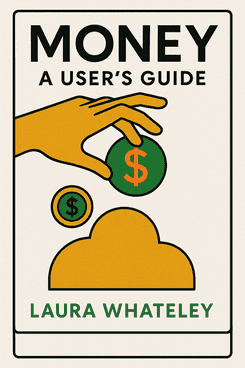
Money: A Users Guide by Laura Whateley Summary

Overview of Money
Laura Whateley's bestseller demystifies personal finance without patronizing you. Praised by The Times for making money talk accessible, this British sensation tackles taboo financial topics that schools don't teach. Dip in as needed - your relationship with money will never be the same.
- Laura Whateley's 50-30-20 budget simplifies spending: 50% needs, 30% wants, 20% savings.
- Manage money mindset by tracking daily financial decisions to uncover hidden biases.
- Financial freedom means life choices unconstrained by money anxiety or debt limits.
- Relationships thrive with open money talks about cohabitation costs and shared goals.
- Build credit history strategically to secure mortgages and avoid loan rejections.
- Start pensions early: compound interest outperforms last-minute retirement savings scrambles.
- Psychological triggers like sales anchoring distort spending—plan purchases mindfully.
- Millennials should prioritize emergency cash over risky short-term stock investments.
- Ethical fund investing balances returns with personal values in wealth building.
- Mental health impacts money habits: create safety nets for bipolar spending cycles.
- Rent-versus-buy calculations must include hidden ownership costs beyond mortgage payments.
- Negotiate freelance income streams using industry rate cards and contract templates.
About the Author of Money
Laura Whateley is the acclaimed author of Money: A User’s Guide, a Sunday Times bestselling personal finance handbook that empowers millennials and Gen-Z audiences.
An award-winning journalist and former Times consumer champion, Whateley built her expertise through a decade of reporting on money, housing, and consumer rights, including her influential Millennial Money column. With a PPE degree from the University of Warwick, she combines analytical rigor with relatable advice, addressing post-2008 financial challenges like housing affordability, debt management, and recession-proof budgeting.
Beyond her book—updated in 2021 to reflect pandemic-era shifts—Whateley contributes to Grazia’s Life Admin column and speaks widely on financial literacy for women and young professionals. Her work has been featured in The Guardian, Good Housekeeping, and financial podcasts like The Wallet, where she discusses topics from social media spending to generational wealth gaps. Money: A User’s Guide remains a trusted resource, lauded for transforming complex finance concepts into actionable strategies for modern readers.
FAQs About Money
What is Money: A User's Guide by Laura Whateley about?
Money: A User's Guide is a practical guide to personal finance that simplifies complex topics like budgeting, mortgages, pensions, and ethical investing. Laura Whateley, an award-winning journalist, combines actionable advice with relatable anecdotes, targeting millennials navigating post-recession financial challenges. The book emphasizes building credit scores, reducing debt, and addressing money-related stress, making it a toolkit for financial confidence.
Who should read Money: A User's Guide?
This book is ideal for young adults, renters, first-time buyers, or anyone overwhelmed by financial jargon. It’s particularly relevant to UK readers (with a US edition available) seeking step-by-step guidance on student loans, pensions, and everyday money management. Beginners or those rebuilding finances post-pandemic will find its approachable tone helpful.
Is Money: A User's Guide worth reading?
Yes, for financial novices or those needing a refresher. Readers praise its clarity on credit scores, debt payoff strategies, and investment basics. However, seasoned investors may find it too introductory. The book’s strength lies in demystifying topics like mortgages and pensions, with annotated copies cited as go-to resources.
How does Money: A User's Guide tackle student loans and debt?
Whateley provides actionable steps to manage student debt, including repayment prioritization and negotiating with lenders. She advocates for budgeting tools to avoid overdrafts and consolidating high-interest loans. Real-life examples illustrate balancing debt reduction with saving for emergencies, emphasizing long-term stability over short-term fixes.
What are the key takeaways on ethical investing in Money: A User's Guide?
The book introduces ethical investment options like ESG funds and green bonds, explaining how to align portfolios with personal values. Whateley breaks down risk levels, diversification, and platforms for beginners, stressing that even small contributions can yield impact. She cautions against “greenwashing” and advises researching fund prospectuses.
How does Laura Whateley address money and mental health?
A dedicated chapter links financial stress to mental well-being, offering strategies to avoid overspending during low moods and negotiating payment plans with creditors. Whateley encourages open conversations about money in relationships and workplaces, reducing stigma. Tips include automating savings to ease anxiety and seeking free debt counseling.
How does Money: A User's Guide compare to The Barefoot Investor?
While both simplify personal finance, Whateley’s guide is more UK-focused, with specifics on ISAs and British pension systems. The Barefoot Investor uses an Australian-centric “bucket” system, whereas Whateley emphasizes adaptability for renters and gig workers. Both prioritize emergency funds, but A User’s Guide delves deeper into mental health ties.
What practical tools does Money: A User's Guide offer?
The book includes templates for budget trackers, bill-negotiation scripts, and checklists for mortgage applications. Whateley explains how to dispute credit report errors, compare insurance policies, and calculate retirement savings gaps. A standout tool is her “financial fire drill” exercise to prepare for income shocks.
What critiques exist about Money: A User's Guide?
Some reviewers note the advice leans basic, lacking depth on advanced investing or tax optimization. Others highlight the UK-centric examples, though the US edition adapts content. Critics argue it could better address high-income earners or freelancers, but most praise its accessibility for those starting their financial journey.
Why is Money: A User's Guide relevant in 2025?
Post-pandemic, the book’s focus on emergency savings, remote work budgets, and gig economy finances remains vital. Updated editions address rising interest rates and cryptocurrency risks, while core principles—like building credit resilience—apply to economic uncertainty. Whateley’s advocacy for open money conversations aligns with growing mental health awareness.
What quotes or frameworks define Money: A User's Guide?
Key quotes include:
- “Your pension is your future self’s paycheck—stop ignoring it.”
- “A credit score isn’t a report card; it’s a tool to hack the system.”
Frameworks like the “50-30-20 budget rule” and the “debt snowball method” are simplified with relatable examples, such as balancing rent with side hustles.
Are there updates to Money: A User's Guide since its first edition?
Yes, later editions include post-Brexit financial changes, updated ISA allowances, and crypto guidance. The US edition adapts tax tips and 401(k) comparisons. Digital tools like budgeting apps and open banking APIs are also covered, reflecting 2025’s tech-driven finance landscape.
Feel the book through the author's voice
Turn knowledge into engaging, example-rich insights
Capture key ideas in a flash for fast learning
Enjoy the book in a fun and engaging way
Key Themes in Money
Quotes from Money
Debt has been cleverly rebranded as "credit."
Ignoring financial problems won't make them disappear.
Payday loans should be avoided at all costs.
Without a budget, we're psychologically programmed to make terrible financial decisions.
The housing crisis has fundamentally shaped millennial finances.
Characters in Money
Quick Summary Mode - Read or listen to Money Summary in 10 Minutes

Break down key ideas from Money into bite-sized takeaways to understand how innovative teams create, collaborate, and grow.

Flash Card Mode - Top 7 Insights from Money in a Nutshell

Distill Money into rapid-fire memory cues that highlight key principles of candor, teamwork, and creative resilience.

Fun Mode - Money Lessons Told Through 24-Min Stories

Experience Money through vivid storytelling that turns innovation lessons into moments you'll remember and apply.
Personalize Mode - Read or listen to Money Summary in 0 Minutes

Ask anything, pick the voice, and co-create insights that truly resonate with you.

From Columbia University alumni built in San Francisco
"Instead of endless scrolling, I just hit play on BeFreed. It saves me so much time."


"I never knew where to start with nonfiction—BeFreed’s book lists turned into podcasts gave me a clear path."


"Perfect balance between learning and entertainment. Finished ‘Thinking, Fast and Slow’ on my commute this week."
"Crazy how much I learned while walking the dog. BeFreed = small habits → big gains."
"Reading used to feel like a chore. Now it’s just part of my lifestyle."

"Feels effortless compared to reading. I’ve finished 6 books this month already."
"BeFreed turned my guilty doomscrolling into something that feels productive and inspiring."

"BeFreed turned my commute into learning time. 20-min podcasts are perfect for finishing books I never had time for."
"BeFreed replaced my podcast queue. Imagine Spotify for books — that’s it. 🙌"

"It is great for me to learn something from the book without reading it."
"The themed book list podcasts help me connect ideas across authors—like a guided audio journey."
"Makes me feel smarter every time before going to work"
From Columbia University alumni built in San Francisco
"Instead of endless scrolling, I just hit play on BeFreed. It saves me so much time."
"I never knew where to start with nonfiction—BeFreed’s book lists turned into podcasts gave me a clear path."
"Perfect balance between learning and entertainment. Finished ‘Thinking, Fast and Slow’ on my commute this week."
"Crazy how much I learned while walking the dog. BeFreed = small habits → big gains."
"Reading used to feel like a chore. Now it’s just part of my lifestyle."
"Feels effortless compared to reading. I’ve finished 6 books this month already."
"BeFreed turned my guilty doomscrolling into something that feels productive and inspiring."
"BeFreed turned my commute into learning time. 20-min podcasts are perfect for finishing books I never had time for."
"BeFreed replaced my podcast queue. Imagine Spotify for books — that’s it. 🙌"
"It is great for me to learn something from the book without reading it."
"The themed book list podcasts help me connect ideas across authors—like a guided audio journey."
"Makes me feel smarter every time before going to work"
"Instead of endless scrolling, I just hit play on BeFreed. It saves me so much time."
"I never knew where to start with nonfiction—BeFreed’s book lists turned into podcasts gave me a clear path."
"Perfect balance between learning and entertainment. Finished ‘Thinking, Fast and Slow’ on my commute this week."
"Crazy how much I learned while walking the dog. BeFreed = small habits → big gains."
"Reading used to feel like a chore. Now it’s just part of my lifestyle."
"Feels effortless compared to reading. I’ve finished 6 books this month already."
"BeFreed turned my guilty doomscrolling into something that feels productive and inspiring."
"BeFreed turned my commute into learning time. 20-min podcasts are perfect for finishing books I never had time for."
"BeFreed replaced my podcast queue. Imagine Spotify for books — that’s it. 🙌"
"It is great for me to learn something from the book without reading it."
"The themed book list podcasts help me connect ideas across authors—like a guided audio journey."
"Makes me feel smarter every time before going to work"
"Instead of endless scrolling, I just hit play on BeFreed. It saves me so much time."
"I never knew where to start with nonfiction—BeFreed’s book lists turned into podcasts gave me a clear path."
"Perfect balance between learning and entertainment. Finished ‘Thinking, Fast and Slow’ on my commute this week."
"Crazy how much I learned while walking the dog. BeFreed = small habits → big gains."
"Reading used to feel like a chore. Now it’s just part of my lifestyle."
"Feels effortless compared to reading. I’ve finished 6 books this month already."
"BeFreed turned my guilty doomscrolling into something that feels productive and inspiring."
"BeFreed turned my commute into learning time. 20-min podcasts are perfect for finishing books I never had time for."
"BeFreed replaced my podcast queue. Imagine Spotify for books — that’s it. 🙌"
"It is great for me to learn something from the book without reading it."
"The themed book list podcasts help me connect ideas across authors—like a guided audio journey."
"Makes me feel smarter every time before going to work"

Get the Money summary as a free PDF or EPUB. Print it or read offline anytime.