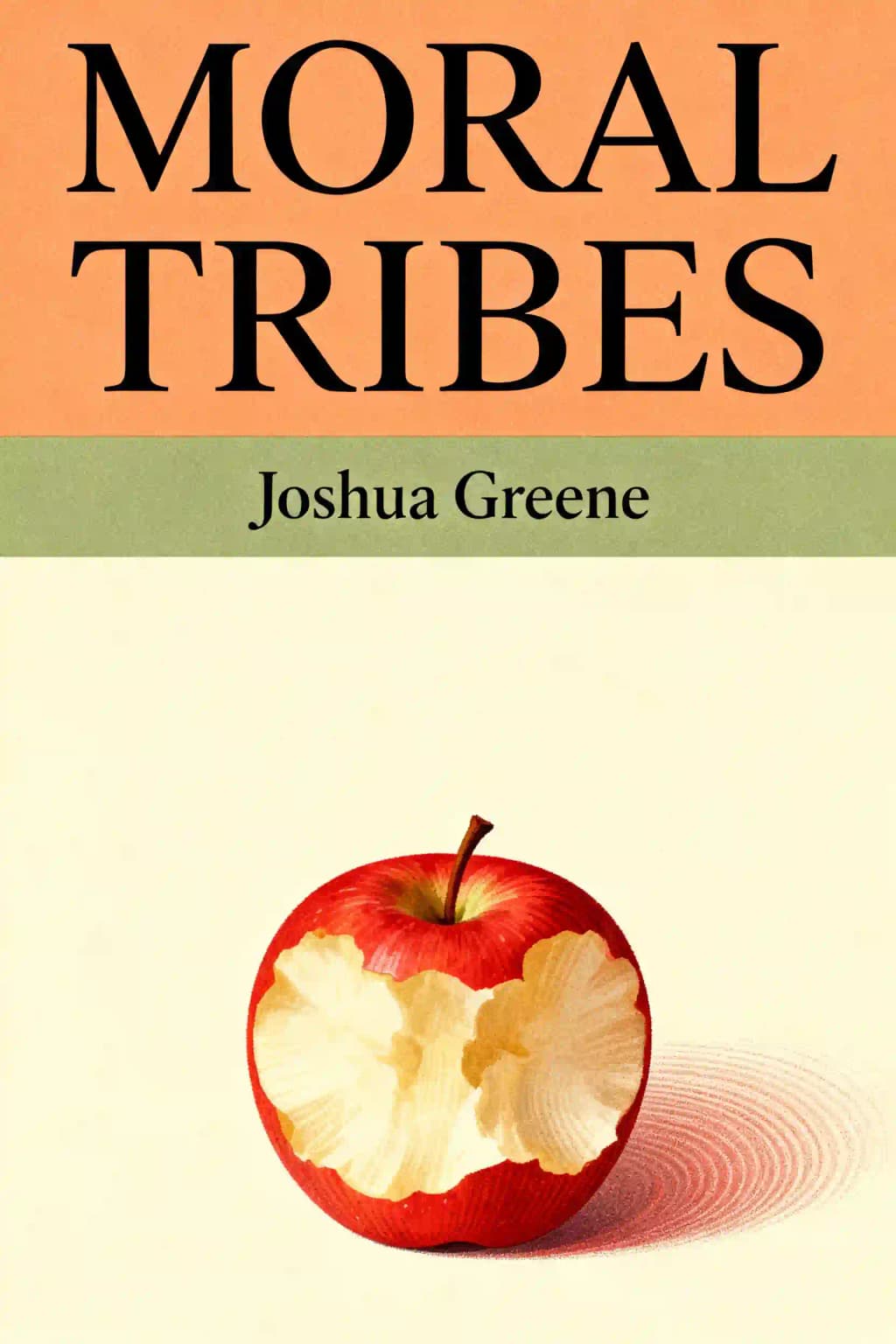
Moral Tribes: Emotion, Reason, and the Battle Between Us and Them book cover

Moral Tribes

Emotion, Reason, and the Battle Between Us and Them

Joshua Greene

Overview of Moral Tribes

In "Moral Tribes," Joshua Greene reveals why our evolved moral instincts fail in today's global conflicts. Blending neuroscience with philosophy, he offers a revolutionary "deep pragmatism" that transcends tribal thinking. Can reason truly bridge what evolution has divided?

Key Themes in Moral Tribes

  • tribal cooperation
  • dual-process morality
  • utilitarian reasoning
  • moral intuition
  • intergroup conflict

Quotes from Moral Tribes

  • Liberals prioritize care and fairness defined as equality.

  • Conservatives emphasize loyalty, authority, and sanctity.

  • Our moral brains evolved primarily for tribal competition, not global cooperation.

  • Each side believes their moral intuitions reflect objective truth rather than tribal adaptations.

Characters in Moral Tribes

  • Joshua GreeneAuthor, neuroscientist, and moral philosopher
  • Peter SingerPhilosopher who cites the book as transformative

About the Author

About the Author of Moral Tribes

Joshua David Greene is a Harvard psychologist, neuroscientist, and philosopher whose groundbreaking work Moral Tribes: Emotion, Reason, and the Gap Between Us and Them explores the neuroscience of ethical decision-making. A specialist in moral judgment and conflict resolution, Greene earned his Ph.D. in philosophy from Princeton University under influential thinkers David Lewis and Gilbert Harman.

His research on the interplay of emotion and reason in moral dilemmas has shaped modern debates in cognitive science, earning him the Stanton Prize from the Society for Philosophy and Psychology.

Greene’s expertise extends beyond academia—his frameworks for alleviating intergroup conflict inform strategies in policymaking and social psychology. As a professor at Harvard’s Department of Psychology and Center for Brain Science, he has been honored with the Roslyn Abramson Award for teaching excellence and repeatedly voted a “Favorite Professor” by graduating classes.

Moral Tribes, praised for bridging evolutionary psychology and practical ethics, won acclaim as a New York Times Editor’s Choice and is taught in university courses worldwide. The book has been translated into 12 languages, solidifying Greene’s role as a leading voice in understanding humanity’s most divisive moral challenges.

Download Summary of Moral Tribes

Get the Moral Tribes summary as a free PDF or EPUB. Print it or read offline anytime.

FAQs About This Book

Moral Tribes explores why humans clash over moral issues and proposes utilitarianism as a framework for resolving conflicts. Joshua Greene combines neuroscience, philosophy, and evolutionary psychology to argue that tribal instincts once aided survival but now hinder global cooperation. The book introduces the "tragedy of common sense morality" and advocates for deliberate reasoning over emotional instincts in modern dilemmas.

This book is ideal for readers interested in ethics, decision-making, or social psychology. It appeals to those seeking insights into polarized debates (e.g., climate change, abortion) and anyone curious about how neuroscience shapes moral judgments. Greene’s blend of academic rigor and accessible storytelling makes it suitable for both scholars and general audiences.

This concept describes how evolved tribal instincts—effective for small-group cohesion—fail in a globally interconnected world. Greene argues that differing moral "settings" (e.g., fairness, loyalty) create conflict when tribes with competing values interact. For example, political disputes often stem from clashing intuitive priorities rather than rational disagreements.

Greene posits that moral decisions rely on two systems: fast, emotional intuitions ("automatic mode") and slow, reasoned analysis ("manual mode"). Tribal biases, like favoring in-group members, originate from automatic instincts shaped by evolution. Manual mode, exemplified by utilitarian reasoning, helps override these biases in complex modern scenarios.

Greene advocates for utilitarianism—maximizing overall well-being—as a "common currency" for resolving disputes. This approach prioritizes consequences over rigid rules, aiming to balance competing values impartially. For instance, he applies utilitarian logic to debates like abortion, weighing fetal viability against bodily autonomy.

The book frames climate change as a "tragedy of the commons," where individual interests conflict with collective survival. Greene suggests utilitarian policies (e.g., carbon taxes) to align incentives, emphasizing cooperative solutions over tribal blame.

Critics argue Greene oversimplifies moral diversity and overstates utilitarianism’s universal appeal. Some contend his focus on neuroscience neglects cultural and historical factors shaping ethics. Others question whether calculated reasoning can consistently override deep-seated tribal instincts.

Both books explore dual-process cognition, but Greene applies this framework to moral decision-making. While Kahneman focuses on cognitive biases, Greene examines how these biases fuel tribal conflicts and proposes utilitarianism as a corrective.

Greene compares the brain to a camera with "automatic" (emotional) and "manual" (rational) modes. He also uses tribal parables to illustrate how evolved morality succeeds locally but fails globally. These analogies simplify complex ideas for non-academic readers.

The book remains pertinent amid rising political polarization and global crises like misinformation. Greene’s emphasis on evidence-based reasoning and cooperative frameworks offers tools to navigate divisive issues, from AI ethics to climate policy.

He argues that fetal moral status depends on developmental stages, not binary distinctions. Early-term abortions may maximize well-being by respecting bodily autonomy, while late-term procedures require stricter scrutiny. This approach aims to balance competing rights through consequence-based analysis.

  1. Tribal instincts hinder global cooperation: Evolved biases prioritize "Us vs. Them".
  2. Switch to "manual mode": Solve modern problems with deliberate, utilitarian reasoning.
  3. Seek common currency: Policies promoting overall well-being can bridge moral divides.

Explore Your Way of Learning

Moral Tribes isn't just a book — it's a masterclass in Psychology. To help you absorb its lessons in the way that works best for you, we offer five unique learning modes. Whether you're a deep thinker, a fast learner, or a story lover, there's a mode designed to fit your style.

Quick Summary Mode

Read or listen to Moral Tribes Summary in 9 Minutes

Break down key ideas from Moral Tribes into bite-sized takeaways to understand how innovative teams create, collaborate, and grow.

play
00:00
00:00

Fun Mode

Moral Tribes Lessons Told Through 19-Min Stories

Experience Moral Tribes through vivid storytelling that turns innovation lessons into moments you'll remember and apply.

play
00:00
00:00

Personalize Mode

Experience Moral Tribes in your own learning style

Ask anything, choose your learning style, and co-create insights that truly resonate with you.

Personalize Mode

From Columbia University alumni built in San Francisco

BeFreed Brings Together A Global Community Of 1,000,000 Curious Minds

"Instead of endless scrolling, I just hit play on BeFreed. It saves me so much time."

@Moemenn
platform
star
star
star
star
star

"I never knew where to start with nonfiction—BeFreed’s book lists turned into podcasts gave me a clear path."

@Chloe, Solo founder, LA
platform
comments
12
likes
117

"Perfect balance between learning and entertainment. Finished ‘Thinking, Fast and Slow’ on my commute this week."

@Raaaaaachelw
platform
star
star
star
star
star

"Crazy how much I learned while walking the dog. BeFreed = small habits → big gains."

@Matt, YC alum
platform
comments
12
likes
108

"Reading used to feel like a chore. Now it’s just part of my lifestyle."

@Erin, Investment Banking Associate , NYC
platform
comments
254
likes
17

"Feels effortless compared to reading. I’ve finished 6 books this month already."

@djmikemoore
platform
star
star
star
star
star

"BeFreed turned my guilty doomscrolling into something that feels productive and inspiring."

@Pitiful
platform
comments
96
likes
4.5K

"BeFreed turned my commute into learning time. 20-min podcasts are perfect for finishing books I never had time for."

@SofiaP
platform
star
star
star
star
star

"BeFreed replaced my podcast queue. Imagine Spotify for books — that’s it. 🙌"

@Jaded_Falcon
platform
comments
201
thumbsUp
16

"It is great for me to learn something from the book without reading it."

@OojasSalunke
platform
star
star
star
star
star

"The themed book list podcasts help me connect ideas across authors—like a guided audio journey."

@Leo, Law Student, UPenn
platform
comments
37
likes
483

"Makes me feel smarter every time before going to work"

@Cashflowbubu
platform
star
star
star
star
star

"Instead of endless scrolling, I just hit play on BeFreed. It saves me so much time."

@Moemenn
platform
star
star
star
star
star

"I never knew where to start with nonfiction—BeFreed’s book lists turned into podcasts gave me a clear path."

@Chloe, Solo founder, LA
platform
comments
12
likes
117

"Perfect balance between learning and entertainment. Finished ‘Thinking, Fast and Slow’ on my commute this week."

@Raaaaaachelw
platform
star
star
star
star
star

"Crazy how much I learned while walking the dog. BeFreed = small habits → big gains."

@Matt, YC alum
platform
comments
12
likes
108

"Reading used to feel like a chore. Now it’s just part of my lifestyle."

@Erin, Investment Banking Associate , NYC
platform
comments
254
likes
17

"Feels effortless compared to reading. I’ve finished 6 books this month already."

@djmikemoore
platform
star
star
star
star
star

"BeFreed turned my guilty doomscrolling into something that feels productive and inspiring."

@Pitiful
platform
comments
96
likes
4.5K

"BeFreed turned my commute into learning time. 20-min podcasts are perfect for finishing books I never had time for."

@SofiaP
platform
star
star
star
star
star

"BeFreed replaced my podcast queue. Imagine Spotify for books — that’s it. 🙌"

@Jaded_Falcon
platform
comments
201
thumbsUp
16

"It is great for me to learn something from the book without reading it."

@OojasSalunke
platform
star
star
star
star
star

"The themed book list podcasts help me connect ideas across authors—like a guided audio journey."

@Leo, Law Student, UPenn
platform
comments
37
likes
483

"Makes me feel smarter every time before going to work"

@Cashflowbubu
platform
star
star
star
star
star

"Instead of endless scrolling, I just hit play on BeFreed. It saves me so much time."

@Moemenn
platform
star
star
star
star
star

"I never knew where to start with nonfiction—BeFreed’s book lists turned into podcasts gave me a clear path."

@Chloe, Solo founder, LA
platform
comments
12
likes
117

"Perfect balance between learning and entertainment. Finished ‘Thinking, Fast and Slow’ on my commute this week."

@Raaaaaachelw
platform
star
star
star
star
star

"Crazy how much I learned while walking the dog. BeFreed = small habits → big gains."

@Matt, YC alum
platform
comments
12
likes
108

"Reading used to feel like a chore. Now it’s just part of my lifestyle."

@Erin, Investment Banking Associate , NYC
platform
comments
254
likes
17

"Feels effortless compared to reading. I’ve finished 6 books this month already."

@djmikemoore
platform
star
star
star
star
star

"BeFreed turned my guilty doomscrolling into something that feels productive and inspiring."

@Pitiful
platform
comments
96
likes
4.5K

"BeFreed turned my commute into learning time. 20-min podcasts are perfect for finishing books I never had time for."

@SofiaP
platform
star
star
star
star
star

"BeFreed replaced my podcast queue. Imagine Spotify for books — that’s it. 🙌"

@Jaded_Falcon
platform
comments
201
thumbsUp
16

"It is great for me to learn something from the book without reading it."

@OojasSalunke
platform
star
star
star
star
star

"The themed book list podcasts help me connect ideas across authors—like a guided audio journey."

@Leo, Law Student, UPenn
platform
comments
37
likes
483

"Makes me feel smarter every time before going to work"

@Cashflowbubu
platform
star
star
star
star
star

See More Stories?

How people are talking about BeFreed across the web
1.5K Ratings4.7
Start your learning journey, now