Capítulo 1
The Digital Trap That's Stealing Your Focus and Productivity
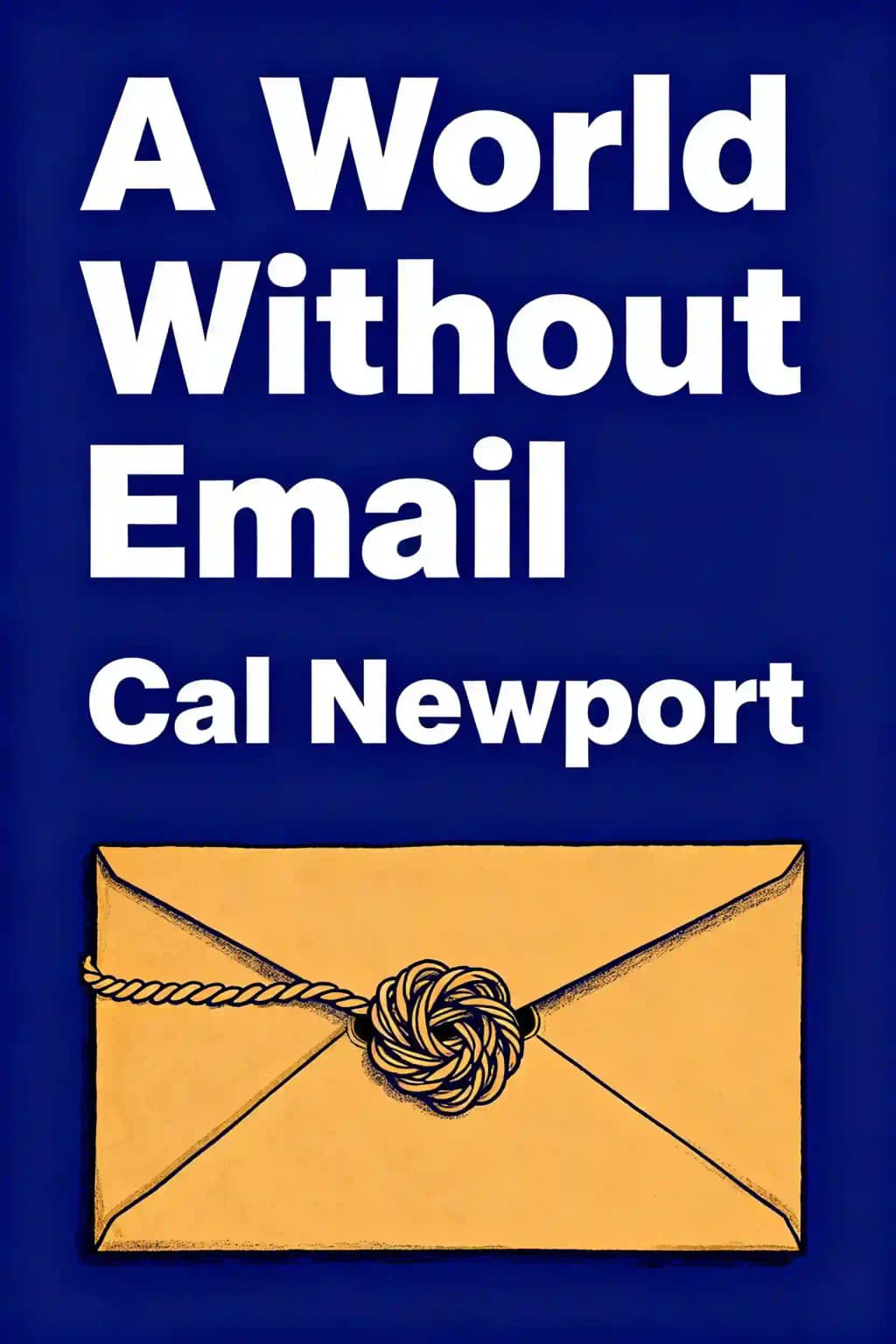
Ever wondered why you feel so exhausted after a day of "just checking emails"? Cal Newport's groundbreaking book exposes the hidden crisis of modern work: the hyperactive hive mind workflow that's destroying our ability to think clearly and work effectively. This isn't just another productivity guide-it's a radical rethinking of how we organize knowledge work. The book has sparked a movement among tech executives and entrepreneurs, with figures like Twitter co-founder Jack Dorsey implementing "no-email Fridays" and Microsoft CEO Satya Nadella citing Newport's research in company-wide digital wellness initiatives. As the Wall Street Journal noted, this book "arrives at precisely the moment when many of us have reached our breaking point with technological overload."
Capítulo 2
The Hyperactive Hive Mind: Our Modern Work Crisis
When Obama's director of innovation and entrepreneurship Nish Acharya experienced what he called "Dark Tuesday"-a six-week network shutdown that eliminated email access-something unexpected happened. Initially, the situation seemed "hellish" for logistics and coordination. But Acharya soon discovered his work actually improved. Without constant email distractions, he held longer, more meaningful in-person meetings and found precious "whitespace" for deeper thinking that yielded breakthrough ideas.
This experience raises a provocative question: What if email didn't save knowledge work but instead traded minor conveniences for a major drag on productivity?
The average worker now sends and receives 126 business emails daily-one every four minutes. Studies show people check communication tools every six minutes on average, with some checking inboxes over 400 times daily. Knowledge workers self-report spending more than three hours daily on email. This has created what Newport calls "the hyperactive hive mind"-a workflow centered around ongoing conversation fueled by unstructured and unscheduled messages delivered through digital communication tools.
This radical shift in work culture has become ubiquitous across the knowledge sector, structuring our days around tending to organizational conversations rather than focused productive work. The hyperactive hive mind isn't obviously a bad idea-it's simple, adaptive, and allows for quick coordination. But as Newport argues, it's spectacularly ineffective due to our psychology.
Constant switching between work and communication about work induces heavy mental costs, reducing cognitive performance and creating exhaustion. Our social brain circuits perceive unread messages as neglected social obligations, generating anxiety. No one decided this workflow was good; it arose of its own volition, making us mistake frenetic communication for actual work.
Capítulo 3
The Cognitive Cost of Constant Connectivity
Gloria Mark's transition from Germany to the United States revealed a stark contrast in work environments. In Germany, she enjoyed deep focus on a few projects with leisurely lunches and walks around a beautiful campus. Upon arriving at UC Irvine, she was struck by how busy everyone seemed, with colleagues eating at their desks and constant fragmentation of attention.
Her famous 2004 study found that knowledge workers shifted attention every three minutes on average. Email was the primary culprit-as it became widespread between 1984 and 2002, desk work increased while scheduled meetings decreased, but this created a shattered rhythm of quick inbox checks throughout the day. Multiple subsequent studies confirmed this trend, with email volume growing from 50 messages daily in 2005 to a projected 126 messages in 2019.
Despite the hyperactive hive mind's apparent efficiency, our brains fundamentally cannot parallel process information. When knowledge workers maintain multiple electronic conversations while working on primary tasks, the prefrontal cortex must constantly switch between different networks, consuming time and cognitive resources. This "network switching" has been studied since at least 1927, when Arthur Jersild documented how alternating between simple tasks like adding and subtracting significantly slowed completion times.
Sophie Leroy's groundbreaking 2009 research identified "attention residue" as a key problem-when we switch tasks without proper closure, the previous task continues occupying mental resources, measurably degrading performance on subsequent work. This helps explain why the hyperactive hive mind workflow leaves us feeling exhausted yet unproductive at day's end.
Many knowledge workers believe their roles require constant responsiveness rather than deep focus. They acknowledge the cognitive costs of attention switching but consider them necessary sacrifices for team coordination. This view creates a false dichotomy between "makers" who need uninterrupted time and "managers" who thrive in interruption.
Yet history offers compelling counterexamples, like George Marshall, who as Army Chief of Staff during World War II rejected hyperactive management. Marshall radically streamlined the War Department's structure, reducing direct reports from sixty to twelve, establishing clear interaction protocols, and religiously leaving work at 5:30 p.m. His success demonstrates that management requires thoughtful concentration, not just responsiveness, and that the hyperactive workflow actually degrades a manager's most valuable contributions: smart decisions and strategic planning.
Capítulo 4
The Psychological Toll of Digital Overload
The hyperactive hive mind workflow doesn't just reduce productivity-it makes us miserable, with consequences for both individual wellbeing and organizational stability.
In 2017, France enacted a "right to disconnect" law requiring companies with fifty or more employees to establish policies limiting after-hours email, primarily to reduce burnout. Research confirms email's negative impact: a 2016 study found heart rate monitors showed higher stress levels during hours with increased email use. Another Swedish study linked constant connectivity with "suboptimal" health outcomes, even after adjusting for confounding factors.
When Harvard researcher Leslie Perlow introduced "predictable time off" from electronic communication at Boston Consulting Group, consultant satisfaction and perceived effectiveness significantly improved. Newport's own survey of 1,500 readers revealed emotionally charged responses to email, with terms like "frustrating," "anxiety," "frazzled," "isolated," "haunted," and "depressed." This widespread misery affects both business outcomes (through burnout and turnover) and human wellbeing, with over 230 million knowledge workers worldwide suffering under this system.
The Mbendjele BaYaka hunter-gatherer tribes demonstrate how our brains evolved to prioritize social connections. Researchers found that tracking one-on-one interactions accurately predicted reproductive success among mothers-those who managed direct interactions effectively thrived, while others struggled. This reveals our hardwired drive to treat socializing with great psychological urgency.
As psychologist Matthew Lieberman explains, our social networks connect to our pain systems, creating intense heartbreak when relationships are disrupted. This evolutionary obsession with social interaction creates corresponding distress when thwarted-just as hunger signals food needs, anxiety signals neglected connections. The hyperactive hive mind workflow constantly triggers this distress through unmanageable message volumes, creating persistent background anxiety regardless of rational understanding about email's true importance.
Beyond the anxiety of unread messages, text-based communication fundamentally frustrates our social instincts. Alex Pentland's research reveals that beyond words, humans rely on unconscious "ancient primate signaling mechanisms" during collaboration. These signals include "influence" (matching speaking patterns) and "activity" (physical movements) that provide fast readings of power dynamics and true intentions. When we shifted to email-based workflows, we crippled these finely tuned social circuits that make us good at working together.
Capítulo 5
How Email Creates More Work Than It Solves
Email dramatically reduces the effort required to ask questions or delegate tasks, leading to a perpetual state of overload. When the friction involved in asking someone to do something was removed, the number of requests spiraled out of control. As Brigid Schulte notes in her book Overwhelmed, many knowledge workers "wake in a panic" about all the things they need to do, worried their lives are getting "lost in this frantic flotsam of daily stuff."
This busyness epidemic coincided with email's spread throughout the working world between the late 1980s and early 2000s. In Gloria Mark's email freedom experiment, simply adding a small amount of friction significantly reduced requests-a boss stopped handing off extra tasks when he had to walk two doors down instead of sending an email.
With friction reintroduced, many "urgent" tasks would simply disappear or get consolidated into more reasonable chunks. Friction also motivates the development of more intelligent processes and systems. When communication became essentially free, we accidentally triggered a massive increase in our workloads-not because these tasks were fundamentally necessary, but as an unintended side effect of frictionless communication.
When IBM deployed internal email in the early 1980s, they experienced an unexpected phenomenon. Adrian Stone, tasked with provisioning the server capacity, had carefully calculated how much processing power would be needed to handle the existing communication that would shift from analog methods to email. Within days, the system crashed from overload-experiencing five to six times more traffic than estimated.
Not only were people sending more messages than in the pre-email era, they were cc'ing these messages to many more recipients, transforming simple person-to-person exchanges into sprawling threads with multiple participants. This dramatic increase wasn't planned by management or welcomed by employees-so who decided everyone should interact five to six times more than normal? Some scholars suggest a radical answer: the technology itself drove this behavior change.
Capítulo 6
The Attention Capital Principle: A New Framework for Knowledge Work
Henry Ford revolutionized automobile manufacturing by moving from the "craft method" where workers swarmed around partially assembled cars to a precisely engineered assembly line system. With interchangeable parts and specialized workers performing specific tasks as cars moved past them on conveyors, Ford reduced Model T production time from over twelve hours to just ninety-three minutes.
This innovation transformed manufacturing, demonstrating that how capital is deployed matters as much as how much capital you have. Ford's Highland Park factory eventually produced a new Model T every forty seconds, making the company ten times more profitable than competitors despite starting with limited resources.
Newport argues that in knowledge work, our primary capital is human attention. The attention capital principle states that how we deploy this resource dramatically impacts organizational performance. Just as Ford revolutionized manufacturing by engineering better workflows, we can transform knowledge work by designing systems that maximize valuable cognitive output.
Devesh, a marketing entrepreneur, exemplifies this principle by transforming his company's workflow. He abandoned email-centered work for Trello boards that organize projects into stacks like "Research & Notes," "Backlog," and active columns like "Designing" and "Implementing." Each card contains descriptions, status updates, comments, checklists, deadlines, and attached files.
Instead of being driven by inboxes, employees now rotate through project boards, checking email only once or twice daily. This structure encourages single-tasking, as employees see only information related to the current project they're working on, rather than constantly switching between tasks. The transformation dramatically reduced Devesh's email load to just eight threads and forty-four messages in a month-"a godsend" in his words.
The persistence of the hyperactive hive mind workflow stems partly from Peter Drucker's influential emphasis on autonomy in knowledge work. Drucker correctly noted that knowledge work is too skilled and creative to be broken down into repetitive tasks prescribed by managers. However, we must distinguish between two components: work execution (the actual value-producing activities) and workflow (how activities are identified, assigned, coordinated, and reviewed).
Autonomy matters for execution, but workflows shouldn't be left to individuals to figure out on their own. In Devesh's case, he didn't constrain how his team executed marketing campaigns, but he did change how projects were tracked and information was communicated.
Capítulo 7
The Process Principle: Structured Workflows for Knowledge Work
The Process Principle introduces the fundamental idea that efficiency extends beyond individual actions to how work is coordinated. Just as industrial management evolved from focusing solely on physical productivity to considering entire production processes, knowledge work must undergo a similar transformation.
A 1916 case study from the now-defunct business magazine System reveals how Pullman's brass works department transformed its operations through process thinking. Initially, the department operated with no real system-just "slipshod methods" where seven overwhelmed managers struggled to coordinate 350 workers. This created a chaotic environment where workers from other departments would wait around all day, interrupting brass workers to get needed parts-essentially a century-old version of the hyperactive hive mind workflow.
Pullman's counterintuitive solution was making operations more structured. They implemented a formal request system with forms, literally locked doors to prevent circumvention, and increased administrative staff from seven to forty-seven people. Despite this substantial increase in overhead costs, the new process reduced production costs by $100 per train car and generated substantial profits.
The key insight: the previous lack of process forced skilled workers to constantly switch between managing workflow and executing actual work, dramatically reducing their productivity. This production process thinking-combining manufacturing work with the information and decisions that organize it-went on to dominate industrial management.
Many knowledge workers resist processes, partly due to the insistence on autonomy that Drucker championed, but also from a belief that lack of process represents nimbleness and creativity. This Rousseauian vision assumes workers naturally adapt to complex conditions when left alone. In reality, the workplace without formal processes is more Hobbesian-when work unfolds informally, dominance hierarchies emerge where the brash and disagreeable avoid undesirable work while the reasonable become overloaded, creating both demoralization and inefficient use of attention capital.
A well-designed production process isn't an obstacle to efficient knowledge work but often a precondition. The Process Principle states: Introducing smart production processes to knowledge work can dramatically increase performance and make work much less draining. These processes don't reduce skilled work to step-by-step recipes but rather coordinate workflows to let knowledge workers spend more time actually working instead of talking about their work.
Capítulo 8
Task Boards: A Revolution in Work Organization
Task boards have revolutionized knowledge work organization, as demonstrated by Alex's fifteen-person healthcare data analysis team. His office features a massive chalkboard divided into columns (plan, ready, blocked, work, and done), with handwritten notecards tracking projects. Project leaders gather daily at "the big board" to discuss and rearrange cards, avoiding email distractions.
Each card on the main board represents a project, and when projects reach the "work" column, the assigned team creates their own digital board in tools like Asana or Jira to track specific tasks. This hierarchical system allows both high-level project tracking and detailed task management.
This approach has roots in hospital ER tracking boards and early 20th century industrial management but has been refined through software development's "agile" methodologies. The 2001 Agile Manifesto promoted flexibility over rigid planning, recognizing that software development requires adaptation and continuous improvement. Task boards-whether physical or digital-provide the visual organization that helps humans apply their natural planning instincts effectively.
Effective task boards require cards that clearly describe specific work tasks without ambiguity. Equally important is a clear method for assigning cards to individuals-whether through digital headshots in systems like Flow, explicit notation on cards, or implicit assignment based on column responsibility.
Regular review meetings are essential for effective task board management. These short, scheduled meetings determine who works on what tasks, with decisions reflected by card assignments. The agile methodology rejects informal, asynchronous email conversations in favor of these structured gatherings. During these meetings, each person summarizes current work, needs from others, and progress on previous commitments.
These meetings work well because they're collaborative (everyone participates in work assignments), unambiguous (everyone hears the same conversation), and efficient (ten minutes of real-time communication can eliminate dozens of interrupting messages).
Digital board systems offer powerful conversation features built directly into each virtual card. These card conversations allow team members to ask questions and provide answers in a structured format attached to specific tasks. Unlike hyperactive hive mind messaging, card conversations "flip the script" on communication-rather than being forced to constantly check a general inbox filled with discussions about many projects, you deliberately navigate to specific project boards to engage with only relevant conversations.
Capítulo 9
The Protocol Principle: Structured Communication Rules
Claude Shannon, a pioneering figure in twentieth-century science, transformed our understanding of communication through his 1948 paper establishing information theory. His profound insight was that by adding complexity to communication rules, we can actually reduce the amount of information required for interactions. This principle can be adapted to workplace communication: by investing time upfront to establish coordination protocols, we can dramatically reduce the ongoing effort needed for collaboration.
The inefficiency of energy-minimizing email ping-pong for scheduling meetings represents a significant cognitive cost for knowledge workers. This back-and-forth process requires frequent inbox checking and interrupts deep work. With executives spending an average of 23 hours weekly in meetings, the scheduling burden becomes substantial.
Several solutions exist: hiring virtual assistants (often manageable in 2-3 billable hours weekly for around $40), using scheduling tools like Acuity, Calendly, or x.ai that sync with calendars, or employing group polling services like Doodle for multi-person meetings. These protocols introduce minimal inconvenience while dramatically reducing cognitive costs.
Office hours provide a structured alternative to constant ad hoc communication. In 2016, Newport proposed this academic concept as a potential email replacement. By 2018, software company Basecamp had successfully implemented office hours, where subject matter experts publish set times when they're available for questions. This approach balances the benefits of expert consultation with the cognitive costs of constant interruption.
USC president C. L. Max Nikias addressed email overload with a simple yet powerful protocol: keeping all emails brief-no longer than an average text message. For anything requiring substantial interaction, he would call or schedule a meeting, recognizing that "crucial nuances of human communication don't translate well into cyberspace." Web designer Mike Davidson adopted a similar approach with his five-sentence limit, even creating a website (five.sentenc.es) to explain his policy to correspondents.
These short-message protocols represent a fundamental shift away from email as a neutral carrier for all types of communication. Instead, they specify email as appropriate only for quick exchanges, forcing more complex matters onto better-suited communication channels. This simple constraint dramatically reduces email's stranglehold on attention while maintaining its utility for quick, asynchronous communication.
Capítulo 10
The Specialization Principle: Do Less, Better
Edward Tenner's 1996 book "Why Things Bite Back" examines a perplexing contradiction: despite massive investment in computing technology throughout the 1980s and early 1990s, the expected productivity revolution failed to materialize. Despite workers feeling "autonomous, in control, more powerful," the data told a different story. Economist Stephen Roach found that while technology investment grew 116 percent per worker between 1980-1989, worker output increased only 2.2 percent.
Tenner argues that computers often create more work rather than reducing labor. Some of this is direct-systems are complicated, change frequently, and break often. More insidiously, computers make tasks just easy enough that specialized professionals end up doing their own administrative work.
The specialization principle argues that less can be more. When knowledge workers focus without distraction on their specialized skills, they produce far more value than when their attention is diffused across many activities. Extreme Programming (XP) development teams demonstrate this principle in action-though they may be challenging to work with, they deliver astonishing results. As one practitioner notes, "An XP team of eight to ten can do the work of a non-agile team of forty to fifty."
For entrepreneurs, outsourcing non-vital tasks (bookkeeping, web design, social media, customer service) may seem costly upfront but allows concentration on high-value specialized work that drives growth. For those working within large organizations, trading accountability for autonomy can be effective-volunteering for larger initiatives that provide cover to ignore messages and decline meetings in exchange for delivering measurable results.
The concept of working in sprints-focusing exclusively on one objective until completion-originated in software development but offers powerful applications across knowledge work. Jake Knapp, a partner at GV (formerly Google Ventures), adapted this approach into "design sprints"-five-day intensive sessions where teams solve critical business questions from problem identification through prototype testing with real clients.
Knowledge workers suffer from an asymmetry that drives overload: individual requests for help seem reasonable in isolation, but collectively they become overwhelming. The solution is to directly confront the zero-sum reality of attention by implementing budgets. By making the hidden costs of overload explicit, we create natural resistance to the endless accumulation of responsibilities.
Capítulo 11
Toward a Future Without Email
In his 1998 speech "Five Things We Need to Know about Technological Change," social critic Neil Postman argued that "technological change is not additive; it is ecological... A new medium does not add something; it changes everything." This insight clarifies the cognitive dissonance many feel about email-rationally, we know it's better than fax machines and memo folders, yet we're fed up with our inboxes.
The issue is that we think of email as additive, when it's actually ecological. The office of 2021 isn't the office of 1991 plus faster messaging; it's a fundamentally different office where work unfolds as a never-ending flow of messages-the hyperactive hive mind workflow. Email made this workflow possible, but not inevitable.
Peter Drucker assessed that knowledge worker productivity is where manual labor was in 1900-meaning we've barely scratched the surface of optimal operations in this sector. The potential productivity gains from breaking free of the hyperactive hive mind are staggering, potentially hundreds of billions in increased GDP. As one Silicon Valley CEO told Newport, "Knowledge worker productivity is the moonshot of the twenty-first century."
Through attention capital theory, we can see the hyperactive hive mind as just one way to deploy our primary resource-human brains. It's easy and flexible but produces low returns. The industrial revolution followed a similar pattern: starting with simple capital deployments before advancing to more complex but profitable options.
It's shortsighted to assume the workflows we threw together in the immediate aftermath of these tech breakthroughs are the best ways to organize knowledge work. The true Luddites are those who nostalgically cling to the hyperactive hive mind, claiming there's no need to improve how we work in a high-tech world. Once we understand our frustrations with knowledge work, we can make it not only more productive, but also more fulfilling and sustainable-an exciting challenge that almost no one is talking about... yet.