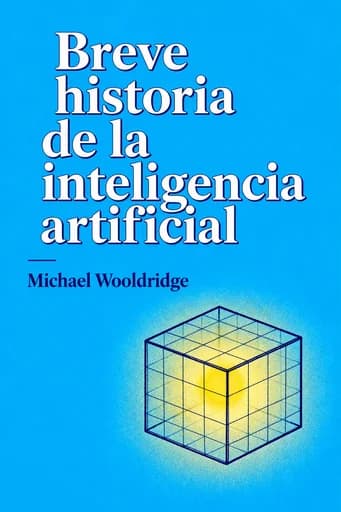
A Brief History of Artificial Intelligence
What It Is, Where We Are, and Where We Are Going
Resumen de A Brief History of Artificial Intelligence
Journey through AI's evolution with Michael Wooldridge's accessible guide - praised by computer scientists and novices alike. Unraveling complex concepts from cybernetics to deep learning, this exceptional resource reveals how AI's visionaries are reshaping society, technology, and our collective future.
Temas clave en A Brief History of Artificial Intelligence
- computational history
- turing test limitations
- symbolic vs connectionist ai
- algorithmic problem solving
- machine intelligence philosophy
Citas de A Brief History of Artificial Intelligence
AI's story is largely one of failure.
Understanding where AI came from might be our best guide.
These machines weren't intelligent in any meaningful sense.
Passing the Turing Test doesn't necessarily indicate intelligence.
AI's first golden age [was] a period of boundless optimism.
Personajes en A Brief History of Artificial Intelligence
- Michael WooldridgeAuthor and AI researcher
- Joseph WeizenbaumCreator of the ELIZA psychotherapist program
Sobre el Autor
Sobre el autor de A Brief History of Artificial Intelligence
Michael John Wooldridge, author of A Brief History of Artificial Intelligence, is a leading authority on AI and professor of computer science at the University of Oxford. With over three decades of research in multi-agent systems and computational logic, his work bridges technical AI advancements with societal implications.
As Director for AI at the Alan Turing Institute, he shapes foundational AI research and policy, advising government committees and institutions like the House of Lords.
Wooldridge’s expertise extends to public engagement through his bestselling books, including The Road to Conscious Machines and The Ladybird Expert Guide to AI, translated into nine languages. A recipient of the Lovelace Medal and AAAI Outstanding Educator Award, he demystifies AI’s evolution in accessible prose, drawing from his roles as Editor-in-Chief of Artificial Intelligence journal and former president of the International Joint Conference on AI. His 2023 Royal Institution Christmas Lectures brought AI’s history and future to global audiences, cementing his reputation as a trusted voice in tech discourse.
Descargar resumen de A Brief History of Artificial Intelligence
Obtén el resumen de A Brief History of Artificial Intelligence como PDF o EPUB gratis. Imprímelo o léelo sin conexión en cualquier momento.
Preguntas Frecuentes Sobre Este Libro
A Brief History of Artificial Intelligence by Michael Wooldridge traces AI’s evolution from theoretical foundations to modern applications. It explores key milestones like the Turing Test, expert systems, and the pursuit of artificial general intelligence (AGI), while addressing ethical risks like algorithmic bias and deepfakes. Wooldridge balances optimism about breakthroughs (e.g., self-driving cars) with skepticism toward AGI’s feasibility.
This book suits tech enthusiasts, students, and professionals seeking a concise yet comprehensive overview of AI’s past and future. It’s ideal for readers curious about AI’s societal impact, ethical challenges, and foundational concepts like machine learning and natural language processing. Wooldridge’s accessible style also appeals to general audiences unfamiliar with technical jargon.
Yes—Wooldridge combines academic rigor with engaging storytelling, demystifying complex topics like neural networks and AI ethics. The book offers historical context (e.g., the 1950s “Golden Age” of AI) while critiquing hype around AGI. Its balanced perspective on AI’s capabilities and limitations makes it a standout resource for informed discussions.
- Turing Test: A benchmark for machine intelligence where humans can’t distinguish AI from human behavior.
- Expert Systems: Early AI programs designed for specialized tasks, limited by rigid logic.
- AGI: The controversial “grand dream” of machines with human-like consciousness.
- AI Risks: Biases in algorithms, deepfake misinformation, and ethical dilemmas.
Wooldridge considers AGI a distant and unlikely prospect, emphasizing that current AI excels in narrow tasks (e.g., language translation) but lacks consciousness. He cautions against dystopian fears while advocating for proactive governance to mitigate risks like job displacement and privacy breaches.
- 1950s: Development of modern computers enabling AI research.
- 1956 Dartmouth Workshop: John McCarthy coins “artificial intelligence” and pioneers LISP programming.
- 1970s “AI Winter”: Funding declines as early systems fail to meet expectations.
- 2000s-Present: Renaissance driven by machine learning and big data.
Wooldridge highlights bias in training data, accountability gaps in autonomous systems, and the societal impact of deepfakes. He argues for transparency in AI development and interdisciplinary collaboration to align technology with human values.
Wooldridge is an Oxford AI professor, director at the Alan Turing Institute, and award-winning author with 400+ publications. His leadership roles in global AI organizations and advisory work for governments and companies like Facebook underscore his expertise.
Proposed by Alan Turing in 1950, the test shifts focus from “true intelligence” to behavioral imitation. Wooldridge critiques its limitations but acknowledges its role in shaping AI research goals, such as chatbots and natural language processing.
He notes that expert systems relied too heavily on rigid logic, failing to handle real-world complexity. Projects like SHRDLU (a 1960s language-understanding AI) struggled with scalability, leading to the 1970s “AI Winter” of reduced funding and interest.
As AI transforms industries, the book provides context for debates on regulation, job automation, and ChatGPT-style tools. Wooldridge’s insights help readers navigate misinformation risks and advocate for ethical AI design in a tech-driven era.
He praises AI’s strides in pattern recognition (e.g., medical diagnostics) but stresses that machines lack common sense or creativity. The book argues that human oversight remains crucial to avoid overreliance on flawed algorithms.
- On AGI: “The dream of conscious machines remains a distant prospect”.
- On Bias: “AI mirrors the prejudices of its creators”.
- On Progress: “Driverless cars weren’t built in a day—they stand on decades of incremental research”.
Wooldridge anticipates advances in healthcare and climate modeling but warns against unchecked corporate control. He advocates for public education to democratize AI benefits and prevent misuse.