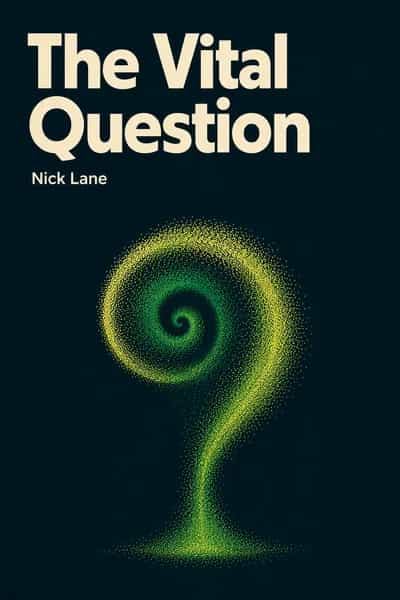

Overview of The Vital Question
Nick Lane's groundbreaking exploration of life's origins rewires our understanding of evolution through energy and cellular mechanics. Bill Gates calls it a "stunning inquiry," praising that "more people should know about this guy's work." Why did life evolve this way? The answer changes everything.
- Alkaline hydrothermal vents—not primordial soup—drove life’s origin through proton gradients.
- Energy from proton gradients preceded DNA and cells in early biochemistry.
- Mitochondria’s endosymbiosis gave eukaryotes 200,000x more energy per gene than bacteria.
- All complex life shares a single ancestor from one rare evolutionary leap.
- Bacterial membranes limit genetic complexity; mitochondrial power enabled multicellular life.
- The genetic code’s three-letter structure shows non-random chemical constraints.
- Life requires continuous energy flux—equilibrium systems like “soup” can’t sustain it.
- LUCA (Last Universal Common Ancestor) likely lived in iron-sulfur rock pores.
- Sex evolved as error-correction for large eukaryotic genomes.
- Energy efficiency dictates why bacteria stayed simple and eukaryotes diversified.
- Cellular complexity arose just once in 4 billion years—a frozen accident.
- Life on exoplanets may need similar alkaline vent energy systems.
About the Author of The Vital Question
Nick Lane, the acclaimed British biochemist and award-winning science writer, explores the deep mysteries of evolution in The Vital Question, blending cutting-edge research on bioenergetics with groundbreaking theories about life’s origins.
A Professor of Evolutionary Biochemistry at University College London and Co-Director of its Centre for Life’s Origin and Evolution, Lane bridges laboratory science and big-picture biology to explain how energy flow shaped life over billions of years. His expertise in mitochondria and cellular evolution underpins this bold examination of why complex life emerged—a theme he further explores in earlier works like Life Ascending (winner of the Royal Society Science Book Prize) and Power, Sex, Suicide.
Lane’s books, translated into 25+ languages and praised by The Independent as “thrillingly ambitious,” combine rigorous scholarship with narrative flair, earning recognition from institutions like the Royal Society and Biochemical Society. The Vital Question builds on his two-decade career redefining evolutionary biology’s most profound questions, with over 150,000 copies of his works sold globally.
FAQs About The Vital Question
What is The Vital Question by Nick Lane about?
The Vital Question explores energy’s role in the origin and evolution of life, arguing that mitochondria—the powerhouses of eukaryotic cells—were central to the leap from simple bacteria to complex organisms. Nick Lane synthesizes biochemistry, genetics, and evolutionary theory to explain how energy constraints shaped life’s major transitions, from the emergence of cells to sexual reproduction and aging.
Who should read The Vital Question?
Science enthusiasts, biology students, and readers curious about life’s origins will find this book compelling. It’s ideal for those interested in evolutionary biochemistry, astrobiology, or the interplay between energy and biology. Lane’s accessible style bridges complex concepts for both academic and general audiences.
Is The Vital Question worth reading?
Yes—it’s a groundbreaking work that won the 2015 Biochemical Society Award and was shortlisted for the Royal Society Science Book Prize. Lane’s synthesis of energy-driven evolution challenges conventional views, offering fresh insights into mitochondria’s role in health, disease, and biodiversity.
What are the main ideas in The Vital Question?
- Energy as evolution’s driver: Life’s complexity arose from energy constraints in cells.
- Mitochondria’s pivotal role: Their symbiotic origin enabled eukaryotic cells’ efficiency.
- Hydrothermal vents as life’s cradle: Alkaline vents provided ideal conditions for early biochemistry.
- Sex and aging: Mitochondrial DNA’s vulnerabilities explain why sex evolved and why we age.
How does The Vital Question explain the origin of complex cells?
Lane proposes that an ancient partnership between archaea and bacteria led to mitochondria, enabling cells to harness energy more efficiently. This symbiosis allowed for larger genomes, multicellularity, and the diversity of life seen today.
What is the “chemiosmotic theory” in The Vital Question?
The theory explains how cells generate energy via proton gradients across membranes. Lane argues this mechanism, foundational to mitochondria, was a prerequisite for complex life and remains central to cellular function.
How does The Vital Question address the origin of life?
Lane hypothesizes that alkaline hydrothermal vents created natural proton gradients, driving the synthesis of organic molecules and the emergence of primitive cells. This contrasts with “RNA world” theories, emphasizing energy’s role over genetic material.
What critiques exist about The Vital Question?
Some scientists argue Lane’s hydrothermal vent hypothesis is speculative, lacking direct evidence. Others note the book’s heavy focus on energy downplays genetic or environmental factors in evolution.
How does The Vital Question relate to Nick Lane’s other books?
It expands on themes from Life Ascending (evolution’s “inventions”) and Power, Sex, Suicide (mitochondria’s role in aging). However, The Vital Question uniquely ties energy flow to life’s origin and eukaryotic complexity.
Why is The Vital Question relevant in 2025?
Its insights into mitochondrial dysfunction inform aging research and biotech, while hypotheses about extraterrestrial life guide NASA’s search for habitable planets. The book remains a key text in evolutionary biochemistry.
What iconic quotes come from The Vital Question?
- “Life is chemistry writ large—but it is a special kind of chemistry.”
- “Mitochondria… are the hidden puppet masters of the living world.”
These lines encapsulate Lane’s thesis that energy transformations underpin life’s history.
How does The Vital Question compare to Life on the Edge by Al-Khalili and McFadden?
While both explore quantum biology, Lane’s work focuses on energy’s macro-evolutionary impact, whereas Life on the Edge examines quantum effects in cellular processes. They’re complementary for understanding life’s physical foundations.
Feel the book through the author's voice
Turn knowledge into engaging, example-rich insights
Capture key ideas in a flash for fast learning
Enjoy the book in a fun and engaging way
Characters in The Vital Question
- Nick LaneAuthor and biochemist at University College London
- Peter MitchellScientist who proposed chemiosmotic coupling
Key Themes in The Vital Question
- origin of life
- chemiosmotic coupling
- alkaline hydrothermal vents
- mitochondrial evolution
- bioenergetic constraints
Quotes from The Vital Question
Life is often viewed through the lens of information... But this perspective misses something fundamental: energy.
That something is energy flow.
When we shift our perspective from "What is life?" to "What is living?", we see that energy flow creates constraints.
The primordial soup theory faces insurmountable problems.
Life emerged on Earth approximately 4 billion years ago.
Explore Your Way of Learning
 Quick Summary Mode
Read or listen to The Vital Question Summary in 10 Minutes
Break down key ideas from The Vital Question into bite-sized takeaways to understand how innovative teams create, collaborate, and grow.

 Fun Mode
The Vital Question Lessons Told Through 22-Min Stories
Experience The Vital Question through vivid storytelling that turns innovation lessons into moments you'll remember and apply.
 Personalize Mode
Experience The Vital Question in your own learning style
Ask anything, choose your learning style, and co-create insights that truly resonate with you.
From Columbia University alumni built in San Francisco
"Instead of endless scrolling, I just hit play on BeFreed. It saves me so much time."


"I never knew where to start with nonfiction—BeFreed’s book lists turned into podcasts gave me a clear path."


"Perfect balance between learning and entertainment. Finished ‘Thinking, Fast and Slow’ on my commute this week."
"Crazy how much I learned while walking the dog. BeFreed = small habits → big gains."
"Reading used to feel like a chore. Now it’s just part of my lifestyle."

"Feels effortless compared to reading. I’ve finished 6 books this month already."
"BeFreed turned my guilty doomscrolling into something that feels productive and inspiring."

"BeFreed turned my commute into learning time. 20-min podcasts are perfect for finishing books I never had time for."
"BeFreed replaced my podcast queue. Imagine Spotify for books — that’s it. 🙌"

"It is great for me to learn something from the book without reading it."
"The themed book list podcasts help me connect ideas across authors—like a guided audio journey."
"Makes me feel smarter every time before going to work"
From Columbia University alumni built in San Francisco
"Instead of endless scrolling, I just hit play on BeFreed. It saves me so much time."
"I never knew where to start with nonfiction—BeFreed’s book lists turned into podcasts gave me a clear path."
"Perfect balance between learning and entertainment. Finished ‘Thinking, Fast and Slow’ on my commute this week."
"Crazy how much I learned while walking the dog. BeFreed = small habits → big gains."
"Reading used to feel like a chore. Now it’s just part of my lifestyle."
"Feels effortless compared to reading. I’ve finished 6 books this month already."
"BeFreed turned my guilty doomscrolling into something that feels productive and inspiring."
"BeFreed turned my commute into learning time. 20-min podcasts are perfect for finishing books I never had time for."
"BeFreed replaced my podcast queue. Imagine Spotify for books — that’s it. 🙌"
"It is great for me to learn something from the book without reading it."
"The themed book list podcasts help me connect ideas across authors—like a guided audio journey."
"Makes me feel smarter every time before going to work"
"Instead of endless scrolling, I just hit play on BeFreed. It saves me so much time."
"I never knew where to start with nonfiction—BeFreed’s book lists turned into podcasts gave me a clear path."
"Perfect balance between learning and entertainment. Finished ‘Thinking, Fast and Slow’ on my commute this week."
"Crazy how much I learned while walking the dog. BeFreed = small habits → big gains."
"Reading used to feel like a chore. Now it’s just part of my lifestyle."
"Feels effortless compared to reading. I’ve finished 6 books this month already."
"BeFreed turned my guilty doomscrolling into something that feels productive and inspiring."
"BeFreed turned my commute into learning time. 20-min podcasts are perfect for finishing books I never had time for."
"BeFreed replaced my podcast queue. Imagine Spotify for books — that’s it. 🙌"
"It is great for me to learn something from the book without reading it."
"The themed book list podcasts help me connect ideas across authors—like a guided audio journey."
"Makes me feel smarter every time before going to work"
"Instead of endless scrolling, I just hit play on BeFreed. It saves me so much time."
"I never knew where to start with nonfiction—BeFreed’s book lists turned into podcasts gave me a clear path."
"Perfect balance between learning and entertainment. Finished ‘Thinking, Fast and Slow’ on my commute this week."
"Crazy how much I learned while walking the dog. BeFreed = small habits → big gains."
"Reading used to feel like a chore. Now it’s just part of my lifestyle."
"Feels effortless compared to reading. I’ve finished 6 books this month already."
"BeFreed turned my guilty doomscrolling into something that feels productive and inspiring."
"BeFreed turned my commute into learning time. 20-min podcasts are perfect for finishing books I never had time for."
"BeFreed replaced my podcast queue. Imagine Spotify for books — that’s it. 🙌"
"It is great for me to learn something from the book without reading it."
"The themed book list podcasts help me connect ideas across authors—like a guided audio journey."
"Makes me feel smarter every time before going to work"

Download Summary of The Vital Question
Get the The Vital Question summary as a free PDF or EPUB. Print it or read offline anytime.