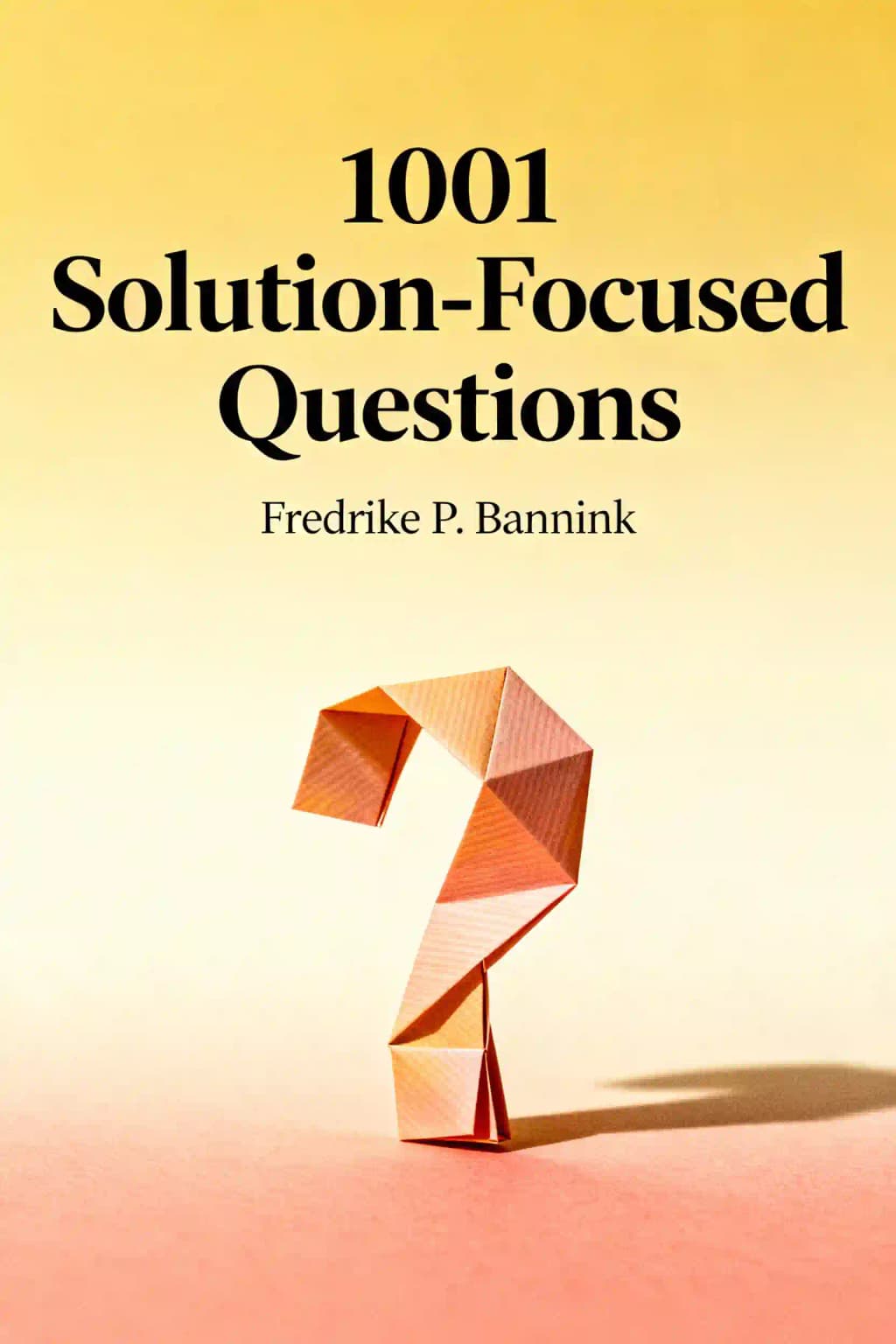
1001 solution-focused questions
handbook for solution-focused interviewing
Overview of 1001 solution-focused questions
Revolutionize your therapeutic approach with "1001 Solution-Focused Questions" - the handbook that transformed clinical psychology by shifting focus from problems to solutions. Endorsed by solution-focused pioneer Insoo Kim Berg, it's the resource therapists credit with breaking their toughest client stalemates. What question will unlock your breakthrough?

Key Themes in 1001 solution-focused questions
- solution building
- brief therapy techniques
- positive psychology interviewing
- goal oriented coaching
- exception finding
Quotes from 1001 solution-focused questions
If it works, don't fix it.
Clients are experts in their own lives.
Clients are always cooperating.
Problems differ fundamentally from solutions.
Characters in 1001 solution-focused questions
- Fredrike BanninkAuthor and expert on solution-focused interviewing
- Steve de ShazerPioneer of solution-focused interviewing
- Insoo Kim BergCo-developer of the solution-focused approach
- Gregory BatesonResearcher whose work influenced the model
- Milton EricksonPsychiatrist known for competence-focused methods
About the Author
About the Author of 1001 solution-focused questions
Fredrike P. Bannink, clinical psychologist and acclaimed author of 1001 Solution-Focused Questions, is a pioneering figure in solution-focused therapy and positive psychology. With nearly 30 years of clinical experience, her work bridges cognitive-behavioral strategies with strength-based methodologies, emphasizing clients’ existing resources over deficits.
A trained mediator and international trainer, she has conducted workshops for mental health teams at Doctors Without Borders and delivered keynote addresses at events like the National Mediation Conference in Sydney.
Her influential titles, including Practicing Positive CBT and Post Traumatic Success, integrate solution-focused techniques with trauma-informed care and positive psychiatry, reshaping therapeutic practices globally. Bannink’s insights have been featured in Psychology Today and academic journals, while her books—translated into multiple languages—are staple resources in clinical training programs.
1001 Solution-Focused Questions remains a definitive guide, celebrated for its practical, accessible approach to fostering resilience and goal-oriented change in therapy and coaching contexts.
Download Summary of 1001 solution-focused questions
Get the 1001 solution-focused questions summary as a free PDF or EPUB. Print it or read offline anytime.
FAQs About This Book
1001 Solution-Focused Questions provides therapists and coaches with a practical toolkit for client-centered interviewing, emphasizing goal-setting, resource identification, and future-oriented problem-solving. It offers 1,001 categorized questions for diverse scenarios – from trauma to family therapy – alongside exercises and case studies demonstrating the model’s effectiveness.
Mental health professionals (therapists, counselors), coaches, social workers, and educators seeking actionable techniques for client empowerment will benefit. Its structured frameworks and adaptable questions also aid mediators and organizational leaders navigating conflict resolution.
Yes – it balances theoretical foundations with immediately applicable strategies. Readers praise its comprehensive question bank, exception-seeking techniques, and exercises fostering creative client engagement. Therapists report enhanced session efficiency through its goal-oriented approach.
- Client-as-expert: Clients possess inherent problem-solving abilities.
- Exception-seeking: Identifying past successes to build future strategies.
- Language precision: Questions crafted to reframe problems into solvable goals.
- Scaling questions: Measuring progress quantitatively to maintain momentum.
Unlike problem-focused approaches, it avoids analyzing root causes, instead prioritizing actionable steps toward clients’ desired futures. It contrasts with CBT by emphasizing strengths over cognitive distortions.
- “The client is the expert”: Reinforces autonomy in solution-building.
- “If it works, don’t fix it”: Encourages leveraging existing effective strategies.
- “Nothing is constant in the whole world”: Highlights adaptability as a therapeutic asset.
It provides targeted questions to help clients articulate coping strategies, recognize resilience, and formulate immediate goals. Examples include exploring “survival skills” used during past challenges and scaling current crisis severity.
Yes – its frameworks apply to workplace coaching, education, and family mediation. Questions like “What would a 10% improvement look like?” help teams break down complex problems into manageable steps.
Some argue its simplicity may oversimplify complex trauma cases. Others note the approach requires skill to avoid seeming dismissive of clients’ emotional experiences.
Bannink’s 30+ years in clinical practice and training inform the book’s balance of rigor and accessibility. Her background in positive psychology and international workshops ensures globally tested methodologies.
- Miracle question drills: Guiding clients to envision problem-free futures.
- Exception journals: Documenting times when issues were less severe.
- Scaling visualizations: Using 1-10 metrics to track progress.
It categorizes clients as “visitors,” “complainants,” or “customers,” tailoring questions to their engagement level. For reluctant clients, it uses “soft” openers like “What would make this conversation useful?”