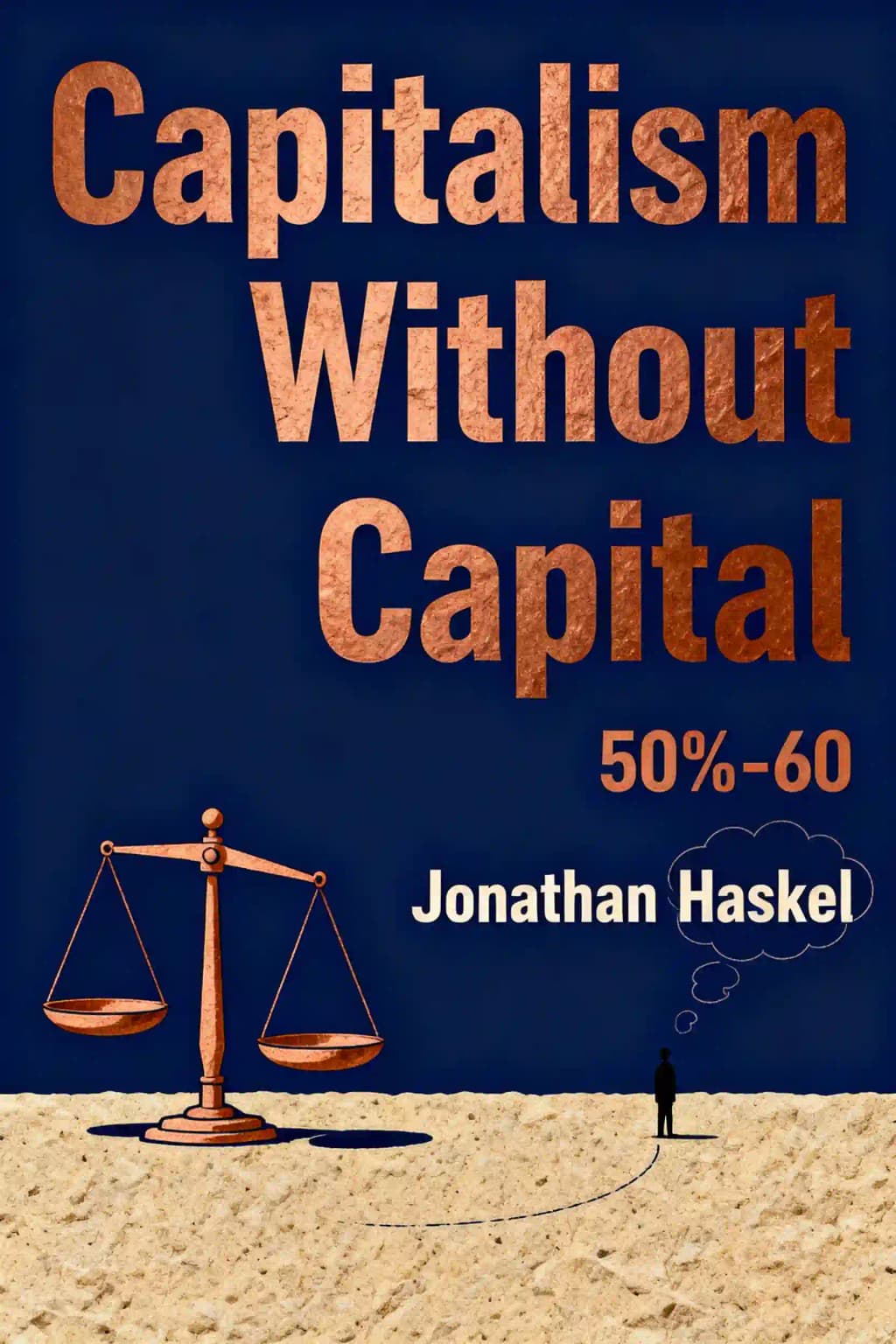
Capitalism Without Capital
The Rise of the Intangible Economy
Overview of Capitalism Without Capital
In "Capitalism Without Capital," Haskel and Westlake reveal how intangible assets now dominate our economy. Bill Gates called it "brilliant" for explaining why software and ideas - not physical assets - drive modern wealth, challenging everything we thought about measuring economic value.

Key Themes in Capitalism Without Capital
- intangible asset valuation
- knowledge economy dynamics
- scalability and spillovers
- modern capital investment
- economic measurement gap
Quotes from Capitalism Without Capital
This represents capitalism without capital.
Competition becomes winner-takes-all.
The sunk nature of intangible investments creates several economic challenges.
Ideas, being non-rival and often non-excludable, readily flow between companies.
Characters in Capitalism Without Capital
- Jonathan HaskelCo-author and economist
- Stian WestlakeCo-author and researcher
- Colin MatthewsCEO of British Airports Authority
- William the ConquerorHistorical figure who commissioned the Domesday Book
- Carol CorradoEconomist who estimated intangible investment
About the Author
About the Author of Capitalism Without Capital
Jonathan Haskel, co-author of Capitalism Without Capital: The Rise of the Intangible Economy, is a leading economist and professor at Imperial College Business School, specializing in innovation, productivity, and the intangible economy. A Commander of the Order of the British Empire (CBE) honoree and external member of the Bank of England’s Monetary Policy Committee, Haskel bridges academic rigor with real-world policy expertise.
His work explores how intangible assets like patents and software reshape modern economies, informed by decades of research and advisory roles for institutions like the UK Statistics Authority and European Commission.
Alongside collaborator Stian Westlake, Haskel expanded his analysis in the follow-up Restarting the Future: How to Fix the Intangible Economy, offering solutions for equitable growth in knowledge-driven markets. Recognized by the Financial Times as one of 2017’s best economics books, Capitalism Without Capital has been translated into 15 languages and cited in global policy debates. Haskel’s insights regularly feature in major media outlets, reinforcing his status as a pivotal voice on 21st-century economic challenges.
Download Summary of Capitalism Without Capital
Get the Capitalism Without Capital summary as a free PDF or EPUB. Print it or read offline anytime.
FAQs About This Book
Capitalism Without Capital explores the shift from physical assets (like machinery) to intangible investments (such as software, R&D, and branding) as the cornerstone of modern economies. Authors Jonathan Haskel and Stian Westlake analyze how intangible-driven businesses scale faster, face unique risks, and reshape competition, productivity, and inequality. The book argues this transition explains sluggish economic growth and offers policy solutions.
This book is essential for economists, policymakers, and business leaders seeking to understand 21st-century economic challenges. Entrepreneurs and investors will gain insights into scaling intangible-based ventures, while academics will appreciate its data-driven analysis of productivity trends and innovation.
Key ideas include:
- Intangible dominance: Non-physical assets now drive economic value more than tangible goods.
- Scalability & spillovers: Intangibles enable rapid growth but are easily copied, reducing private returns.
- Secular stagnation: Underinvestment in intangibles may explain slowed productivity and wage growth.
The book links stagnant productivity to intangible investment’s unique traits: high upfront costs, uncertain returns, and the ease with which competitors can replicate ideas. This discourages private investment, requiring policy interventions like better intellectual property frameworks and public R&D funding.
The intangible economy refers to systems where value creation relies on non-physical assets like patents, software, data, and organizational practices. Unlike factories or machinery, these assets can scale infinitely but lack collateral value, complicating traditional financing and economic measurement.
Some economists argue the book overstates intangible investment’s novelty, noting similar shifts occurred during industrialization. Others question its policy prescriptions, suggesting tax incentives for intangibles might disproportionately benefit tech giants. However, its core thesis remains widely influential in macroeconomic discourse.
The book frames digital technologies (AI, cloud computing) as accelerators of intangible dominance, enabling businesses to leverage data and networks at unprecedented scale. It warns this could widen inequality if intangible wealth concentrates among few firms.
Haskel and Westlake advocate:
- Reforming IP laws to balance innovation incentives with competition.
- Expanding public funding for R&D and education.
- Updating national accounting systems to better track intangible investments.
While classical economics focuses on physical capital and labor, this book highlights intangibles’ distinct properties: scalability (zero marginal cost), synergies (combining ideas creates exponential value), and sunk costs (investments can’t be resold).
With AI and automation accelerating intangible investment, the book’s insights help explain trends like tech monopolies, gig economy precarity, and the ROI challenges of climate innovation. Its framework remains critical for addressing today’s policy debates.
Haskel’s decades of research on productivity and innovation—combined with his Bank of England policymaking role—lend rigor to the analysis. His work on UK competition policy and statistics authority governance grounds theoretical ideas in real-world data challenges.
- “The growing importance of intangible assets has made the economy weightless, but no less real.”
- “Intangibles make the world spiky: small differences in ideas yield massive differences in success.”