Overview of Unthinking
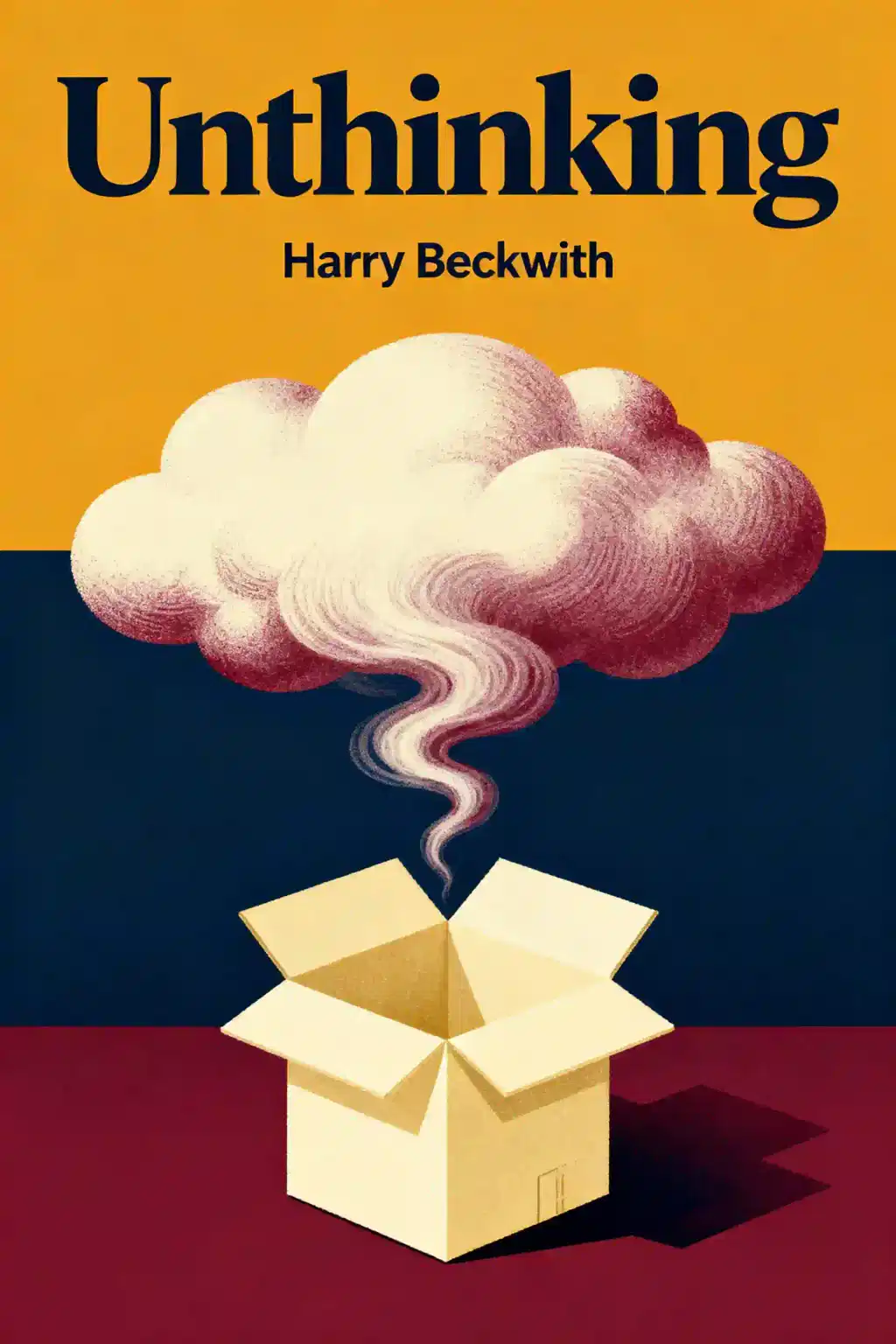
Discover why we buy what we buy without thinking. "Unthinking" reveals the hidden psychological forces driving our purchases - insights that helped Beckwith advise 23 Fortune 200 companies. Drew McLellan calls it "the why" behind consumer behavior that smart marketers can't ignore.
- Childhood nostalgia fuels purchasing more powerfully than logical product benefits.
- Fear of appearing foolish shapes brand loyalty more than product quality.
- American consumers prioritize individualism in marketing but crave group validation.
- “Click It or Ticket” succeeded by offering autonomy over safety lectures.
- Visual design trumps functionality in creating perceived product value.
- Storytelling outperforms statistics in persuading emotionally-driven buyers.
- Scarcity marketing backfires when products lose exclusivity (e.g., Krispy Kreme).
- Cultural optimism makes Americans reject warnings but embrace aspirational messaging.
- Malcolm Gladwell’s success mirrors how audiences prefer curiosity over answers.
- Consumers reconstruct facts to justify decisions made subconsciously.
- Nike and Beatles leveraged America’s love for rebellion in branding.
- “Buckle Up” campaigns failed by emphasizing fear; choice-based nudes worked.
About the Author of Unthinking
Harry Beckwith, bestselling author of Unthinking: The Surprising Forces Behind What We Buy, is a renowned marketing strategist and branding expert whose insights have shaped Fortune 100 companies like Target, Microsoft, and Disney. A Phi Beta Kappa graduate of Stanford University and former federal law clerk, Beckwith blends behavioral psychology with practical business acumen to explore unconscious consumer decision-making—a theme central to Unthinking.
His earlier works, including the seminal Selling the Invisible (1997) and What Clients Love (2003), established him as a thought leader in service marketing, with combined global sales exceeding 980,000 copies across 21 languages.
Beckwith’s expertise extends to keynote speeches for major corporations and media features on CNN. As founder of Beckwith Partners, he advises organizations on positioning and customer retention strategies honored by the American Marketing Association. Recognized for his accessible, anecdotal style, his books frequently appear on required reading lists for MBA programs and executive training. Selling the Invisible alone has sold over 650,000 copies and spent 36 consecutive months on the BusinessWeek bestseller list, cementing its status as a modern marketing classic.
FAQs About Unthinking
What is Unthinking: The Surprising Forces Behind What We Buy about?
Unthinking explores how subconscious forces—like childhood experiences, cultural narratives, and visual perception—drive consumer choices more than rational analysis. Harry Beckwith combines psychology, marketing case studies (e.g., Krispy Kreme’s rise and fall), and behavioral research to reveal why tactics like storytelling and surprise outperform logic in influencing purchases.
Who should read Unthinking by Harry Beckwith?
Marketers, advertisers, and business leaders seeking to understand irrational consumer behavior will benefit most. It’s also valuable for psychology enthusiasts interested in applied decision-making science, though academics may find some insights familiar.
Is Unthinking by Harry Beckwith worth reading?
Yes, for its actionable insights into consumer psychology. Beckwith’s Gladwell-esque storytelling and real-world examples (e.g., the “Click It or Ticket” campaign’s success) make complex concepts accessible. However, readers familiar with behavioral economics may encounter overlapping ideas.
What childhood influences on buying habits does Unthinking highlight?
Beckwith identifies three key drivers from childhood: the love of play, surprise, and stories. For example, marketers tap into nostalgia through whimsical product designs or campaigns that evoke childhood memories, bypassing logical evaluation.
How does Unthinking explain the downfall of Krispy Kreme?
Krispy Kreme initially thrived as a “cult brand” due to scarcity and exclusivity. When it expanded into mass retailers like Target, the loss of perceived rarity eroded its appeal—a case study in how violating cultural expectations can backfire.
What marketing strategies does Unthinking recommend?
- Leverage cultural narratives: Align products with ideals like individualism or optimism.
- Prioritize aesthetics: Visually pleasing designs trigger emotional responses.
- Use simplicity: Clear, story-driven messaging (e.g., Nike’s “Just Do It”) outperforms complex pitches.
How does Unthinking compare to Malcolm Gladwell’s books?
Both use storytelling to dissect human behavior, but Beckwith focuses narrowly on consumer psychology. While Gladwell delves into broader societal trends (e.g., Tipping Point), Unthinking offers tactical marketing insights, making it a practical companion for professionals.
What role does surprise play in Unthinking’s framework?
Surprise disrupts habitual thinking, making consumers more receptive to messages. Beckwith cites campaigns like “Click It or Ticket,” which used unexpected humor to increase seatbelt compliance, as proof that novelty outperforms fear-based appeals.
What criticisms exist about Unthinking?
Some academics argue Beckwith’s conclusions about subconscious drivers are overly simplified. Critics note the book’s reliance on anecdotal evidence and its limited exploration of demographic or socioeconomic factors in consumer behavior.
How does Unthinking apply psychology to branding?
Beckwith argues that brands succeed by evoking primal emotions rather than logic. For example, Sean Connery’s decision to abandon his toupee resonated because it tapped into cultural values of authenticity—a lesson in aligning products with deeper identity narratives.
Why does Unthinking emphasize visual design?
The book cites studies showing consumers judge products within 90 seconds, with 62-90% of assessments based on visuals. Beckwith highlights Apple’s minimalist aesthetics as proof that design shapes perceived value more than technical specs.
How does Unthinking remain relevant in 2025?
Its insights into attention economics and information overload (“the inundation age”) are increasingly critical as marketers compete in crowded digital spaces. The book’s focus on emotional engagement over data-driven pitches aligns with trends toward experiential branding.
Feel the book through the author's voice
Turn knowledge into engaging, example-rich insights
Capture key ideas in a flash for fast learning
Enjoy the book in a fun and engaging way
Characters in Unthinking
- Harry BeckwithAuthor and marketing expert
- Kobe BryantNBA player used as a case study in decision-making
- Carmelo AnthonyNBA player cited for his statistical performance
- Johan HuizingaHistorian who defined humans as 'Homo ludens'
- Stuart BrownResearcher who studied play behavior in mammals
Key Themes in Unthinking
- unconscious bias
- irrational decision making
- consumer psychology
- cognitive shortcuts
- emotional marketing
Quotes from Unthinking
We're not just occasional players; we're obsessive ones.
Surprise isn't just pleasant-it's essential to joy itself.
Tell me a story.
We don't just tolerate play; we actively seek it out.
We create narratives that feel right, then convince ourselves they're logical.
Explore Your Way of Learning
 Quick Summary Mode
Read or listen to Unthinking Summary in 8 Minutes
Break down key ideas from Unthinking into bite-sized takeaways to understand how innovative teams create, collaborate, and grow.

 Fun Mode
Unthinking Lessons Told Through 21-Min Stories
Experience Unthinking through vivid storytelling that turns innovation lessons into moments you'll remember and apply.
 Personalize Mode
Experience Unthinking in your own learning style
Ask anything, choose your learning style, and co-create insights that truly resonate with you.

From Columbia University alumni built in San Francisco
"Instead of endless scrolling, I just hit play on BeFreed. It saves me so much time."


"I never knew where to start with nonfiction—BeFreed’s book lists turned into podcasts gave me a clear path."


"Perfect balance between learning and entertainment. Finished ‘Thinking, Fast and Slow’ on my commute this week."
"Crazy how much I learned while walking the dog. BeFreed = small habits → big gains."
"Reading used to feel like a chore. Now it’s just part of my lifestyle."

"Feels effortless compared to reading. I’ve finished 6 books this month already."
"BeFreed turned my guilty doomscrolling into something that feels productive and inspiring."

"BeFreed turned my commute into learning time. 20-min podcasts are perfect for finishing books I never had time for."
"BeFreed replaced my podcast queue. Imagine Spotify for books — that’s it. 🙌"

"It is great for me to learn something from the book without reading it."
"The themed book list podcasts help me connect ideas across authors—like a guided audio journey."
"Makes me feel smarter every time before going to work"
From Columbia University alumni built in San Francisco
"Instead of endless scrolling, I just hit play on BeFreed. It saves me so much time."
"I never knew where to start with nonfiction—BeFreed’s book lists turned into podcasts gave me a clear path."
"Perfect balance between learning and entertainment. Finished ‘Thinking, Fast and Slow’ on my commute this week."
"Crazy how much I learned while walking the dog. BeFreed = small habits → big gains."
"Reading used to feel like a chore. Now it’s just part of my lifestyle."
"Feels effortless compared to reading. I’ve finished 6 books this month already."
"BeFreed turned my guilty doomscrolling into something that feels productive and inspiring."
"BeFreed turned my commute into learning time. 20-min podcasts are perfect for finishing books I never had time for."
"BeFreed replaced my podcast queue. Imagine Spotify for books — that’s it. 🙌"
"It is great for me to learn something from the book without reading it."
"The themed book list podcasts help me connect ideas across authors—like a guided audio journey."
"Makes me feel smarter every time before going to work"
"Instead of endless scrolling, I just hit play on BeFreed. It saves me so much time."
"I never knew where to start with nonfiction—BeFreed’s book lists turned into podcasts gave me a clear path."
"Perfect balance between learning and entertainment. Finished ‘Thinking, Fast and Slow’ on my commute this week."
"Crazy how much I learned while walking the dog. BeFreed = small habits → big gains."
"Reading used to feel like a chore. Now it’s just part of my lifestyle."
"Feels effortless compared to reading. I’ve finished 6 books this month already."
"BeFreed turned my guilty doomscrolling into something that feels productive and inspiring."
"BeFreed turned my commute into learning time. 20-min podcasts are perfect for finishing books I never had time for."
"BeFreed replaced my podcast queue. Imagine Spotify for books — that’s it. 🙌"
"It is great for me to learn something from the book without reading it."
"The themed book list podcasts help me connect ideas across authors—like a guided audio journey."
"Makes me feel smarter every time before going to work"
"Instead of endless scrolling, I just hit play on BeFreed. It saves me so much time."
"I never knew where to start with nonfiction—BeFreed’s book lists turned into podcasts gave me a clear path."
"Perfect balance between learning and entertainment. Finished ‘Thinking, Fast and Slow’ on my commute this week."
"Crazy how much I learned while walking the dog. BeFreed = small habits → big gains."
"Reading used to feel like a chore. Now it’s just part of my lifestyle."
"Feels effortless compared to reading. I’ve finished 6 books this month already."
"BeFreed turned my guilty doomscrolling into something that feels productive and inspiring."
"BeFreed turned my commute into learning time. 20-min podcasts are perfect for finishing books I never had time for."
"BeFreed replaced my podcast queue. Imagine Spotify for books — that’s it. 🙌"
"It is great for me to learn something from the book without reading it."
"The themed book list podcasts help me connect ideas across authors—like a guided audio journey."
"Makes me feel smarter every time before going to work"

Download Summary of Unthinking
Get the Unthinking summary as a free PDF or EPUB. Print it or read offline anytime.