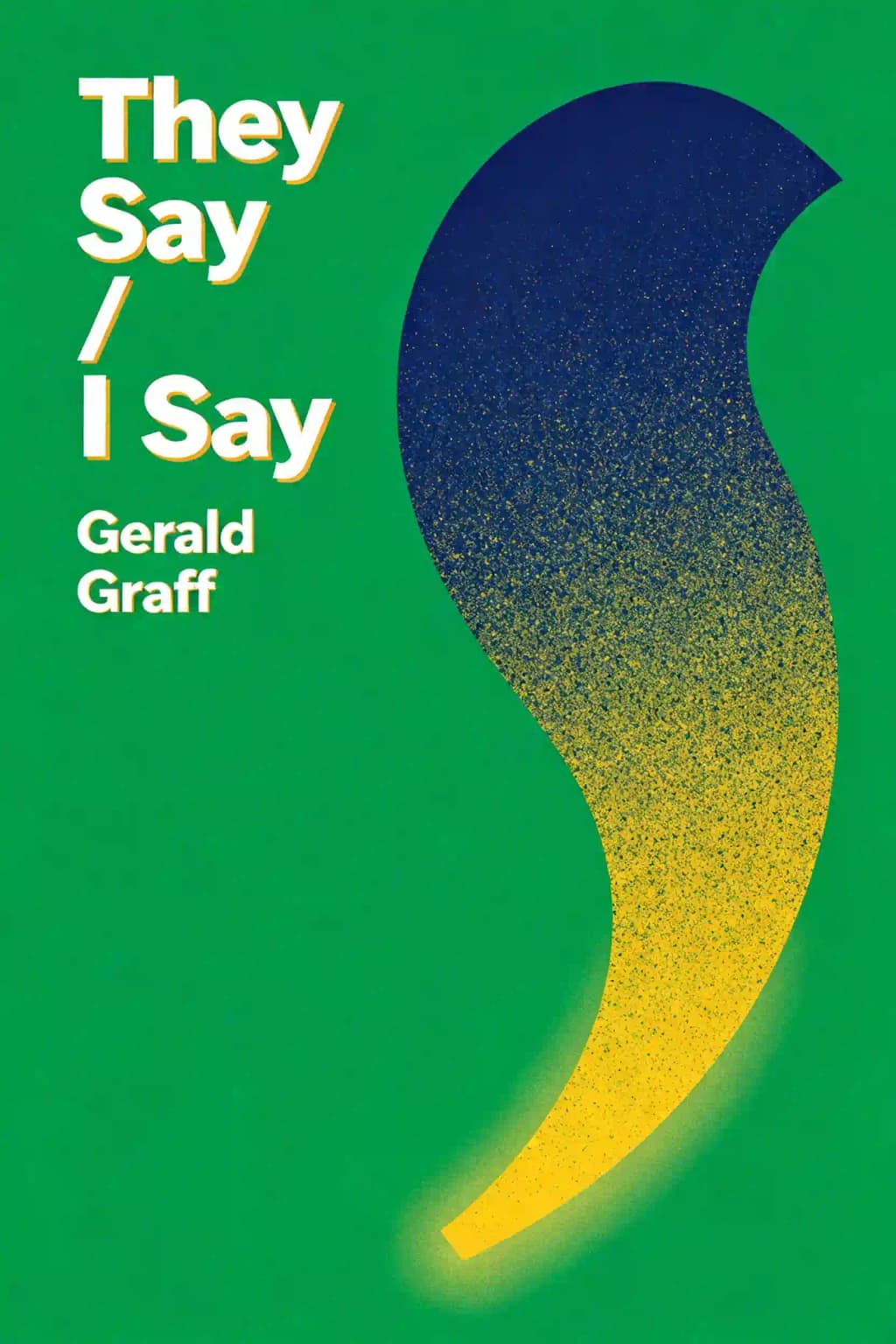
"They Say / I Say" with Readings
Overview of "They Say / I Say" with Readings
Unlock academia's secret language with "They Say / I Say" - the revolutionary writing guide that professors call "the best book that's happened to teaching composition-ever." Why do students refuse to sell it back to bookstores? It's your permanent membership card to scholarly conversations.

Key Themes in "They Say / I Say" with Readings
- academic conversation
- argumentative templates
- rhetorical framing
- intellectual empathy
- persuasive synthesis
Quotes from "They Say / I Say" with Readings
In other words, the common formulas They Say / I Say can be templates that you can continually adapt and re-use in a variety of contexts.
The templates on the following pages are designed to help you not only summarize what others say but also to set up what you want to say.
Even the most seemingly self-evident claims often turn out to be responses to something that someone else has claimed.
Quotations never speak for themselves; they require framing to become meaningful parts of your argument.
Writer Jane Tompkins realized that moments of doubt about potential criticisms actually mark where her "text really begins".
Characters in "They Say / I Say" with Readings
- Gerald GraffCo-author and professor of English and Education
- Cathy BirkensteinCo-author and lecturer in English
- Kenneth BurkePhilosopher who used the parlor conversation metaphor
- Peter ElbowPhilosopher who developed 'the believing game'
About the Author
About the Author of "They Say / I Say" with Readings
Gerald Graff is a distinguished education theorist and co-author of They Say/I Say: The Moves That Matter in Academic Writing, a groundbreaking textbook that demystifies academic argumentation. Born in Chicago in 1937 and educated at the University of Chicago and Stanford, Graff has dedicated his career to making academic discourse accessible to all students. His influential concept of "teaching the conflicts" reshaped literature and composition pedagogy across American universities.
Graff served as President of the Modern Language Association in 2008 and held prestigious professorships at Northwestern, the University of Chicago, and the University of Illinois at Chicago. His landmark Professing Literature: An Institutional History (1987) remains the definitive analysis of English departments, while Clueless in Academe (2003) laid the groundwork for They Say/I Say.
Co-written with his wife Cathy Birkenstein and published in 2006, They Say/I Say has set records for adoptions in colleges and high schools nationwide, becoming the go-to resource for teaching academic writing across disciplines.
Download Summary of "They Say / I Say" with Readings
Get the "They Say / I Say" with Readings summary as a free PDF or EPUB. Print it or read offline anytime.
FAQs About This Book
They Say / I Say by Gerald Graff and Cathy Birkenstein is a guide to academic writing that teaches students how to construct effective arguments through dialogue. The book emphasizes presenting others' viewpoints ("they say") before introducing your own perspective ("I say"), helping writers situate their ideas within broader scholarly conversations. It provides practical templates and strategies to demystify academic writing, making complex argumentative techniques accessible to students across all disciplines.
They Say / I Say is essential for college students learning academic writing, particularly those struggling to structure persuasive arguments or engage with scholarly sources. The book serves undergraduate and graduate students across all disciplines, from humanities to natural sciences, as it provides adaptable frameworks for discipline-specific writing. English language learners also benefit significantly, as the templates help structure academic thinking and argumentation beyond just grammar and vocabulary.
They Say / I Say is the best-selling composition book of this century, used at over 1,500 colleges and universities with more than one million copies sold. The book's proven framework transforms struggling writers into confident arguers by providing clear templates that reduce the mystery of academic writing. Students consistently report increased confidence and effectiveness in their argumentative writing, making it an invaluable resource for anyone serious about improving their academic communication skills.
Gerald Graff is a distinguished professor of English and Education at the University of Illinois at Chicago and one of the most influential education commentators of his generation. Born in Chicago in 1937, Graff earned his B.A. from the University of Chicago and Ph.D. from Stanford University. He co-authored They Say / I Say with Cathy Birkenstein, and his other notable works include Beyond the Culture Wars and Clueless in Academe, all focused on making academic discourse more accessible.
The "They Say / I Say" framework is a rhetorical structure where writers first present existing arguments or viewpoints ("they say") before introducing their own stance ("I say"). This approach ensures that personal arguments are positioned as responses within broader academic conversations rather than isolated opinions. The framework teaches writers to acknowledge, summarize, and engage with others' perspectives before contributing their own insights, which strengthens critical thinking and creates more persuasive arguments by demonstrating awareness of ongoing scholarly debates.
They Say / I Say offers practical writing templates that serve as rhetorical scaffolding for constructing clear arguments and addressing opposing views. Templates include structures like "In discussions of X, one controversial issue has been whether B" and "While I understand the impulse to A, my own view is B". These formulaic phrases help students make rhetorical moves clearly and logically, distinguishing their arguments from those they respond to while building confidence in academic discourse.
They Say / I Say dedicates substantial guidance to accurately summarizing others' arguments to establish a foundation for your own position. The book teaches writers to create focused summaries that align with their argumentative goals rather than merely listing information. Chapter 3 specifically addresses "the art of quoting," explaining how to select and integrate exact words from sources to launch effective arguments while maintaining the original author's intended meaning.
Metacommentary, introduced in Chapter 10 of They Say / I Say, is a technique for clarifying your arguments by commenting on your own writing to ensure readers understand your perspective. This "art of metacommentary" involves explicitly guiding readers through your reasoning, using phrases that signal what you're doing in your argument. The technique helps writers make their intentions transparent, preventing misinterpretation and strengthening the overall coherence of academic papers by directing readers' attention to key points and connections.
They Say / I Say is divided into four parts that progressively build argumentative skills.
- Part One (Chapters 1-3) focuses on presenting others' viewpoints through summarizing and quoting.
- Part Two (Chapters 4-7) develops personal arguments, including addressing counterarguments.
- Part Three (Chapters 8-11) integrates these skills using transitions, voice, and metacommentary.
- Part Four (Chapters 12-17) applies the framework to specific academic disciplines, demonstrating how the "They Say / I Say" approach adapts across fields from natural sciences to humanities.
They Say / I Say explicitly addresses writing across diverse academic disciplines in its fourth section, showing how the framework adapts to field-specific requirements. Students in sciences, social sciences, and humanities can customize the templates and strategies to fit their discipline's conventions while maintaining the core "They Say / I Say" dialogue structure. The book includes examples from literature, science, and social sciences, making it a versatile "Swiss Army knife" for academic writing regardless of your major or research area.
The latest edition of They Say / I Say includes new sections addressing contemporary academic challenges, particularly conversations about artificial intelligence and global issues like climate change. These updates reflect the book's ongoing relevance by helping students engage with current debates using the established framework. The continuous revisions since its 2006 publication demonstrate the authors' commitment to keeping the text aligned with evolving academic discourse while maintaining the core templates and strategies that have made it indispensable for over 1,500 universities.
While They Say / I Say is widely praised, some critics argue that reliance on templates might limit creativity or produce formulaic writing. However, authors Gerald Graff and Cathy Birkenstein counter that structured writing enhances rather than restricts creativity by providing frameworks that free students to focus on content and critical thinking. Others suggest the approach may oversimplify complex academic discourse, though supporters note that the templates serve as training wheels that writers eventually move beyond once they internalize the rhetorical moves and gain confidence in academic argumentation.