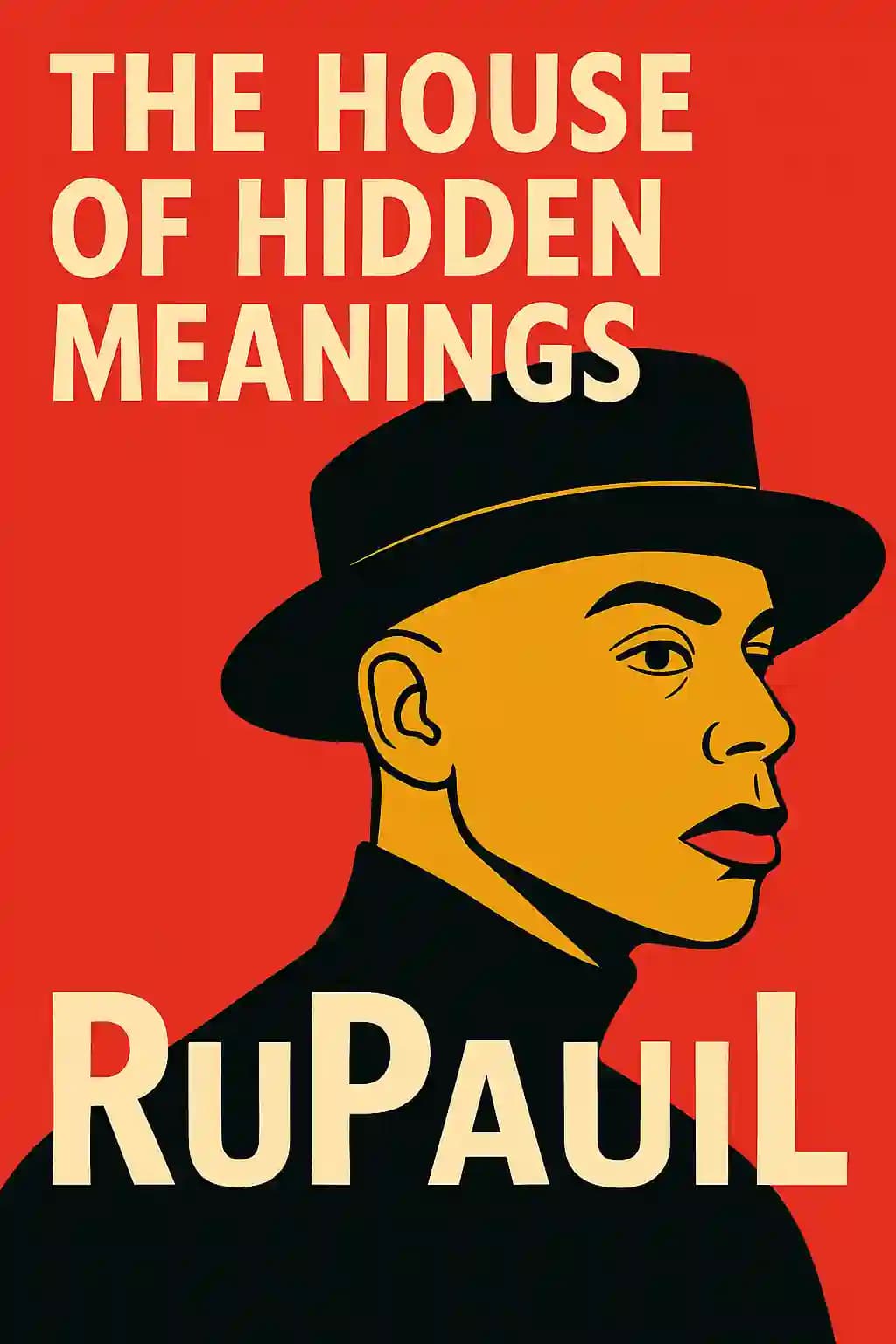
Chapter 1
Beyond the Sequins: A Journey Through the House of Hidden Meanings
RuPaul's memoir has become a cultural phenomenon since its release, topping bestseller lists and earning praise from celebrities like Oprah Winfrey, who called it "a masterclass in resilience." The book reveals the person behind the persona that revolutionized drag culture and brought it into the mainstream. What makes this memoir particularly powerful is how it transcends the typical celebrity narrative-it's not just about fame, but about the universal human journey toward self-acceptance. As Lady Gaga noted, "RuPaul's story reminds us that our greatest power comes from embracing who we truly are." In a world increasingly divided, RuPaul's story of finding belonging while celebrating uniqueness offers wisdom that resonates far beyond the drag community.
Chapter 2
The Magic of Transformation
My earliest memory shines like a photograph-sitting in our San Diego backyard with my sister Renetta as she spread a blanket and poured homemade peanut butter cookies from a paper bag. By naming our simple gathering a "picnic," she transformed something ordinary into something magical. In that moment, I understood an essential truth that would guide my life: magic must be created.
Growing up in conservative, segregated San Diego, television became my portal to possibility. I'd crowd onto my parents' bed, watching the gray light dance across the chenille bedspread, sometimes sitting on my father's shoulders, licking the salt from his head-one of the few moments I felt close to him. I performed constantly for my stoic mother, "Mean Miss Charles" to the neighborhood kids. Wrapping towels around my head, I'd impersonate Tina Turner or Carol Burnett, desperate to pierce her dark cloud with laughter.
My mother carried deep wounds she wouldn't discuss-possibly sexual trauma-and I later discovered she had a glass eye my entire life. Her Acadian French background made her tough and world-weary. From her, I learned independence and self-sufficiency, though she warned me against my sensitivity: "Ru, you're too goddamn sensitive, and you reminisce too much."
After my parents' divorce, my mother took to her bed for years, medicated with Valium and lithium. I began seeking freedom-riding on a college student's moped without permission, taking buses all over San Diego, visiting beaches alone. These explorations violated neighborhood expectations, revealing my desire to experience life beyond our limited boundaries.
Eventually, my mother emerged from her depression, inspired partly by Jackie Onassis, whose elegance and resilience she admired. We watched The Flip Wilson Show together, where his character Geraldine showed me that gender boundaries could be crossed successfully. At twelve, I found inspiration in Cleopatra Jones-fearless and powerful with her bell-bottoms and Afro. I understood later she represented my "secret girl"-who I wanted to be.
The divorce created upheaval for everyone. My sisters moved out after conflicts with our mother, and I sought escape through marijuana and alcohol with neighborhood friends. Despite our struggles, I found hope through my sister's boyfriend Gerald, who shared my dreams of a better life as we drove around affluent La Jolla neighborhoods on Sundays, imagining possibilities beyond our circumstances.
Chapter 3
Finding Freedom on America's Highways
My first plane ride to visit my father when I was ten felt exhilarating-looking down at the ground, feeling free, moving faster than anyone else with a sense of limitless potential. This freedom would later manifest in my cross-country drives for Gerald's luxury car business. I'd fly to cities across America to inspect vehicles he found in newspaper ads, purchase them with bank drafts, and drive them back to Atlanta where Gerald would detail and sell them to Atlanta's elite.
The CB radio craze of the mid-seventies romanticized highway travel, making these journeys feel like participating in a storied American tradition. I admired the code of the highway-slow cars in the slow lane, fast lane for passing-as the perfect system, an acknowledgment of natural order. This culture of civility made me proud to be American, participating in a system built on mutual respect.
Driving alone across the United States connected me to America's frontier spirit. From San Diego to Dallas stretched desert landscapes that were anything but monotonous-majestic mountains and jagged cliffs giving way to the green forests and kudzu of the South. I'd stop at truck stops, collect speeding tickets from good-natured highway patrolmen, eat fast food, and gaze at the stars through open sunroofs. In those solitary moments on dark highways, I found a rare magic, sailing forward with the certainty I would find my way home.
These journeys weren't without danger. Once, my cousin Welby and I were detained in Weatherford, Texas simply for being Black men in a nice car. These experiences taught me about America's contradictions-the freedom of its open roads existing alongside the constraints of its prejudices.
The key to detailing a car is thoroughness-you can't gloss over anything. I'd start with dishwashing liquid in water, wet the whole car, then go over it again with sudsy water to remove dirt. I'd carefully clean every part, from windshield wipers to tire rims. After rinsing, I'd dry with a shammy, apply Diamond Shield wax, buff it out, and clean any residue from cracks. I'd vacuum the interior, clean windows with Windex, apply Armor All to tires and upholstery, and meticulously clean ashtrays. I could complete this process in under ninety minutes because I loved cars.
This attention to detail would later serve me well in my drag career-understanding that true transformation requires patience and thoroughness, that you can't skip steps if you want a flawless result.
Chapter 4
The Birth of a Star in Atlanta's Underground
Atlanta represented everything San Diego wasn't: progressive, cosmopolitan, Black, and future-oriented. At Northside School of Performing Arts, I performed in Tennessee Williams' "Camino Real" as a drag queen named Queenie under drama teacher Bill Panell, who taught me that life was essentially theater, and we were all playing roles.
One day while driving in Atlanta, I heard a radio interview with Tom Zarilli and Elouise Montague discussing their public access television program, "The American Music Show." Their playful, musical conversation style intrigued me immediately. When I finally watched the show, I was captivated by its raw, unorthodox aesthetic-hosts James Bond and Dick Richards sat in a cluttered room filled with irreverent knickknacks, interviewing guests who performed music or dance numbers with a casual, unpretentious approach.
The show's DIY energy and refusal to take itself seriously resonated deeply with me. Like Monty Python, which I'd grown up watching, it poked fun at everything sacred in American consciousness. For the first time, I sensed my tribe existed-I just needed to connect.
I wrote to the P.O. box shown at the end of each episode, introducing myself as a "future star" who wanted to perform on the show. To my surprise, a man named Paul called back enthusiastically inviting me on. Later I'd discover they were thrilled-I was the first person who'd ever written asking to be on the show.
The "studio" turned out to be the basement apartment where James, one of the producers, lived-complete with stacks of newspapers, harsh fluorescent lights, and the aroma of cannabis. Though not the cultural epicenter I'd imagined, it taught me an important lesson: through the lens of a television camera, everything becomes magical.
I soon learned that James was the brother of civil rights activist Julian Bond, a confidante of Martin Luther King Jr. and the first Black politician to host Saturday Night Live. The show's opening credits featured Julian Bond campaign materials and MLK's picture. This connection between the civil rights movement and this new creative scene wasn't lost on me-both represented an unwillingness to accept the status quo.
Finding my people in Atlanta at twenty-one was transformative. The magic of those performances came from a shared spirit of childlike play and refusal to take life seriously. We had all awakened to see the "great, idiotic theater" of societal norms from outside, like reaching a mountaintop perspective that forever changes how you view the world below. What united us was our outsider status-the pain of not fitting into ordinary society had driven us to create something better.
Chapter 5
Love and Belonging in the Counterculture
My first acid trip with a tab from my friend Cassie Banks was revelatory, transforming an ordinary Atlanta afternoon into a technicolor awakening. The experience felt like being reborn into the life I was meant to have, seeing beyond society's constraints into the vibrating molecules of reality itself. Colors became more vivid, sounds took on new dimensions, and even the air seemed to pulse with meaning. I wandered through Piedmont Park in awe of nature's beauty, touching tree bark that felt alive under my fingers, until I encountered three people who would change my life-Floyd, Anna, and Mark.
Mark, a tall blonde with genteel good looks and an air of Southern aristocracy gone rogue, created an electric charge when our knees touched during that chance meeting. We quickly formed an inseparable bond, sharing not just drugs and music, but a vision of life unbounded by convention. Our adventures in my beaten-up convertible became legendary among our friends - racing through Atlanta's streets at dawn, staging impromptu fashion shows in parking lots, and finding beauty in the city's grittiest corners. While I seemed protected by some guardian angel during our misadventures (somehow passing a sobriety test while driving in nothing but a halter top and Daisy Dukes, the officer more amused than suspicious), Mark had a more complicated relationship with the world, struggling between his natural feminine grace and the staunch masculinity instilled by his military father.
Our connection deepened into passionate romance, fueled by shared dreams and chemical enhancement. During a particularly memorable acid trip that began during an apocalyptic traffic jam on Peachtree Street and ended at my housesitting gig in Buckhead, I discovered that true belonging was possible-the satisfying click of finding someone who truly understands you, who sees both your surface sparkle and your deeper shadows.
Mark moved into my apartment by summer's end, bringing little more than a duffel bag of clothes and his collection of David Bowie albums. Though he arrived with few possessions, I welcomed him warmly, immediately doing his makeup with my precious collection of drugstore cosmetics and taking glamour shots with Renetta's borrowed Minolta camera. We survived on a diet of Coca-Cola, Pringles, Snickers bars, and Virginia Slims, sleeping on a bare mattress on the floor of our sparsely furnished apartment. After losing my job at Davison's department store for wearing drag to work, I took a position as a janitor at a conference center while still occasionally transporting cars for Gerald, my sometimes-benefactor. Despite our poverty, we had each other, and our love transformed our shabby apartment into a palace of possibilities.
One transformative night, Mark shared wisdom he'd learned from drag queen Lakesha Lucky at the Sweet Gum Head club: "You're born naked, and the rest is drag"-words that unlocked a universal truth for me. This philosophy would later become one of my most famous mantras, recognizing that all identity is performance, whether we're conscious of it or not. It wasn't just about clothing or makeup, but about the roles we all play in the theater of life.
When Mark eventually left me for a more conventional life, disappearing one day with just a note left behind, I channeled my heartbreak into fierce ambition. I designed a poster with my most dramatic photograph and a bold slogan, made hundreds of copies at an all-night copy shop, and pasted them all over Atlanta's streets, telephone poles, and club walls. The signs declared: RUPAUL IS EVERYTHING. This wasn't just bravado or attention-seeking-it was a declaration of intent, a manifestation of the future I was determined to create, turning pain into power and rejection into self-proclamation.
Chapter 6
Creating a Persona in New York's Club Scene
After my band Wee Wee Pole disbanded, I created the RuPaul Is Red Hot Revue, inspired by the James Brown concert I'd seen in 1969. I assembled a cast including Floyd, Bunny, sweet-natured Lady Pecan, and dry-humored Opal Foxx. The show was deliberately simple but effective-Lady Pecan might recite a biscuit recipe, while others danced around me in cardboard Instamatic camera costumes. We previewed in Atlanta before taking it to New York's intimidating Pyramid Club, where our optimistic, glamorous energy conquered even the most cynical downtown audience.
New York showed me its harsh reality. Madonna's cold contempt in the Pyramid break room exemplified the city's attitude-she sized me up as worthless to her power equation. New York showed no kindness; when I used a coke dealer's phone without permission, his fury broke my composure, making me cry uncharacteristically. Unlike my mother's coldness backed by love, New York didn't care if I lived or died.
After returning to Atlanta from this first New York attempt, I focused on building my star power locally. I landed a paid role as Riff Raff in "The Rocky Horror Show" and created the "Starbooty" films-zero-budget tributes to blaxploitation movies featuring me as a former supermodel turned secret agent. These VHS tapes developed a cult following in clubs across the country.
During a later New York trip, I met Randy Barbato, experiencing an electric connection where I saw my future potential reflected in his eyes. Looking into Randy's eyes, I experienced something extraordinary-I saw my own future potential reflected back at me with an electric connection unlike anything I'd felt before. A week later, I met Randy's partner Fenton Bailey, an Englishman with sweet features masking his business acumen. We quickly agreed to collaborate on music, recording what became my album "RuPaul Is Starbooty."
After several false starts in New York, I experienced what astrologers call a Saturn return-that moment when you peek behind the curtain like Dorothy in "The Wizard of Oz" and must recalibrate your path. The call that changed everything came from Larry Tee: "Ru, enough is enough. It's time to come back to New York. What the fuck are you doing? Get your fucking ass back to New York where you belong."
I said yes-yes to his offer, yes to New York, and yes to whatever came next. But this time I would do it as a high-femme sexy glamazon.
Chapter 7
The Transformation into Supermodel of the World
The eighties in New York were an era of excess. My genderfuck anarchist drag had only taken me so far, and by the dawn of the nineties, the culture had doubled down on worshipping wealth, beauty, and glamour. I didn't have money, but I could serve sex and fashion.
When I returned to New York, I shaved my legs and chest, adopting a drag aesthetic I described as somewhere between "Black hooker" and "Soul Train dancer." My body was built for drag-long legs, tiny waist, no need for stockings. I got back on the go-go box, paid Larry back, and Susanne Bartsch started booking me. Larry started Love Machine at the World club, reuniting our Atlanta crew, and finally people were asking "Who the fuck is she?" in the best possible way.
I channeled my wounded romantic energy into my career. At Wigstock that Labor Day, I performed Whitney Houston's "So Emotional" and "Don't You Want My Love," driving the audience wild. Weeks later at the King and Queen of Manhattan Pageant, I was crowned queen while Kenny Kenny became king. As confetti rained down on me, I realized the crown symbolized something bigger-I'd charmed the toughest audience in the world. If I could do that, I could do anything.
After choosing Randy and Fenton as managers, I traveled to Italy with Larry and Lahoma. In Milan, we attended a Versace fashion show where I watched in awe as Linda Evangelista, Cindy Crawford, Naomi Campbell, and Christy Turlington strutted down the runway to "Freedom! '90." Looking down at them, I knew that's what I wanted to become.
After returning from Italy, I worked with Mathu Andersen and Zaldy Goco to elevate my look while recording demos with Jimmy Harry. One morning at Randy and Fenton's loft, I heard Monica Lynch from Tommy Boy Records leave a message saying they wanted to sign me. Later, Larry offered a song inspired by my new look, with lyrics referencing Linda Evangelista's "$10,000 a day" quote. Jimmy and I rewrote it, keeping the supermodel concept.
I recorded "Supermodel" in Battery Park City, gazing at the Statue of Liberty while singing. When I later heard it playing on Z100, it felt inevitable-everything in my life had prepared me for this moment. I had created the perfect formula: two spoonfuls of Diana Ross, a pinch of Cher, a shake of Dolly Parton, all sealed with Disney's family-friendliness.
The next year, I returned to Milan-not in the nosebleeds but as Gianni Versace's guest, taking photos with the same supermodels I'd once admired from afar.
Chapter 8
Loss, Love, and Finding Home
The year I became famous brought both births and deaths in my life. With success came money, eliminating my fear of poverty, but also new anxieties and responsibilities. I could no longer be the freewheeling troublemaker of my past-I was now "America's drag sweetheart."
After "Supermodel" was released, Randy and I visited my mother in San Diego, who was walking with a cane after a fall. She and Randy connected immediately, both being people who saw my potential clearly. As my star rose, I appeared on MTV News, sharing my philosophy that "everybody is a drag queen" and "you're born naked, and the rest is drag."
The following week, I returned to San Diego, knowing my mother was dying. As we watched the MTV segment together from her bed in the living room, she looked at me in awe and said, "Nigga, you are crazy"-a simple statement hiding an ocean of meaning, acknowledging the prophecy fulfilled. That night, I helped clean her when she needed me, a profound act of love after all she'd done for me. Before she died, she called to say she loved me and was proud. She had held on just long enough to see her child in full bloom-partly out of love, partly out of spite, to prove everyone wrong.
After my mother's death, I navigated the strange new world of fame. At Limelight nightclub, I met Georges, an incredibly tall, wildly dancing fashion student celebrating his 21st birthday. Something about his guileless, sweet nature made me trust him immediately. Though I initially declined to date him due to our age difference-I was 33, he was 21-when I visited his new apartment on Jones Street, something changed. His goodness radiated from him in a way I'd never experienced with other men.
We began dating, exploring New York together, and I felt truly myself with him. One pivotal moment came during an argument when I almost sent him away, but seeing the hurt in his eyes, I recognized my own wounded child testing his devotion. I let him in, literally and figuratively, finally trusting someone with my heart.
Georges and I never outlined strict terms for our relationship, but we understood not to hurt each other's feelings or make each other uncomfortable when together. Eventually, I noticed troubling signs-he was getting skinnier and spending more time in Miami where we had bought a condo. When he finally confessed, "I am addicted to crystal meth," everything crashed down but also made sense. I immediately got him into rehab.
While visiting him, I attended a twelve-step meeting and was stunned when a 71-year-old woman shared her story-it was as if she was telling my own. I realized I belonged there too. Georges wasn't the only one hitting rock bottom. I had been stoned daily since age ten, with only brief periods of sobriety. As my fame grew, so did my substance use-weed in the morning, champagne backstage, and eventually cocaine alone.
After treatment, Georges wanted to stay in Miami to continue his recovery, but I wanted him in Los Angeles. When he refused, I ended our relationship. Looking at my reflection in a cracked mirror in our Miami apartment later, I couldn't look away anymore. My old life was never coming back.
Chapter 9
Finding Peace in the House of Hidden Meanings
The sound of freeway traffic had always comforted me since childhood, reminding me that people were always in motion. When I found a house in Lake Hollywood near the 101 freeway, I knew it was perfect. Opening my house represented the opposite of my childhood shame-I didn't want anyone to see inside my wounded self. It was therapy for the child within-throwing him parties every night, taking him bowling, line dancing, or simply gathering friends in my backyard, talking late into the night over the soft rush of the freeway.
Though devastated by my breakup with Georges, we still talked daily. He was building his own life in Miami, free from the perpetual adolescence of being with me. Fame had been my lifelong motivation, but now I questioned whether I was done with show business entirely.
In recovery, I realized my "terminal uniqueness"-feeling different from everyone-was an illusion. The work now was to be part of the whole. If I returned to entertainment, it couldn't be driven by seeking my father's approval or fear of inadequacy. I needed to be motivated by joy-colors, music, laughter, dancing and creativity-all that made life worth living.
Years later in Atlanta, collecting boxes of videotapes from my youth, I look out at a building being demolished-one I watched being constructed when everything felt fresh and new. The sight fills me with fear about impermanence. I worry about being forgotten like that building, torn down and replaced. I feel homesick for a vanished era when people connected on the streets rather than staring at phones.
But then I turn inward, to the house of hidden meanings once more, and beneath the fear I find love. Love for the club kids who survived with me, for my mother whose phrases I still use, for the men who broke my heart, and for Georges who restored my faith. Love for this body that crashed on park benches, performed in grungy clubs worldwide, and has remained sober for nearly twenty-five years. Love for the little boy waiting on that porch, and for whatever God gave me such a rich life.
Looking again at the demolished building, it doesn't seem so serious anymore. I laugh to myself: "It's just Mama's living room. They're all gonna love you." I zip my suitcase, already home.