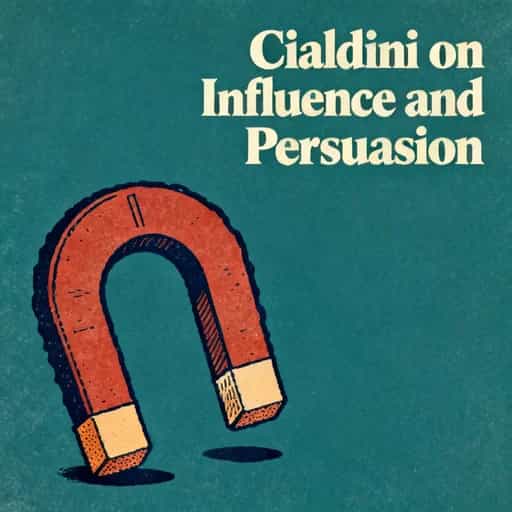
Discover the hidden psychology that makes you say "yes" in this legendary guide used by FBI negotiators and Fortune 500 CEOs alike. With over 30 translations and millions sold, Cialdini's six principles reveal why that "limited-time offer" is so irresistible.
Robert B. Cialdini, PhD, is the New York Times bestselling author of Influence: The Psychology of Persuasion and a globally recognized authority on the science of ethical persuasion. A Regents’ Professor Emeritus of Psychology and Marketing at Arizona State University, Cialdini’s groundbreaking work in social psychology explores themes of decision-making, behavioral economics, and human motivation.
His research-driven approach stems from years of immersive fieldwork, including undercover studies at sales organizations and fundraising groups.
Cialdini’s Influence, a cornerstone of marketing and psychology literature, introduced the iconic “Six Principles of Persuasion” (reciprocity, commitment, social proof, authority, liking, scarcity) and later expanded to seven with the unity principle. The book has sold over 5 million copies worldwide and been translated into 41 languages.
His follow-up works, including Pre-Suasion and Yes! 50 Scientifically Proven Ways to Be Persuasive, further cement his reputation as the “Godfather of Influence.” Through his institute, INFLUENCE AT WORK®, he trains organizations like Google and the NFL in ethical persuasion strategies. Cialdini’s research is required reading in top MBA programs and has earned him induction into the National Academy of Sciences.
Influence: The Psychology of Persuasion explores six universal principles that drive human compliance: reciprocity, commitment/consistency, social proof, liking, authority, and scarcity. Robert Cialdini uses decades of research to reveal how marketers, salespeople, and manipulators exploit these psychological triggers, while teaching readers to recognize and resist unethical persuasion tactics. The book combines academic rigor with real-world examples to decode decision-making shortcuts.
This book is essential for marketers, sales professionals, psychologists, and anyone interested in behavioral science. It’s equally valuable for general readers seeking to protect themselves from manipulation in daily decisions. Cialdini’s insights apply to negotiation, advertising, and even personal relationships, making it a versatile guide for understanding human behavior.
Yes—it’s a foundational text in behavioral psychology with over 5 million copies sold. The principles remain widely cited in marketing, management, and social sciences. Its blend of peer-reviewed research and engaging anecdotes (like why Tupperware parties work or how waiters upsell) ensures practical takeaways for professional and personal growth.
Cialdini’s six principles are:
These principles explain compliance tactics used in sales, politics, and social interactions.
Reciprocity leverages our innate urge to repay debts. For example, free samples or unexpected gifts (like a mint with a restaurant bill) increase purchase likelihood by 20-30%. Compliance professionals use “reject-then-retreat” tactics—starting with a large request before scaling down—to trigger reciprocal concessions.
Scarcity triggers loss aversion—a fear of missing out. Studies show items labeled “limited edition” or “last chance” see 50% higher demand. Cialdini explains how cookie jars with fewer cookies are perceived as tastier, and how sudden scarcity (e.g., “Only 2 left in stock!”) intensifies desire.
Cialdini advises pausing to assess whether a request aligns with genuine self-interest. For example, ask: “Would I want this if scarcity/authority/liking weren’t influencing me?” Recognize “commitment traps” (e.g., free trials that auto-renew) and question uninvited favors designed to trigger reciprocity.
The book cites laugh tracks boosting comedy show ratings, crowded restaurants attracting more diners, and charity donors listing previous contributors’ names. Cialdini also details how the “Werther effect”—copycat suicides after media coverage—reveals social proof’s dark side.
Cialdini’s research shows people obey authority figures even against their morals—like Milgram’s shock experiments where 65% administered lethal voltages when instructed. Titles (e.g., “Professor”), clothing (lab coats), and symbols (luxury cars) amplify perceived authority.
Critics argue the principles oversimplify complex behavior or are misused for manipulation. Some note cultural differences—e.g., authority deference varies globally. However, most praise its actionable framework, with Harvard Business Review calling it “the bible of behavioral influence”.
Pre-Suasion focuses on priming audiences before persuasion (e.g., setting mental frames), while Influence dissects real-time compliance tactics. Both emphasize ethical use, but Influence remains the entry point for foundational principles, whereas Pre-Suasion targets advanced practitioners.
Absolutely. For example:
Cialdini’s principles underpin modern strategies like influencer marketing (liking) and expert endorsements (authority).
Feel the book through the author's voice
Turn knowledge into engaging, example-rich insights
Capture key ideas in a flash for fast learning
Enjoy the book in a fun and engaging way
Our decisions are far less rational than we believe.
Expensive = valuable.
The first step toward freedom from manipulation is awareness.
Reciprocity: we feel obligated to repay what another person has provided us.
The key is distinguishing genuine gifts from manipulation.
Break down key ideas from Influence into bite-sized takeaways to understand how innovative teams create, collaborate, and grow.
Experience Influence through vivid storytelling that turns innovation lessons into moments you'll remember and apply.
Ask anything, choose your learning style, and co-create insights that truly resonate with you.

From Columbia University alumni built in San Francisco
"Instead of endless scrolling, I just hit play on BeFreed. It saves me so much time."
"I never knew where to start with nonfiction—BeFreed’s book lists turned into podcasts gave me a clear path."
"Perfect balance between learning and entertainment. Finished ‘Thinking, Fast and Slow’ on my commute this week."
"Crazy how much I learned while walking the dog. BeFreed = small habits → big gains."
"Reading used to feel like a chore. Now it’s just part of my lifestyle."
"Feels effortless compared to reading. I’ve finished 6 books this month already."
"BeFreed turned my guilty doomscrolling into something that feels productive and inspiring."
"BeFreed turned my commute into learning time. 20-min podcasts are perfect for finishing books I never had time for."
"BeFreed replaced my podcast queue. Imagine Spotify for books — that’s it. 🙌"
"It is great for me to learn something from the book without reading it."
"The themed book list podcasts help me connect ideas across authors—like a guided audio journey."
"Makes me feel smarter every time before going to work"
From Columbia University alumni built in San Francisco

Get the Influence summary as a free PDF or EPUB. Print it or read offline anytime.
Why did you buy that unnecessary kitchen gadget at 2 AM? Or agree to attend a party you had zero interest in? Welcome to the fascinating world of persuasion psychology, where invisible triggers guide our choices without our awareness. These mental shortcuts-which Robert Cialdini calls "weapons of influence"-operate like hidden buttons that, when pushed, produce almost automatic compliance. The insights emerged from Cialdini's three-year immersion as an "undercover researcher" among compliance professionals-car dealers, telemarketers, and fundraisers whose livelihoods depend on getting people to say "yes." What he discovered was both illuminating and disturbing: our decisions are far less rational than we believe. We rely on psychological shortcuts that evolved to help us navigate complexity but can be weaponized against us by those who understand them. Think about the jewelry store owner who accidentally doubled the price of turquoise jewelry that wasn't selling-only to find it sold out the next day. The customers, using the mental shortcut that "expensive = valuable," suddenly found the items irresistible. Or consider how people in line for a copy machine were equally likely to let someone cut ahead whether they said "because I'm in a rush" or merely "because I need to make copies"-the word "because" itself triggered automatic compliance, regardless of what followed it.
Ever wondered why supermarkets offer free samples? This taps into reciprocity-our deep-seated obligation to repay what others provide. This rule is so fundamental that it exists in every known society, evolving from early humans' need to safely share resources with the expectation of future returns. When leveraged for influence, this social mechanism becomes a powerful persuasion tool. The Hare Krishna Society proved this by giving airport travelers unwanted flowers before asking for donations-recipients often gave despite disliking the gift. Reciprocity works regardless of whether we wanted the initial favor. Studies show that giving subjects sodas increased compliance with requests-one soda boosted compliance by 65%, two by 107%. A clever variation is the "rejection-then-retreat" technique: making a large request followed by a smaller one. The apparent concession triggers reciprocity, making people more likely to accept the smaller request-which was the true aim.
Once we make a choice or take a stand, we face strong internal and external pressures to remain consistent with that commitment - even when it works against our interests. A New York beach experiment demonstrated this powerfully: people who agreed to "watch someone's things" actively chased down staged thieves, while those without this prior commitment rarely intervened. The Chinese military leveraged this principle during the Korean War with American prisoners. They started with small requests, like acknowledging minor problems with America, gradually escalating to full anti-American propaganda essays. Many prisoners eventually believed their own writings. Several factors strengthen commitment: written statements, public declarations, personal effort (like fraternity hazings), and especially the belief that we chose an action freely rather than through external pressure. This explains why car dealers use the "lowball" technique - offering an attractive price to secure commitment before raising it. Many customers still buy at the higher price because they've already internally committed to the purchase.
TV shows use laugh tracks because they work - audiences laugh more at jokes when accompanied by canned laughter. This demonstrates social proof: we determine what's correct by observing others' behavior. Social proof is strongest when we're uncertain and among people similar to us. This explains the bystander effect - during emergencies, people look to others to gauge the situation. If everyone appears calm while seeking cues, no one acts. This "pluralistic ignorance" contributed to Kitty Genovese's murder, where neighbors heard her screams but didn't call police, each assuming others would act. The consequences can be deadly. Research shows publicized suicides trigger increased suicide rates in similar demographic groups, with victims often copying the method. The Jonestown tragedy, where over 900 followers died drinking cyanide-laced Kool-Aid, demonstrates social proof's extreme power. Isolated and uncertain, followers became highly susceptible to social cues, creating a cascade of fatal compliance.
Tupperware parties succeed because we prefer saying yes to people we like. The success comes from friend hosts making requests, not from product demonstrations themselves. Several factors drive liking. Physical attractiveness creates a halo effect where good-looking people are seen as having other positive traits, doubling their persuasiveness. We also favor those similar to us in opinions, background, or lifestyle, which salespeople leverage by finding commonalities. Even obviously insincere compliments work because we tend to like those who like us. Car salesman Joe Girard became highly successful simply by sending "I like you" cards to customers. Contact and cooperation build liking when people work toward shared goals, though competitive situations can increase tensions. School desegregation cases showed both outcomes - prejudice in competitive environments but positive relationships through cooperation. Association links people to positive or negative things regardless of logic. This explains why we dislike bearers of bad news and why companies use celebrity endorsements. Sports fans demonstrate this by saying "we won" but "they lost" - claiming success while distancing from failure.
Why would experienced nurses prepare to administer dangerous medication doses based on a phone order? This reveals authority's extraordinary power over behavior. Stanley Milgram's famous experiments showed this clearly - 65% of subjects administered apparently lethal shocks when instructed by an authority figure in a lab coat. These weren't cruel people, just ordinary individuals overwhelmed by authority. Three key symbols trigger automatic deference: Titles carry immense weight, often exceeding actual expertise. People introduced as "Dr." are perceived as physically taller than without the title. Con artists exploit this using impressive but unverified credentials. Clothes convey authority through uniforms and professional attire. People more readily follow well-dressed strangers and comply with requests from those in uniforms versus casual clothes. Trappings like luxury cars and expensive accessories command respect. Drivers wait longer before honking at luxury cars than economy models blocking traffic. The real danger is authority's ability to bypass rational thought. When confronted with authority symbols, we often respond automatically rather than evaluating actual expertise, making us vulnerable to imposters.
The scarcity principle demonstrates that opportunities seem more valuable when less available. We judge scarce items as higher quality and resist losing access to them - a psychological reaction that begins in childhood. Sudden scarcity is especially effective. When BMW announced longer delivery times in West Germany, orders dramatically increased, causing wait times to triple. People consistently react more strongly to losses than equivalent gains. Competition intensifies scarcity's impact. Shoppers not only bought more "limited" beef but doubled purchases when told this information wasn't widely known. Restrictions increase desirability and credibility. Censored information, like excluded court testimony, carries extra weight. Banned books and films become both more attractive and persuasive - explaining the "Romeo and Juliet effect" where parental opposition often strengthens teenage relationships.