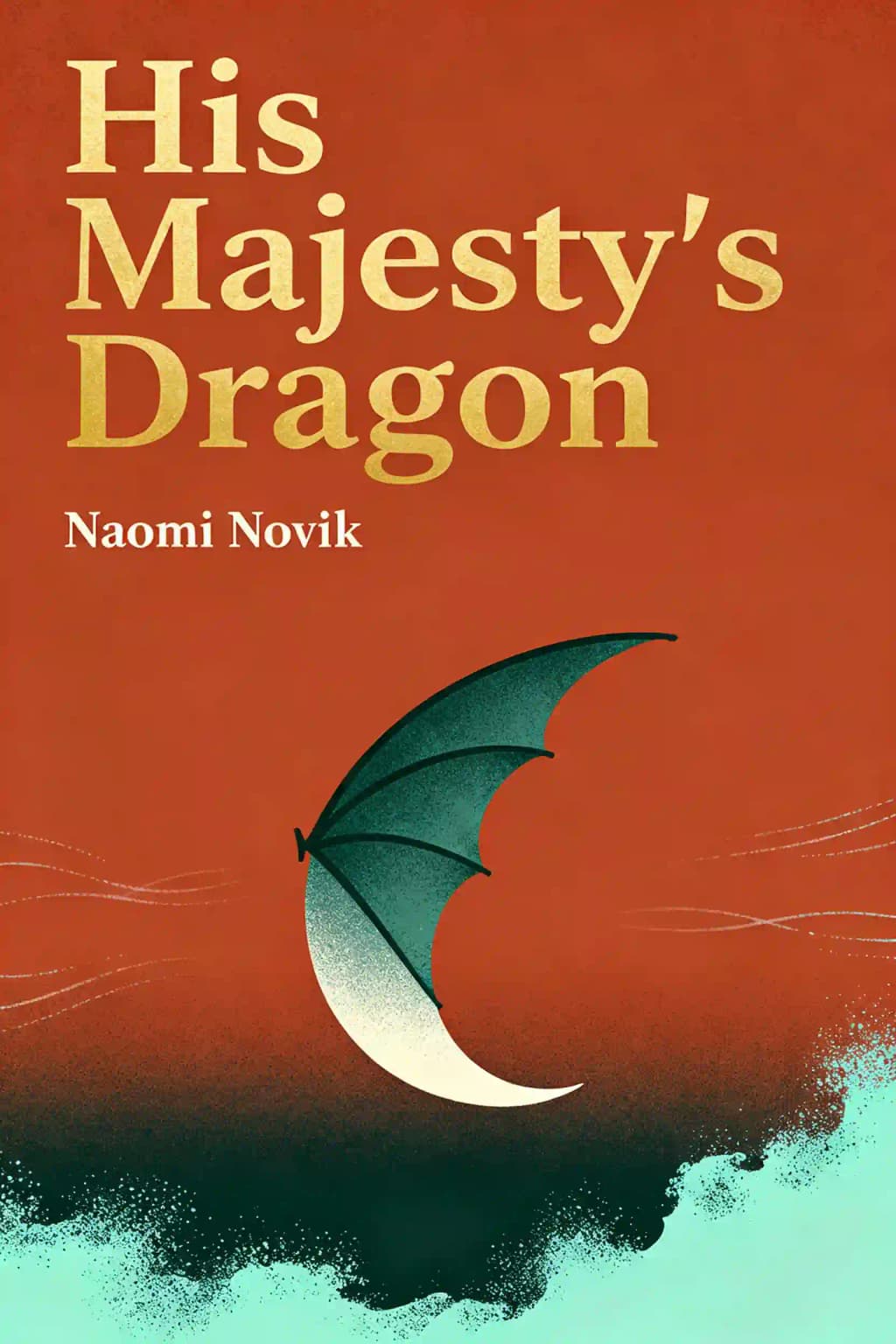
His Majesty's Dragon
Overview of His Majesty's Dragon
Napoleon's wars fought with dragons? Naomi Novik's Hugo-nominated debut reimagines history with aerial dragon combat, earning critical acclaim and spawning a nine-book fantasy phenomenon. What if our greatest military conflicts had been decided by magnificent, intelligent beasts of the sky?

Key Themes in His Majesty's Dragon
- napoleonic aerial combat
- interspecies telepathic bonds
- military culture shock
- alternate history warfare
- duty versus social-standing
Quotes from His Majesty's Dragon
"I do not want another captain."
Laurence discovers in Temeraire not just a military asset but a profound intellectual equal.
The Aerial Corps operates with shocking informality.
Laurence is appalled to learn dragons aren't regularly bathed.
His journey from outsider to respected aviator reflects the novel's broader theme.
Characters in His Majesty's Dragon
- Will LaurenceNaval captain turned dragon aviator
- TemeraireRare Chinese Imperial dragon and Laurence's bond
- GranbyLieutenant in the Aerial Corps
- LevitasA dragon encountered at the training covert
Download Summary of His Majesty's Dragon
Get the His Majesty's Dragon summary as a free PDF or EPUB. Print it or read offline anytime.
FAQs About This Book
His Majesty's Dragon by Naomi Novik is an alternate history fantasy novel set during the Napoleonic Wars where dragons serve as aerial combat forces. The story follows Captain William Laurence, a British naval officer who captures a French dragon egg that hatches and bonds with him, forcing him to leave the Navy and join the Aerial Corps. Together, Laurence and his dragon Temeraire navigate military life, forge an unbreakable bond, and defend England against Napoleon's forces in thrilling aerial battles.
Naomi Novik is an acclaimed American author of speculative fiction best known for the Temeraire series and standalone fantasies Uprooted and Spinning Silver. A first-generation American raised on Polish fairy tales, Novik holds degrees in English literature from Brown University and computer science from Columbia University. She has won numerous awards including the Nebula, Locus, and British Fantasy Awards. Novik is also a co-founder of the Organization for Transformative Works and the Archive of Our Own.
His Majesty's Dragon appeals to fans of historical fiction, fantasy, and dragon-focused narratives who crave unique worldbuilding. Readers who enjoy military strategy, detailed naval history, and the Napoleonic era will appreciate Novik's meticulous period details combined with fantastical elements. The book is perfect for those who love character-driven stories exploring duty, loyalty, and unlikely friendships. Fans of Patrick O'Brian's Aubrey-Maturin series or Anne McCaffrey's Dragonriders of Pern will find this blend of historical adventure and dragon companionship especially compelling.
His Majesty's Dragon is worth reading for its fresh take on dragon fantasy and historical fiction. The novel received mostly positive reviews for its unique premise, heartwarming relationship between Laurence and Temeraire, and impressive worldbuilding that seamlessly integrates dragons into Napoleonic warfare. While some readers found the pacing occasionally slow, most praised the engaging characters, creative aerial battle sequences, and thoughtful exploration of themes like prejudice and belonging. The book successfully launches a nine-book series that maintains reader interest throughout.
The relationship between Captain William Laurence and Temeraire forms the emotional core of His Majesty's Dragon. When the dragon hatches and chooses Laurence as his companion, it creates an unbreakable bond that transcends typical master-beast dynamics. Temeraire's naive, inquisitive personality contrasts with Laurence's rigid naval discipline, creating engaging character development. Their partnership evolves from duty into genuine friendship and mutual respect, with Laurence sacrificing his naval career, social standing, and engagement to honor his bond with Temeraire.
Temeraire possesses unique abilities that set him apart from ordinary dragons in His Majesty's Dragon. He demonstrates exceptional hovering capabilities that other dragons cannot match, proving crucial in aerial combat. Most significantly, Temeraire can emit a powerful subsonic roar that resonates with and destroys wooden structures—an ability unknown to the British until he uses it against Napoleon's troop-ships. He is later revealed to be a rare Celestial Dragon, the rarest breed that traditionally serves Chinese emperors, making his bond with Laurence politically explosive.
His Majesty's Dragon reimagines the Napoleonic Wars by integrating dragons as essential military forces across all nations. Instead of one-on-one dragon-rider pairs, Novik creates tactical aerial combat with full crews manning dragons equipped with harnesses, rifles, and coordinated formations. The novel transforms naval warfare strategies into three-dimensional aerial battles. The climax features Napoleon's innovative attempt to transport troops across the English Channel using dragon-lifted airships rather than traditional naval invasion, showcasing how dragon existence fundamentally alters historical military strategy and geopolitics.
His Majesty's Dragon explores themes of duty versus personal desire, as Laurence sacrifices his naval career and social status for Temeraire. The novel examines loyalty, identity, and belonging within the marginalized Aerial Corps, which faces prejudice from traditional military branches. Class and hierarchy emerge through the corps' unconventional structure, including female captains commanding acid-spitting dragons. Trust and sacrifice define the human-dragon bond, while political intrigue surrounding Temeraire's Celestial status raises questions about power, responsibility, and cultural expectations.
The Aerial Corps in His Majesty's Dragon operates under dramatically different social rules than the Royal Navy. Unlike the Navy's strict propriety, the Aerial Corps accepts female captains out of necessity, as certain dragon breeds prefer female companions. The corps faces social stigma and isolation, treated as outsiders by traditional military society despite their crucial defensive role. Aviators live communally with their dragons rather than maintaining naval formality, creating tight-knit teams. Laurence's transition highlights these cultural shocks, as his naval background and sense of propriety clash with the corps' more egalitarian, practical approach.
A Celestial Dragon in His Majesty's Dragon represents the rarest and most prestigious dragon breed in the world, traditionally bonded exclusively to Chinese emperors for centuries. Temeraire's identity as a Celestial creates international political tension, as the Chinese are furious that such a valuable dragon serves a British captain rather than their emperor. Celestial Dragons possess unique abilities including the devastating subsonic roar that Temeraire uses to destroy Napoleon's invasion fleet. This breed's rarity and symbolic importance drive much of the series' political intrigue.
Critics of His Majesty's Dragon note that some readers found the pacing slow, particularly in the training sequences, with limited action compared to expectations. Some felt the writing style seemed dated or overly formal, reflecting Laurence's stiff naval background. A few reviewers criticized the straightforward plot structure lacking major twists or surprises. The characters' tendency to resolve conflicts through understanding and acceptance struck some as unrealistically progressive for the historical period. Despite these critiques, most readers still recommended the book for its originality and engaging premise.
His Majesty's Dragon distinguishes itself from traditional dragon fantasy by featuring multi-person dragon crews rather than single riders, making aerial combat more realistic and tactical. Unlike Anne McCaffrey's Dragonriders of Pern or Christopher Paolini's Eragon, which focus on telepathic bonds in high fantasy settings, Novik grounds her dragons in historical reality with Napoleonic military structure. The book emphasizes team dynamics over individual heroics, with captains depending on their crews. Its alternate history approach and period detail also differentiate it from purely fantastical dragon narratives, appealing to historical fiction readers alongside fantasy enthusiasts.


