Chapter 1
The Cosmic Dance of Dragons and Destiny
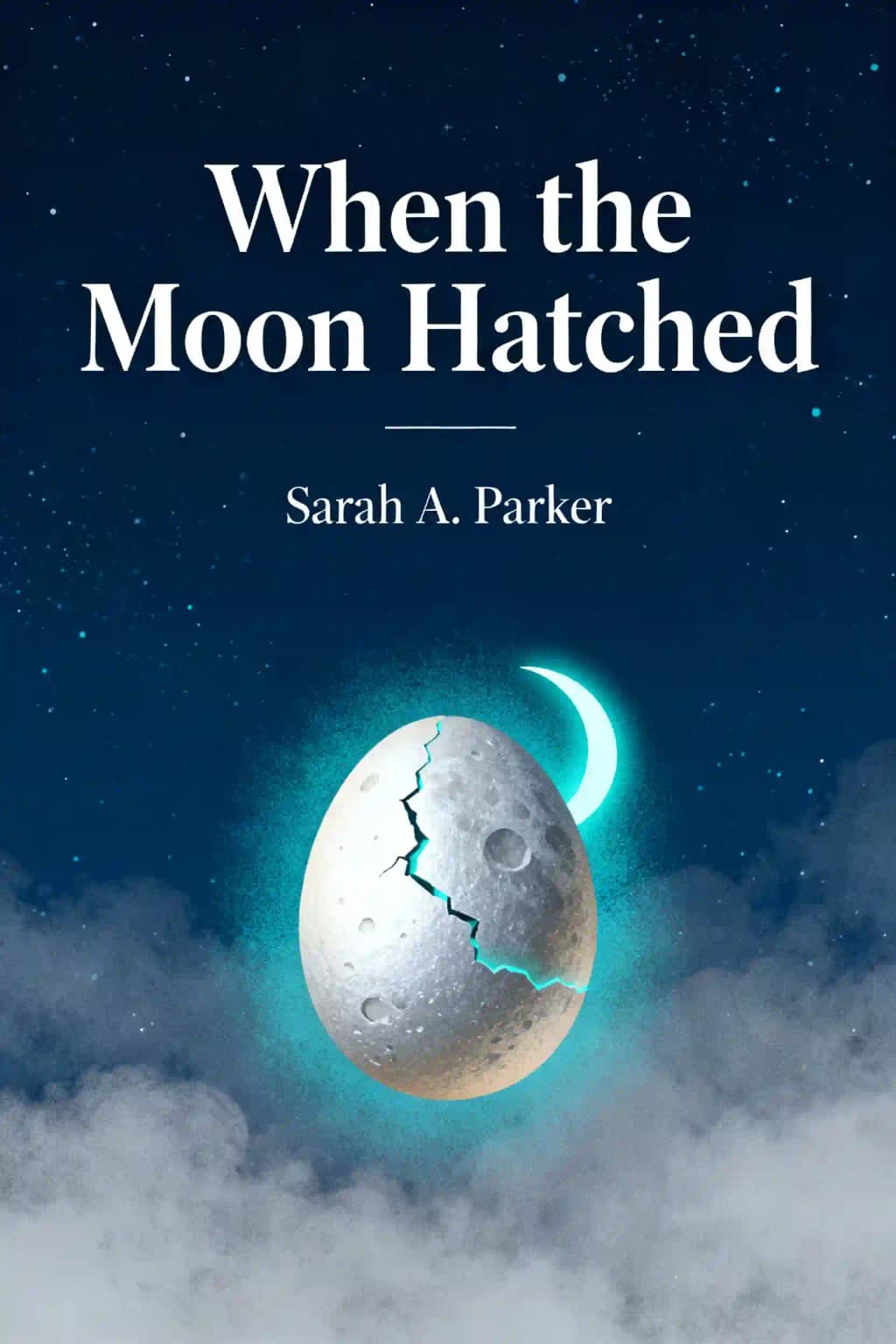
When the moon hatches, worlds collide. Sarah A. Parker's epic fantasy has captivated readers across continents, becoming a BookTok sensation with over 2 million views under its hashtag. This tale of dragons, magic, and forbidden love has been hailed as "Game of Thrones meets Crescent City" by The Fantasy Review. What makes this story particularly compelling is how Parker weaves complex world-building with deeply human emotions - creating a universe where calcified dragons become moons in the sky, and a woman's forgotten past holds the key to preventing catastrophic moonfalls. Even fantasy-skeptic celebrities like Florence Pugh have admitted being "completely consumed" by this universe where elemental magic and dragon lore intertwine with political intrigue and passionate romance.
Chapter 2
A World Divided by Light and Shadow
The world of "When the Moon Hatched" exists in perfect cosmic balance - half bathed in eternal sunlight, half shrouded in perpetual shadow, with a massive crystalline wall dividing the two realms where they meet. This great barrier, known as the Twilight Veil, stretches impossibly high into the atmosphere, its surface constantly shifting with prismatic patterns that reflect both light and darkness.
This world was shaped by five Creator deities, each bringing their own essence to forge reality. Caelis, the God of Aether, provided the invisible canvas of space-time itself, weaving the very fabric of existence. Bulder, the God of Ground, sculpted the terrain with methodical precision, creating everything from towering mountain ranges to crystalline caverns deep beneath the surface. Rayne, the Goddess of Water, filled the world's basins with oceans born from her eternal tears, each droplet containing memories of creation itself. Clode, the Goddess of Air, brought movement and life with her dangerous voice - her whispers becoming winds, her screams becoming storms. Ignos, the God of Fire, created volcanoes and thermal vents in his passionate pursuit of Clode, their eternal dance leaving trails of magma and ash across the landscape.
From this elemental foundation emerged the Fae - long-lived beings with pointed ears and sharp canines who could hear the elemental songs that still echo through creation. They built civilizations in harmony with these primal forces, developing distinct cultures in both the light and shadow realms. Most magnificent among all creatures were the three great dragon species: the fierce Sabersythes with black and bronze scales thriving in the volcanic heat of Gondragh; the colorful Moltenmaws inhabiting the twilight realm of Bhoggith in The Fade; and the ethereal Moonplumes with luminous skin flourishing in icy Netheryn.
When dragons began dying mysteriously, their massive bodies underwent a transformation that defied natural law - they calcified into crystalline forms that rose into the sky as moons, each one carrying the essence of its former life. However, these moons proved unstable, eventually falling to earth in devastating collisions that reshaped entire continents. After seven catastrophic moonfalls, the other gods discovered the terrible truth: Caelis's empty space was acting as a cosmic vacuum, pulling the dragon moons down from their celestial perch. In desperation, they trapped his essence within the Aether Stone - a gem of impossible depth set within a sterling diadem. This solution required a permanent guardian to contain Caelis's power, beginning a sacred lineage of chosen protectors.
For five million phases, peace reigned across both realms - the light and shadow existing in careful equilibrium. Cities flourished, trade routes connected distant lands, and the Fae developed complex societies adapted to their respective domains. Until, unexpectedly, another moon began its deadly descent, shattering the long-held peace and signaling the beginning of our story.
Chapter 3
The Assassin Known as Raeve
We first meet our protagonist as Kemori Daphidone, a veiled performer infiltrating the Hungry Hollow club. In reality, she is Raeve, an assassin for the rebellious Fiur du Ath ("From the Ashes"). Her target is Tarik Relaken, a despicable man who keeps null children captive for fighting pits. After a brutal execution where she carves a code into his chest marking his crimes, she takes his hand to free his captives.
Raeve's world is one of stark contrasts. The kingdom of The Fade was once filled with laughter and art but has devolved into a nightmare under King Cadok Vaegor's military obsession. The society is deeply divided - those with elemental magic wear colored beads signifying their powers, while "nulls" (those without magic) are marked, oppressed, and often conscripted. Raeve operates from the shadows, using her connection to the elemental goddesses Clode and Bulder to steal breath from her enemies and split the earth beneath their feet.
Her personal life is equally complex. She lives in a hidden den with Essi, a young woman she rescued from the Undercity years ago. Though they care deeply for each other, Raeve maintains emotional distance, believing that anyone she loves will inevitably die. "The folk I care about die," she reminds herself, refusing to acknowledge their mutual concern. This emotional wall extends to her handler Sereme, who controls Raeve through a painful rune that can torture her from a distance.
When Essi is murdered by bounty hunter Rekk Zharos as bait to capture Raeve, her carefully controlled world shatters. Consumed by grief and rage, she surrenders to "The Other" - a darker, more primal aspect of herself that emerges in moments of extreme emotion. This deadly alter ego slaughters Crown soldiers before Raeve is eventually captured and sentenced to death in the coliseum.
Chapter 4
The King of The Burn and the Mystery of Identity
Just as Raeve faces certain death in the coliseum, an enormous blood-colored Sabersythe dragon rescues her. She discovers her savior is Kaan Vaegor, King of The Burn and eldest of three royal brothers who rule the divided kingdoms. Kaan takes her to his realm of Dhomm, a surprisingly prosperous kingdom where nulls aren't mistreated but given educational opportunities.
Their relationship is immediately charged with tension - both antagonistic and undeniably attracted to each other. Kaan reveals a shocking truth: he believes Raeve is actually Elluin Raeve Nevan, a woman who supposedly died years ago. According to him, she fell from the sky and "hatched" from the calcified remains of a Moonplume dragon named Slatra.
Raeve fiercely denies this identity, yet finds herself drawn to a hidden cliff dwelling that feels inexplicably familiar. There, she discovers evidence of a past life with Kaan - a home they shared, filled with memories she can't consciously access. Despite her resistance, fragments of Elluin's memories begin to surface: her brother Haedeon's dangerous journey to steal a Moonplume egg, her parents' tragic deaths, and her own connection to a dragon named Slatra.
As these memories emerge, so does a profound realization: "I'm not back-not really," she tells Kaan. "This moment is a gift we either waste or treasure." Their romance blossoms in this hidden sanctuary, creating a bubble where "the rest of the world can't touch us." Yet shadows of the past loom large, particularly when Raeve encounters an injured Moonplume named Liri who was tortured by her enemy, Rekk Zharos.
Chapter 5
The Politics of Three Kingdoms
The world's political landscape mirrors its fractured geography, with three brothers wielding power over distinct realms that couldn't be more different in their governance and culture. Kaan, the eldest, rules The Burn from the golden city of Solaria with wisdom and compassion, fostering trade and protecting ancient knowledge in vast libraries. His people prosper through innovation and commerce, though some criticize his occasional hesitation to take decisive military action. The markets of The Burn buzz with merchants from across the realms, and its universities attract scholars from the farthest corners of the world.
Cadok, the middle brother, maintains an iron grip on The Fade through military might and systematic oppression. His capital of Steelhaven houses the realm's largest standing army - the infamous Iron Legion - whose black-armored soldiers patrol the streets and borders with mechanical precision. Public executions are common, and dissenters disappear into the notorious Shadowkeep prisons. Yet Cadok's military efficiency has also brought stability and protection from external threats, earning him a peculiar loyalty among his subjects.
Tyroth, the youngest, rules The Shade with calculated cruelty from the obsidian towers of Nighthaven. His network of spies - the Whisper Guild - ensures no secret remains hidden for long, and his court is a deadly dance of intrigue where favor can shift like morning mist. Those who curry his favor enjoy immense privilege, while those who fall from grace often meet mysterious ends in the labyrinthine streets below the palace.
Their father, King Ostern Vaegor, had masterfully orchestrated political marriages to consolidate power across the realms. His most controversial move was attempting to force the marriage of Elluin, a beloved scholar-princess from the neutral territory of Arithia, to Tyroth - despite her deep love for Kaan. This decision would set in motion events that would echo through generations.
Princess Kyzari's situation adds another layer to this complex political web. Raised as Tyroth's daughter in the cutthroat court of The Shade, she carries a burden few could imagine - the ability to communicate with Caelis, the imprisoned God of Aether, through her ceremonial diadem. Their secret conversations in the ancient tongue of the gods have blossomed into a forbidden romance, leading her to seek out Raeve's expertise in breaking divine seals. "The diadem can only be removed from a pulseless host," Raeve warns her grimly, but Kyzari's determination remains unshaken by the prospect of death.
The political powder keg threatens to explode with Raeve's discovery of Elluin's hidden diary in Arithia's Imperial Archives. Its tear-stained pages reveal a truth that could reshape the political landscape: Kyzari is actually Kaan's daughter, conceived in love but born in secrecy. Elluin had fled to Dhomm while carrying their child, knowing her own death approached, and Tyroth - for reasons yet unknown - chose to raise his brother's daughter as his own. This secret, if revealed, threatens not just family bonds but the delicate peace between the kingdoms.
The plot thickens with the Scavenger King's involvement, a mysterious figure controlling the lawless borderlands. His capture of Kyzari seems more than mere chance, especially given her striking resemblance to someone he calls his "Fire Lark" - a connection that hints at deeper ties to Raeve's own shadowed past. As these threads of family secrets and political ambitions interweave, Raeve must carefully navigate this treacherous landscape while pursuing her own quest for identity and survival.
Chapter 6
The Binding of Souls and the Price of Power
In this richly detailed world, relationships are formalized through sacred binding ceremonies, symbolized by the exchange of malmr pendants - intricate medallions forged from precious metals and imbued with ancestral magic. These ceremonies trace back thousands of years to the First Binding, when the ancient Skyhunters established the foundations of their society. When Raeve is forced to participate in a Tookah Trial by the traditionalist Johkull Clan, she discovers she bears the mark of the "Kholu" - a rare destiny that marks her as one who will bear children capable of "tethering the moons to the sky forever." This prophecy carries immense political and social implications, as the moons' stability ensures the balance of elemental magic throughout the realm.
Rather than accepting this predetermined fate passively, Raeve boldly challenges tradition by demanding to fight for herself in the arena - an unprecedented action for a Kholu. This decision sends ripples through the clan hierarchies and challenges centuries of established custom. The arena itself is a sacred space carved from ancient bloodstone, where binding ceremonies traditionally culminate in ritual combat.
When her opponent Hock employs forbidden blood magic and poisoned weapons during their combat, Kaan breaks protocol by intervening. In a moment that shocks the assembled clans, he offers his own malmr to Raeve, designating her as his roskr (his greater) - a complete inversion of traditional power dynamics that allows Raeve to maintain her autonomy while acknowledging their deep connection. Their relationship evolves from initial antagonism marked by cultural misunderstanding to a profound love that transcends clan boundaries, though both recognize that their union would upset delicate political alliances between the Sky Clans and the Desert Kingdoms.
Power in this world demands sacrifice at every level. Elemental magic requires physical connection to the deities through iron rings embedded in the flesh - rings that can be removed to access greater power but at the cost of severe physical trauma. The legendary Aether Stone diadem, worn only by the highest shamans, slowly drains its wearer's life force with each use, leaving them progressively weakened and vulnerable to their enemies. Even the sacred bonds between dragons and their riders exact terrible prices - as exemplified by the silver dragon Slatra, who followed her wounded rider across the Burning Plains despite the sun's rays searing her metallic scales, leaving her permanently blind and scarred but unwavering in her loyalty.
The novel intricately explores how these various bindings - political alliances, magical contracts, emotional connections - simultaneously constrain and empower the characters who bear them. Raeve's journey becomes a complex navigation of these competing forces as she breaks free from oppressive traditional bonds while choosing to forge new connections on her own terms. Each decision requires careful weighing of power gained against freedom lost, illustrating how true strength often lies not in avoiding bonds entirely, but in choosing which bonds to honor and which to break.
Chapter 7
Dragons: Majestic Beings of Elemental Power
Dragons are not mere beasts but majestic, intelligent creatures that form the cornerstone of the world's ecological balance and mythological heritage. These ancient beings possess consciousness that rivals or exceeds human intelligence, with the ability to form complex thoughts, experience deep emotions, and maintain generational memories that span centuries. The three distinct species - Sabersythes, Moltenmaws, and Moonplumes - each embody different elemental forces that shape the very nature of their respective territories.
Sabersythes, with their imposing black and bronze scales that shimmer like liquid metal in sunlight, are perfectly adapted to the scorching wastelands of Gondragh and share a deep connection to The Burn. Their scales can withstand temperatures that would melt steel, and their wingspans often exceed sixty feet at maturity. Kaan's dragon Rygun exemplifies their raw power - his landing force can splinter granite, and his roar carries for leagues across the desert. These dragons prefer to nest in volcanic calderas, where they harvest thermal energy directly from the planet's core.
Moltenmaws stand in stark contrast with their vibrant, feathered plumage ranging from crimson to azure. Native to the misty realm of Bhoggith in The Fade, they possess unique internal chambers that produce and store volatile gases, allowing them to unleash devastating plumes of blue-white flame hot enough to vaporize stone. Their feathers change color based on their emotional state - bright gold for aggression, deep purple for contentment.
The Moonplumes remain the most mysterious and ethereal of all dragons. Their translucent skin seems to capture and reflect moonlight, creating an otherworldly glow that illuminates the dark reaches of their icy domain in Netheryn. Unable to tolerate direct sunlight, they've developed extraordinary night vision and the ability to navigate using subtle magnetic fields. Their bodies maintain a constant temperature just above freezing, and they can survive in the most extreme arctic conditions.
The bond between dragon and rider transcends mere partnership, forming a psychological and spiritual connection that fundamentally alters both beings. This sacred bond manifests in shared emotions, synchronized breathing, and even shared dreams. When dragons die, their bodies undergo a remarkable transformation - calcifying and ascending to become new moons in the sky, a process known as the Stellar Ascension. While beautiful, this phenomenon has begun to destabilize the world's orbital mechanics, threatening catastrophic consequences.
Raeve's particular fascination with "Hae's Perch" - a small, asymmetrical silver moon formed from a Moonplume with a malformed wing - speaks to deeper, unconscious connections. The distinctive wobble in its orbit mirrors her own unstable identity, creating a poignant parallel between personal and celestial instability.
The novel uses dragons as powerful metaphors for societal issues, particularly through their mistreatment. When Raeve discovers Liri, a Moonplume subjected to horrific experiments by Rekk Zharos, her visceral reaction reveals both her own buried trauma and an instinctive connection to these creatures. Her confession about failing her Moonplume Slatra suggests that her fractured identity and lost memories are intrinsically linked to a severed dragon bond - a wound that continues to shape her character and motivations throughout the narrative.
Chapter 8
Memory, Identity, and the Self
At its core, this novel explores the nature of identity when memory fails. Raeve exists in a liminal space - neither fully her present self nor the Elluin she once was. "I'm gorging on the ancient scraps of a happiness that belonged to somebody else," she reflects, struggling to reconcile her fragmented past with her present reality.
Her journey involves both remembering and choosing which parts of herself to reclaim. When memories surface - triggered by music, touch, or familiar places - they arrive not as coherent narratives but as visceral sensations: "a feeling like coming home" or "an aurora rising in my chest." These emotional echoes suggest that identity persists even when explicit memories fail.
The novel also explores identity through doubling. Raeve's alter ego "The Other" represents a primal, vengeful aspect of herself that emerges in moments of extreme emotion. Princess Kyzari bears an "uncanny resemblance" to the Scavenger King's "Fire Lark," suggesting connections yet to be revealed. Even the dragons mirror aspects of their riders' personalities, forming external manifestations of internal traits.
Perhaps most poignantly, the novel asks whether we can truly start anew or if our past inevitably shapes our present. "This moment is a gift we either waste or treasure," Raeve tells Kaan, suggesting that even with fragmented memories, we can choose how to live now. Yet the persistent return of her past suggests that complete reinvention may be impossible - some connections run too deep to be severed by memory loss.
Chapter 9
Love as Both Vulnerability and Strength
Throughout the novel, love manifests as both a dangerous vulnerability and a profound source of strength, weaving through the narrative in increasingly complex patterns. Raeve initially maintains emotional distance as a survival strategy, believing that "loving Essi makes me feel like I'm handling something fragile that might break." Her fear proves devastatingly justified when Essi is brutally murdered specifically to wound Raeve - a tragedy that seems to validate her instinct for emotional isolation. Similarly, she actively resists her growing attraction to Kaan, recognizing that their opposing political allegiances and duties make any future together seem not merely unlikely but potentially catastrophic for their respective causes.
Yet love repeatedly emerges as an unexpected wellspring of resilience and power. Kaan's devotion to Elluin/Raeve spans more than two decades, surviving not only her apparent death but also her complete transformation into a different identity. "Raeve, you could flay me down the middle and I'd still fucking love you," he confesses in a moment of raw honesty. This unwavering commitment - tested through betrayal, war, and loss - gradually erodes her carefully constructed defenses, allowing her to risk emotional connection despite her well-founded fears. Their love becomes not just a personal bond but a force capable of reshaping political realities.
The novel presents a rich tapestry of different forms of love: the deep familial bond between Raeve and Essi, forged in childhood and strengthened through shared trauma; the passionate and complex romance between Raeve and Kaan that defies political boundaries; the fierce maternal protection Raeve feels toward the injured Moonplume Liri, surprising even herself with its intensity; and even the twisted but powerful devotion Princess Kyzari develops for the god trapped in her diadem. Each relationship illuminates different aspects of love's dual nature - its capacity to create both devastating vulnerability and extraordinary strength.
Perhaps most significantly, the novel explores how love persists beyond conscious memory, embedding itself in the body and soul. Even when Raeve cannot consciously recall her past with Kaan, her physical being remembers: "Your hands know me," she whispers during their midnight dance in the palace gardens. This embodied memory suggests that love creates connections deeper than rational thought or conscious recollection, forging bonds that survive even the most profound forgetting. The way her body responds to his presence - in combat, in dance, in moments of crisis - reveals that some truths exist beyond the realm of memory, in the very fabric of being.
Through these various manifestations, the novel suggests that while love may indeed make us vulnerable, it is precisely this vulnerability that allows for true strength - not the brittle strength of isolation, but the resilient strength of connection.
Chapter 10
When Worlds Collide: The Promise of Revolution
As the novel progresses, the stage is set for revolutionary change. The current political order - three brothers ruling separate kingdoms with varying degrees of cruelty and compassion - appears increasingly unstable. Raeve's discovery that Princess Kyzari is actually Kaan's daughter, not Tyroth's, threatens to upend the fragile balance of power. The Fiur du Ath rebellion continues to fight against Crown oppression in The Fade, while Princess Kyzari's desire to free the god Caelis from the Aether Stone could have catastrophic consequences.
The title "When the Moon Hatched" takes on multiple meanings as the story unfolds. Literally, it refers to Raeve's rebirth from Slatra's calcified form. Metaphorically, it suggests the hatching of new possibilities - political, personal, and cosmic. Just as the moons represent calcified dragons that might someday return to life, the rigid structures of this world appear poised for transformation.
The novel ends with multiple threads unresolved: Raeve's vendetta against Rekk Zharos; the truth about Princess Kyzari's parentage; the fate of the imprisoned god Caelis; and the political futures of the three kingdoms. Yet through these uncertainties runs a current of hope - that even in a world where dragons become moons and moons sometimes fall, new beginnings remain possible.
As Raeve reflects while gazing at her favorite moon: "Loving the moon feels safe - it'll always be there. Loving Essi makes me feel like I'm handling something fragile that might break." By the novel's end, she has begun to risk that fragility, choosing connection despite its dangers. In doing so, she embodies the central promise of the story - that even after catastrophic loss, new life can hatch from the calcified remnants of what came before.