Chapter 1
The Cosmic Dance of Light and Shadow
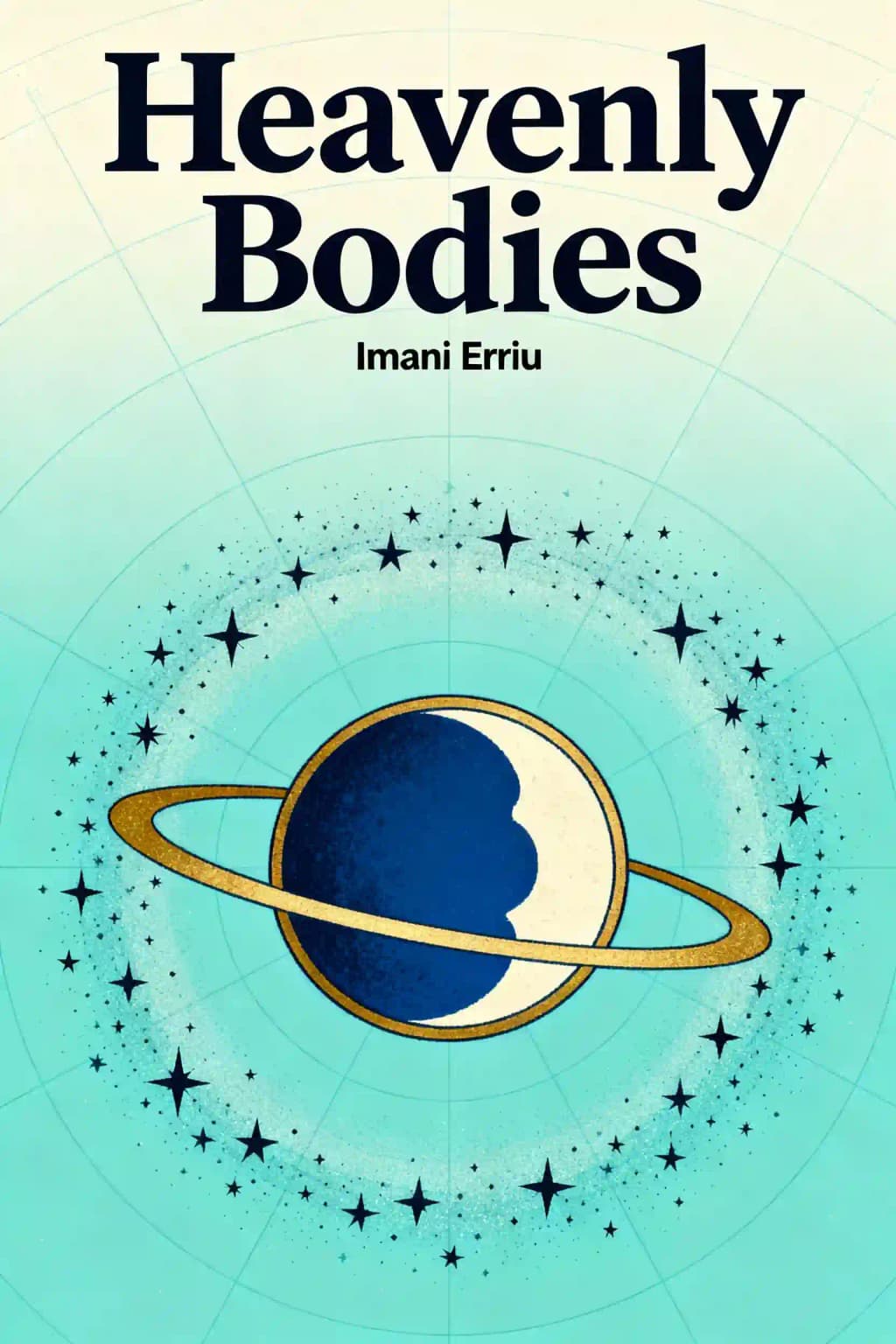
Have you ever wondered what would happen if the sun and moon fell in love? Imani Erriu's "Heavenly Bodies" answers this question with a breathtaking fantasy romance that has taken BookTok by storm, accumulating over 50 million views under its hashtag. This debut novel has captured readers' hearts with its enemies-to-lovers storyline set against a backdrop of celestial magic and divine warfare. Praised by Cosmopolitan as "the fantasy romance that will define a generation," the book has already been optioned for a major streaming adaptation, with celebrities like Florence Pugh and Timothee Chalamet rumored to be in talks for the lead roles. What makes this story so compelling isn't just its steamy romance, but how it explores themes of trauma, identity, and the courage to defy fate itself.
Chapter 2
A World Where Gods Walk Among Mortals
The world of Celestia is a realm where twelve celestial deities known as Stars rule as patron gods over different kingdoms. Each Star governs specific domains - Ariete controls war, Torra oversees pleasure, Gem and Eli manipulate knowledge and pain, and others command elements like earth, justice, oceans, and fate. These divine beings aren't distant figures but active participants in mortal affairs, sometimes blessing their chosen kingdoms and other times demanding terrible sacrifices.
The geography of this world reflects its divine influences. Helios, blessed by Leyon, basks in perpetual daylight with a deep red sky, while Asteria exists in eternal twilight under Ariete's patronage. Other realms like Aphrodea, known for its seduction and charm magic, and Neptuna, home to vicious merfolk, complete this rich tapestry of kingdoms.
What makes Celestia particularly fascinating is how magic manifests differently across regions. In Asteria, the royal family possesses three potential gifts: dreamwalking (the ability to enter others' dreams), shadow manipulation, and illusion creation. Meanwhile, Helion royalty can wield light, fire, and a unique ability to detect lies. This diversity of magical systems creates natural tensions between kingdoms with opposing powers, especially between light-wielding Helios and shadow-commanding Asteria.
The political landscape is equally complex. Kingdoms maintain uneasy alliances through royal marriages and treaties, but the Stars' unpredictable demands often disrupt these arrangements. The relationship between mortals and Stars is particularly nuanced - they're worshipped as gods but also feared as tyrants, creating a fascinating power dynamic where kings and queens must balance divine servitude with protecting their people from divine whims.
Chapter 3
A Princess of Shadows and Secrets
Our journey begins with Elara Bellereve, the crown princess of Asteria, who finds herself kidnapped on her eighteenth birthday after a violent attack at her celebration ball. Despite possessing dreamwalking and illusion abilities, she's unable to access her shadow manipulation powers, which have remained dormant since a traumatic childhood incident. Bound and disoriented, she's being transported across enemy lines by Helion soldiers led by General Leonardo Acardi, known as "The King's Thunderbolt."
Elara's character is immediately established through her mental compartmentalization of emotions - she imagines locking her fear away in an obsidian box in her mind, a coping mechanism that reveals both her trauma and resilience. When she briefly escapes in Sol, Helios's capital, she demonstrates her power by inflicting personalized nightmares on guards who attempt to assault her, showing both her magical prowess and her fierce determination to survive.
Upon reaching the magnificent Palace of Light with its towering spires and gold-streaked waterfall, Elara meets King Idris D'Oro and his son, Prince Lorenzo. Rather than execution, she faces a shocking proposal: King Idris wants her help to kill Ariete, the King of Stars - the very deity who murdered her parents. The irony isn't lost on her; her sworn enemy offers alliance against a common foe, leaving her with little choice but to accept this dangerous arrangement.
What makes Elara compelling is her complex moral positioning. She's neither purely heroic nor villainous but a survivor navigating impossible choices. Her royal upbringing has taught her diplomacy and strategy, yet her trauma has left emotional scars that manifest in her magic - particularly her inability to access her shadows. This creates a fascinating parallel between her magical journey and emotional healing that drives much of the narrative.
Chapter 4
The Prince of Light and Fire
Prince Lorenzo D'Oro, called Enzo by those close to him, initially appears as the arrogant, privileged heir to the Helion throne. His first interactions with Elara are hostile and dismissive, establishing their enemies-to-lovers dynamic. However, beneath this facade lies a complex character shaped by his father's abuse and the burden of royal expectations.
Enzo possesses "the Three" - all three magical gifts of his kingdom: light manipulation, fire summoning, and a special seer ability that allows him to detect lies and see through glamours. His reputation as "The Lion of Helios" precedes him, particularly his ruthlessness against Asterians in battle, which initially makes Elara view him as nothing more than a murderer.
What makes Enzo fascinating is how the narrative gradually peels back his layers. During training sessions with Elara, we glimpse his strategic mind and commitment to duty. When he takes her around Helios to show how light can nurture rather than destroy - creating forget-me-nots with his magic and showing her light sculptures - we see his artistic soul. And when Elara dreamwalks into his nightmare, witnessing King Idris whipping him with light while the numbers "333" (representing the Asterians he's killed) haunt him, we understand the guilt and trauma he carries.
Perhaps most revealing is the discovery that Enzo secretly warned villagers before the infamous Borderland Fires, ensuring everyone escaped safely while still appearing to follow his father's brutal orders. This act of quiet rebellion shows his true character - someone trying to maintain his humanity despite the cruelty demanded by his position.
The dynamic between Enzo and Elara evolves beautifully from mutual contempt to reluctant respect to genuine connection. Their opposing magics - his light and her darkness - create a literal and metaphorical tension that makes their eventual union all the more powerful. As Enzo tells Elara, "You look like the Light has made love to you," their attraction becomes not just physical but symbolic of the balance between their opposing elements.
Chapter 5
The Awakening of Power
Elara's journey to reclaim her shadow magic forms one of the book's most compelling arcs. Having lost access to her shadows after a traumatic childhood incident when a Helion soldier forced light down her throat, she's been incomplete for eighteen years. Her training with Enzo becomes not just about preparing to face Ariete but about confronting her deepest fears.
When conventional training fails, they visit Isra, an oracle with ice powers who attempts to access Elara's blocked shadows. During this session, Isra encounters not only Elara's trauma but a strange silver power within her that attacks Isra's magic. The oracle shares a disturbing vision: when Elara's chill magic combines with Enzo's fiery light, their flames will turn black and a Star will die. More troublingly, she reveals a prophecy that Elara "will fall in love with the King of Stars, and it will kill you both" - explaining why Ariete hunts her.
The breakthrough comes during a desperate moment when Enzo takes Elara to a cliff edge and threatens to jump unless she reveals what blocks her shadows. After her confession about the childhood attack, their training takes a different approach - Enzo showing her how light can create rather than destroy, helping her overcome her fear.
In a dramatic scene, Enzo convinces Elara that her shadows will only emerge if she truly believes she's going to die. He attacks her with his light magic, and when she still can't access her shadows, she deliberately provokes him until he sends her over a cliff edge. To her shock, Enzo jumps after her, and his willingness to sacrifice himself triggers something in Elara. When he commands her to "Spread your wings," her shadows finally burst forth, forming a massive winged shadow lion that carries them both skyward.
This moment represents not just magical awakening but emotional breakthrough - Elara's shadows emerge when she connects with someone willing to fall with her rather than let her fall alone. It's a beautiful metaphor for how vulnerability and trust can heal even the deepest wounds.
Chapter 6
Dreamwalking Between Worlds
Dreamwalking emerges as one of the most fascinating magical elements in the story. As a dreamwalker, Elara can enter others' dreams, visualizing her connection to her physical body as a midnight blue rope with silver patterns that serves as her tether to reality. The Dreamlands themselves are portrayed as a vast space filled with dreamer clouds, each containing someone's unconscious mind.
This ability creates intimate connections between characters that would be impossible in waking life. When Elara dreamwalks into Leonardo's dream, she witnesses his origin story - how he once tried to rob Prince Enzo as a boy but was offered sanctuary and training instead of punishment. This explains Leonardo's unwavering loyalty to Enzo and gives Elara insight into a side of her enemy she wouldn't otherwise see.
More significantly, Elara's dreamwalking into Enzo's nightmares creates profound intimacy between them. She witnesses his father's abuse and the guilt that haunts him over the Asterians he's killed in battle. Rather than judging him, she comforts him, showing him how to change his dreamscape and replace painful memories with better ones. This shared vulnerability becomes a turning point in their relationship.
Dreamwalking also serves as a communication tool when Elara uses her obsidian dagger to contact her sister Sofia through their connected shadows. This brief, urgent exchange reveals that Ariete has slaughtered many in the Asterian palace, including the entire King's Guard, and that Sofia herself has been hurt. The emotional impact of seeing her sister's projection after believing her possibly dead drives Elara's determination to return to Asteria despite the dangers.
Perhaps most poignantly, dreamwalking reveals that Elara and Enzo had met before as children - she had dreamwalked into his room when he was crying after being beaten by his father. Young Elara taught him a song her father sang to comfort her: "I loved him more than the dark loves the night. And he loved me more than the day loves the light-Lions may fly, and lovers will die-but my love, it will live on." This connection across time suggests their bond was fated long before they recognized each other as adults.
Chapter 7
The Masquerade of Royalty
The narrative reaches a turning point when Elara and Enzo defy King Idris's orders to attend Lukas Saintsombre's coronation and masquerade ball in Asteria. This event serves multiple purposes: Elara hopes to rescue her sister Sofia, while also facing the man who betrayed her by summoning Ariete on her birthday.
The ball sequence brilliantly uses the masquerade concept both literally and metaphorically. Physically disguised with masks and glamours, Elara (as "Nova") and Enzo (as "Alec") navigate the transformed ballroom that resembles a magical woodland with midnight blue trees and floating stars. Their dance to the Celestian Waltz becomes an intimate, charged experience as they spin beneath the twilight ceiling, momentarily forgetting their mission in each other's arms.
Yet the masquerade extends beyond physical disguises to the political performances required of royalty. Multiple Stars attend the ball, including the charming Leyon and the mysterious twin Stars Gem and Eli. Each interaction becomes a dangerous game of hidden identities and veiled threats. When Leyon warns Elara that "When you think you are a step ahead of him [Ariete], he is usually already three in front," the stakes of their deception become clear.
The ball culminates in Elara and Enzo discovering Sofia bound and gagged in the throne room, with Lukas sitting on the throne wearing a black crown, shadows swelling around him. After a brief confrontation where Enzo overpowers Lukas, Ariete himself arrives, greeting Elara as "lover" - a reference to the prophecy that haunts her. The King of Stars is portrayed as beautiful and terrifying with his black hair striped with red, burgundy eyes, and tattoos of playing cards, a circus tent, and grotesque war scenes covering his pale skin. The words "Divine Violence" inscribed under his left eye perfectly encapsulate his nature.
When Ariete effortlessly defeats Enzo and bites Elara with venomous fangs that paralyze her magic, the masquerade ends in disaster. Elara loses consciousness reaching toward Enzo's prone form, their brief triumph shattered by divine intervention.
Chapter 8
Divine Politics and Celestial Rebellion
As the story progresses, we discover that the relationships between the twelve Stars are far more complex than initially presented. Rather than a unified pantheon, they have their own politics, rivalries, and rebellions brewing beneath the surface.
Ariete, as King of Stars, rules through fear and dominance. His obsession with hunting Elara stems from the prophecy that she will fall in love with the King of Stars and it will kill them both - which he interprets as a threat to his power. His brother Leyon, the Patron Star of Helios, maintains a more playful relationship with mortals but clearly chafes under Ariete's rule.
The most significant revelation comes when Torra and Eli approach Elara, revealing themselves as part of a faction of Stars who oppose Ariete and seek to restore peace. They believe Elara and Enzo together have the power to vanquish Ariete - "when light and dark combine." Torra promises to serve Elara if she kills Ariete, calling her a "Starkiller," while Eli cryptically mentions "a light within your darkness" that she must find.
This celestial civil war adds depth to the world-building, transforming the Stars from distant deities to complex characters with their own motivations and conflicts. It also positions Elara and Enzo at the center of a divine power struggle that extends far beyond their personal vendetta against Ariete.
The revelation that Merissa, Elara's handmaid and friend, is actually Torra's half-Star daughter further complicates these divine politics. As Merissa explains, Stars can have children but rarely do because of the vulnerability it creates. Her minimal Star magic - a weak stream of rose starlight and some inherited charm abilities - makes her a bridge between the mortal and divine worlds, and her loyalty to Elara becomes crucial to the rebellion against Ariete.
Chapter 9
Betrayal and Sacrifice
The emotional core of the story reaches its climax when Elara and Enzo finally surrender to their feelings for each other, despite the prophecy that haunts them. After an intimate encounter in Enzo's studio where Elara discovers he's been sculpting her likeness with exquisite detail and care, they confess their love. Elara calls him "half her soul," promising to love him "until my last breath and beyond."
Their happiness is short-lived. When Ariete attacks the palace, Elara and Enzo prepare to face him together with the duskglass blade they created by combining their powers. However, in a devastating twist, Enzo appears to betray Elara, walking past her and placing the duskglass directly into Ariete's waiting hand. He reveals he has been deceiving her all along - using her as a bargaining chip, trading her life and his father's for the Helion throne.
This betrayal shatters Elara, who is dragged to the dungeons by Ariete. Alone in her cell, she collapses in overwhelming grief as memories of her time with Enzo assault her. The emotional pain becomes almost physical as her carefully locked box of suppressed emotions finally breaks open completely.
Yet this breakdown becomes breakthrough. In a powerful dreamscape sequence, Elara confronts her shadow self and realizes she must accept both her darkness and light: "The Dark cannot exist without the Light, nor the Light without the Dark." She understands she's neither villain nor hero - just herself, a girl who has lost, grieved, and found her way forward.
When she awakens with newfound power surging through her skin, Elara begins to question inconsistencies in Enzo's betrayal. When "Enzo" visits her cell, she notices subtle details wrong with his appearance - the scent of godslilies, a silver earring instead of gold. Revealing she had hidden the real duskglass blade in an illusion, she stabs the impostor, who transforms into Gem, the pale Star of trickery.
This revelation leads to Elara rescuing the real Enzo, who has been imprisoned in Idris's lucirium. Together, they confront King Idris, who has been taunting his son about his mother's death. With Elara's encouragement - "I killed my monster. It's your turn now" - Enzo finally stands up to his abusive father, declaring "I am not a little boy any more. Nor a prince. I am king. Long may I reign" before killing him with overwhelming fire magic.
Chapter 10
The Truth of Celestial Origins
The final confrontation with Ariete reveals the story's most profound twist. After a fierce battle where Elara demonstrates her newfound shadow powers, Ariete stabs Enzo in the stomach with a ram-hilted sword. As Elara cradles a dying Enzo, he offers her a small ball of his light, explaining that soulmates can share magic.
This exchange triggers a revelation: Elara and Enzo aren't just mortal enemies who fell in love - they are the Moon and Sun, ancient Celestes who ruled the heavens together before the Stars arrived. The Stars couldn't kill them but bound them to mortal bodies, forcing them to be reborn repeatedly without memory.
This cosmic truth recontextualizes everything - their instant connection despite being enemies, how their powers complement each other, and why Ariete has been hunting Elara. The prophecy that she would "fall in love with the King of Stars and it will kill them both" referred not to Ariete but to Enzo as the Sun, the original King of Stars before Ariete's usurpation.
In a final desperate act, Elara and Enzo combine their duskglass magic as they whisper "I defy the Stars" together. Though they manage to wound Ariete, he escapes with Enzo's golden tether - the connection to his soul - leaving him trapped in the Dreamlands while his body remains alive.
The epilogue reveals that Elara has reclaimed her power as the Moon, causing a new heavenly body to appear in the night sky for the first time in Celestia's memory. The once-burgundy night sky is now pitch black except for stars and skeletal moonlight, as Elara has fulfilled her promise to turn the world to darkness if Enzo was taken from her.
Rather than claiming the thrones of Asteria or Helios, Elara declares herself "Queen of the Stars-damned Universe" and vows to awaken the Sun, find the other Celestes, and make the Stars fall. This sets up the continuation of the series with a cosmic war between the original celestial beings and their usurpers.
Chapter 11
A Love That Defies the Stars
At its heart, "Heavenly Bodies" is a story about defying fate and finding identity through love. The enemies-to-lovers arc between Elara and Enzo transcends the typical romance trope to become something mythic - the reunion of cosmic forces that belong together.
Their journey from mutual hatred to reluctant alliance to deep love parallels their magical development. As Elara learns to embrace both her shadows and the mysterious silver light within her, Enzo discovers how to use his fire and light for creation rather than destruction. Their powers - initially opposed - become complementary, culminating in the creation of duskglass when their magic combines.
The revelation that they are the Moon and Sun reborn adds profound meaning to their relationship. Their love isn't just personal but cosmic, representing the natural order that was disrupted when the Stars seized power. Their defiance of the prophecy - "I defy the Stars" - becomes both a personal declaration of autonomy and a cosmic rebellion against those who usurped their rightful place.
What makes their love story particularly compelling is how it heals their individual traumas. Elara's compartmentalization of emotions - locking them away in mental boxes - gradually gives way to vulnerability as she learns to trust Enzo. Similarly, Enzo's guilt over the Asterians he's killed and his shame from his father's abuse finds redemption through Elara's acceptance and understanding.
The final image of Elara as the Moon, vowing to awaken the Sun and restore their rightful place in the cosmos, transforms their love story into a creation myth. Their reunion isn't just the happy ending of a romance but the potential rebirth of an entire world order - suggesting that love itself has the power to reshape reality.
Chapter 12
The Cosmic Balance of Power and Identity
Imani Erriu's "Heavenly Bodies" masterfully weaves together themes of power, identity, and destiny into a narrative that feels both intimate and cosmic in scale. Through Elara and Enzo's journey, we explore how power corrupts when divorced from compassion, how identity forms through both acceptance and defiance of our origins, and how destiny can be both embraced and transcended.
The contrast between the Stars' tyrannical rule and the balanced harmony of the original Celestes suggests that true power comes not from domination but from partnership. Ariete's need to control through fear and violence ultimately proves weaker than the combined strength of Elara and Enzo working in harmony. Their creation of duskglass - a substance capable of killing Stars - represents the alchemical power of opposing forces united in common purpose.
Identity emerges as a central theme through Elara's struggle to accept both her shadows and light. Her initial inability to access her shadow magic symbolizes her rejection of parts of herself deemed too dangerous or painful. Only by embracing her full nature - including her rage, grief, and desire - can she become whole. Similarly, Enzo must reconcile his public persona as the fearsome "Lion of Helios" with his private self who creates beautiful light sculptures and dreams of a more just world.
The revelation of their true celestial identities adds another layer to this theme. Both Elara and Enzo must integrate their mortal experiences with their cosmic origins, suggesting that identity is neither fixed at birth nor entirely self-created but an ongoing dialogue between our essence and our experiences.
Perhaps most powerfully, the story challenges the notion that destiny is inescapable. The prophecy that haunts Elara throughout the narrative - that she will fall in love with the King of Stars and it will kill them both - comes true but not in the way anyone expected. By reinterpreting rather than escaping their fate, Elara and Enzo demonstrate that prophecies, like identities, are subject to interpretation and reimagining.
As the first book in a series, "Heavenly Bodies" sets the stage for a cosmic conflict that promises to explore these themes on an even grander scale. The final image of Elara gazing at the stars with "venomous thoughts" about making them fall suggests that the true battle for the heavens has only just begun.