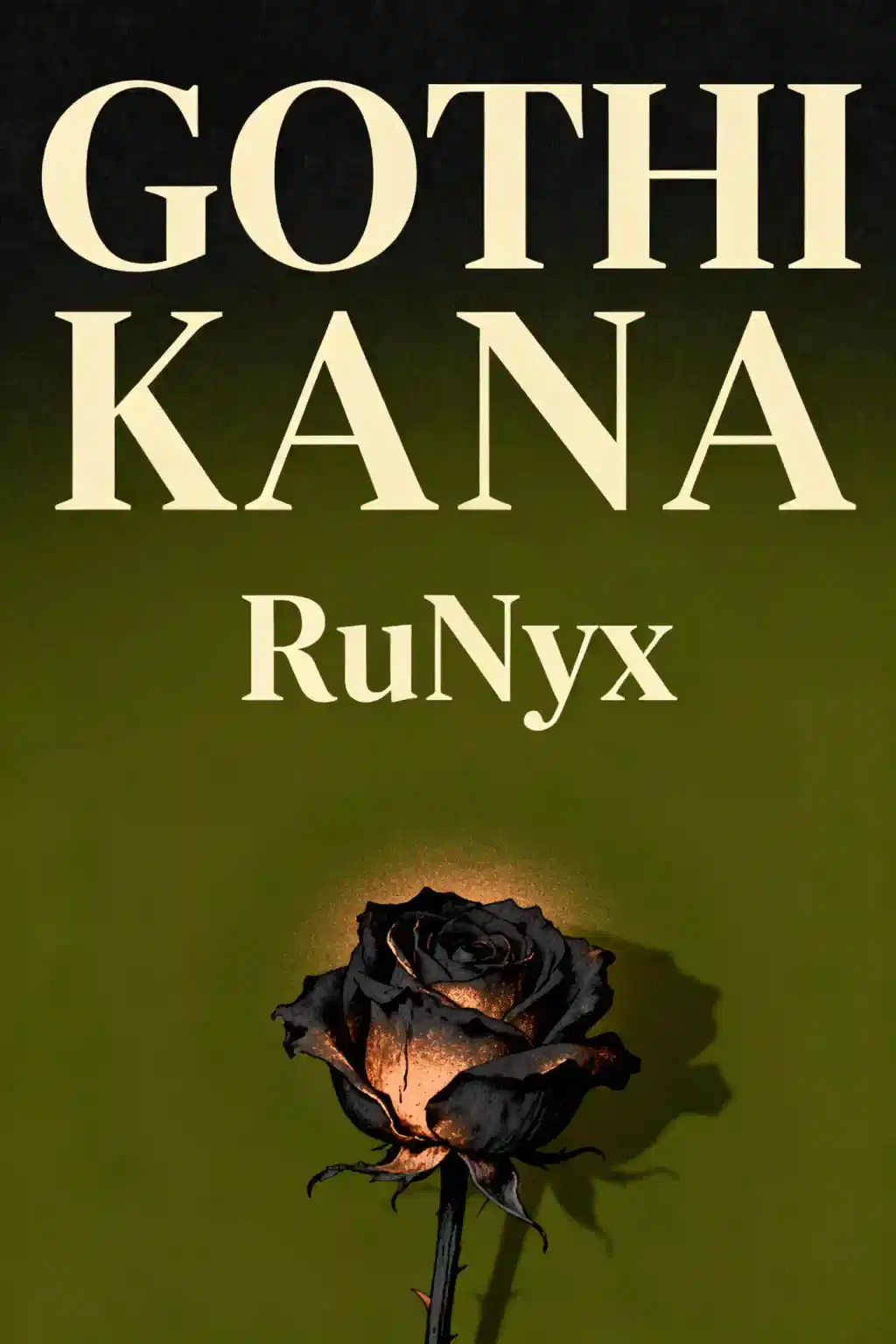
Dive into the gothic romance sensation that conquered BookTok and earned praise from Hannah Grace and L.J. Shen. "Gothikana" blends dark academia with steamy romance in a haunting world that's been translated into 10+ languages. What dark secrets await in RuNyx's bestselling masterpiece?
RuNyx is a New York Times and USA Today bestselling author of Gothikana, celebrated for her mastery of dark romance and gothic storytelling. The book exemplifies her signature style, blending gothic romance with dark academia through atmospheric settings, forbidden love, and spine-tingling mysteries within a secluded castle. Her writing explores the darker facets of passion with rich sensory prose and psychological intensity.
Best known for Gothikana and her widely acclaimed Dark Verse series, RuNyx has built a devoted international following since beginning her publishing journey in 2020. Writing emerged as her form of healing during a period of severe depression, transforming into a lifelong passion for crafting emotionally resonant stories. Her works span subgenres from dark contemporary to gothic to fantasy, published both traditionally and independently.
Her books have been translated into twenty languages and featured in major publications including the New York Times, USA Today, and Publisher's Weekly, cementing her position as a leading voice in contemporary dark romance fiction.
Gothikana by RuNyx is a dark academia gothic romance set at the mysterious University of Verenmore, an ancient castle harboring deadly secrets. The story follows Corvina Clemm, an outcast with violet eyes, who enrolls after her mother's death and becomes entangled with enigmatic professor Vad Deverell. Together, they investigate a century-old mystery where students disappear every five years, blending supernatural elements with forbidden romance.
RuNyx is a USA Today and international bestselling author known for creating dark, intense romance universes. She is particularly celebrated for her Dark Verse series and enjoys crafting stories with morally complex characters and atmospheric settings. RuNyx is intensely private but maintains a strong connection with readers through her emotionally charged, provocative storytelling that combines suspense, romance, and darker themes.
Gothikana by RuNyx is perfect for readers seeking dark romance with high spice levels (rated 5/5), gothic atmosphere, and supernatural mystery. This book appeals to fans of dark academia aesthetics, Beauty and the Beast retellings mixed with Dracula vibes, and readers who enjoy morally ambiguous characters. The publisher recommends it for ages 18+ due to explicit content and darker themes including mental health representation.
Gothikana by RuNyx receives mixed reviews but captivates readers who enjoy atmospheric gothic settings and intense romance. Fans praise its transportive dark academia aesthetic, spine-tingling mystery, and compelling sexual tension between leads. However, some readers criticize unanswered plot questions and loose threads in the mystery's resolution. Despite divisive opinions, many rate it five stars for its ability to keep readers guessing and its immersive castle setting.
The University of Verenmore in Gothikana by RuNyx is an ancient, secluded castle perched atop a mountain, serving as a mysterious collegiate boarding school. The castle is riddled with supernatural secrets, dark folklore, and a deadly pattern of student disappearances occurring every five years for over a century. Verenmore possesses inherent dangers tied to the mountain's magical properties, creating an atmospheric backdrop where paranormal activity and forbidden romance collide.
Gothikana by RuNyx explores themes of isolation and belonging, as outcast Corvina finds her place in the mysterious castle. The novel blends Beauty and the Beast dynamics with Dracula's gothic atmosphere, examining forbidden love between unlikely souls. Additional themes include the supernatural versus reality, self-discovery through darkness, and the dangerous pursuit of hidden truths. The story weaves together dark academia aesthetics with folklore, witchcraft, and the macabre.
Gothikana by RuNyx is rated 5 out of 5 chilies on spice meters, making it extremely explicit with high heat levels. Reviewers describe the sexual content as prominent, memorable, and sometimes "too dark" with intense dynamics between Corvina and Vad. The book is recommended for readers 18+ who are comfortable with explicit romantic scenes woven throughout the gothic mystery. Despite the high spice level, many readers note the plot remains compelling enough to stand independently.
Major criticisms of Gothikana by RuNyx include numerous unanswered plot questions and unresolved mysteries, frustrating readers expecting closure. Critics point to unexplained elements like character deaths, the thesis subplot, purple eyes, rituals, and magical lake, with vague explanations attributed to "the mountain is magical". Some readers found the prose lacking polish compared to RuNyx's later Dark Verse series and criticized the sudden romantic connection between leads. The book's representation of schizophrenia also drew negative feedback.
The central mystery in Gothikana by RuNyx revolves around students disappearing from Verenmore Castle every five years for over a hundred years. Corvina Clemm receives cryptic clues to unraveling this century-old pattern involving witches, rituals, a supernatural lake, and the forest surrounding the castle. While the mystery creates spine-tingling suspense and paranormal atmosphere throughout, many readers felt disappointed by the lack of concrete answers and broadly explained supernatural elements by the conclusion.
Gothikana by RuNyx differs from her Dark Verse series in genre and polish, serving as an earlier work before her bestselling mafia romance collection. While Dark Verse features contemporary organized crime settings, Gothikana embraces gothic dark academia with supernatural elements and a historical castle backdrop. Readers note the Dark Verse series demonstrates more refined writing and tighter plotting, though Gothikana showcases RuNyx's signature talent for creating atmospheric tension and enigmatic male leads. Both feature morally complex characters and high spice levels.
Corvina Clemm in Gothikana by RuNyx represents the witchy outsider who thrives in darkness rather than fearing it. With her violet eyes, affinity for tarot cards, crystals, and dark aesthetic, Corvina is specially suited for Verenmore's supernatural environment, vibing with the castle's creepy atmosphere. Her character embodies themes of finding belonging in unconventional spaces and embracing one's mysterious nature. After losing her mother, Corvina's journey involves self-discovery through paranormal experiences and forbidden love.
The atmosphere in Gothikana by RuNyx is intensely gothic, macabre, and spine-tingling, transporting readers to a haunted castle setting with masterful descriptive prose. The book creates genuine creepiness, particularly in lake scenes, blending dark academia aesthetics with paranormal dread that had readers "reading with the lights on". RuNyx crafts an immersive environment mixing the mystique of ancient stone corridors, supernatural occurrences, century-old secrets, and foreboding mountain isolation. The setting becomes a character itself within the gothic romance.
Feel the book through the author's voice
Capture key ideas in a flash for fast learning
it's a matter of many deaths.
They call Corvina witch-child.
it represents Corvina's passage from her mundane life into Verenmore's realm of shadows and secrets.
orphans, outcasts, and those marked by unusual events.
Jade describes him as the silver-eyed devil.
Ask anything, choose your learning style, and co-create insights that truly resonate with you.

From Columbia University alumni built in San Francisco
"Instead of endless scrolling, I just hit play on BeFreed. It saves me so much time."
"I never knew where to start with nonfiction—BeFreed’s book lists turned into podcasts gave me a clear path."
"Perfect balance between learning and entertainment. Finished ‘Thinking, Fast and Slow’ on my commute this week."
"Crazy how much I learned while walking the dog. BeFreed = small habits → big gains."
"Reading used to feel like a chore. Now it’s just part of my lifestyle."
"Feels effortless compared to reading. I’ve finished 6 books this month already."
"BeFreed turned my guilty doomscrolling into something that feels productive and inspiring."
"BeFreed turned my commute into learning time. 20-min podcasts are perfect for finishing books I never had time for."
"BeFreed replaced my podcast queue. Imagine Spotify for books — that’s it. 🙌"
"It is great for me to learn something from the book without reading it."
"The themed book list podcasts help me connect ideas across authors—like a guided audio journey."
"Makes me feel smarter every time before going to work"
From Columbia University alumni built in San Francisco

Get the Gothikana : a Dark Academia Gothic Romance summary as a free PDF or EPUB. Print it or read offline anytime.
Runyx's "Gothikana" has become a BookTok sensation, amassing over 500 million views under its hashtag and earning praise from celebrities like Kendall Jenner, who called it "the perfect blend of romance and gothic horror." This dark academia romance follows Corvina Clemm, a young woman with mysterious purple eyes who receives a scholarship to the enigmatic Verenmore University, where she falls for her brooding professor Vad Deverell. Set against a backdrop of ancient curses, disappearing students, and haunting voices, the novel explores themes of belonging, mental illness, and forbidden desire. What makes this story particularly compelling is how it blends supernatural elements with the very real struggles of finding one's identity while fearing inherited mental illness-a theme Runyx has revealed was inspired by her own experiences at a mountain boarding school where unexplained phenomena occurred.
The story begins with two parallel childhoods marked by isolation and strange premonitions, each unfolding in the shadow of supernatural forces. Seven-year-old Vad, residing in Saint Michael's Home for Boys - a stark Victorian structure on the outskirts of a declining industrial town - encounters Old Zelda during what should have been a joyous birthday celebration. The blind woman, known locally for her unsettling accuracy in predicting futures, grabs his arm with surprising strength, her milky eyes seeming to see beyond the physical world. Her prediction emerges in fragments between labored breaths: he will go to "a castle where none go" and find "purple eyes," warning cryptically that "it's a matter of many deaths." The other boys draw back, leaving Vad alone with this burden of prophecy - a moment that marks him as different and sets him apart from his peers. Meanwhile, young Corvina's childhood unfolds in a dilapidated cottage at the forest's edge, where she grows up under the watchful eye of her mother, Magdalena. The townspeople's whispers follow them everywhere - how Magdalena performs rituals at midnight, how strange lights flicker in their windows during new moons, how animals behave oddly near their property. They call Corvina "witch-child" because of her striking purple eyes, a trait unseen in the region's history. Her mother moves through their days like a ghost, speaking primarily in whispered conversations with unseen presences, only becoming fully present when teaching Corvina about herbs, moon phases, and the ancient ways. Their morning ritual of feeding crows becomes increasingly significant as Corvina grows older. In their small clearing, surrounded by ancient oaks, her mother explains that these aren't ordinary birds but vessels for ancestral spirits - watchers who guard their bloodline through generations. During the rare Ink Moon celebration - when the moon appears black against the star-filled sky - ten-year-old Corvina first hears the whispers herself. The voices speak in an old language she somehow understands, mixing prophecies with warnings, leaving her terrified of following her mother's path into what the villagers call madness. These parallel beginnings weave together the novel's central themes: the inexorable pull of destiny versus the desperate desire for self-determination, the thin line separating genuine supernatural phenomena from mental illness, and the profound isolation of those marked as different from birth. Both children develop complex coping mechanisms - Vad becomes fiercely rational, attempting to explain away Old Zelda's words, while Corvina develops a careful system of testing reality, counting crows and recording voices to distinguish between what others can and cannot perceive. Their childhood experiences shape them into outsiders, each carrying their own form of haunting - Vad by a prophecy whose meaning eludes him, and Corvina by voices that might represent either her inheritance of ancient power or the beginning of a descent into madness that claimed her mother.
When twenty-one-year-old Corvina receives a mysterious scholarship letter from the University of Verenmore, she sees it as an opportunity for a fresh start after years of isolation in her aunt's cramped apartment. The journey to this gothic university establishes the eerie atmosphere that permeates the novel, beginning with a fog-shrouded train ride through dense forest. As she travels up Mount Verenmore, her taxi driver Larry - a weathered local with deep worry lines - shares disturbing rumors about the university's dark past. It's housed in a haunted castle where students have gone missing without explanation, their belongings found arranged in peculiar patterns. Others have thrown themselves from the towers during full moons, though their bodies were never recovered. The imposing iron gates, adorned with intricate carvings of twisted creatures, are guarded by Oak - a mustached man whose friendly demeanor seems at odds with his unnaturally dark eyes and the ancient sword at his hip. This threshold marks more than just an entrance; it represents Corvina's passage from her mundane life into Verenmore's realm of shadows and secrets. The very air seems to change as she crosses this boundary, becoming thick with the scent of night-blooming jasmine and decay. When Corvina arrives at the enormous castle, she's immediately befriended by Jade, an energetic girl with startling white hair and emerald eyes that seem to shift color in different lights. Jade's offer to be her roommate comes with an infectious enthusiasm that makes Corvina momentarily forget her unease. This friendship represents Corvina's first chance at normal human connection after years of being shunned for her unusual abilities to sense others' emotions and see flickers of shadow where there should be none. Verenmore itself becomes a living, breathing character - a gothic masterpiece of architecture spanning seven centuries. Its grounds feature gardens where black roses bloom year-round, towers that seem to scrape the perpetually clouded sky, and gargoyles whose eyes appear to follow students across the courtyard. We learn it has about 2,000 students, all chosen from "odd circumstances" - orphans, outcasts, and those marked by unusual events. The university is funded by a secretive board of influential members whose names are never spoken aloud, making it exclusive but not elite in the traditional sense. The university's dark history emerges through whispered conversations and warning notes. Jade confirms that her previous roommate Alissa had thrown herself from the highest tower after a tumultuous secret relationship with Mr. Deverell, a doctoral student temporarily teaching first-year Ancient Mythologies. Jade describes him as the "silver-eyed devil" - a haunting figure with a premature streak of white in his black hair and an unsettling ability to appear silently in darkened hallways. This establishes both the dangerous reputation of Vad Deverell and the pattern of tragedy that seems to follow him like a shadow, setting up the central romantic conflict. Corvina will find herself inexplicably drawn to this man who may be dangerous or deadly - a man whose very presence makes the shadows in the corners of rooms grow deeper and more menacing.
As Corvina settles into life at Verenmore, the supernatural elements of the story begin to intensify with an almost suffocating presence. During her third week at the university, she follows a haunting melody through the tower's winding staircase, the notes drawing her upward like a siren's call. In a dusty attic room illuminated only by moonlight, she discovers Vad Deverell at an ancient grand piano, his fingers creating music that seems to bend reality itself. Their first encounter establishes both the magnetic attraction and inherent danger he represents - when his dark eyes meet hers, his command to leave carries such force that she feels physically compelled to obey. The novel's supernatural elements take on a more sinister tone when Jade reveals the blood-soaked history of "the Black Ball," a masquerade held every five years at Verenmore. For the past century, the ball has claimed victims with clockwork precision - a student vanishes during each celebration, leaving behind only a single black rose. Nearly twenty students have disappeared, their cases remaining unsolved despite extensive investigations. Even when the university attempted to break the cycle by canceling the ball for a decade, people still vanished on the same night, their disappearances marked by the same haunting signature. This establishes one of the central mysteries of the novel - what dark force has such a grip on Verenmore that even canceling its traditional venue cannot stop its harvest? Corvina's personal connection to the supernatural deepens through her relationship with Mo, the mysterious voice that has guided her since childhood. When a crow with unusually intelligent eyes leads her into the forbidden woods, Mo's familiar whispers encourage her to follow. The path takes her to a lake so dark it seems to swallow light, its surface unnaturally still despite the wind. Here, Corvina performs what feels like an ancient ritual, feeding the crow from her palm while speaking words that seem to rise unbidden from her subconscious. This scene establishes her as someone marked by older, deeper magic than even Verenmore holds. Professor Deverell's sudden appearance behind her at the lake creates a moment of electric tension. His warning about the woods' dangers carries multiple layers of meaning, especially when Corvina boldly confronts him about the rumors surrounding his own mysterious past. Their conversation is interrupted by a new voice - unlike Mo's warm, familiar presence, this voice belongs to a woman whose pleas for help carry the unmistakable taint of decay. The voice seems to rise from the lake itself, bringing with it the smell of rotting water lilies and the sensation of cold, dead fingers brushing against skin. These supernatural elements weave together to create a constant state of uncertainty. Corvina struggles to reconcile her experiences with rationality - are the voices evidence of the same mental illness that plagued her grandmother, who died in an asylum claiming to hear the dead? Or is she truly gifted with an ability to perceive the supernatural world that exists alongside our own? This ambiguity is further complicated by the discovery of her grandmother's journals, which contain eerily similar accounts of voices and visions, along with warnings about Verenmore written in increasingly frantic handwriting. The tension between supernatural truth and possible madness drives the narrative forward, leaving readers as uncertain as Corvina about which explanation is more terrifying.
The central romance between Corvina and Vad Deverell develops against a backdrop of danger and forbidden attraction. Their interactions are charged with tension from the beginning, with Vad warning her to "steer clear" of him with a provocative metaphor: "I'm a mad pirate and I'm trying to resist your call. If I land on your shores, I will plunder and take away everything worth having." Despite these warnings, their attraction intensifies. In a pivotal scene in the library, Professor Frost (Vad) appears while Corvina is searching for books, pressing her against the bookshelves in a moment of intense attraction. Despite knowing they shouldn't, they share an intimate moment where he touches her intimately, tasting her desire before pulling away. This establishes the pattern of their relationship-intense physical connection followed by Vad's attempts to maintain distance, which inevitably fail. Their relationship takes a significant turn during a trip to town when Corvina meets Vad at the driveway, noting his unusual light grey Henley instead of his typical black attire-a symbolic lightening of his dark persona. During their drive, they share personal details: Corvina reveals her mother is in a psychiatric institute, while Vad discloses he grew up in a boys' home before being adopted. This mutual vulnerability deepens their connection beyond mere physical attraction. As a storm approaches on their return journey, they surrender to their desires in the car, with Vad guiding Corvina through her first time with gentle dominance and passionate intensity. Their connection deepens as they surrender to their desire, with Vad calling her his "little witch" while she names him the "Devil of Verenmore." This consummation of their relationship marks a point of no return for both characters. The development of their romance parallels the intensification of the supernatural elements in the story, suggesting that their connection is both dangerous and fated. Their relationship breaks taboos-not just the prohibition against faculty-student relationships, but also the sense that they are crossing boundaries between the natural and supernatural worlds.
One of the most compelling aspects of "Gothikana" is its nuanced exploration of inherited mental illness and the psychological burden of genetic predisposition. Corvina lives with the constant dread that she will develop the same schizophrenia that afflicts her mother - a fear that manifests in her meticulous self-monitoring and hesitation to trust her own perceptions. This anxiety colors every aspect of her daily life, from her careful documentation of potential symptoms to her reluctance to form deep emotional connections. The novel delves deep into Corvina's family history of mental illness. Her mother's schizophrenia manifested in violent episodes and paranoid delusions, while her father's suicide - driven by persistent auditory hallucinations - left an indelible mark on her childhood. Through flashbacks and internal monologues, we learn about the voice named Mo that Corvina heard throughout her adolescence, a presence that both comforted and terrified her. The devastating decision to have her mother committed on her eighteenth birthday stands as a pivotal moment in her life, even though subsequent medical tests showed no signs of schizophrenia in Corvina herself. At Verenmore, the line between supernatural occurrence and potential mental illness becomes increasingly blurred. Corvina begins experiencing a cascade of unexplained phenomena: whispered conversations in empty rooms, shadowy figures in mirrors, and an overwhelming sense of being watched. These experiences mirror common early symptoms of schizophrenia, creating a masterful tension between psychological and supernatural explanations. The gothic setting of Verenmore itself becomes a character in this ambiguity - its ancient stones and dark histories either manifesting genuine paranormal activity or serving as catalysts for Corvina's potential mental decline. Vad's role in this narrative thread proves particularly significant. His declaration - "I am your beast. I am your madness. And you, you're my afterlife" - represents more than romantic devotion. It demonstrates an unconditional acceptance that Corvina has never experienced, especially regarding her fears of mental illness. His promise to stand by her, regardless of her potential diagnosis, challenges the stigma often associated with mental health conditions and offers a powerful counterpoint to her isolation. The novel's treatment of mental illness remains admirably complex throughout. Dr. Detta's final assessment of Corvina's condition - stable but at high risk due to her family history - reflects the real-world complexity of mental health prognosis. The story resists offering easy answers or magical cures, instead highlighting the importance of support systems, professional help, and self-acceptance in managing mental health concerns. This approach resonates particularly with readers who have experienced similar uncertainties about their own mental health predispositions or those of their loved ones. Through Corvina's journey, the novel examines how the fear of inherited mental illness can become its own form of haunting, sometimes more devastating than any supernatural threat. Her story raises important questions about identity, perception, and the complex interplay between genetic predisposition and environmental factors in mental health.
As the novel progresses, the dark history of Verenmore gradually comes to light, revealing connections between the past and present mysteries. The discovery of fifteen unmarked graves that Corvina suspects might belong to students from an old legend marks the beginning of this unveiling. The legend speaks of students who performed sacrificial rituals in the woods being lynched on the night of the Black Ball, and are said to haunt the grounds still seeking revenge. The mysteries deepen when Troy reveals disturbing local legends about "The Slayers," students who allegedly murdered villagers years ago. Troy has been investigating Verenmore's dark history through his part-time job delivering packages to town, where an old woman at the post office has connections to the past tragedies. A pivotal moment comes when Corvina meets Mrs. Remi at the post office, who shares local history about mysterious disappearances that once plagued the town-people vanishing every full moon night, allegedly taken by "Slayers" from the mountain who sacrificed them. Though the disappearances eventually stopped, strange events followed when students from the school began vanishing one by one. The most significant revelation comes when Vad reveals his true identity as the heir to Verenmore. He explains his dark past: abandoned as a child, adopted at thirteen by his grandfather who wanted an heir to Verenmore. At eighteen, his grandfather confessed the horrifying truth-he had been one of the original Slayers ninety years ago who murdered people in the woods, but then betrayed his friends by leading the group that lynched them. His grandfather feared a curse from a dying "witch" that the Slayers would hunt their killers from beyond the grave. This revelation connects the supernatural phenomena at Verenmore to its dark history, suggesting that the voices Corvina hears and the disappearances during the Black Ball may be connected to this ancient curse. It also explains Vad's presence at the university-he's there to investigate the suspicious activities, including the recent staged suicides, and potentially break the cycle of violence that has plagued Verenmore for generations.
The novel builds toward the Black Ball, a masquerade event that occurs every five years and coincides with an Ink Moon-a rare powerful full moon that Corvina was born under. This setting combines all the elements that have been building throughout the story: the supernatural connection to the moon, the history of disappearances, and the intensifying relationship between Corvina and Vad. Before the ball, Corvina and Ajax discover a horrific scene in a shack in the woods-a partially burned female corpse that has been there for some time. This discovery heightens the sense of danger surrounding the upcoming event and raises questions about who might be responsible for the ongoing violence at Verenmore. The ball itself is a sensual, darkly glamorous affair. Corvina dons a burgundy dress with a daring neckline and thigh-high slit-a gift from Vad-and enters the previously locked Main Hall Tower with its massive chandeliers, ancient torch-bearing pillars, and arched windows overlooking the woods. The setting creates a perfect blend of beauty and danger, mirroring the relationship between the protagonists. During the ball, Vad gives Corvina an amethyst ring that matches her eyes, with the silver setting matching his. The inscription from Dracula reads: "I will not let you go into the unknown alone." This exchange symbolizes their commitment to face whatever darkness lies ahead together. The climax comes when two students go missing during the ball-Jade and Roy. As search parties form, Corvina spots smoke coming from the ruins where she and Vad often meet. They discover Vad's beloved piano completely engulfed in flames-a seemingly personal attack. Roy is found floating in the lake, and Corvina bravely jumps in to save him despite her fear of the water from her dreams. The tension reaches its peak when Corvina begins hearing overwhelming voices commanding her to die and jump from the roof. Vad desperately tries to keep her conscious as she begins shutting down from sensory overload. This moment brings together the novel's central themes: the question of whether Corvina is experiencing supernatural phenomena or mental illness, the danger that has haunted Verenmore for generations, and the depth of Vad's commitment to protecting her.
The resolution of "Gothikana" offers both closure and new beginnings. After Corvina's breakdown during the Black Ball, she spends six months in the Institute. When she finally visits her mother, Celeste Clemm, whose schizophrenia and dementia have worsened, there's a moment of recognition when Celeste acknowledges Vad as the "Boy. Found" and "Boy. Safe." This emotional reunion confirms both Celeste's profound love for her daughter despite her mental illness and some supernatural awareness of Vad's connection to Corvina. In the corridor after the visit, Corvina expresses her fear of forgetting Vad someday like her mother has forgotten her. Vad reassures her with their familiar exchange: "You'll leave me when the roots of roses on your grave leave the roots of roses on yours." He reminds her that he is her "devil," her "madness," and her "mountain." This exchange reaffirms their commitment to each other regardless of what challenges they may face in the future. The epilogue reveals that five years after the Black Ball incident, Corvina and Vad are living in a cottage-mansion on Deverell family land not far from Verenmore. For the first time in a century, no one disappeared at the recent Black Ball, suggesting that the cycle of violence may have been broken. Vad reveals he's reversed his vasectomy as they discuss starting a family, indicating their hope for the future. In a final twist, Corvina surprises Vad with tickets to return to Verenmore, feeling it's time to reclaim their past and make the castle their home again, especially as they plan to have children. Despite its darkness, she believes it's where they both found themselves. This decision to return to the place of so much pain and danger represents their complete acceptance of their complex history and their determination to transform it into something positive. The novel's conclusion maintains the ambiguity that has run throughout-we never get a definitive answer about whether the voices Corvina hears are supernatural or symptoms of mental illness. Instead, the focus is on acceptance and support. Vad's commitment to standing by Corvina regardless of what challenges she may face represents the novel's ultimate message: that love can thrive even in darkness, and that acceptance of our whole selves-including the parts we fear-is the foundation of true connection.