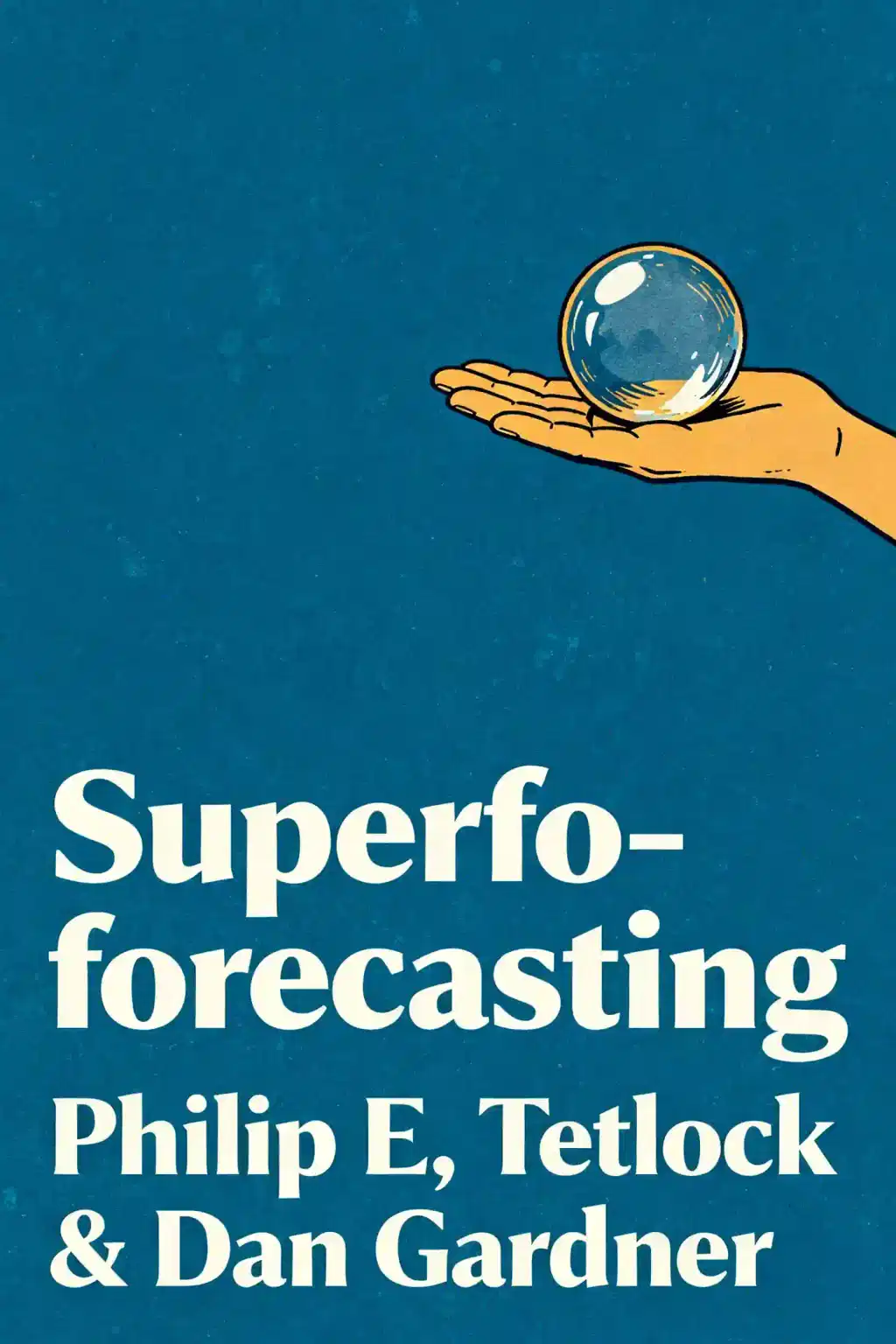
Superforecasting by Philip E. Tetlock & Dan Gardner Summary

Overview of Superforecasting
Discover why ordinary people outperformed intelligence agencies in Tetlock's groundbreaking forecasting research. Can prediction truly be learned? This NYT bestseller reveals the cognitive toolkit that helps superforecasters beat experts - even those with classified information at their disposal.
- Superforecasters beat experts by 60% using probabilistic thinking over yes/no predictions
- Break complex questions into smaller, testable parts using Fermi estimation techniques
- Update probability estimates weekly—not yearly—to incorporate new data and reduce bias
- Teams of forecasters outperform individuals by 23% through structured disagreement and aggregation
- Track prediction accuracy in scoring logs to identify cognitive blind spots systematically
- Seek "outside view" historical comparisons before analyzing unique-seeming events
- Replace overconfidence with precise percentage estimates (35% vs "maybe")
- The Good Judgment Project proves ordinary people can outperform intelligence agencies
- Combine fluid intelligence with growth mindset to achieve 30% better forecasts
- Apply "perpetual beta" mentality to predictions through continuous error analysis
- Balance inside-view expertise with outside-view statistical baselines for calibration
- Four keys to accuracy: talent-spotting, training, teaming, and mathematical aggregation
About the Author of Superforecasting
Philip E. Tetlock and Dan Gardner are the bestselling authors of Superforecasting: The Art and Science of Prediction, a groundbreaking exploration of decision-making and probabilistic forecasting. Tetlock, a Wharton School professor and political psychology expert, revolutionized understanding of prediction through his decades-long research, including the landmark Good Judgment Project, which identified non-experts outperforming intelligence analysts. Gardner, an award-winning journalist and author of Risk and How Big Things Get Done, brings a razor-sharp narrative style to translating complex research into actionable insights.
Their collaboration merges Tetlock’s academic rigor—honed through affiliations with the University of Pennsylvania and his Grawemeyer Award-winning work—with Gardner’s knack for distilling data-driven stories. The book, spanning psychology, behavioral economics, and cognitive science, reveals how "superforecasters" combine humility, curiosity, and analytical frameworks to improve accuracy.
Featured in The Economist, NPR, and The Wall Street Journal—which called it “the most important book on decision making since Kahneman’s Thinking, Fast and Slow”—Superforecasting has been translated into 20 languages and endorsed by figures like former U.S. Treasury Secretary Robert Rubin. Tetlock and Gardner’s work remains essential reading for professionals in finance, policy, and technology seeking to navigate uncertainty.
FAQs About Superforecasting
What is Superforecasting: The Art and Science of Prediction about?
Superforecasting explores how ordinary people achieve extraordinary prediction accuracy through structured reasoning, probabilistic thinking, and continuous belief updating. Authors Philip Tetlock and Dan Gardner analyze findings from the decade-long Good Judgment Project, revealing techniques like "Fermi-izing" complex questions and using "dragonfly forecasting" to synthesize multiple perspectives. The book challenges the myth of expert infallibility while providing actionable strategies for improving foresight.
Who should read Superforecasting?
This book suits professionals in finance, policy analysis, and strategic planning who need to assess risks, plus anyone interested in decision-making psychology. Leaders managing uncertainty and self-improvers seeking to reduce cognitive biases will find practical frameworks like probabilistic forecasting and belief updating invaluable.
Is Superforecasting worth reading in 2025?
Yes – its evidence-based approach to geopolitical, economic, and technological forecasting remains vital in our AI-driven era. The 2025 reader gains tools to navigate misinformation and rapid change, with studies showing superforecasters outperforming intelligence analysts by 60% even a decade after publication.
What distinguishes "foxes" from "hedgehogs" in forecasting?
Foxes aggregate diverse viewpoints, express probabilities precisely, and revise forecasts frequently. Hedgehogs rely on single ideological frameworks, make bold yes/no predictions, and resist updating beliefs. Tetlock's research shows foxes consistently outperform hedgehogs across 20 years of geopolitical forecasting.
How did the Good Judgment Project prove superforecasting works?
This US government-funded study (2011-2015) demonstrated that crowdsourced forecasters using structured techniques beat CIA analysts with classified data. Top performers achieved 60% greater accuracy than professionals by applying belief updating, Fermi problem-solving, and collaborative error-checking.
What is "Fermi-izing" in prediction?
Named after physicist Enrico Fermi, this technique breaks complex questions into smaller, answerable components. For example, estimating pandemic spread by analyzing:
- Transmission rates
- Vaccine development timelines
- Government response effectiveness
This method reduces overconfidence and enables granular probability assessments.
Why is belief updating crucial for accurate forecasting?
Superforecasters revise predictions 2-3x more frequently than average forecasters. They treat opinions as "hypotheses in need of testing," systematically adjusting probabilities as new data emerges. This counters confirmation bias – a key reason why 72% of experts underperform basic prediction algorithms.
What does the "dragonfly mindset" entail?
Inspired by insects' multi-lens vision, this approach synthesizes contradictory perspectives into unified forecasts. Practitioners:
- Gather opposing viewpoints
- Identify valid arguments in each
- Create weighted probability models
This prevents single-narrative thinking while maintaining decisiveness.
What are key Superforecasting quotes and their meanings?
"Strong views, weakly held" Advocates conviction in current forecasts while remaining open to disconfirming evidence.
"The fox knows many things..." Highlights the predictive advantage of eclectic knowledge over ideological rigidity.
"Forecast, measure, revise" Encapsulates the core three-step improvement cycle used by top forecasters.
How does teamwork enhance forecasting accuracy?
Groups beat individual superforecasters by 23% through:
- Cross-examination of assumptions
- Aggregation of diverse knowledge pools
- Dynamic probability averaging
The book details structured collaboration techniques like prediction markets and Bayesian updating pools.
What criticisms exist of Superforecasting?
Some argue its methods:
- Require unsustainable time investments for busy professionals
- Struggle with "black swan" events lacking historical data
- Overemphasize quantifiable predictions over qualitative insights
However, 85% of corporate users report measurable decision-making improvements from adopting its frameworks.
How does Superforecasting compare to Thinking, Fast and Slow?
While Kahneman explores cognitive biases broadly, Tetlock provides specific tools for improving predictions. Superforecasting offers more actionable frameworks like Fermi decomposition and belief calibration scales, making it preferred by practitioners needing operational methods over theoretical insights.
Feel the book through the author's voice
Turn knowledge into engaging, example-rich insights
Capture key ideas in a flash for fast learning
Enjoy the book in a fun and engaging way
Key Themes in Superforecasting
Quotes from Superforecasting
Beliefs are hypotheses to be tested, not treasures to be guarded.
Good judgment depends on knowing things, but also on how one thinks.
Our minds rush to judgment and resist changing course, even when wrong.
If it feels true, it is.
Characters in Superforecasting
Quick Summary Mode - Read or listen to Superforecasting Summary in 10 Minutes

Break down key ideas from Superforecasting into bite-sized takeaways to understand how innovative teams create, collaborate, and grow.

Flash Card Mode - Top 10 Insights from Superforecasting in a Nutshell

Distill Superforecasting into rapid-fire memory cues that highlight key principles of candor, teamwork, and creative resilience.

Fun Mode - Superforecasting Lessons Told Through 24-Min Stories

Experience Superforecasting through vivid storytelling that turns innovation lessons into moments you'll remember and apply.
Personalize Mode - Read or listen to Superforecasting Summary in 0 Minutes

Ask anything, pick the voice, and co-create insights that truly resonate with you.

From Columbia University alumni built in San Francisco
"Instead of endless scrolling, I just hit play on BeFreed. It saves me so much time."


"I never knew where to start with nonfiction—BeFreed’s book lists turned into podcasts gave me a clear path."


"Perfect balance between learning and entertainment. Finished ‘Thinking, Fast and Slow’ on my commute this week."
"Crazy how much I learned while walking the dog. BeFreed = small habits → big gains."
"Reading used to feel like a chore. Now it’s just part of my lifestyle."

"Feels effortless compared to reading. I’ve finished 6 books this month already."
"BeFreed turned my guilty doomscrolling into something that feels productive and inspiring."

"BeFreed turned my commute into learning time. 20-min podcasts are perfect for finishing books I never had time for."
"BeFreed replaced my podcast queue. Imagine Spotify for books — that’s it. 🙌"

"It is great for me to learn something from the book without reading it."
"The themed book list podcasts help me connect ideas across authors—like a guided audio journey."
"Makes me feel smarter every time before going to work"
From Columbia University alumni built in San Francisco
"Instead of endless scrolling, I just hit play on BeFreed. It saves me so much time."
"I never knew where to start with nonfiction—BeFreed’s book lists turned into podcasts gave me a clear path."
"Perfect balance between learning and entertainment. Finished ‘Thinking, Fast and Slow’ on my commute this week."
"Crazy how much I learned while walking the dog. BeFreed = small habits → big gains."
"Reading used to feel like a chore. Now it’s just part of my lifestyle."
"Feels effortless compared to reading. I’ve finished 6 books this month already."
"BeFreed turned my guilty doomscrolling into something that feels productive and inspiring."
"BeFreed turned my commute into learning time. 20-min podcasts are perfect for finishing books I never had time for."
"BeFreed replaced my podcast queue. Imagine Spotify for books — that’s it. 🙌"
"It is great for me to learn something from the book without reading it."
"The themed book list podcasts help me connect ideas across authors—like a guided audio journey."
"Makes me feel smarter every time before going to work"
"Instead of endless scrolling, I just hit play on BeFreed. It saves me so much time."
"I never knew where to start with nonfiction—BeFreed’s book lists turned into podcasts gave me a clear path."
"Perfect balance between learning and entertainment. Finished ‘Thinking, Fast and Slow’ on my commute this week."
"Crazy how much I learned while walking the dog. BeFreed = small habits → big gains."
"Reading used to feel like a chore. Now it’s just part of my lifestyle."
"Feels effortless compared to reading. I’ve finished 6 books this month already."
"BeFreed turned my guilty doomscrolling into something that feels productive and inspiring."
"BeFreed turned my commute into learning time. 20-min podcasts are perfect for finishing books I never had time for."
"BeFreed replaced my podcast queue. Imagine Spotify for books — that’s it. 🙌"
"It is great for me to learn something from the book without reading it."
"The themed book list podcasts help me connect ideas across authors—like a guided audio journey."
"Makes me feel smarter every time before going to work"
"Instead of endless scrolling, I just hit play on BeFreed. It saves me so much time."
"I never knew where to start with nonfiction—BeFreed’s book lists turned into podcasts gave me a clear path."
"Perfect balance between learning and entertainment. Finished ‘Thinking, Fast and Slow’ on my commute this week."
"Crazy how much I learned while walking the dog. BeFreed = small habits → big gains."
"Reading used to feel like a chore. Now it’s just part of my lifestyle."
"Feels effortless compared to reading. I’ve finished 6 books this month already."
"BeFreed turned my guilty doomscrolling into something that feels productive and inspiring."
"BeFreed turned my commute into learning time. 20-min podcasts are perfect for finishing books I never had time for."
"BeFreed replaced my podcast queue. Imagine Spotify for books — that’s it. 🙌"
"It is great for me to learn something from the book without reading it."
"The themed book list podcasts help me connect ideas across authors—like a guided audio journey."
"Makes me feel smarter every time before going to work"

Get the Superforecasting summary as a free PDF or EPUB. Print it or read offline anytime.





![[PDF] Toward a Theory of Behavioral Operations - Harvard Business School](/_next/image?url=https%3A%2F%2Fd1y2du6z1jfm9e.cloudfront.net%2Fassets%2Fpodcast%2Fblue.png&w=1024&q=50)