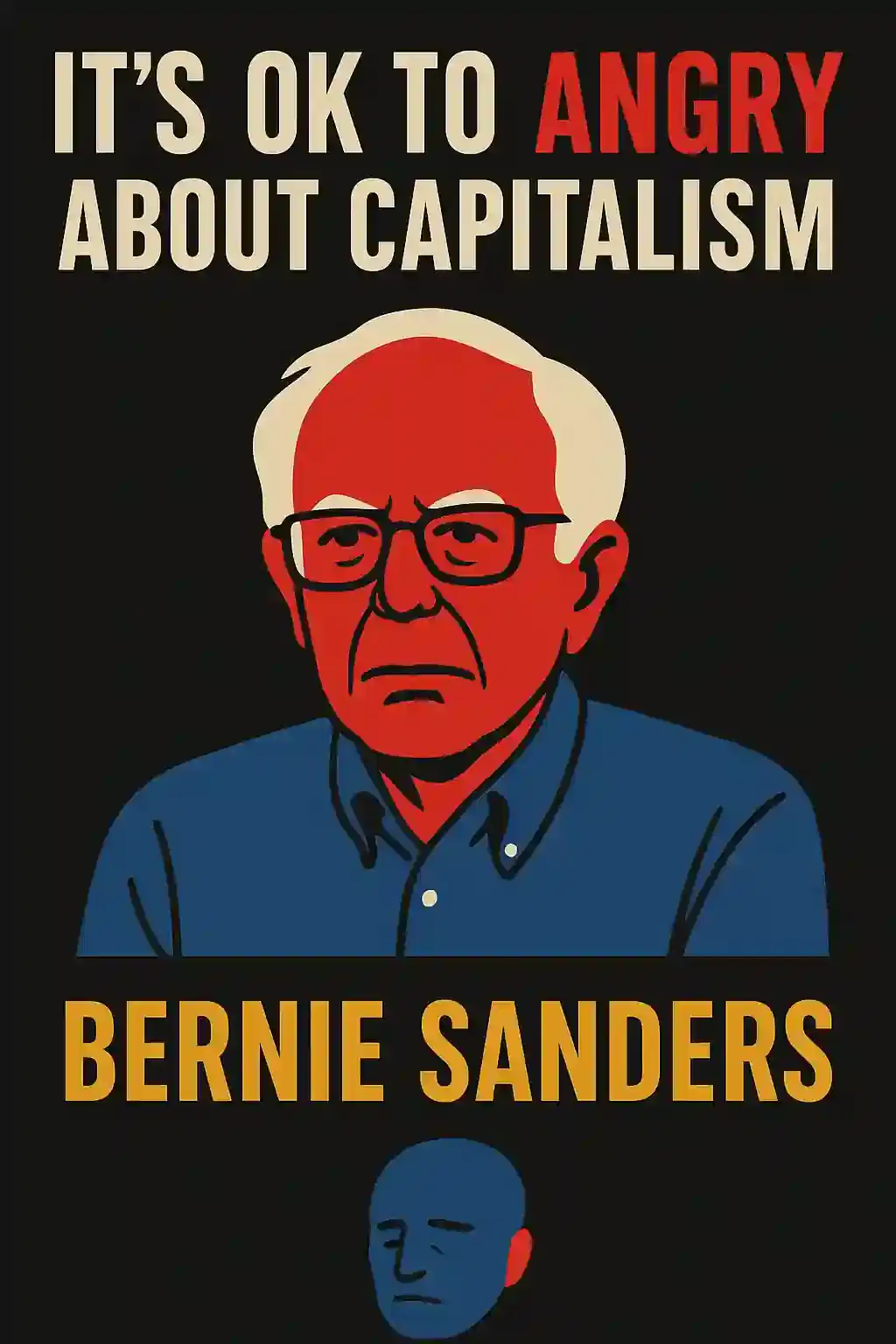
It's OK to Be Angry about Capitalism by Bernie Sanders Summary

Overview of It's OK to Be Angry about Capitalism
Bernie Sanders' fiery manifesto exposes capitalism's rigged game, resonating with progressives nationwide. British journalist Owen Jones declares, "Sanders has changed US politics forever." Beyond critique, it's a rallying cry for grassroots movements challenging corporate power and economic inequality.
- Bernie Sanders argues unfettered capitalism prioritizes corporate greed over public good.
- "Billionaires should not exist" reflects systemic inequality in capitalist structures.
- Sanders links climate action to job creation through green energy transitions.
- Economic rights are human rights in Sanders' vision for moral capitalism.
- Grassroots movements must counter billionaire oligarchy controlling politics and media.
- Universal healthcare and fair wages define Sanders' democratic socialist blueprint.
- Wealth concentration among three billionaires exceeds bottom 50% of Americans.
- Corporate dominance distorts markets under capitalism’s "rigid profit-over-people" ethos.
- Political revolution requires rejecting scarcity myths to prioritize shared prosperity.
- Sanders condemns capitalism’s exploitation of workers as morally indefensible.
- Transformational change demands taxing extreme wealth to fund social programs.
- "It’s OK to Be Angry" validates frustration with unequal economic systems.
About the Author of It's OK to Be Angry about Capitalism
Bernard “Bernie” Sanders, author of It’s Okay to Be Angry About Capitalism, is a U.S. Senator from Vermont and a leading progressive voice in American politics. A self-described democratic socialist, Sanders has spent decades advocating for economic justice, universal healthcare, and policies to address income inequality, themes central to this critique of modern capitalism.
As the longest-serving independent in congressional history, he has chaired influential Senate committees, including Veterans’ Affairs and Budget, while earning recognition as a “practical and successful legislator” for his bipartisan work on issues like VA reform.
Sanders’ political career began with transformative leadership as Burlington mayor, followed by 16 years in the House of Representatives and four Senate terms, most recently reelected in 2024 with 63% support. His prior book, Outsider in the White House, chronicles his insurgent political rise and 2016 presidential campaign, which reshaped U.S. policy debates.
Sanders’ advocacy has made him one of America’s most recognizable legislators, with his 2020 presidential campaign raising over $200 million from small-dollar donors.
FAQs About It's OK to Be Angry about Capitalism
What is It's OK to Be Angry About Capitalism about?
Bernie Sanders critiques unfettered capitalism’s role in worsening wealth inequality, corporate dominance in politics, and climate destruction. He argues for systemic reforms like universal healthcare, living wages, and grassroots activism to prioritize human rights over corporate profits. The book blends policy analysis with calls for political revolution, emphasizing economic fairness and democratic accountability.
Who should read It's OK to Be Angry About Capitalism?
Progressives, activists, and readers seeking an accessible critique of modern capitalism will find value in Sanders’ arguments. It’s tailored for those interested in income inequality, healthcare reform, or climate policy, offering a roadmap for progressive change. Critics of corporate power and fans of Sanders’ prior work will also appreciate its passionate tone.
Is It's OK to Be Angry About Capitalism worth reading?
Yes, for readers seeking a clear summary of Sanders’ policy vision and a critique of wealth concentration. However, those expecting deep theoretical analysis or bipartisan solutions may find it repetitive or ideologically narrow. The book prioritizes motivational messaging over detailed citations, which some reviewers note as a limitation.
What are the main critiques of capitalism in the book?
Sanders highlights three systemic flaws:
- Wealth inequality: 3 billionaires own more than the bottom 50% of Americans.
- Corporate political influence: Super-rich donors distort democracy through campaign financing.
- Climate negligence: Fossil fuel profits trump environmental sustainability.
These inequalities, he argues, demand structural reforms like taxing extreme wealth and expanding social programs.
How does Bernie Sanders address income inequality?
Sanders advocates for higher taxes on billionaires, a $17/hour federal minimum wage, and universal healthcare to redistribute wealth. He frames economic rights—like housing and education—as fundamental human rights requiring government protection. The book ties inequality to corporate greed, urging grassroots mobilization to counter lobbyist power.
What solutions does It's OK to Be Angry About Capitalism propose?
Key policies include:
- Medicare for All to replace privatized healthcare.
- Breaking up monopolies to restore market competition.
- Green New Deal investments to combat climate change.
- Public funding of elections to reduce corporate PAC influence.
Sanders argues these changes are achievable through voter engagement and political courage.
What are notable quotes from the book?
- “Real change always comes from the bottom on up”: Emphasizes grassroots movements over top-down reforms.
- “We harm the discourse when we get bogged down with personalities”: Critiques focusing on individual billionaires instead of systemic flaws.
- “The older I get, the angrier I become”: Reflects Sanders’ urgency for transformational policies.
How does the book criticize corporate influence in politics?
Sanders condemns “oligarchic control” by corporations and billionaires who fund campaigns to block progressive legislation. He cites examples like pharmaceutical companies opposing Medicare for All and fossil fuel lobbyists delaying climate action. The solution, he argues, is publicly funded elections and strict lobbying bans.
What critiques exist about the book’s structure?
Reviewers note the lack of endnotes and an index, making it difficult to verify sources or reference specific claims. The tone is more motivational than analytical, with heavy repetition of Sanders’ campaign themes rather than new policy details.
How does Sanders link climate change to capitalism?
He blames fossil fuel companies for prioritizing short-term profits over climate action, advocating a Green New Deal to transition to renewable energy. The book ties environmental justice to economic equity, arguing that decarbonization must create jobs and protect vulnerable communities.
How does this book compare to Sanders’ earlier works?
Like Our Revolution and Where We Go From Here, it reiterates Sanders’ progressive priorities: healthcare, wages, and climate. However, this book sharpens its critique of billionaire power and systemic corruption, reflecting post-2020 political shifts. Longtime followers may find overlap, but new readers gain a consolidated manifesto.
Feel the book through the author's voice
Turn knowledge into engaging, example-rich insights
Capture key ideas in a flash for fast learning
Enjoy the book in a fun and engaging way
Key Themes in It's OK to Be Angry about Capitalism
Quotes from It's OK to Be Angry about Capitalism
This isn't democracy-it's oligarchy.
No elected official can genuinely represent ordinary Americans while being financially beholden to corporate interests.
This direct-to-voter approach allowed them to bypass corporate media filters.
The movement demonstrated that a different kind of politics was not only possible but increasingly necessary.
Characters in It's OK to Be Angry about Capitalism
Quick Summary Mode - Read or listen to It's OK to Be Angry about Capitalism Summary in 10 Minutes

Break down key ideas from It's OK to Be Angry about Capitalism into bite-sized takeaways to understand how innovative teams create, collaborate, and grow.

Flash Card Mode - Top 6 Insights from It's OK to Be Angry about Capitalism in a Nutshell

Distill It's OK to Be Angry about Capitalism into rapid-fire memory cues that highlight key principles of candor, teamwork, and creative resilience.

Fun Mode - It's OK to Be Angry about Capitalism Lessons Told Through 27-Min Stories

Experience It's OK to Be Angry about Capitalism through vivid storytelling that turns innovation lessons into moments you'll remember and apply.
Personalize Mode - Read or listen to It's OK to Be Angry about Capitalism Summary in 0 Minutes

Ask anything, pick the voice, and co-create insights that truly resonate with you.

From Columbia University alumni built in San Francisco
"Instead of endless scrolling, I just hit play on BeFreed. It saves me so much time."


"I never knew where to start with nonfiction—BeFreed’s book lists turned into podcasts gave me a clear path."


"Perfect balance between learning and entertainment. Finished ‘Thinking, Fast and Slow’ on my commute this week."
"Crazy how much I learned while walking the dog. BeFreed = small habits → big gains."
"Reading used to feel like a chore. Now it’s just part of my lifestyle."

"Feels effortless compared to reading. I’ve finished 6 books this month already."
"BeFreed turned my guilty doomscrolling into something that feels productive and inspiring."

"BeFreed turned my commute into learning time. 20-min podcasts are perfect for finishing books I never had time for."
"BeFreed replaced my podcast queue. Imagine Spotify for books — that’s it. 🙌"

"It is great for me to learn something from the book without reading it."
"The themed book list podcasts help me connect ideas across authors—like a guided audio journey."
"Makes me feel smarter every time before going to work"
From Columbia University alumni built in San Francisco
"Instead of endless scrolling, I just hit play on BeFreed. It saves me so much time."
"I never knew where to start with nonfiction—BeFreed’s book lists turned into podcasts gave me a clear path."
"Perfect balance between learning and entertainment. Finished ‘Thinking, Fast and Slow’ on my commute this week."
"Crazy how much I learned while walking the dog. BeFreed = small habits → big gains."
"Reading used to feel like a chore. Now it’s just part of my lifestyle."
"Feels effortless compared to reading. I’ve finished 6 books this month already."
"BeFreed turned my guilty doomscrolling into something that feels productive and inspiring."
"BeFreed turned my commute into learning time. 20-min podcasts are perfect for finishing books I never had time for."
"BeFreed replaced my podcast queue. Imagine Spotify for books — that’s it. 🙌"
"It is great for me to learn something from the book without reading it."
"The themed book list podcasts help me connect ideas across authors—like a guided audio journey."
"Makes me feel smarter every time before going to work"
"Instead of endless scrolling, I just hit play on BeFreed. It saves me so much time."
"I never knew where to start with nonfiction—BeFreed’s book lists turned into podcasts gave me a clear path."
"Perfect balance between learning and entertainment. Finished ‘Thinking, Fast and Slow’ on my commute this week."
"Crazy how much I learned while walking the dog. BeFreed = small habits → big gains."
"Reading used to feel like a chore. Now it’s just part of my lifestyle."
"Feels effortless compared to reading. I’ve finished 6 books this month already."
"BeFreed turned my guilty doomscrolling into something that feels productive and inspiring."
"BeFreed turned my commute into learning time. 20-min podcasts are perfect for finishing books I never had time for."
"BeFreed replaced my podcast queue. Imagine Spotify for books — that’s it. 🙌"
"It is great for me to learn something from the book without reading it."
"The themed book list podcasts help me connect ideas across authors—like a guided audio journey."
"Makes me feel smarter every time before going to work"
"Instead of endless scrolling, I just hit play on BeFreed. It saves me so much time."
"I never knew where to start with nonfiction—BeFreed’s book lists turned into podcasts gave me a clear path."
"Perfect balance between learning and entertainment. Finished ‘Thinking, Fast and Slow’ on my commute this week."
"Crazy how much I learned while walking the dog. BeFreed = small habits → big gains."
"Reading used to feel like a chore. Now it’s just part of my lifestyle."
"Feels effortless compared to reading. I’ve finished 6 books this month already."
"BeFreed turned my guilty doomscrolling into something that feels productive and inspiring."
"BeFreed turned my commute into learning time. 20-min podcasts are perfect for finishing books I never had time for."
"BeFreed replaced my podcast queue. Imagine Spotify for books — that’s it. 🙌"
"It is great for me to learn something from the book without reading it."
"The themed book list podcasts help me connect ideas across authors—like a guided audio journey."
"Makes me feel smarter every time before going to work"

Get the It's OK to Be Angry about Capitalism summary as a free PDF or EPUB. Print it or read offline anytime.