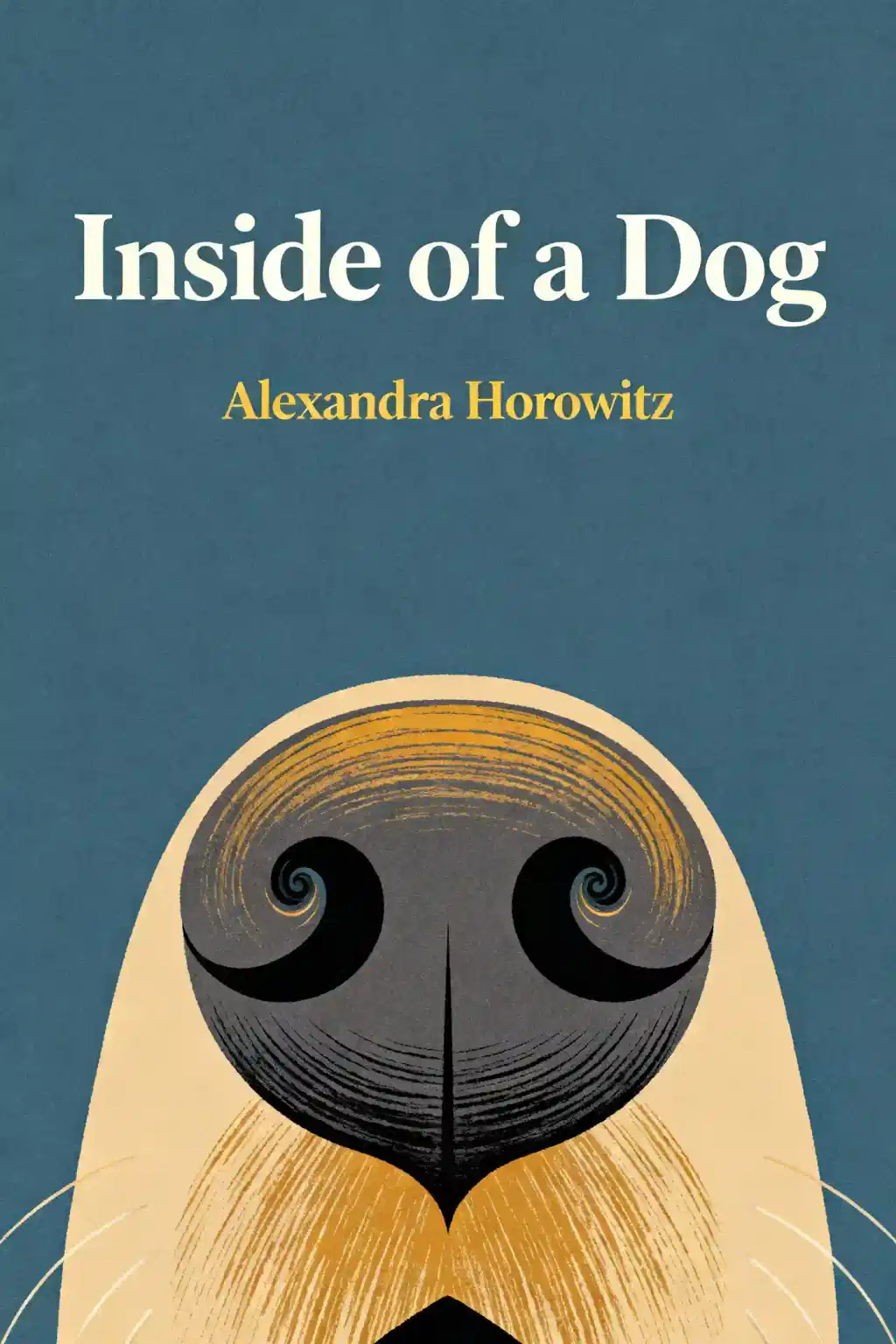
Inside of a Dog: What Dogs See, Smell, and Know by Alexandra Horowitz Summary

Overview of Inside of a Dog
Ever wondered what your dog truly experiences? Alexandra Horowitz's groundbreaking exploration reveals dogs perceive the world through smell 100,000 times more powerful than ours. Temple Grandin praised this mind-bending journey that forever changes how you'll understand your four-legged companion's mysterious inner life.
- Dogs perceive time through scent decay, creating a "smell timeline" of past events.
- Tail wags communicate emotional states based on direction and speed—not just happiness.
- Canine "umwelt" revolves around olfactory dominance, not human-centric visual or auditory cues.
- Dogs sniff ground-level air currents to detect threats humans never perceive.
- Play bows and exaggerated movements serve as universal canine peacekeeping signals.
- Scent-marked urine contains biochemical social updates dogs "read" like newsfeeds.
- Dogs interpret eye contact as collaboration, not dominance, reshaping training approaches.
- Urban environments deprive dogs of olfactory enrichment critical for mental stimulation.
- Canine guilt displays are human projections—dogs react to immediate cues, not remorse.
- Sniffing walks satisfy dogs' cognitive needs more effectively than structured obedience drills.
- Dogs track human breathing patterns to anticipate moods and predict behaviors.
- Horowitz redefines "dog intelligence" through scent-driven problem-solving and social attunement.
About the Author of Inside of a Dog
Alexandra Horowitz, New York Times bestselling author of Inside of a Dog: What Dogs See, Smell, and Know, is a leading expert in canine cognition and the psychology of human-animal relationships.
A Senior Research Fellow at Barnard College, Columbia University, she heads the Dog Cognition Lab, where her groundbreaking work explores dogs' sensory experiences, emotions, and social behaviors. Her writing bridges scientific rigor and accessible storytelling, demystifying the canine "umwelt"—the unique sensory world through which dogs perceive reality.
Horowitz’s other acclaimed works include Our Dogs, Ourselves (2019), which examines the cultural complexities of dog ownership, and Being a Dog (2016), a deep dive into the science of smell. A frequent contributor to The New Yorker and The New York Times, she translates cutting-edge research into insights for dog lovers and scholars alike.
Inside of a Dog spent 64 weeks on the New York Times bestseller list and has been adapted into a Young Readers Edition, cementing its status as a seminal text in animal behavior literature.
FAQs About Inside of a Dog
What is Inside of a Dog by Alexandra Horowitz about?
Inside of a Dog explores how dogs perceive the world through their unique sensory experiences and cognitive abilities. Alexandra Horowitz combines scientific research with personal anecdotes to explain canine behaviors, focusing on concepts like umwelt (a dog’s subjective reality), their extraordinary sense of smell, and how they interpret human actions. The book dispels myths while offering insights into dogs’ emotional lives and problem-solving skills.
Who should read Inside of a Dog?
Dog owners, animal behavior enthusiasts, and anyone curious about canine psychology will find this book valuable. It’s ideal for readers seeking a blend of accessible science and practical advice, such as understanding why dogs sniff obsessively or how to interpret their body language. Critics note its occasional dense academic tone, but dog lovers appreciate its heartfelt storytelling.
What is the umwelt concept in Inside of a Dog?
The umwelt refers to a dog’s unique sensory worldview, shaped by their dominant sense of smell and ability to detect fleeting environmental details. Horowitz uses this concept to explain behaviors like ground-level exploration and lickable-object fascination. By prioritizing smell over sight, dogs experience a reality radically different from humans.
How does Inside of a Dog explain a dog’s sense of time?
Dogs perceive time through routines and biological cues rather than abstract concepts. They anticipate meals or walks based on patterns like light changes or owner behavior. The book suggests dogs live “in the moment,” adapting to isolation without human-like boredom by relying on environmental stimuli.
What does Inside of a Dog say about self-awareness in dogs?
Horowitz notes dogs fail the mirror test but exhibit self-awareness through social interactions. They gauge their abilities by observing reactions from humans or other dogs, such as hesitating before jumping a high fence. This suggests a body-centered awareness rather than introspective reflection.
How can owners apply insights from Inside of a Dog?
Practical tips include:
- Go on “smell walks” to let dogs explore scents.
- Avoid over-bathing, which strips their natural odor-based communication.
- Interpret “calming signals” like yawning or tail position to reduce stress.
These methods align with a dog’s umwelt to foster better communication.
What critiques exist about Inside of a Dog?
Some readers find the scientific explanations overly detailed, suggesting tighter editing could improve readability. Others praise its depth but caution against expecting a traditional training manual. Despite this, the blend of research and storytelling resonates with most dog lovers.
How does Inside of a Dog address anthropomorphism?
Horowitz advises balancing anthropomorphism with respect for canine instincts. For example, interpreting a dog’s “guilty look” as a response to owner cues, not moral reasoning. She encourages viewing behaviors through a dog’s sensory lens rather than human assumptions.
What role does the author’s dog, Pumpernickel, play in the book?
Pumpernickel, Horowitz’s 16-year-old rescue, serves as a recurring example of canine quirks and emotional bonds. Stories about Pump—like his reluctance to climb stairs—illustrate broader themes of dog cognition and the human-canine relationship.
How does Inside of a Dog compare to other animal behavior books?
Unlike purely anecdotal pet guides, Horowitz grounds her work in ethology and psychology while maintaining accessibility. It’s often compared to Temple Grandin’s Animals in Translation but focuses exclusively on dogs, offering deeper insights into their sensory world.
What metaphors or quotes define Inside of a Dog?
The Groucho Marx epigraph—”Inside of a dog, it’s too dark to read”—symbolizes the book’s mission: illuminating the unknowable canine mind. Another key idea is that dogs see the world as “close to the ground, lickable, and fleeting,” shaping their priorities.
Why is Inside of a Dog still relevant in 2025?
As pet ownership rises, understanding dogs’ needs remains critical. The book’s emphasis on empathy and species-specific communication aligns with trends in humane training and animal welfare, making it a timeless resource for fostering healthier human-dog bonds.
Feel the book through the author's voice
Turn knowledge into engaging, example-rich insights
Capture key ideas in a flash for fast learning
Enjoy the book in a fun and engaging way
Key Themes in Inside of a Dog
Quotes from Inside of a Dog
Dogs see dog things, not human things.
Dogs look at our eyes.
Dogs are indeed animals with atavistic tendencies.
Dogs investigate their world
Characters in Inside of a Dog
Quick Summary Mode - Read or listen to Inside of a Dog Summary in 9 Minutes

Break down key ideas from Inside of a Dog into bite-sized takeaways to understand how innovative teams create, collaborate, and grow.

Flash Card Mode - Top 10 Insights from Inside of a Dog in a Nutshell

Distill Inside of a Dog into rapid-fire memory cues that highlight key principles of candor, teamwork, and creative resilience.

Fun Mode - Inside of a Dog Lessons Told Through 19-Min Stories

Experience Inside of a Dog through vivid storytelling that turns innovation lessons into moments you'll remember and apply.
Personalize Mode - Read or listen to Inside of a Dog Summary in 0 Minutes

Ask anything, pick the voice, and co-create insights that truly resonate with you.

From Columbia University alumni built in San Francisco
"Instead of endless scrolling, I just hit play on BeFreed. It saves me so much time."


"I never knew where to start with nonfiction—BeFreed’s book lists turned into podcasts gave me a clear path."


"Perfect balance between learning and entertainment. Finished ‘Thinking, Fast and Slow’ on my commute this week."
"Crazy how much I learned while walking the dog. BeFreed = small habits → big gains."
"Reading used to feel like a chore. Now it’s just part of my lifestyle."

"Feels effortless compared to reading. I’ve finished 6 books this month already."
"BeFreed turned my guilty doomscrolling into something that feels productive and inspiring."

"BeFreed turned my commute into learning time. 20-min podcasts are perfect for finishing books I never had time for."
"BeFreed replaced my podcast queue. Imagine Spotify for books — that’s it. 🙌"

"It is great for me to learn something from the book without reading it."
"The themed book list podcasts help me connect ideas across authors—like a guided audio journey."
"Makes me feel smarter every time before going to work"
From Columbia University alumni built in San Francisco
"Instead of endless scrolling, I just hit play on BeFreed. It saves me so much time."
"I never knew where to start with nonfiction—BeFreed’s book lists turned into podcasts gave me a clear path."
"Perfect balance between learning and entertainment. Finished ‘Thinking, Fast and Slow’ on my commute this week."
"Crazy how much I learned while walking the dog. BeFreed = small habits → big gains."
"Reading used to feel like a chore. Now it’s just part of my lifestyle."
"Feels effortless compared to reading. I’ve finished 6 books this month already."
"BeFreed turned my guilty doomscrolling into something that feels productive and inspiring."
"BeFreed turned my commute into learning time. 20-min podcasts are perfect for finishing books I never had time for."
"BeFreed replaced my podcast queue. Imagine Spotify for books — that’s it. 🙌"
"It is great for me to learn something from the book without reading it."
"The themed book list podcasts help me connect ideas across authors—like a guided audio journey."
"Makes me feel smarter every time before going to work"
"Instead of endless scrolling, I just hit play on BeFreed. It saves me so much time."
"I never knew where to start with nonfiction—BeFreed’s book lists turned into podcasts gave me a clear path."
"Perfect balance between learning and entertainment. Finished ‘Thinking, Fast and Slow’ on my commute this week."
"Crazy how much I learned while walking the dog. BeFreed = small habits → big gains."
"Reading used to feel like a chore. Now it’s just part of my lifestyle."
"Feels effortless compared to reading. I’ve finished 6 books this month already."
"BeFreed turned my guilty doomscrolling into something that feels productive and inspiring."
"BeFreed turned my commute into learning time. 20-min podcasts are perfect for finishing books I never had time for."
"BeFreed replaced my podcast queue. Imagine Spotify for books — that’s it. 🙌"
"It is great for me to learn something from the book without reading it."
"The themed book list podcasts help me connect ideas across authors—like a guided audio journey."
"Makes me feel smarter every time before going to work"
"Instead of endless scrolling, I just hit play on BeFreed. It saves me so much time."
"I never knew where to start with nonfiction—BeFreed’s book lists turned into podcasts gave me a clear path."
"Perfect balance between learning and entertainment. Finished ‘Thinking, Fast and Slow’ on my commute this week."
"Crazy how much I learned while walking the dog. BeFreed = small habits → big gains."
"Reading used to feel like a chore. Now it’s just part of my lifestyle."
"Feels effortless compared to reading. I’ve finished 6 books this month already."
"BeFreed turned my guilty doomscrolling into something that feels productive and inspiring."
"BeFreed turned my commute into learning time. 20-min podcasts are perfect for finishing books I never had time for."
"BeFreed replaced my podcast queue. Imagine Spotify for books — that’s it. 🙌"
"It is great for me to learn something from the book without reading it."
"The themed book list podcasts help me connect ideas across authors—like a guided audio journey."
"Makes me feel smarter every time before going to work"

Get the Inside of a Dog summary as a free PDF or EPUB. Print it or read offline anytime.