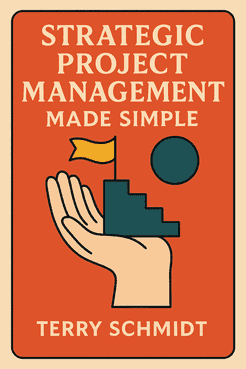
Strategic Project Management Made Simple by Terry Schmidt Summary

Overview of Strategic Project Management Made Simple
Transform chaos into clarity with Schmidt's "Strategic Project Management Made Simple." This game-changing guide introduces the powerful Logical Framework Approach, helping leaders turn ideas into executable plans. The 2021 edition adds crucial insights on navigating uncertainty - a must-have for today's volatile business landscape.
- Replace vague objectives with If-Then logic to clarify project cause-and-effect.
- Build stakeholder commitment early using Schmidt’s Four Critical Strategic Questions.
- Measure success through verifiable outcomes, not just activity completion.
- Use Logical Framework (LogFrame) to align tasks with strategic goals.
- Turn risks into "assumptions" to proactively manage project uncertainties.
- Apply Minimum Viable Project thinking to test ideas before scaling.
- Break initiatives into phases via Schmidt’s Strategic Action Cycle.
- Prioritize "chunking" to simplify complex projects into manageable steps.
- Convert resistance into support by mapping stakeholder influence networks.
- Design learning cycles to adapt projects amid changing conditions.
- Link every activity to purpose using the Project Hierarchy Model.
- Align team efforts through Schmidt’s Iterating to Excellence method.
About the Author of Strategic Project Management Made Simple
Terry Schmidt is the bestselling author of Strategic Project Management Made Simple and a pioneering expert in strategic project management and leadership development.
With over 35 years of global experience advising Fortune 500 companies, government agencies, and U.S. national research laboratories, Schmidt holds an MBA from Harvard Business School and has authored seven management books that bridge academic theory with real-world execution.
His groundbreaking Logical Framework Approach (LogFrame), detailed in this book, provides organizations with a proven matrix tool for simplifying complex project design and aligning objectives with measurable outcomes.
A top-rated instructor at MIT and UCLA, Schmidt’s methodologies are taught in executive programs worldwide and form the basis for the Association for Strategic Planning’s certification curriculum. His work has been instrumental in shaping modern project management practices, particularly in sectors requiring rigorous strategic alignment. Strategic Project Management Made Simple has become a cornerstone resource for professionals, praised for its actionable frameworks and adopted by organizations seeking operational excellence.
FAQs About Strategic Project Management Made Simple
What is Strategic Project Management Made Simple about?
Strategic Project Management Made Simple by Terry Schmidt provides a systematic approach to aligning projects with organizational strategy using the Logical Framework Approach (LogFrame). It teaches leaders to clarify objectives, measure success, manage risks, and execute phased plans through real-world examples and tools like the Four Critical Strategic Questions. The book bridges the gap between strategy formulation and implementation.
Who should read Strategic Project Management Made Simple?
Project managers, team leaders, and executives seeking to connect day-to-day tasks with long-term strategy will benefit most. It’s ideal for professionals in government, healthcare, tech, or academia who manage complex initiatives and need practical frameworks to reduce wasted effort and improve stakeholder alignment.
Is Strategic Project Management Made Simple worth reading?
Yes, the book is praised for transforming abstract strategies into actionable plans using Terry Schmidt’s 35+ years of global consulting experience. Readers gain tools like the LogFrame matrix and phased execution techniques, which are applicable across industries. Real-world examples and clear summaries make it a valuable resource for avoiding “chart maintenance” projects.
What are the Four Critical Strategic Questions in the book?
The framework guides project design by asking:
- What are you trying to achieve, and why? (Objectives)
- How will you measure success? (Indicators)
- What internal/external conditions must exist? (Assumptions)
- How will you achieve results? (Activities)
This logical structure ensures alignment with organizational goals and identifies risks early.
How does the Logical Framework Approach (LogFrame) work?
The LogFrame matrix links project components vertically (Goals → Objectives → Outputs → Activities) and horizontally (metrics, assumptions). It simplifies complexity by breaking projects into manageable phases, such as equipment procurement or staff training, while maintaining strategic focus. This tool is widely used in sectors like healthcare and IT for clarity and adaptability.
What are key takeaways from Strategic Project Management Made Simple?
- Align projects with organizational strategy using the LogFrame.
- Define success metrics at every level (e.g., patient outcomes in hospitals).
- Rank assumptions by risk to preempt bottlenecks.
- Engage stakeholders early through workshops.
- Use phased execution to prioritize resources and adjust plans.
How does Terry Schmidt address project risks in the book?
Schmidt emphasizes explicitly listing assumptions (e.g., budget approvals, stakeholder buy-in) and ranking them by likelihood/impact. Teams then develop contingency plans, such as alternative funding sources or communication strategies, to mitigate disruptions. This proactive approach reduces surprises in multi-phase projects.
Can the book’s methods apply to non-profit or government projects?
Yes—Schmidt’s examples include public-sector initiatives like national lab research and hospital upgrades. The LogFrame’s flexibility helps nonprofits align grants with mission-critical goals and governments track infrastructure project metrics (e.g., road safety improvements).
How does Strategic Project Management Made Simple compare to traditional PM guides?
Unlike tactical PM guides focused on Gantt charts, Schmidt prioritizes strategic alignment and adaptive execution. The LogFrame complements PMI standards by adding a “why” layer, ensuring projects contribute to broader business outcomes rather than just delivering outputs.
What real-world examples does Terry Schmidt include?
Case studies span IT system overhauls, hospital equipment upgrades, and book-writing projects. For example, a digital transformation starts with IT audits (Phase 1) before system changes (Phase 2), illustrating phased planning. Another example shows aligning a nonprofit’s training program with poverty-reduction goals.
How does the book help with stakeholder engagement?
Schmidt advises mapping stakeholders by influence/interest, then involving them in LogFrame workshops to co-design objectives. A tech project might include engineers, executives, and end-users early to surface conflicting priorities and build consensus.
Why is Strategic Project Management Made Simple relevant in 2025?
With 70% of strategies still failing due to poor execution (per Schmidt’s research), the book’s focus on agility and strategic rigor remains critical. Its tools help teams adapt to AI-driven changes, remote work challenges, and economic uncertainty by linking projects to evolving goals.
Feel the book through the author's voice
Turn knowledge into engaging, example-rich insights
Capture key ideas in a flash for fast learning
Enjoy the book in a fun and engaging way
Key Themes in Strategic Project Management Made Simple
Quotes from Strategic Project Management Made Simple
What are we trying to accomplish and why?
How will we measure success?
What other conditions must exist?
How do we get there?
Purpose drives Outcomes.
Characters in Strategic Project Management Made Simple
Quick Summary Mode - Read or listen to Strategic Project Management Made Simple Summary in 13 Minutes

Break down key ideas from Strategic Project Management Made Simple into bite-sized takeaways to understand how innovative teams create, collaborate, and grow.

Flash Card Mode - Top 8 Insights from Strategic Project Management Made Simple in a Nutshell

Distill Strategic Project Management Made Simple into rapid-fire memory cues that highlight key principles of candor, teamwork, and creative resilience.

Fun Mode - Strategic Project Management Made Simple Lessons Told Through 24-Min Stories

Experience Strategic Project Management Made Simple through vivid storytelling that turns innovation lessons into moments you'll remember and apply.
Personalize Mode - Read or listen to Strategic Project Management Made Simple Summary in 0 Minutes

Ask anything, pick the voice, and co-create insights that truly resonate with you.

From Columbia University alumni built in San Francisco
"Instead of endless scrolling, I just hit play on BeFreed. It saves me so much time."


"I never knew where to start with nonfiction—BeFreed’s book lists turned into podcasts gave me a clear path."


"Perfect balance between learning and entertainment. Finished ‘Thinking, Fast and Slow’ on my commute this week."
"Crazy how much I learned while walking the dog. BeFreed = small habits → big gains."
"Reading used to feel like a chore. Now it’s just part of my lifestyle."

"Feels effortless compared to reading. I’ve finished 6 books this month already."
"BeFreed turned my guilty doomscrolling into something that feels productive and inspiring."

"BeFreed turned my commute into learning time. 20-min podcasts are perfect for finishing books I never had time for."
"BeFreed replaced my podcast queue. Imagine Spotify for books — that’s it. 🙌"

"It is great for me to learn something from the book without reading it."
"The themed book list podcasts help me connect ideas across authors—like a guided audio journey."
"Makes me feel smarter every time before going to work"
From Columbia University alumni built in San Francisco
"Instead of endless scrolling, I just hit play on BeFreed. It saves me so much time."
"I never knew where to start with nonfiction—BeFreed’s book lists turned into podcasts gave me a clear path."
"Perfect balance between learning and entertainment. Finished ‘Thinking, Fast and Slow’ on my commute this week."
"Crazy how much I learned while walking the dog. BeFreed = small habits → big gains."
"Reading used to feel like a chore. Now it’s just part of my lifestyle."
"Feels effortless compared to reading. I’ve finished 6 books this month already."
"BeFreed turned my guilty doomscrolling into something that feels productive and inspiring."
"BeFreed turned my commute into learning time. 20-min podcasts are perfect for finishing books I never had time for."
"BeFreed replaced my podcast queue. Imagine Spotify for books — that’s it. 🙌"
"It is great for me to learn something from the book without reading it."
"The themed book list podcasts help me connect ideas across authors—like a guided audio journey."
"Makes me feel smarter every time before going to work"
"Instead of endless scrolling, I just hit play on BeFreed. It saves me so much time."
"I never knew where to start with nonfiction—BeFreed’s book lists turned into podcasts gave me a clear path."
"Perfect balance between learning and entertainment. Finished ‘Thinking, Fast and Slow’ on my commute this week."
"Crazy how much I learned while walking the dog. BeFreed = small habits → big gains."
"Reading used to feel like a chore. Now it’s just part of my lifestyle."
"Feels effortless compared to reading. I’ve finished 6 books this month already."
"BeFreed turned my guilty doomscrolling into something that feels productive and inspiring."
"BeFreed turned my commute into learning time. 20-min podcasts are perfect for finishing books I never had time for."
"BeFreed replaced my podcast queue. Imagine Spotify for books — that’s it. 🙌"
"It is great for me to learn something from the book without reading it."
"The themed book list podcasts help me connect ideas across authors—like a guided audio journey."
"Makes me feel smarter every time before going to work"
"Instead of endless scrolling, I just hit play on BeFreed. It saves me so much time."
"I never knew where to start with nonfiction—BeFreed’s book lists turned into podcasts gave me a clear path."
"Perfect balance between learning and entertainment. Finished ‘Thinking, Fast and Slow’ on my commute this week."
"Crazy how much I learned while walking the dog. BeFreed = small habits → big gains."
"Reading used to feel like a chore. Now it’s just part of my lifestyle."
"Feels effortless compared to reading. I’ve finished 6 books this month already."
"BeFreed turned my guilty doomscrolling into something that feels productive and inspiring."
"BeFreed turned my commute into learning time. 20-min podcasts are perfect for finishing books I never had time for."
"BeFreed replaced my podcast queue. Imagine Spotify for books — that’s it. 🙌"
"It is great for me to learn something from the book without reading it."
"The themed book list podcasts help me connect ideas across authors—like a guided audio journey."
"Makes me feel smarter every time before going to work"

Get the Strategic Project Management Made Simple summary as a free PDF or EPUB. Print it or read offline anytime.