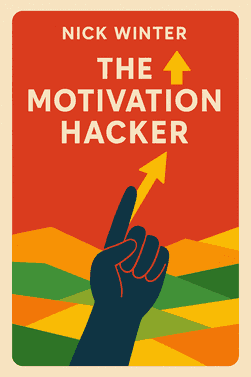
The Motivation Hacker by Nick Winter Summary

Overview of The Motivation Hacker
Ever wonder how to hack your brain for unlimited motivation? Nick Winter wrote this guide while simultaneously learning Chinese, running marathons, and launching a startup - all in 3 months. His "Motivation Equation" transforms willpower into a renewable resource you can master.
- Hack motivation using the equation: (Expectancy × Value) ÷ (Impulsiveness × Delay)
- Start success spirals with tiny wins to build unstoppable momentum
- Precommit to goals by eliminating escape routes and public accountability
- Boost expectancy through proven track records and visualized achievements
- Reduce impulsiveness by designing distraction-free environments and routines
- Shorten reward delay by breaking goals into immediate milestones
- Practice Rejection Therapy to desensitize fear and build social confidence
- Stack new habits onto existing ones for automatic adherence
- Gamify tasks with challenges and rewards to maximize enjoyment
- Track progress meticulously to maintain motivation through visible growth
- Treat motivation as renewable fuel, not a fixed resource
- Overcome planner fallacy by preparing for worst-case scenarios upfront
About the Author of The Motivation Hacker
Nick Winter, author of The Motivation Hacker, is a tech entrepreneur and productivity expert renowned for blending behavioral psychology with practical self-improvement strategies.
A co-founder of CodeCombat and Skritter—educational platforms serving over 20 million learners—Winter leverages his background in computer science and startup culture to create actionable frameworks for achieving ambitious goals.
His book, a staple in the self-help and personal development genre, distills his experiments in motivation hacking, including skill acquisition, habit formation, and productivity optimization, into a guide praised for its no-nonsense, tech-driven approach. Winter frequently shares insights on his blog and through platforms like the Beeminder blog, where he discusses cognitive performance and quantified self-tracking.
A Y Combinator alumnus, his work is endorsed by productivity communities for its empirical, results-focused methodology. The Motivation Hacker remains a cult classic among entrepreneurs and lifelong learners seeking science-backed tools to transcend procrastination.
FAQs About The Motivation Hacker
What is The Motivation Hacker about?
The Motivation Hacker by Nick Winter is a practical guide to achieving goals by "hacking" motivation through self-experimentation. It combines personal anecdotes with strategies like the Motivation Equation and Success Spirals, teaching readers to boost confidence, reduce procrastination, and build habits. Winter emphasizes excess motivation to not only succeed but enjoy the process, using tactics like pre-commitment and tracking progress.
Who is Nick Winter, the author of The Motivation Hacker?
Nick Winter is a self-improvement enthusiast and programmer who transformed his approach to productivity after years of stagnation. His book chronicles a summer of extreme challenges—like coding an app and improving his 5K time—to test motivation strategies. Winter’s work blends psychological insights with actionable hacks, positioning him as a relatable figure in personal development.
Who should read The Motivation Hacker?
This book suits self-improvement seekers, productivity enthusiasts, and anyone struggling with procrastination. It’s ideal for readers who prefer hands-on techniques over theoretical advice, offering tools like habit stacking and pre-commitment. Entrepreneurs, freelancers, and students will find tactics to tackle overwhelming goals by breaking them into manageable steps.
Is The Motivation Hacker worth reading?
Yes, for its unconventional, actionable strategies. Winter’s focus on experimentation—like adjusting the Motivation Equation’s variables (expectancy, value, impulsiveness, delay)—provides a fresh take on productivity. While some criticize its reliance on personal anecdotes, the book’s practicality and emphasis on measurable progress make it valuable for goal-oriented readers.
What is the "Motivation Equation" in The Motivation Hacker?
The equation Motivation = (Expectancy × Value) / (Impulsiveness × Delay) quantifies how to boost drive. Increase expectancy (confidence) and value (enjoyment/rewards), while reducing impulsiveness (distractions) and delay (time to reward). For example, breaking tasks into smaller steps shortens delay, making goals feel more attainable.
How do "Success Spirals" work in The Motivation Hacker?
Success Spirals involve setting tiny, achievable goals to build momentum. Completing these tasks reinforces confidence (expectancy), creating a cycle of motivation. Winter suggests tracking progress to visualize wins, which helps tackle larger challenges over time. This method avoids the demotivation of unrealistic targets.
What pre-commitment strategies does Nick Winter recommend?
Winter advocates public goal declarations, apps like Beeminder (which charges money for missed targets), and environmental tweaks to reduce impulsiveness. For example, uninstalling social media apps during work hours forces focus. These tactics leverage external accountability to sustain motivation when willpower falters.
How does The Motivation Hacker address common motivation pitfalls?
It tackles procrastination by reframing tasks as rewarding (increasing value) and breaking them into steps (reducing delay). Winter also addresses burnout by advocating "excess motivation"—designing goals to feel energizing, not draining. Techniques like habit stacking (linking new habits to existing routines) make consistency easier.
What are the main criticisms of The Motivation Hacker?
Critics note its reliance on Winter’s personal experiments, which may not apply universally. Some tactics, like extreme pre-commitment, risk becoming unsustainable. However, the book’s emphasis on adaptability—testing and adjusting strategies—offsets these concerns by encouraging personalized approaches.
How does The Motivation Hacker compare to Atomic Habits?
While both focus on habit-building, Winter’s approach is more experimental and math-driven (e.g., the Motivation Equation). Atomic Habits emphasizes incremental changes, whereas The Motivation Hacker prioritizes "hacking" motivation spikes for rapid progress. Both books complement each other, offering tactical and philosophical insights.
How can The Motivation Hacker help with remote work or freelance productivity?
Remote workers can use Winter’s pre-commitment tools (e.g., time-blocking apps) and Success Spirals to combat distractions. The book’s emphasis on aligning tasks with personal values helps freelancers stay motivated without external oversight. Tracking systems also provide structure in flexible environments.
What are key quotes from The Motivation Hacker?
- “Motivation is fuel for life”: Emphasizes treating motivation as a renewable resource to be optimized.
- “Excess motivation isn’t just about succeeding—it’s about enjoying the ride”: Encourages designing goals to feel intrinsically rewarding.
- “Willpower deserts you when you need it most”: Highlights the need for systems over sheer discipline.
Feel the book through the author's voice
Turn knowledge into engaging, example-rich insights
Capture key ideas in a flash for fast learning
Enjoy the book in a fun and engaging way
Key Themes in The Motivation Hacker
Quotes from The Motivation Hacker
Concentration flows naturally when distractions are eliminated in advance.
The crucial element is never weaseling out of commitments.
Each failure makes rebuilding harder.
Precommitment means choosing now to limit your options later.
The beauty of proper precommitment is that once done, you're no longer afraid.
Characters in The Motivation Hacker
Quick Summary Mode - Read or listen to The Motivation Hacker Summary in 9 Minutes

Break down key ideas from The Motivation Hacker into bite-sized takeaways to understand how innovative teams create, collaborate, and grow.

Flash Card Mode - Top 10 Insights from The Motivation Hacker in a Nutshell

Distill The Motivation Hacker into rapid-fire memory cues that highlight key principles of candor, teamwork, and creative resilience.

Fun Mode - The Motivation Hacker Lessons Told Through 23-Min Stories

Experience The Motivation Hacker through vivid storytelling that turns innovation lessons into moments you'll remember and apply.
Personalize Mode - Read or listen to The Motivation Hacker Summary in 0 Minutes

Ask anything, pick the voice, and co-create insights that truly resonate with you.

From Columbia University alumni built in San Francisco
"Instead of endless scrolling, I just hit play on BeFreed. It saves me so much time."


"I never knew where to start with nonfiction—BeFreed’s book lists turned into podcasts gave me a clear path."


"Perfect balance between learning and entertainment. Finished ‘Thinking, Fast and Slow’ on my commute this week."
"Crazy how much I learned while walking the dog. BeFreed = small habits → big gains."
"Reading used to feel like a chore. Now it’s just part of my lifestyle."

"Feels effortless compared to reading. I’ve finished 6 books this month already."
"BeFreed turned my guilty doomscrolling into something that feels productive and inspiring."

"BeFreed turned my commute into learning time. 20-min podcasts are perfect for finishing books I never had time for."
"BeFreed replaced my podcast queue. Imagine Spotify for books — that’s it. 🙌"

"It is great for me to learn something from the book without reading it."
"The themed book list podcasts help me connect ideas across authors—like a guided audio journey."
"Makes me feel smarter every time before going to work"
From Columbia University alumni built in San Francisco
"Instead of endless scrolling, I just hit play on BeFreed. It saves me so much time."
"I never knew where to start with nonfiction—BeFreed’s book lists turned into podcasts gave me a clear path."
"Perfect balance between learning and entertainment. Finished ‘Thinking, Fast and Slow’ on my commute this week."
"Crazy how much I learned while walking the dog. BeFreed = small habits → big gains."
"Reading used to feel like a chore. Now it’s just part of my lifestyle."
"Feels effortless compared to reading. I’ve finished 6 books this month already."
"BeFreed turned my guilty doomscrolling into something that feels productive and inspiring."
"BeFreed turned my commute into learning time. 20-min podcasts are perfect for finishing books I never had time for."
"BeFreed replaced my podcast queue. Imagine Spotify for books — that’s it. 🙌"
"It is great for me to learn something from the book without reading it."
"The themed book list podcasts help me connect ideas across authors—like a guided audio journey."
"Makes me feel smarter every time before going to work"
"Instead of endless scrolling, I just hit play on BeFreed. It saves me so much time."
"I never knew where to start with nonfiction—BeFreed’s book lists turned into podcasts gave me a clear path."
"Perfect balance between learning and entertainment. Finished ‘Thinking, Fast and Slow’ on my commute this week."
"Crazy how much I learned while walking the dog. BeFreed = small habits → big gains."
"Reading used to feel like a chore. Now it’s just part of my lifestyle."
"Feels effortless compared to reading. I’ve finished 6 books this month already."
"BeFreed turned my guilty doomscrolling into something that feels productive and inspiring."
"BeFreed turned my commute into learning time. 20-min podcasts are perfect for finishing books I never had time for."
"BeFreed replaced my podcast queue. Imagine Spotify for books — that’s it. 🙌"
"It is great for me to learn something from the book without reading it."
"The themed book list podcasts help me connect ideas across authors—like a guided audio journey."
"Makes me feel smarter every time before going to work"
"Instead of endless scrolling, I just hit play on BeFreed. It saves me so much time."
"I never knew where to start with nonfiction—BeFreed’s book lists turned into podcasts gave me a clear path."
"Perfect balance between learning and entertainment. Finished ‘Thinking, Fast and Slow’ on my commute this week."
"Crazy how much I learned while walking the dog. BeFreed = small habits → big gains."
"Reading used to feel like a chore. Now it’s just part of my lifestyle."
"Feels effortless compared to reading. I’ve finished 6 books this month already."
"BeFreed turned my guilty doomscrolling into something that feels productive and inspiring."
"BeFreed turned my commute into learning time. 20-min podcasts are perfect for finishing books I never had time for."
"BeFreed replaced my podcast queue. Imagine Spotify for books — that’s it. 🙌"
"It is great for me to learn something from the book without reading it."
"The themed book list podcasts help me connect ideas across authors—like a guided audio journey."
"Makes me feel smarter every time before going to work"

Get the The Motivation Hacker summary as a free PDF or EPUB. Print it or read offline anytime.