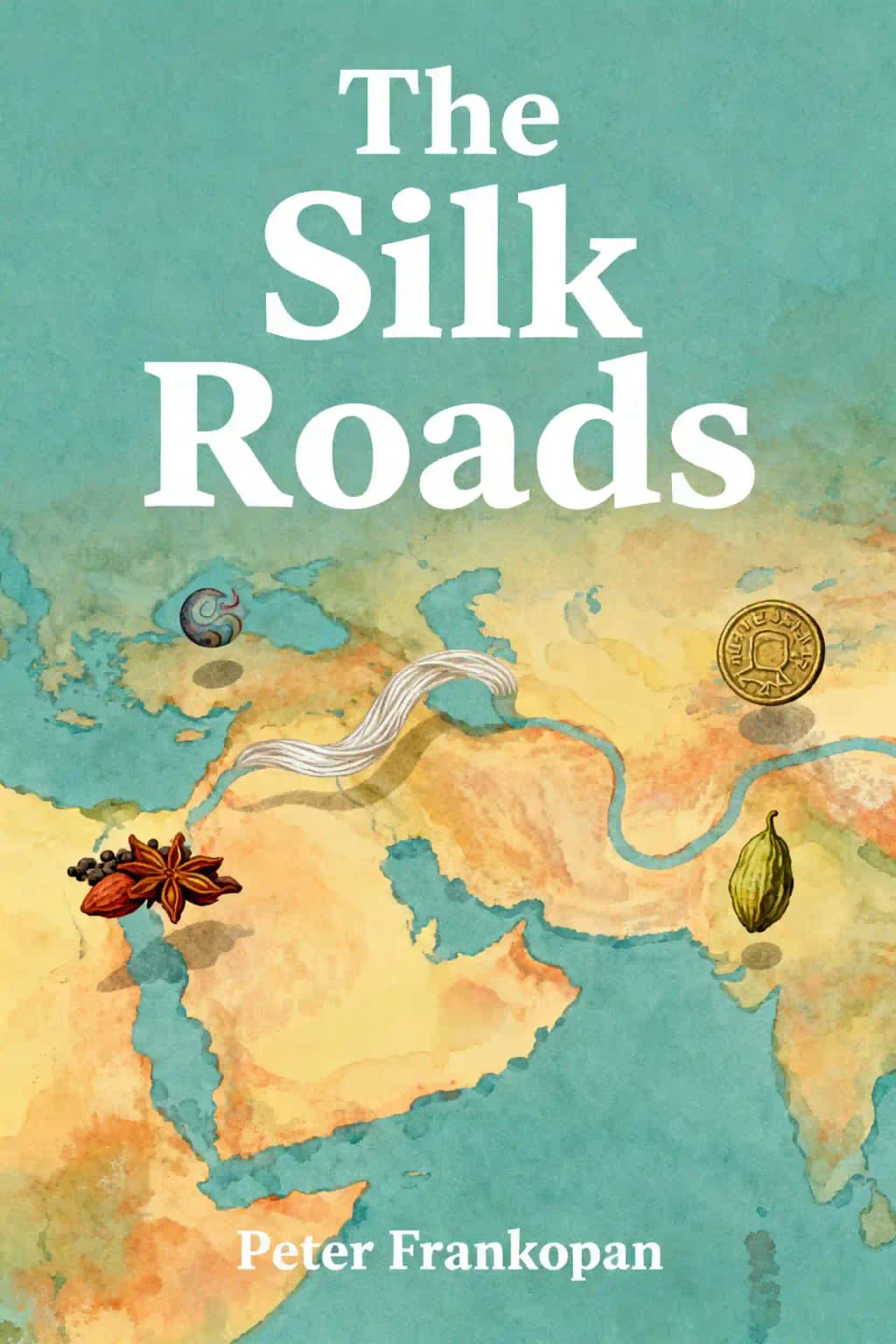
Frankopan's "The Silk Roads" rewrites history through Central Asia's lens, challenging Eurocentric narratives. Entrepreneur Derek Sivers rated it 8/10, praising its accessibility. What if everything you know about world history is centered on the wrong continent?
Peter Frankopan, bestselling author of The Silk Roads: A New History of the World, is a Professor of Global History at Oxford University and a leading authority on Eurasian civilizations. His groundbreaking work redefines world history by centering the interconnected trade networks linking Asia, Europe, and Africa.
As Director of Oxford’s Centre for Byzantine Research and UNESCO Chair of Silk Roads Studies, Frankopan draws on decades of archival research to challenge Eurocentric narratives, tracing how commerce, religion, and ideas shaped empires. The New York Times bestseller, which topped charts in the UK, India, and China, established his reputation for weaving expansive geopolitical analysis with vivid storytelling.
His follow-ups – The New Silk Roads and The Earth Transformed – further explore global power shifts and environmental history. Frankopan regularly contributes to The Guardian and Financial Times, advises the UN and World Bank on sustainable development, and has delivered keynote addresses at global forums. Translated into 30+ languages, The Silk Roads has sold over 1 million copies worldwide and is widely taught in universities as a paradigm-shifting historical framework.
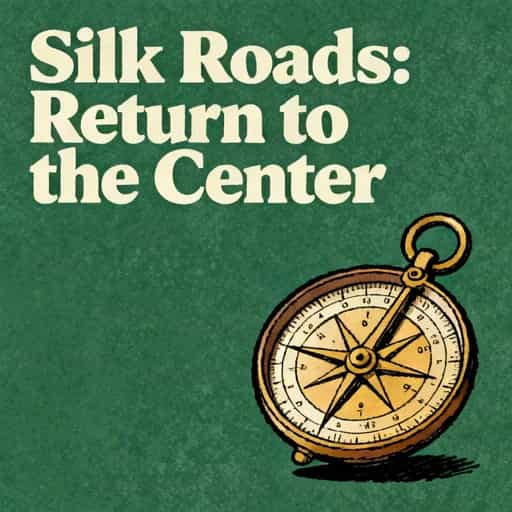
The Silk Roads redefines global history by centering the interconnected trade routes linking Asia, Europe, and Africa. Frankopan challenges Eurocentric narratives, showing how ideas, religions, and commodities like silk and spices shaped empires, cultures, and modern geopolitics. The book spans ancient Persia and the Mongol Empire to the 20th-century oil wars, emphasizing how the East influenced the West’s rise.
This book is ideal for readers interested in global history, trade, and cultural exchange. It appeals to those seeking alternatives to Eurocentric perspectives and anyone curious about how interconnected networks shaped civilizations. Policymakers and business leaders exploring modern initiatives like China’s Belt and Road will also find historical parallels.
Yes—it’s a New York Times bestseller praised as "magnificent" (Sunday Times) and "phenomenal" (Die Welt). Frankopan’s vivid storytelling and fresh perspective make complex histories accessible, offering insights into today’s geopolitical tensions. Critics note its ambitious scope, but it remains a cornerstone for understanding global interconnectedness.
Frankopan argues that Western civilization’s roots lie in Persian, Central Asian, and Middle Eastern influences rather than solely Greece and Rome. By tracing the Silk Roads’ role in spreading Buddhism, Islam, and technologies like paper, he dismantles the myth of Europe’s historical dominance.
The Persian Empire is portrayed as a cornerstone of early globalization, establishing trade networks that enabled cultural and economic exchange. Frankopan highlights its innovations in governance and infrastructure, which later influenced Roman and Islamic systems.
The plague depopulated Europe, boosting wages and weakening feudal systems. Surviving laborers gained bargaining power, spurring economic demand and laying the groundwork for Europe’s eventual global dominance.
Frankopan links historical trade routes to China’s Belt and Road Initiative and 20th-century oil politics. He argues that regions along the Silk Roads remain pivotal in today’s energy markets and geopolitical rivalries.
Some scholars argue the book oversimplifies complex histories to fit its thesis, occasionally glossing over regional nuances. Others praise its ambition but note uneven coverage of certain eras.
Frankopan details how Muslim caliphates leveraged trade networks to spread Islam, create scientific advancements, and build cosmopolitan cities like Baghdad. Their control of key routes shaped medieval globalism.
Central Asia was the Silk Roads’ crossroads, where empires clashed and blended. Frankopan argues its history is central to understanding globalization, from Alexander the Great’s campaigns to Soviet-US Cold War rivalries.
The book ties historical power shifts to control of resources like silver, oil, and water. Frankopan suggests climate change and resource competition will define the 21st century, mirroring past struggles along the Silk Roads.
Feel the book through the author's voice
Turn knowledge into engaging, example-rich insights
Capture key ideas in a flash for fast learning
Enjoy the book in a fun and engaging way
When Alexander of Macedon looked for conquest, he turned eastward.
China's westward expansion sparked intense interest in lands beyond its borders.
Silk served multiple crucial functions beyond mere luxury.
The intellectual spaces of the Silk Roads became crowded with competing deities.
Break down key ideas from The Silk Roads into bite-sized takeaways to understand how innovative teams create, collaborate, and grow.
Distill The Silk Roads into rapid-fire memory cues that highlight key principles of candor, teamwork, and creative resilience.

Experience The Silk Roads through vivid storytelling that turns innovation lessons into moments you'll remember and apply.
Ask anything, pick the voice, and co-create insights that truly resonate with you.

From Columbia University alumni built in San Francisco
"Instead of endless scrolling, I just hit play on BeFreed. It saves me so much time."
"I never knew where to start with nonfiction—BeFreed’s book lists turned into podcasts gave me a clear path."
"Perfect balance between learning and entertainment. Finished ‘Thinking, Fast and Slow’ on my commute this week."
"Crazy how much I learned while walking the dog. BeFreed = small habits → big gains."
"Reading used to feel like a chore. Now it’s just part of my lifestyle."
"Feels effortless compared to reading. I’ve finished 6 books this month already."
"BeFreed turned my guilty doomscrolling into something that feels productive and inspiring."
"BeFreed turned my commute into learning time. 20-min podcasts are perfect for finishing books I never had time for."
"BeFreed replaced my podcast queue. Imagine Spotify for books — that’s it. 🙌"
"It is great for me to learn something from the book without reading it."
"The themed book list podcasts help me connect ideas across authors—like a guided audio journey."
"Makes me feel smarter every time before going to work"
From Columbia University alumni built in San Francisco

Get the The Silk Roads summary as a free PDF or EPUB. Print it or read offline anytime.
For most of human history, the world's center of gravity wasn't London, Paris, or Rome. It was the vast stretch of territory spanning from the Mediterranean to China. Peter Frankopan's groundbreaking work "The Silk Roads" challenges our Western-centric view of history by revealing how these ancient routes served as the planet's primary arteries of ideas, religions, technologies, diseases, and cultural exchange. These weren't just trade routes carrying exotic goods-they were civilization's central nervous system. The book has become a global sensation, translated into over 30 languages and celebrated by figures from Hillary Clinton to Chinese President Xi Jinping. What makes this perspective revolutionary is how it completely reorients our understanding of history, showing that for millennia, the true engines of human progress operated along these interconnected pathways that have been largely written out of our conventional historical narratives.