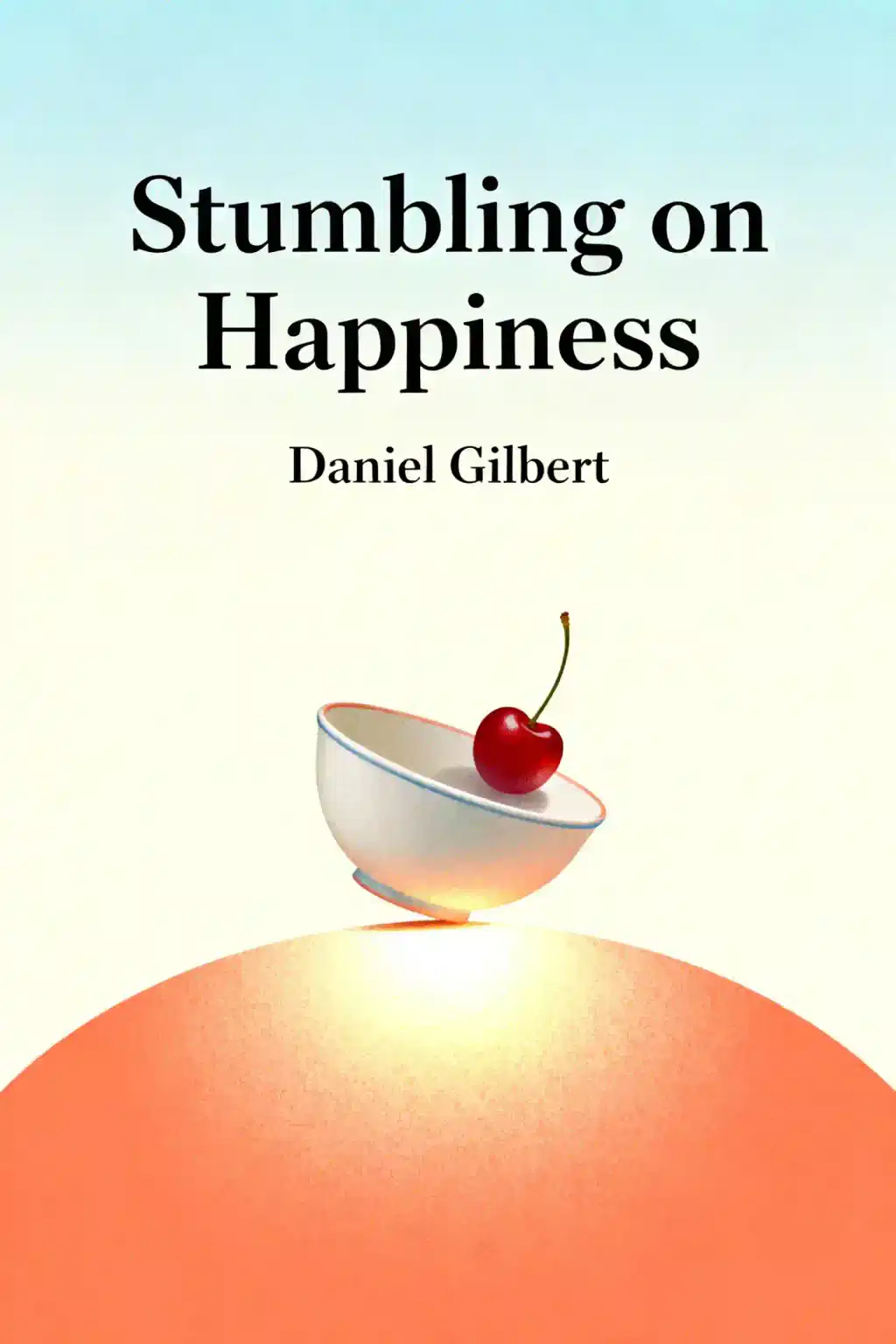
Stumbling on happiness by Daniel Gilbert Summary

Overview of Stumbling on happiness
Harvard psychologist Daniel Gilbert reveals why we're terrible at predicting what makes us happy. A New York Times bestseller translated into 30+ languages, this mind-bending journey through cognitive biases earned Derek Sivers' rare 10/10 rating. Your brain is lying to you - but Gilbert knows why.
- Why predictions fail: Imagination anchors on present emotions, not future realities
- Psychological immune system protects us from trauma’s lasting pain more than expected
- Happiness requires embracing uncertainty—rare events create more lasting satisfaction than predictable ones
- How memory distorts happiness: We compare peaks, not average experiences
- Presentism bias makes future plans mirror current feelings, not actual needs
- Why wealth stops boosting happiness past $100k: Comparison overcomes absolute gains
- “Nexting” reveals why humans compulsively imagine futures—but often inaccurately
- Trauma’s silver lining: Rationalization helps reframe losses as growth opportunities
- Why inaction causes more regret than bad decisions: Imagination fears consequences
- Measuring happiness falters because subjective states defy objective calibration
- Better future predictions come from others’ current experiences, not personal simulations
- Daniel Gilbert’s three imagination flaws: Missing details, present bias, and over-rationalization
About the Author of Stumbling on happiness
Daniel Gilbert, bestselling author of Stumbling on Happiness and Edgar Pierce Professor of Psychology at Harvard University, is a globally recognized expert in affective forecasting and decision-making. His groundbreaking work explores how people predict emotional outcomes and navigate social complexities, themes central to this psychology and self-help classic.
A contributor to Time, The New York Times, and NPR’s All Things Considered, Gilbert has hosted the Emmy-winning PBS series This Emotional Life and delivered TED Talks with over 30 million collective views. His Prudential Financial campaign on retirement planning set a Guinness World Record for creative data visualization.
Stumbling on Happiness spent six months on the New York Times bestseller list, sold over one million copies worldwide, and won the Royal Society’s General Book Prize. Translated into 40+ languages, it remains a cornerstone of behavioral science literature.
FAQs About Stumbling on happiness
What is Stumbling on Happiness about?
Stumbling on Happiness by Daniel Gilbert explores why humans struggle to predict what will make them happy. Gilbert argues that cognitive biases, flawed imagination, and present-mindedness distort our ability to forecast future emotions. The book examines themes like the subjectivity of happiness, the brain’s tendency to rationalize outcomes, and the value of others’ experiences in guiding decisions.
Who should read Stumbling on Happiness?
This book suits psychology enthusiasts, self-help readers, and anyone curious about decision-making pitfalls. Gilbert’s blend of humor and research appeals to those seeking a science-backed perspective on happiness without oversimplified advice. It’s particularly valuable for skeptics of traditional self-help approaches.
Is Stumbling on Happiness worth reading?
Yes—Gilbert’s witty, evidence-rich analysis challenges conventional wisdom about happiness. While not a step-by-step guide, it offers profound insights into why we misjudge future emotions and how to make better decisions by relying on others’ experiences. Readers praise its engaging style and actionable takeaways.
What are the main concepts in Stumbling on Happiness?
Key ideas include:
- Presentism: Projecting current feelings onto future scenarios
- Psychological immune system: Rationalizing negative events to protect mental well-being
- Imagination’s flaws: Overlooking details and inflating unrealistic expectations
- Corrigibility: Using others’ experiences to improve predictions
How does Stumbling on Happiness define happiness?
Gilbert distinguishes three types:
- Emotional: A subjective, immediate feeling.
- Moral: Virtue-driven fulfillment (rejected as conflating cause and effect).
- Judgmental: Cognitive approval of events. The book focuses on emotional happiness, emphasizing its fleeting, perception-based nature.
What does Daniel Gilbert say about predicting happiness?
Gilbert argues humans are uniquely bad at forecasting future emotions due to cognitive biases. For example, we overestimate the impact of events (e.g., winning the lottery) and underestimate our ability to adapt to adversity. He advises trusting others’ experiences over personal intuition.
What is the “psychological immune system” in Stumbling on Happiness?
This concept describes the mind’s ability to rationalize negative outcomes, helping us recover from setbacks. Gilbert notes it balances feeling “good enough to cope” while remaining “bad enough to act”—ensuring resilience without complacency.
How does Stumbling on Happiness suggest improving decision-making?
Gilbert advocates the surrogation method: Bypass flawed imagination by studying others’ experiences in similar situations. For instance, instead of guessing if a career change will bring joy, observe people who’ve made that shift.
What criticisms exist about Stumbling on Happiness?
Some reviewers note the book focuses more on diagnosing prediction errors than offering solutions. Others find its academic tone less actionable compared to practical self-help guides. However, most praise its originality and research depth.
How does Stumbling on Happiness compare to The How of Happiness?
While Sonja Lyubomirsky’s The How of Happiness provides evidence-based strategies, Gilbert’s work focuses on why we mispredict emotions. Both emphasize subjectivity, but Stumbling prioritizes understanding biases over prescribing habits.
Why is Stumbling on Happiness relevant in 2025?
In an era of AI-driven decision tools and mindfulness trends, Gilbert’s warnings about cognitive biases remain critical. The book’s insights help navigate information overload by highlighting the value of collective human experience over isolated speculation.
What famous quotes come from Stumbling on Happiness?
- “The future is imagined by the same brain that… edits memories.”
- “We treat our future selves like strangers.” These lines underscore Gilbert’s thesis that imagination and memory are unreliable guides to happiness.
What is Daniel Gilbert’s background?
A Harvard psychology professor, Gilbert combines academic rigor with accessible storytelling. His TED Talks and media appearances (e.g., This Emotional Life) amplify his research on affective forecasting, making complex ideas relatable.
Feel the book through the author's voice
Turn knowledge into engaging, example-rich insights
Capture key ideas in a flash for fast learning
Enjoy the book in a fun and engaging way
Key Themes in Stumbling on happiness
Quotes from Stumbling on happiness
Human beings are works in progress that mistakenly think they're finished.
The greatest achievement of the human brain is its ability to imagine objects and episodes that do not exist in the realm of the real, and it is this ability that allows us to think about the future.
Humans remain unique in our capacity to imagine distant futures.
Our brains are 'anticipation machines' constantly making predictions.
Our need for control runs so deep that it shapes our very existence.
Characters in Stumbling on happiness
Quick Summary Mode - Read or listen to Stumbling on happiness Summary in 8 Minutes

Break down key ideas from Stumbling on happiness into bite-sized takeaways to understand how innovative teams create, collaborate, and grow.

Flash Card Mode - Top 8 Insights from Stumbling on happiness in a Nutshell

Distill Stumbling on happiness into rapid-fire memory cues that highlight key principles of candor, teamwork, and creative resilience.

Fun Mode - Stumbling on happiness Lessons Told Through 24-Min Stories

Experience Stumbling on happiness through vivid storytelling that turns innovation lessons into moments you'll remember and apply.
Personalize Mode - Read or listen to Stumbling on happiness Summary in 0 Minutes

Ask anything, pick the voice, and co-create insights that truly resonate with you.

From Columbia University alumni built in San Francisco
"Instead of endless scrolling, I just hit play on BeFreed. It saves me so much time."


"I never knew where to start with nonfiction—BeFreed’s book lists turned into podcasts gave me a clear path."


"Perfect balance between learning and entertainment. Finished ‘Thinking, Fast and Slow’ on my commute this week."
"Crazy how much I learned while walking the dog. BeFreed = small habits → big gains."
"Reading used to feel like a chore. Now it’s just part of my lifestyle."

"Feels effortless compared to reading. I’ve finished 6 books this month already."
"BeFreed turned my guilty doomscrolling into something that feels productive and inspiring."

"BeFreed turned my commute into learning time. 20-min podcasts are perfect for finishing books I never had time for."
"BeFreed replaced my podcast queue. Imagine Spotify for books — that’s it. 🙌"

"It is great for me to learn something from the book without reading it."
"The themed book list podcasts help me connect ideas across authors—like a guided audio journey."
"Makes me feel smarter every time before going to work"
From Columbia University alumni built in San Francisco
"Instead of endless scrolling, I just hit play on BeFreed. It saves me so much time."
"I never knew where to start with nonfiction—BeFreed’s book lists turned into podcasts gave me a clear path."
"Perfect balance between learning and entertainment. Finished ‘Thinking, Fast and Slow’ on my commute this week."
"Crazy how much I learned while walking the dog. BeFreed = small habits → big gains."
"Reading used to feel like a chore. Now it’s just part of my lifestyle."
"Feels effortless compared to reading. I’ve finished 6 books this month already."
"BeFreed turned my guilty doomscrolling into something that feels productive and inspiring."
"BeFreed turned my commute into learning time. 20-min podcasts are perfect for finishing books I never had time for."
"BeFreed replaced my podcast queue. Imagine Spotify for books — that’s it. 🙌"
"It is great for me to learn something from the book without reading it."
"The themed book list podcasts help me connect ideas across authors—like a guided audio journey."
"Makes me feel smarter every time before going to work"
"Instead of endless scrolling, I just hit play on BeFreed. It saves me so much time."
"I never knew where to start with nonfiction—BeFreed’s book lists turned into podcasts gave me a clear path."
"Perfect balance between learning and entertainment. Finished ‘Thinking, Fast and Slow’ on my commute this week."
"Crazy how much I learned while walking the dog. BeFreed = small habits → big gains."
"Reading used to feel like a chore. Now it’s just part of my lifestyle."
"Feels effortless compared to reading. I’ve finished 6 books this month already."
"BeFreed turned my guilty doomscrolling into something that feels productive and inspiring."
"BeFreed turned my commute into learning time. 20-min podcasts are perfect for finishing books I never had time for."
"BeFreed replaced my podcast queue. Imagine Spotify for books — that’s it. 🙌"
"It is great for me to learn something from the book without reading it."
"The themed book list podcasts help me connect ideas across authors—like a guided audio journey."
"Makes me feel smarter every time before going to work"
"Instead of endless scrolling, I just hit play on BeFreed. It saves me so much time."
"I never knew where to start with nonfiction—BeFreed’s book lists turned into podcasts gave me a clear path."
"Perfect balance between learning and entertainment. Finished ‘Thinking, Fast and Slow’ on my commute this week."
"Crazy how much I learned while walking the dog. BeFreed = small habits → big gains."
"Reading used to feel like a chore. Now it’s just part of my lifestyle."
"Feels effortless compared to reading. I’ve finished 6 books this month already."
"BeFreed turned my guilty doomscrolling into something that feels productive and inspiring."
"BeFreed turned my commute into learning time. 20-min podcasts are perfect for finishing books I never had time for."
"BeFreed replaced my podcast queue. Imagine Spotify for books — that’s it. 🙌"
"It is great for me to learn something from the book without reading it."
"The themed book list podcasts help me connect ideas across authors—like a guided audio journey."
"Makes me feel smarter every time before going to work"

Get the Stumbling on happiness summary as a free PDF or EPUB. Print it or read offline anytime.