第 1 章
The Future Is Yours to Create, If You're Ready for It
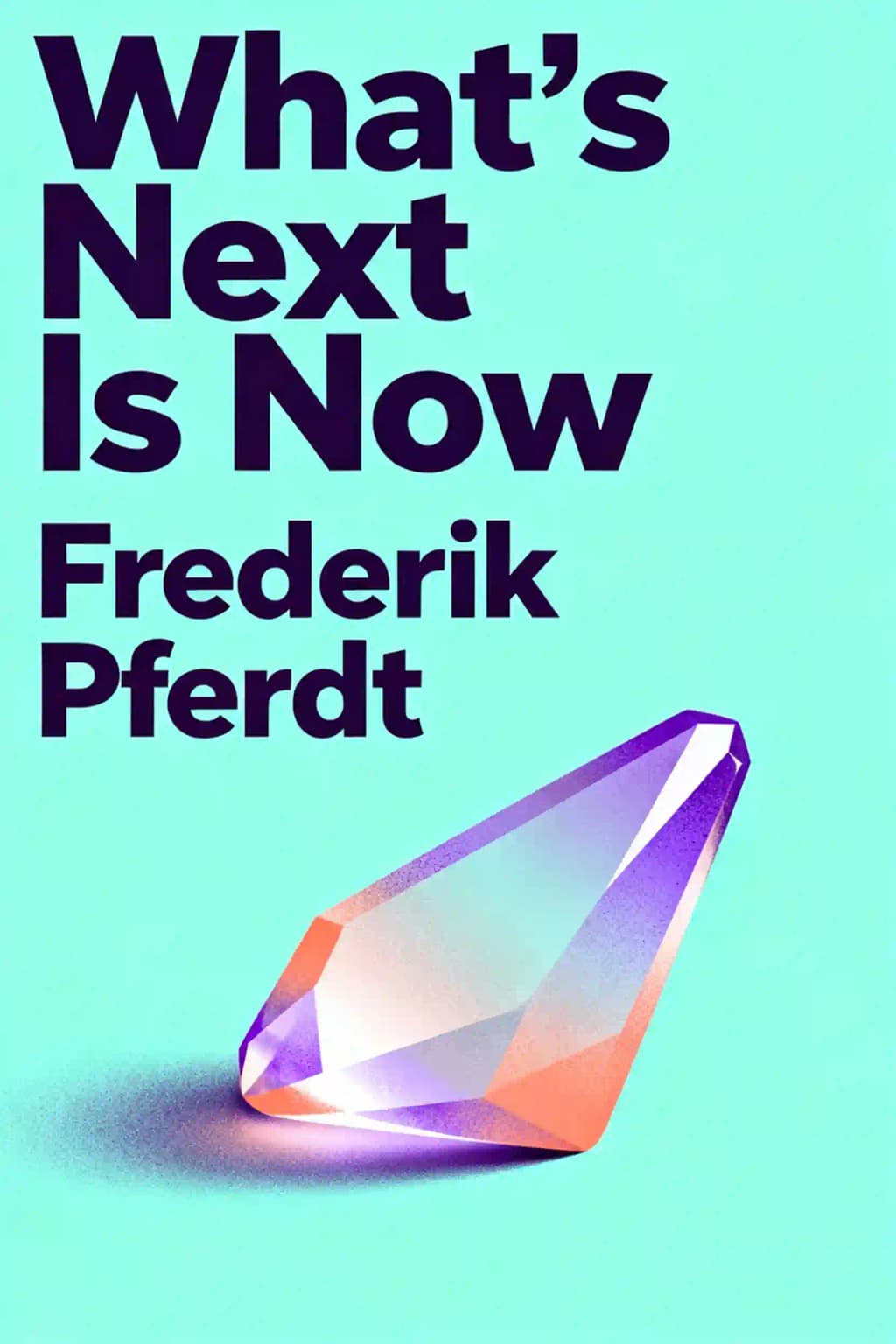
When the wildfires forced Frederik Pferdt to evacuate his Santa Cruz Mountains home in August 2020, he had just ten minutes to decide what to take. In that moment of crisis, he made a pivotal choice-not between possessions, but between mindsets. Would he focus on fear or opportunity? This moment crystallized what Pferdt had been teaching at Google as Chief Innovation Evangelist and at Stanford University: the future isn't something that happens to us; it's something we actively create through our choices. "What's Next Is Now" has become a cultural touchstone for innovation leaders, with figures like Arianna Huffington and LinkedIn co-founder Reid Hoffman praising its transformative approach. The book's influence extends beyond Silicon Valley-it's being integrated into leadership programs at companies worldwide and has been featured in publications from Fast Company to the Wall Street Journal for its fresh perspective on navigating uncertainty with intention.
第 2 章
Reframing Your Relationship with the Future
How often do you think about the future? Your answer reveals much about your satisfaction with the present and your hopefulness about what comes next. The more crucial question is whether you picture yourself in that future. While most people can envision themselves in the near future, seeing yourself decades ahead becomes increasingly difficult, creating distance from the consequences of present actions.
For many, the distant future becomes a one-dimensional construct filled with AI and robotics-a picture painted by futurists. But futurists think about THE future, not YOUR future. They analyze trends and make predictions about where things might go, but rarely capture the personal narrative arc that constitutes your individual future.
We fear the future because we fear change, which is ironic since we're entirely products of change-built by change but not built for change. Your future isn't distant-it's right here before you, shaped by countless choices you make or don't make. When you actively choose, you weave your own future; when you don't, someone else determines it.
The future-ready mindstate operates across five key dimensions plus your unique superpower: radical optimism that reframes problems as opportunities; unreserved openness that puts you where opportunity finds you; compulsive curiosity that creates new pathways; perpetual experimentation that tests ideas rapidly; expansive empathy that connects human experiences; and Dimension X, your unique superpower.
These dimensions aren't a rigid framework but dynamic, complementary factors that fluctuate and recombine. They don't all engage simultaneously or equally-each experience calls for different dimensions, like a DJ mixing tracks. Your mindstate is fluid, continuously adapting to context, with these dimensions humming at varying degrees within it.
Creativity-often misunderstood as a rare genius bestowed on the lucky few-is simply how your brain makes associations across everything your senses absorb. The heart of creativity is input-collecting "dots" of information, experiences and ideas-followed by connecting these dots in infinite combinations. Even small changes to your routine-looking at every person you pass, getting off the subway one stop earlier, buying coffee someplace new-invite different thoughts and ideas that may solve yesterday's problems.
第 3 章
Radical Optimism: Seeing Opportunity in Every Challenge
Radical optimism goes beyond seeing a glass as half full-it reframes problems as opportunities and embraces exceptional outcomes with absolute belief that something better comes from every experience. Our brains are naturally wired with a negativity bias that evolved to help us survive by recognizing dangers and mistakes first. This manifests daily when we fixate on the few negative reviews among dozens of positive ones, avoid eye contact with strangers despite potential positive connections, or focus on travel inconveniences rather than stunning surroundings.
Saying yes transforms both you and those around you. When you say yes to a seemingly off-topic idea in a meeting, you immediately engage more actively, listening and reasoning to find potential benefits. The group dynamic visibly shifts as people become energized by possibility rather than constraint. This simple act begins breaking down negative bias in your thinking.
While saying "yes" removes barriers, saying "yes, and..." actively sets creativity in motion. Rooted in improv theater, this approach builds collaborative momentum where each person adds to what came before. The transformation is remarkable-when people shift from listing reasons why an idea won't work to building upon it with "yes, and," they create concrete, actionable concepts that hadn't previously existed.
Reframing is another approach to developing radical optimism-seeing something entirely new by changing your perspective. We interpret life events through frames built from our beliefs, biases, and experiences. These frames, largely established early in life, influence everything from major life choices to daily decisions. Reframing isn't changing who you are, but changing what you see (focus) and how you perceive it (obstacle or opportunity).
Sometimes reframing means making a better problem. Working with KONE elevators, Pferdt helped teams reframe "elevators are too slow" to "the wait is aggravating and boring," opening creative solutions beyond mechanical fixes. The bigger the problem, the bigger the opportunity to reframe it as a "How might we..." question that's specific, actionable and achievable.
Kalle Ryan, with Irish and Swedish heritage, discovered his creative calling after living in New York City. Upon returning to Ireland, rather than lamenting the absence of creative outlets like those in New York, he created his own-the Brown Bread Mixtape, a show that ran for ten years. For years, he maintained a stark separation between his corporate self (Bruce Wayne) and creative self (Batman). The breakthrough came when he asked himself, "What if Batman came to work?"
This reframing transformed his career approach. Instead of solving problems conventionally, he began seeking creative opportunities in every task. His distinctive, visual approach to internal communications at Google proved that creativity was exactly what corporate functions needed. When facing risk aversion, Ryan pushes through with the mantra "I can't risk not taking a risk."
第 4 章
Unreserved Openness: Embracing the Unknown
Unreserved openness means free-falling into others' metaphorical arms not because you trust them to catch you, but because you trust yourself to benefit from whatever happens. It's accepting the dare to expand your perspective.
Pferdt's journey with openness began after high school when, unable to find chef work near home, he ventured across the lake to study at the University of Konstanz. Though ostensibly there to study technology, education, and psychology, his profound learning came from transforming his belief system. He realized he'd been living in a fortress of assumptions that didn't serve him well. Rather than tackling them individually, he opened himself completely to new ideas and experiences to discover what he truly believed and how he could impact the world.
This unreserved openness generates confidence even amid uncertainty. Openness begins with a leap-you behave as if you're open, then discover the leap itself makes you more open next time. It's generative; each jump reinforces your openness, while choosing to close yourself off denies growth.
We all resist openness to some extent. Status quo bias, habits, traditions, and social norms become armor for closed minds, giving us permission to avoid new experiences. Even when we briefly try something new, we quickly retreat to our comfortable routines.
Being closed wrongly signals you already know everything necessary, limiting your capacity to learn and ensuring static interests. It also stiffens you against inevitable change, putting you in a permanent, exhausting defensive state like a clenched fist.
Transparency complements openness perfectly-openness lets you process incoming information meaningfully, while transparency lets you share honestly without hesitation. Though transparency invites potential criticism, it's the world's best way to establish trust. Unfortunately, there's no "sort of transparent"-you must go all in. Start by inviting others' unvarnished feedback on something important to you, putting yourself in the listening seat to learn about transparency.
Another practice is being first to do the hard thing-share your mistakes. In Google leadership meetings, each person would describe something they'd gotten wrong the previous week. Though initially uncomfortable, this practice built trust and made transparency expected and valued.
Sharing unfinished work also builds transparency. At Google's TGIF meetings, teams would present early prototypes, risking criticism but often gaining valuable collaborations that increased their project's success by attracting other smart people.
Choosing openness requires trusting yourself to handle whatever happens. When new experiences turn out well, we eagerly seek more. But when they don't, we file those memories away as protection against future missteps. As adults, we're hardwired to see uncertainty as threatening. When unexpected events occur, rather than rushing to remove discomfort, try getting comfortable with it as part of your learning process.
第 5 章
Compulsive Curiosity: The Engine of Discovery
Compulsive curiosity transforms you into a native explorer of the unknown, caught up in wonder and mystery as you investigate unfamiliar paths with "what if" as your mantra. Newton Cheng embraced curiosity after abandoning his engineering career, filling his blank slate with new passions. After his breakdancing days ended, he discovered deadlifting, eventually lifting 550 pounds and winning championships after being inspired by Richard Hawthorne. His curiosity also led him to Google where he develops initiatives helping Googlers thrive.
To ignite genuine curiosity, you must first recognize and step over your personal assumptions. When Pferdt started at Google, he wore a time-lapse camera around his neck for two weeks after HR rejected his proposal to have others wear it. The photos revealed countless details he'd missed in his daily life, showing how assumptions create barriers to new insights. Stepping over assumptions simply means seeing them clearly, then consciously moving beyond them toward discovery.
The compulsively curious engage all five senses, not just sight which provides 80% of our daily information. When you observe, you take in information and make connections through any sense. At Google, Pferdt trained thousands to observe more comprehensively, including a team rethinking the hiring process. He encouraged them to get close to those experiencing challenges-hiring managers, applicants, interviewers-and collect information about what Nooglers (new Google employees) were seeing, saying, hearing, and feeling throughout onboarding and beyond.
Their observations revealed that most Nooglers connected with only 8-10 people during early onboarding activities, forming lasting bonds similar to high school lunch groups. This insight led to reconfiguring meeting spaces with 10-person tables instead of auditorium seating, actively encouraging networking, and pointing new hires to community groups like HOLA or PRIDE at Google.
We often abandon curiosity as adults because childhood taught us it can lead to trouble. Curiosity becomes entangled with fear, causing us to avoid uncertain situations. But what if we reimagined our metaphorical horizon-our knowledge edge-not as an endpoint but as a brilliant beginning? People afraid to admit ignorance avoid situations where they lack answers, making their world small. Those comfortable saying "I don't know" happily embrace being beginners, living in a much larger world.
The compulsively curious aren't focused on quick answers but on the act of questioning itself. Neurologist Erwin Strauss called humans "question animals," noting that our questions reveal as much about us as our dreams. The essence of curiosity lies in two simple words: "I wonder..." When we hold onto these thoughts rather than letting them flit away, they lead us down trails of discovery filled with choices, information, and expanded possibilities.
第 6 章
Perpetual Experimentation: Learning Through Action
Perpetual experimentation fuels immediate discovery by rapidly testing ideas and pursuing where the learning leads. Rather than seeking epic epiphanies, it generates numerous small insights that build toward new ideas. Frederik prototyped his relationship with his future wife Angela by taking a three-week unplanned road trip in an unfamiliar country just one month after meeting. This unconventional experiment revealed their compatibility through shared challenges-they discovered mutual passions for nature exploration and food, learned they could rely on each other during difficult situations, and found they could maintain humor even when tired and hungry.
Experimentation deliberately illuminates what's possible by pushing us into the unknown while providing clarity for purposeful movement forward. Even experimenting just for a fresh perspective expands our ability to see the world differently, opening us to innovation. Finding Google lacked spaces for imagination and experimentation, Pferdt collaborated with colleagues to create "The Garage"-an adaptable workspace with movable whiteboard tables, 3D printers, and even junkyard auto parts. Rather than designing the space completely, they observed how Googlers used it, adapting based on actual usage patterns.
Experimentation requires psychological safety-the confidence that others won't respond with derision or rejection to bold questions and ideas. Studies show highly functioning teams create environments where members feel secure voicing opinions and taking risks. Pixar Animation Studios exemplifies this through their "Braintrust" meetings where filmmakers candidly discuss project problems without ego, focusing on solutions rather than personal criticism.
Tom Chi approaches experimentation as a game to overcome fear of failure. He explains that when stakes are too high (like rolling a die where you win a million dollars for a six but lose a million for any other number), people refuse to play. But if you get multiple attempts-twenty, a hundred-your confidence increases dramatically. Chi emphasizes that between where you are now and where you want to go, there are iterations you'll go through to win the game. The only way to lose is taking no action.
At Google Glass, Chi had his team create fifteen hardware prototypes weekly for ten weeks-one per person per day-which prevented attachment to any single experiment. From this experience, Chi developed three mantras: "Conjectures become experiments, and actuals become decisions," "Attachment is the enemy of innovation," and "Specificity is the friend of innovation."
Experimentation transforms opinions into facts by testing practical assumptions about your vision. It helps prove or disprove assumptions, discover audience surprises, make informed decisions, and generate data to tell your story. The fundamental premise is that there's no failure in experimentation, only learning-the more you try, the more you learn.
When prototyping, you can either "fake it" with quick simulations or partially "make it" to answer fundamental questions about design and need. Fake-it prototyping, like testing a floating desk idea by putting a desk on a high-rise roof for a week, quickly reveals practical issues (wind, amenities, accessibility) while confirming benefits (the view).
Building an appetite for risk is essential for experimentation, which is essentially an intelligent but continuous roll of the dice. Start by mapping your daily routine to identify habitual behaviors, then deliberately disrupt them with alternatives. This gradually pushes you out of your comfort zone, helping you notice new things about your experiences. The goal is to leave behind the well-worn path and embrace uncertainty-take drives without destinations, explore without plans, get comfortable with ambiguity.
第 7 章
Expansive Empathy: Connecting Human Experiences
Expansive empathy connects human experiences, creating intersections and bridges on the path to your future. It's not merely a moral imperative but a practical one-you won't succeed in building your desired future without considering what others want. Every interaction with another person presents an opportunity to acknowledge shared humanity, potentially creating tiny sparks that contribute to better outcomes. Empathy isn't selflessness or altruism; it's about balancing your needs with consideration for others, which ultimately benefits you as well.
When preparing for speaking engagements, Pferdt shifts focus from refining his ideas to thinking about where each audience member may be in their lives. Despite his name on the screen, the potential for impact rests inside each person listening. To practice empathy-at that slightest juncture of "I" and "you"-put your own history in the back seat. Stop talking. Listen harder and notice more. You'll hear everything the other person is saying through vocabulary, tone, facial expressions, and body language. You'll even notice what they're not saying, which can reveal what they're actually feeling.
You'll never fully know another person's experience, even someone close to you. When you assume something about their feelings, stop yourself-whatever you think you know is full of surprising holes. To have a clearer understanding, fill the gaps in your knowledge by asking: What am I missing? What could I be unaware of?
Practice predictive empathy by orienting your thinking around what you already know about human nature. What makes people scared, laugh, worry, feel lonely or hopeful? You have accurate answers to these questions from your own experiences, and this knowledge offers infinite choices about what to do with it. Predictive empathy simply requires us to be consciously human, though we often become detached from our humanity when our lives become taskier.
Astrid Weber shares how empathy has shaped her unique path as a UX designer and global change maker at Google. Since childhood, she's been driven by openness and curiosity, working on diverse projects from Google Calendar to refugee and climate tech initiatives. Rather than traditional career advancement, she follows her empathetic interest in different perspectives, diving into new situations, building processes, and teaching others. She builds communities where people inspire and empower each other, hiring smart, passionate people regardless of formal experience. For Astrid, empathy means "being human together"-acknowledging our need for community and understanding others to create positive change.
Predictive empathy extends beyond immediate situations to become empathy for the future itself, considering how your actions affect generations to come. This approach helps you anticipate needs and experiences of future people, making your choices more meaningful. Practicing empathy leads to personal growth by challenging your perspective and enriching your understanding of our diverse world. It serves as the bridge between "I" and "you" that reminds us our future is experienced collectively.
第 8 章
Your Dimension X: Your Unique Superpower
Dimension X is your unique superpower that influences your life trajectory. Rather than looking backward with regret, recognizing your future-ready milestones-key turning points that shaped your path-provides insight into your distinctive qualities. These milestones reveal your Dimension X, a signature reflex that guides your choices and shapes your future.
To identify your Dimension X, map your life's significant junctures-events that triggered intense emotional responses or marked turning points. Draw a horizontal timeline with positive experiences above the line and negative ones below. After plotting 5-10 milestone events, examine your state of mind during each, actions taken, lessons learned, and patterns in your responses. You'll likely spot a consistent factor-your Dimension X-that influenced your decisions at these pivotal moments.
Laura Jones discovered her Dimension X-making unexpected connections-through a journey from economics to creative work. Despite starting at Deloitte, she felt incomplete until finding Stanford's design school, which united her analytical and creative sides. At Visa, she transformed a standard data report into an immersive presentation, beginning a career integrating diverse skills. Her ability to visualize unconventional connections between people and ideas led to innovative projects like partnering fashion people with engineers at Google and creating a Lizzo campaign at Instacart.
Your milestone map doesn't show moments when you didn't move forward because you chose inaction despite your Dimension X urging you to act. Reflect on three occasions where you didn't follow your instincts and analyze what held you back. For each situation, imagine two alternative outcomes had you taken action. Remember that the cost of inaction (COI) will always exceed the cost of making a mistake.
View your Dimension X as a recurring character in your personal narrative by examining how it interacts with other dimensions of your future-ready mindstate during specific periods. Map your experiences during eventful times, like preparing for a business pitch, noting how dimensions like optimism, openness, curiosity, experimentation, and empathy fluctuate. Your Dimension X-whether it's resourcefulness or something else-amplifies these other dimensions at key moments.
Sarah Devereaux grew up near Detroit in a family of blunt, tenacious people who taught her to fight for her beliefs. Her Dimension X-grit-initially manifested as a bulldozer approach that got results but damaged relationships. After receiving difficult feedback from her manager at Google, she embarked on a six-year transformation journey to maintain her strength while developing patience and thoughtfulness. Today, she approaches challenges with both forceful determination and genuine empathy, finding greater satisfaction in her coaching work.
The ancient geometric problem of "squaring the circle" represents the courage to attempt the seemingly impossible. Like mathematicians who worked on this problem for centuries, your efforts today may contribute to future solutions you'll never see. This exemplifies being future-ready: understanding that every choice has consequences, whether immediate or distant. Your Dimension X helps you embrace Larry Page's advice to "have a healthy disregard for the impossible," giving you confidence when facing challenges.
第 9 章
Living Future Ready: Your Day-to-Day Transformation
Like a composer creating music note by note, you craft your future through countless choices, tapping every dimension of your future-ready mindstate. No longer bound by doubt or fear, you approach each day with eager anticipation, seeing opportunities immediately in front of you while nurturing your vision on the horizon. Living future-ready means leveraging inevitable change to your advantage, transforming apprehension about the unknown into excitement about possibilities.
Living future ready means keeping the future close to see immediate opportunities while nurturing a distant vision that inspires ambitious choices. It's being prepared to leverage inevitable change, recognizing the power of everyday decisions to shape your future. With optimism, you focus on what could go right; openness makes change your friend; curiosity drives exploration; experimentation transforms fear of failure into discovery; empathy expands your sense of collective possibility; and your Dimension X makes big things happen.
Your future-ready mindstate drives continuous learning, adaptation, innovation, and connection in ways that evolve you toward your future. The essential question isn't what you want to do or who you want to be, but HOW you want to be. Your "you-print" on this planet will show what you believed in, whether you were resilient and bold, if you tried to understand yourself and others, and the impact you had on people in your story.
Check in daily to ensure how you are in this world aligns with your intentions. There's no ideal way to be-like your Dimension X, it will be distinctively you. Living future-ready with all five dimensions is exactly what you need to make your own future. Within ordinary activities lie opportunities to make choices that compose your future when you ask: "What if?" The question isn't what you want to do or who you want to be, but HOW you want to be in your future-this will determine your "you-print" on this planet.