第 1 章
When Chance Meets Preparation: The Power of Serendipity
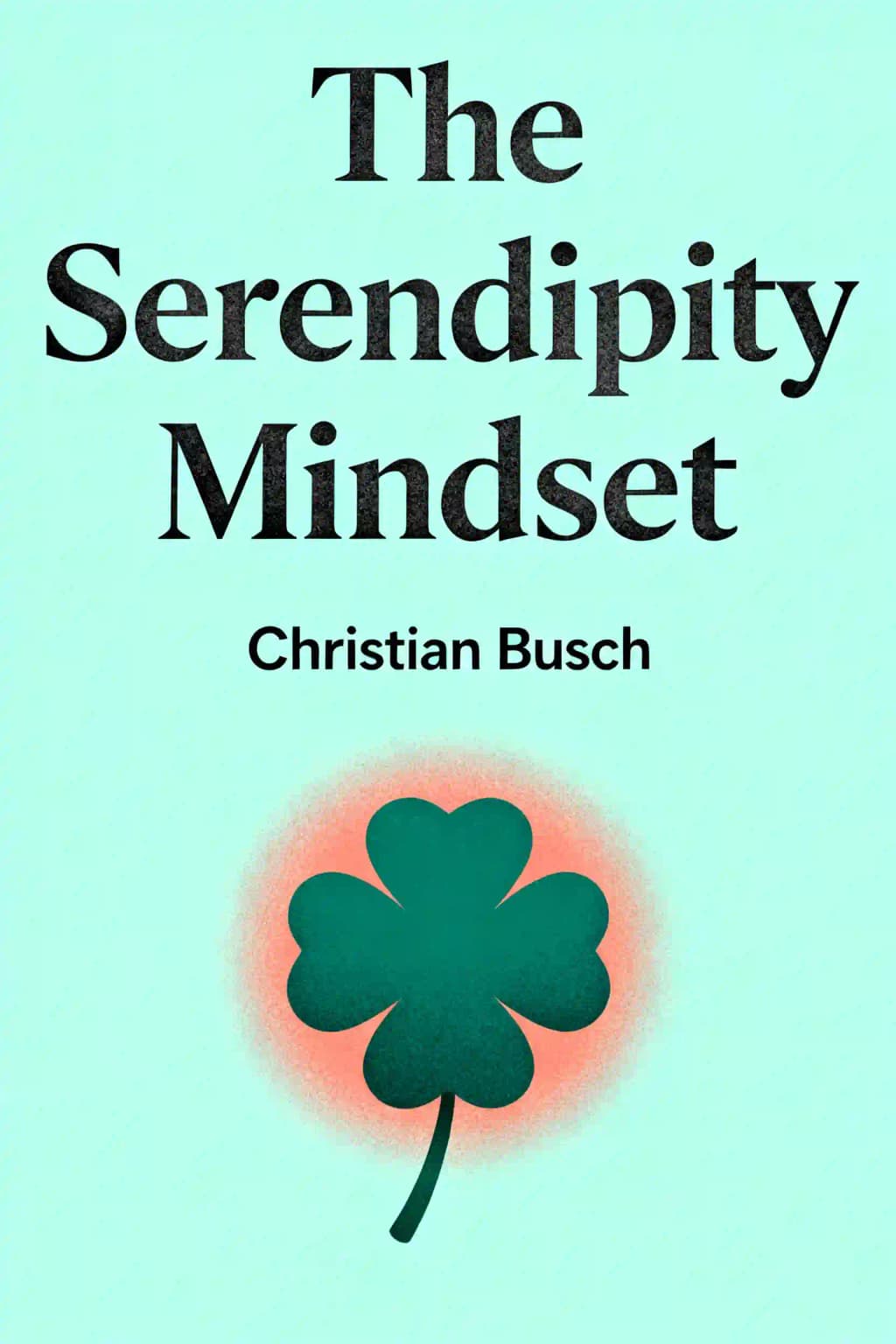
Have you ever wondered why some people seem to have all the luck? Why do certain individuals consistently stumble upon life-changing opportunities while others struggle to find their path? The answer might lie in what Louis Pasteur famously observed: "Chance favors the prepared mind." In his groundbreaking book "The Serendipity Mindset," Christian Busch reveals that what appears as mere coincidence is often the result of a particular way of thinking and acting that can be cultivated by anyone.
This book has become a favorite among innovators and entrepreneurs like Reid Hoffman (LinkedIn co-founder) and has been featured in publications from Harvard Business Review to Psychology Today. Its cultural impact extends beyond business circles into education and personal development, offering a refreshing alternative to rigid planning in our unpredictable world. Busch's work challenges us to reconsider how much control we actually have over our destinies and provides a practical framework for transforming unexpected events from threats into opportunities.
第 2 章
The Science of "Smart Luck"
Serendipity isn't just blind luck-it's a process that can be understood and cultivated. The concept originated from a Persian fairy tale about three princes of Serendip (ancient Sri Lanka) who made unexpected discoveries through their powers of observation. In 1754, Horace Walpole coined the term "serendipity" to describe making discoveries "by accidents and sagacity, of things not in quest of."
While we often reduce serendipity to simply "good luck," it's actually the interaction between chance and human action that creates positive outcomes. Consider Nathaniel Whittemore, who transformed the chaos of an Icelandic volcano eruption grounding flights across Europe into an opportunity. Within 36 hours, he organized "TEDxVolcano," a spontaneous conference that attracted 200 attendees and speakers including eBay's first president. With no budget, he convinced a coworking space to donate facilities and recruited volunteers through his existing networks.
Similarly, Dr. Nico Rose met his idol, former heavyweight champion Wladimir Klitschko, in a hotel gym. A simple interaction about breakfast directions led to Klitschko writing the foreword for Nico's book. These weren't just lucky encounters-both men had laid foundations that allowed them to recognize and act on unexpected opportunities.
Serendipity drives major innovations like nylon, Velcro, Viagra, Post-it Notes, X-rays, penicillin, and microwave ovens. Studies suggest 30-50% of scientific breakthroughs result from unexpected discoveries. Even our personal lives are shaped by serendipity-finding partners, landing jobs, or meeting business collaborators often happens through "coincidences" that aren't really coincidental at all.
Every serendipitous moment begins with an unexpected trigger but falls into one of three categories:
1. Archimedes Serendipity: Finding an unexpected solution to a known problem, like Archimedes discovering how to test the king's crown while relaxing in his bath.
2. Post-it Note Serendipity: Investigating one problem but solving a completely different one, as when Dr. Spencer Silver at 3M tried creating stronger glue but instead discovered the weak adhesive perfect for Post-it Notes.
3. Thunderbolt Serendipity: When no deliberate problem-solving is underway, but something unexpected creates a new opportunity, like the founders of Sofar Sounds creating intimate living room music events after being annoyed by chatty concertgoers.
The core of active serendipity involves three elements: encountering an unexpected trigger, connecting this trigger to something previously unrelated (bisociation), and realizing unanticipated value from this connection. What appears as coincidence typically occurs because someone laid the groundwork for it.
第 3 章
The Barriers to Serendipity
Why don't we experience more serendipity in our lives? The answer lies in our thinking patterns and biases that obscure potential connections. Four major barriers prevent us from spotting and harnessing serendipitous moments:
First, we dramatically underestimate how frequently the unexpected occurs. In a revealing experiment by Richard Wiseman, both "lucky" and "unlucky" participants walked past a five-pound note on the sidewalk and sat next to a successful businessman. Only the "lucky" person noticed the money and engaged in conversation. Both faced identical opportunities, but only one saw them.
Second, we self-censor unconventional ideas for fear of rejection. In organizations, innovative thoughts are often dismissed with phrases like "We've always done things this way, why change?" Even when valuable discoveries emerge through unexpected means, people reframe them as purposeful to avoid criticism for not following conventional processes.
Third, we post-rationalize events, creating neat narratives that ignore the messy reality of how things actually unfolded. We airbrush serendipity out of our histories, making linear stories out of what were actually "squiggle stories" with many unexpected turns. This makes it harder to spot serendipity when it happens again.
Finally, we suffer from "functional fixedness"-being mentally blocked from seeing familiar tools in novel ways. Knowledge and expertise can be both assets and liabilities. While deep domain knowledge helps us spot connections others miss, it can limit our thinking to established patterns. As the saying goes, "If you have a hammer, everything looks like a nail."
To overcome these barriers, we must become aware of our innate biases and deliberately make room for alternative perspectives. By examining the real journeys of people and ideas beyond simplified narratives, we can see serendipity's significant role in innovation and success.
第 4 章
Developing an Open Mind
People with a serendipity mindset aren't naturally luckier than others-they cultivate this mindset through how they frame the world. Being alert to unexpected opportunities is essential. When British researchers developing a heart medication discovered an unexpected side effect-penile erections in male patients-they didn't dismiss it as embarrassing. Instead, they recognized an opportunity and developed Viagra, one of history's most successful medications.
How we frame situations dramatically affects our ability to spot serendipity. Research in resource-constrained environments reveals that people who reframe limitations as opportunities create their own luck. Organizations like South Africa's Reconstructed Living Labs (RLabs) teach communities to identify undervalued resources-like former drug dealers becoming teachers or abandoned garages becoming training centers. This paradigm shift turns perceived liabilities into assets.
Cultivating serendipity begins with small behavioral changes, like viewing challenging situations as learning opportunities rather than problems. Richard Wiseman's research shows that "lucky" people frame negative events differently than "unlucky" people. When presented with a scenario of being shot in the shoulder during a bank robbery, "unlucky" people see it as another bad experience in their pattern of misfortune, while "lucky" people focus on how it could have been worse.
Our language reveals our approach to serendipity. Saying something "happened to me" frames us as passive recipients of fate, whereas focusing on what we can control makes us agents of our own luck. Self-fulfilling prophecies play a powerful role-we literally "manifest" what we believe will happen.
Seeing every situation-especially conversations-as an opportunity for serendipity is an active choice. By listening for connections between what people say and our interests, we train ourselves to connect dots. Successful people often have a "North Star"-a guiding principle that provides direction without dictating each step, allowing for serendipitous diversions along the way.
The Socratic method-persistent questioning dialogue-is one of the most effective approaches for stimulating fresh thinking. Rather than teaching beliefs or facts, asking questions helps people realize their preconceptions are often illusions. Six types of Socratic questions include those for clarification ("Why do you say that?"), probing assumptions, evidence, perspective, implications, and questioning the question itself.
Even the most seemingly boring conversation can be transformed by asking the right questions. Rather than dismissing someone as boring, ask questions that make conversations more interesting. The questions we ask are crucial-"What do you do?" puts people in a box, while open questions like "What's on your mind?" or "What are you inspired by right now?" create space for meaningful connections.
第 5 章
The Emotional Foundation for Serendipity
Our lives gradually reveal a bigger picture as we connect our skills, knowledge, and experiences. Unlike blind luck, serendipity requires active pursuit and motivation-we must want to see triggers and connect dots. The question becomes: how can we develop an outlook that helps us truly experience serendipity?
When exploring what excites us, we often think less about specific goals and more about creating an "opportunity space" for exploration. Organizations like companies and universities can serve as platforms for personal experimentation, allowing us to develop skills while discovering meaningful paths. This approach lets us "place bets" on different possibilities.
Our aspirations often stem from deeper beliefs and values. Viktor Frankl's concept of "will to meaning"-finding purpose both in everyday interactions and larger aspirations-helped him survive the Holocaust and continues to resonate today. This dual focus on micro and macro meaning helps us thrive.
However, Maslow's hierarchy of needs has conditioned us to approach life linearly: fulfill basic needs first, then pursue meaning later. This "first do well, then do good" mentality has led many to spend decades in unfulfilling jobs before pursuing their passions. But expectations are changing-people increasingly want to combine money and meaning simultaneously.
When we bring our authentic selves to our work rather than compartmentalizing, we often experience more serendipity. Research shows people who work on meaningful projects (even monotonous ones) are healthier and more productive.
Rather than focusing on making everyone happy, concentrating on how we can contribute to someone's happiness in the moment makes things less stressful. Studies show that focusing on others rather than ourselves creates lasting happiness and nurtures serendipity by building goodwill.
Research shows that traits like proactivity, humor, openness to experience, and willingness to pursue untested ideas can be trained to nurture serendipity. Proactive behaviors help create serendipitous situations and overcome barriers, leading to better jobs, entrepreneurial success, and even escaping poverty.
Creativity is crucial for serendipity as it helps us attend to the unexpected and make unusual associations. Creative people are often risk-averse but overcome this through an even greater fear-the fear of not having tried.
Our personality traits affect serendipity reception. Extroverts reach optimal mental arousal through social interaction, while introverts often have high baseline arousal and need solitude to recharge. Extroversion increases lucky encounters by meeting more people, attracting others, and maintaining larger networks. However, introverted behaviors also play a crucial role in serendipity through self-awareness, reflection, and allowing ideas to percolate.
第 6 章
Creating Conditions for Serendipity
We can actively create conditions for serendipity rather than waiting passively for it to occur. Michele Cantos, an Ecuadorian educator, experienced unexpected career advancement after sending update emails to her network during a travel break. By honestly sharing her journey and aspirations, she created a serendipity trigger that led to a tech industry job opportunity through an acquaintance who saw potential in her that Michele herself hadn't recognized.
Super-connector Oli Barrett demonstrates how to maximize serendipity opportunities by "casting multiple hooks" in conversations. When asked what he does, he mentions several aspects of his life-his passion for connecting people, his education company, his interest in philosophy, and his piano playing-creating multiple potential connection points.
Serendipity can be deliberately accelerated. Princeton chemist David MacMillan's research team tested chemicals never shown to interact before, discovering valuable new reactions for drug development. This approach treats serendipity as governed by probability-increasing exposure to potential reactions increases the likelihood of discovering something valuable.
People are often the most powerful serendipity triggers. Henry Kissinger's chance encounter with an Eastern Bloc official at a conference in Poland ultimately led to opening diplomatic relations between the US and China in 1972, changing geopolitical history. On a personal scale, doctor Amina Aitsi-Selmi's elevator conversation with a UN vice-chair transformed her career, leading her from despair to fulfilling her twenty-year dream of working in global health.
Creating opportunities for serendipity requires proactive effort-what entrepreneur Mattan Griffel calls "setting thousands of little serendipity bombs." This includes writing speculative emails to people we admire, sharing our interests and work publicly, and introducing ourselves to hosts or staff at events who can lead to further introductions.
Physical environments significantly influence serendipitous encounters. Organizations can deliberately design spaces to increase quality serendipity triggers, as seen at Burning Man where strategically placed art in public plazas makes people interact more frequently. Pixar exemplifies this approach-Steve Jobs designed their campus with a central atrium containing mailboxes, meeting rooms, and cafeteria to "maximize inadvertent encounters" between artists and computer scientists.
Technology dramatically accelerates serendipity when used intentionally. Web Summit employs data scientists to engineer serendipitous encounters, using network theory to create "machine-curated" social events and seating arrangements that cluster compatible strangers. Social media platforms exponentially increase potential serendipitous connections through tagging functions and by maintaining weak ties at scale.
The magic of serendipity happens in those "aha" moments when seemingly unconnected elements suddenly align. This requires not just encountering triggers but actively connecting them. Alabama hairstylist Phil McCrory's serendipitous insight came while watching news about the Exxon oil spill-noticing how oil clung to otters' fur led him to realize human hair could absorb oil spills. Testing this with hair in nylon tights confirmed its effectiveness, eventually leading to oil spill cleanup mats.
第 7 章
Turning Serendipitous Encounters into Opportunity
Serendipity requires both sagacity and tenacity to transform chance encounters into positive outcomes. The difference between serendipity missed and found often lies in our willingness to pursue unusual observations, as illustrated by two researchers who noticed rabbits' ears flopping after papain injections-one ignored it while the other investigated further and won a Nobel Prize.
Serendipity often involves an incubation period between the initial trigger and the final opportunity. Research shows these periods typically last between five minutes and eight hours but can extend for years. During this time, our subconscious processes information until a solution suddenly emerges-like those brilliant ideas that strike in the shower or at 3 a.m.
We often hold back from pursuing serendipitous opportunities due to fear of failure, impostor syndrome, or feeling stuck in current situations. Overnight successes are rarely that-most require years of hard work and perseverance. Grit (perseverance combined with passion) and tenacity are essential for compound serendipity. LinkedIn founder Reid Hoffman uses "positioning for luck" to debunk the myth that success comes from being in the right place at the right time.
Resilience enables us to persevere through difficulties. Robyn Scott documented how eight maximum-security prisoners in South Africa created "The Group of Hope" to help HIV sufferers. Starting by supporting an 11-year-old orphan with AIDS-sewing him clothes, growing him food, and arranging a flight to fulfill his dream of flying-they expanded to help hundreds of township orphans. This responsibility created a powerful self-reinforcing circle: given responsibility, they became more responsible.
Our interpretation of events changes over time-what feels like bad luck initially may become serendipity with persistence. When the author's organization nearly went bankrupt, it felt catastrophic but ultimately led to a stronger community-embedded approach. The difference between these outcomes and failure was tenacity-refusing to stop at the first barrier.
Rather than trying to predict everything, we should prepare ourselves to handle whatever comes our way-like an immune system that develops by exposure to challenges. Suppressing the unexpected makes us more vulnerable, not less. Overcontrolling situations actually increases our vulnerability to randomness. As Susan David notes, "Discomfort is the price of admission to a meaningful life."
Harvard's Leith Sharp found that ideas never progress linearly through organizations but follow a "squiggle" path. These ups and downs are often omitted from success stories, creating dangerous illusions about how progress happens. In reality, "squiggle beats linear."
When faced with too many options, we need effective prioritization systems. Warren Buffett's approach illustrates this perfectly-when his pilot asked about prioritizing career goals, Buffett had him list twenty-five goals, circle the top five, and treat the remaining twenty as an "Avoid at All Costs" list.
Effective serendipity requires proper time management. Paul Graham's transformative essay on "maker's versus manager's schedule" explains how different work requires different time structures. Managers thrive on short, reactive time slots and meetings, while makers need long, uninterrupted blocks to immerse in creative work.
第 8 章
Building Your Serendipity Network
Serendipity isn't just a one-time event but can be cultivated as "compound serendipity"-a process where each new instance has greater potential because of previous ones. Our social groups and communities create the opportunity space that can either accelerate or stifle serendipity, acting as our serendipity field.
Social networks provide us with social capital-access to resources and opportunities that improve our wellbeing. Research published in Science found that diverse relationships strongly correlate with economic development, with disadvantaged regions typically having less access to diverse groups.
Mapping our professional networks can reveal our latent social capital and identify key "multipliers"-well-connected individuals who can spread ideas and connect us to opportunities. Rather than contacting everyone in a network, targeting these key multipliers is more efficient as they have greater credibility with their peers.
Communities go beyond networks by providing a sense of belonging and social identity that can exponentially increase our base level of serendipity. Well-curated communities follow a power law, dramatically improving our serendipity experience rather than just incrementally enhancing it.
Communities traditionally relied on "strong ties"-close relationships that provide trust and support but are limited in reach and diversity. "Weak ties" offer broader reach but less reliability. Well-curated interest-based communities transform weak ties into strong ones through "proxy trust by affiliation." This allows members to activate resources from people they barely know, as if they were close friends.
Effective communities form around common denominators-shared backgrounds, interests, passions, or values. However, communities that are too homogeneous can create echo chambers and limit serendipity. Creating diverse groups with strong common denominators provides both the variety needed for serendipity and the trust required for meaningful exchange.
Traditional "networking" events often create artificial, superficial connections. Effective relationship-building events focus on shared themes, interests, or passions that enable deeper conversations. Well-curated events embody community values, like informal dinners where members share stories in relaxed environments.
Even tight-knit groups can fall victim to the "tragedy of the commons" when shared resources fail because no one takes responsibility. "Lateral accountability"-accountability to oneself and peers rather than hierarchical control-helps successful interest-based communities thrive.
Networks can accelerate serendipity but have dark sides. Hidden agendas create uncomfortable situations that limit serendipity potential. Serendipity can also deepen inequalities, as with police stop-and-search tactics that disproportionately target racial minorities.
Even with equal education, underprivileged individuals experience fewer positive coincidences due to limited support systems and fewer serendipity-triggering conversations or connections. Creating social opportunity spaces matters more than just providing content or direct access. Solutions include professional "speed-dating" between young people and council members, pairing individuals with relatable mentors from similar backgrounds who've achieved success, and enabling shadowing opportunities to observe role models in action.
第 9 章
Creating Cultures of Serendipity
Our collective culture-the values, beliefs, and principles guiding our interactions-can either nurture or constrain serendipity. The "watercooler test" reveals an organization's culture through casual conversations: some focus negatively on people ("Peter's a lousy presenter"), while others build positively on ideas ("Why don't we do a related campaign?").
Psychological safety-the ability to show ourselves without fear of negative consequences-profoundly impacts serendipity by encouraging people to share unexpected encounters or half-formed ideas. Harvard professor Amy Edmondson's research shows that high-performing teams talk more about mistakes, not because they make more, but because they're open to discussing and learning from them.
Project funerals-where failed projects are laid to rest with honest discussion about learnings and feelings-can foster trust and serendipity. In one case, a chemical company's coating for nonreflective picture frame glass was deemed unmarketable due to high cost. During the project funeral, someone asked if the technology might work for solar panels. This unexpected connection led to testing that proved highly effective, creating an entirely new business unit.
Human progress is driven by groups, not heroic individuals working alone. Even celebrated discoveries like penicillin were team efforts-Alexander Fleming shared his Nobel Prize with Ernst Chain and Howard Florey, who were essential to developing the discovery. Successful innovators like Benjamin Franklin and Steve Jobs understood their greatest contribution was assembling complementary teams.
The "smokers' corner" phenomenon shows how random interactions across departments and hierarchies can spark unexpected ideas. Smart companies create similar opportunities through shared activities and clubs that bring diverse people together. Organizations can foster cross-pollination through dual roles after mergers, regular rotation of people, and incentives like "learning lunches" with smart outsiders.
Physical environments significantly influence serendipity. Companies like Google and IBM design headquarters to enhance "cross-pollinations" between people and disciplines. Google's Mountain View campus features bent rectangles ensuring employees are never more than three minutes apart, with rooftop cafes to close structural holes between teams.
In today's rapidly changing world, progress depends on our ability to develop and leverage networks. Companies are shifting from organization-centric initiatives to ecosystems-becoming more like starfish (decentralized, adaptable) than spiders (centralized, vulnerable). PayPal partners with other companies to maximize value, while former competitors like BMW and Mercedes now collaborate on car-sharing.
While consistency and predictability once made organizations successful through economies of scale, today's savvy consumers demand customization and cocreation. Real-time responsiveness to evolving customer needs is key-designing for serendipity means listening actively to unexpected use cases. When Haier discovered rural customers using washing machines to clean vegetables, they developed a specialized potato washing machine rather than dismissing this as an anomaly.
第 10 章
Embracing the Unexpected
How different would our lives be if we had missed that train, or never met that person who changed everything? Looking at counterfactuals helps us understand serendipity's role in our lives. People tend to underestimate how differently life could have unfolded because of small lucky incidents, often unable to distinguish between smart luck (serendipity) and blind luck.
We often mistake blind luck for skill due to survivor bias-focusing only on winners while ignoring the "silent grave" of failures. This creates dangerous false lessons when we attribute success to a person's actions rather than randomness. Near-misses are particularly deceptive; we interpret them as successes rather than warnings.
While inspirational, giants like Michelle Obama or Bill Gates are often outliers whose success involved significant elements of chance or privilege that cannot be replicated. It's more effective to study patterns rather than individual stories, and to find role models closer to our reality.
Attribution bias is one of our most fascinating psychological phenomena. We tend to consider failure due to bad luck while attributing success to effort or skill, leading to overlearning from successes and underlearning from failures. This fundamental attribution error-overattributing success to skill rather than situational factors-creates costly mistakes in performance evaluations.
Good intentions don't necessarily lead to good outcomes, especially with complex social problems. Development projects often have unintended consequences-like educating a boy in Nairobi's Kibera district might destroy family structure if he was the breadwinner, forcing his sister into dangerous money-making situations.
The serendipity score assessment includes 38 questions covering diverse aspects of the serendipity mindset, from connecting with strangers to handling uncertainty. With a maximum score of 190 points, most people initially score between 80-100, but can improve to 140-160 with practice. What matters isn't comparison with others but tracking your own progress over time.
Serendipity infuses life with joy, wonder, and meaning, turning unexpected events from threats into delights. This approach offers hope in an era of polarization by showing how we can all shape our own smart luck, not just famous successful people. While blind luck plays a major role in life, we can create conditions that make "smart" luck more likely.
Success comes neither from blind luck nor skill alone, but from developing a mindset that frames the world differently-establishing motivation, connecting dots, transforming them into opportunities, and amplifying them. In uncertain times when many cling to dogma, the serendipity mindset offers an alternative that puts relationships and meaning at the core of existence. Like a muscle, this mindset strengthens with practice until it becomes natural.