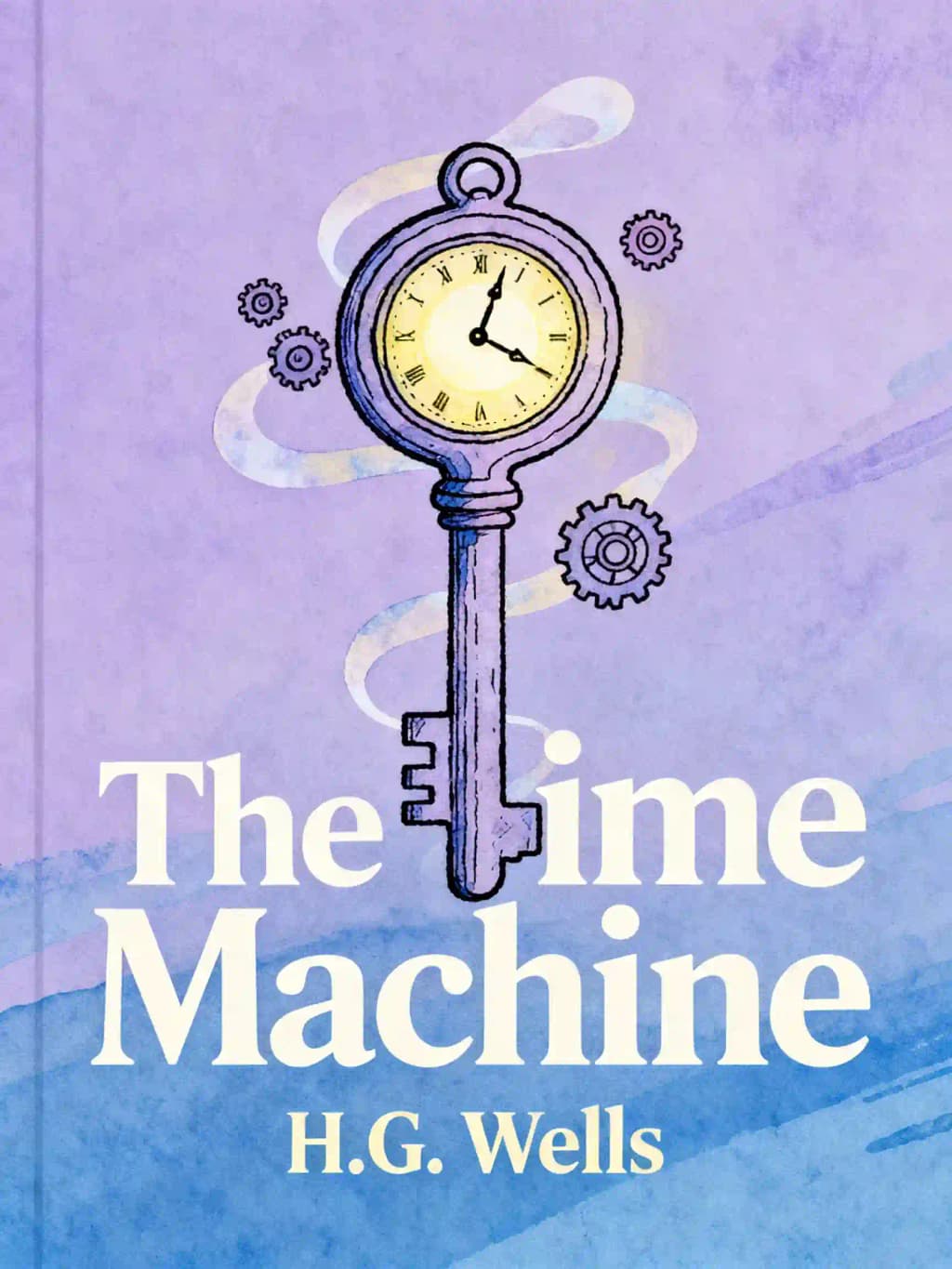
H.G. Wells' 1895 masterpiece invented modern time travel fiction. Influencing Tolkien, Asimov, and spawning countless adaptations, this Victorian critique of industrialization asks: What horrifying class divide awaits humanity's future? The answer still haunts readers today.
Herbert George Wells (1866–1946), acclaimed as the "father of science fiction," authored The Time Machine, a groundbreaking novel that pioneered the time-travel genre while critiquing Victorian social hierarchies.
A biologist trained under Thomas Henry Huxley at London’s Royal College of Science, Wells blended scientific rigor with imaginative storytelling to explore themes of evolution, class struggle, and humanity’s future. His influential works like The War of the Worlds, The Invisible Man, and The Island of Doctor Moreau established foundational tropes of speculative fiction, merging existential questions with futuristic vision.
Beyond fiction, Wells advocated for socialist ideals and global governance in non-fiction works such as The Outline of History. A prolific futurist, he accurately predicted technological advancements like atomic energy and World War II.
The Time Machine, first published in 1895, remains a cultural touchstone, adapted into multiple films and inspiring generations of authors. Translated into over 50 languages, Wells’ works continue to shape discussions about science, society, and humanity’s trajectory.
The Time Machine follows a Victorian scientist who invents a machine to travel to the year 802,701, discovering a divided humanity: the peaceful Eloi and subterranean Morlocks. The story explores themes of social class, evolution, and industrialization’s consequences through this dystopian lens. The Time Traveller’s encounters reveal a chilling vision of humanity’s potential devolution.
Fans of classic science fiction, social commentary, and speculative futures will appreciate this novel. It’s ideal for readers interested in Victorian-era critiques of industrialization, evolutionary theory, or early time-travel narratives. Educators and students analyzing allegorical literature or foundational sci-fi tropes also benefit.
Yes—its exploration of class inequality, technological ethics, and ecological collapse remains relevant. The novel’s concise storytelling and pioneering sci-fi concepts (like time as a fourth dimension) make it a timeless critique of societal divides. Wells’ vivid imagination and philosophical depth ensure its enduring appeal.
The Eloi represent the idle upper class, having grown weak and dependent, while the Morlocks (laborers forced underground) symbolize exploited workers. Their parasitic relationship critiques Victorian capitalism, illustrating how extreme class divisions could lead to humanity’s biological and social decay.
Wells frames time as a fourth dimension, envisioning it as navigable space. The Time Traveller’s machine uses scientific principles to “move” through time, challenging Victorian-era linear progress narratives. This concept popularized time travel as a sci-fi trope and sparked debates about determinism vs. free will.
Weena’s white flowers symbolize fleeting beauty and humanity’s fragility. The Time Traveller keeps them as proof of his journey, but their eventual withering mirrors the impermanence of civilizations. They underscore the novel’s theme that even “evidence” of progress may fade.
Wells warns that unchecked industrial advancement could dehumanize society. The Morlocks’ machine-dominated underworld reflects fears of laborers becoming mechanized, while the Eloi’s leisure highlights aristocratic decadence. The split species suggests technology without ethics leads to societal collapse.
He initially assumes future humans will be intellectually and morally superior. Instead, he finds a regressed species, arguing that comfort without struggle causes stagnation. His theory collapses as he realizes evolution doesn’t guarantee progress—a rebuttal to Victorian optimism.
The Time Traveller returns to Victorian England with his story and the white flowers as evidence. He later vanishes on an unresolved journey, leaving his fate ambiguous. The open ending emphasizes uncertainty about humanity’s trajectory and the limits of scientific control.
It introduced time travel via a mechanical device, established dystopian worldbuilding, and used sci-fi to critique social issues. Wells’ blend of scientific speculation (fourth-dimensional theory) and allegory set precedents for genres like speculative fiction and socio-political sci-fi.
The novel mirrors fears of class rebellion, ecological decay, and technological overreach. The Morlocks’ uprising allegorizes working-class threats to the elite, while the barren future landscape critiques industrial pollution and resource exploitation.
Its warnings about inequality, climate neglect, and unregulated technology resonate in 2025. The split between Eloi-like tech elites and marginalized laborers parallels modern digital divides, making the novel a cautionary tale for AI and automation debates.
通过作者的声音感受这本书
将知识转化为引人入胜、富含实例的见解
快速捕捉核心观点,高效学习
以有趣互动的方式享受这本书
It is a law of nature we overlook, that intellectual versatility is the compensation for change, danger, and trouble.
I grieved to think how brief the dream of the human intellect had been.
I felt naked in a strange world. I felt as perhaps a bird may feel in the clear air, knowing the hawk wings above and will swoop.
Time is merely a fourth dimension alongside length, breadth, and thickness.
Time travel isn't just a scientific concept but a visceral experience.
将《The Time Machine》的核心观点拆解为易于理解的要点,了解创新团队如何创造、协作和成长。
将《The Time Machine》提炼为快速记忆要点,突出坦诚、团队合作和创造力的关键原则。

通过生动的故事体验《The Time Machine》,将创新经验转化为令人难忘且可应用的精彩时刻。
随心提问,选择声音,共同创造真正与你产生共鸣的见解。

"Instead of endless scrolling, I just hit play on BeFreed. It saves me so much time."
"I never knew where to start with nonfiction—BeFreed’s book lists turned into podcasts gave me a clear path."
"Perfect balance between learning and entertainment. Finished ‘Thinking, Fast and Slow’ on my commute this week."
"Crazy how much I learned while walking the dog. BeFreed = small habits → big gains."
"Reading used to feel like a chore. Now it’s just part of my lifestyle."
"Feels effortless compared to reading. I’ve finished 6 books this month already."
"BeFreed turned my guilty doomscrolling into something that feels productive and inspiring."
"BeFreed turned my commute into learning time. 20-min podcasts are perfect for finishing books I never had time for."
"BeFreed replaced my podcast queue. Imagine Spotify for books — that’s it. 🙌"
"It is great for me to learn something from the book without reading it."
"The themed book list podcasts help me connect ideas across authors—like a guided audio journey."
"Makes me feel smarter every time before going to work"

免费获取《The Time Machine》摘要的 PDF 或 EPUB 版本。可打印或随时离线阅读。
In the twilight of the Victorian era, a brilliant inventor proposes something that violates every known law of physics-that time is merely a fourth dimension through which one might travel. To his skeptical dinner guests, he demonstrates a small model that vanishes at the press of a lever, then reveals a larger machine nearing completion in his laboratory. None truly believe him-his brilliance has always made serious things seem like tricks. Yet a week later, these same gentlemen arrive to find their host absent from his own dinner party. When he finally appears, he's disheveled, limping, with bloodstained clothes and a half-healed cut on his chin. After devouring his meal with ravenous hunger, he begins an extraordinary tale of eight days unlike any human has experienced before. What could reduce such a brilliant, confident man to this desperate state? What horrors or wonders await humanity in the distant future? His story begins with the sensation of helpless motion-day and night flapping like black wings as he hurtles through time at over a year a minute, watching buildings rise and pass like dreams, snow flashing across the world followed by brief green springs, all while wondering: has mankind evolved into something inhuman and unsympathetic?