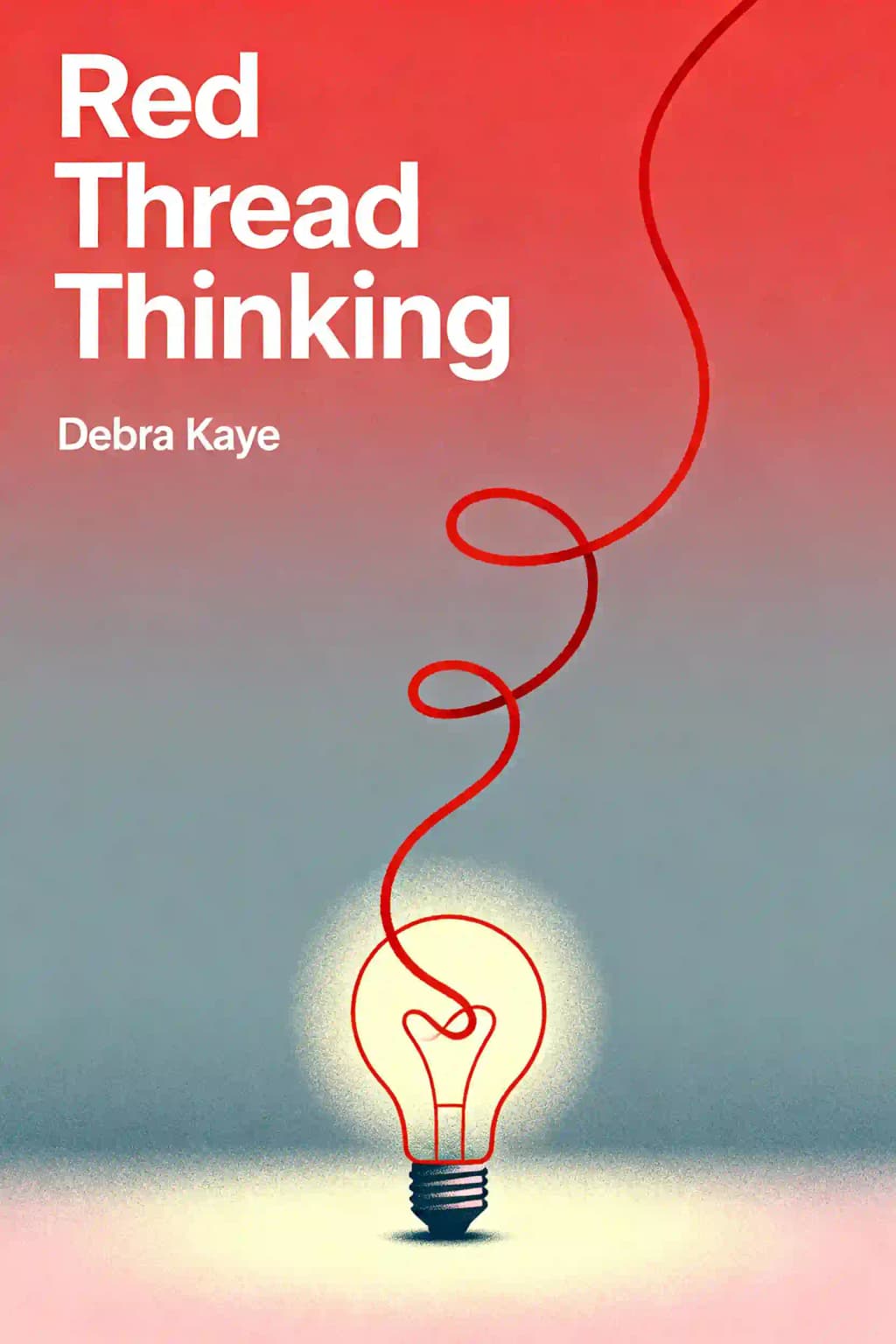
Unlock innovation by weaving connections between unrelated ideas with "Red Thread Thinking." Debra Kaye's framework revolutionized how businesses approach creativity, helping companies like Unilever develop solutions that empower entrepreneurial women in remote villages. What hidden connections are you missing?
Debra Kaye, author of Red Thread Thinking, is an international innovation expert and culture strategist renowned for her work in consumer business transformation.
With decades of experience guiding organizations through brand and cultural shifts, Kaye’s book merges practical frameworks with real-world case studies on fostering creativity and systemic change. Her expertise is amplified through contributions to Fast Company, where she explores topics like disruptive innovation and organizational agility.
A graduate of Mannes College of Music and New York University, Kaye uniquely bridges artistic sensibilities with business strategy, evidenced by her acclaimed compositions performed at Carnegie Hall and featured on classical radio programs nationwide. Beyond writing, she has advised Fortune 500 companies and served on the board of New York Women Composers, reinforcing her multidisciplinary authority.
Red Thread Thinking distills her cross-industry insights, offering readers a roadmap for navigating complexity—a testament to her dual legacy in both boardroom innovation and artistic expression.
Red Thread Thinking explores systematic innovation by connecting existing ideas to create impactful solutions. It offers a five-strand framework to transform creativity into viable products, emphasizing pattern recognition and real-world applications like Coca-Cola’s iconic bottle design. The book blends theory with exercises to help readers rethink problems and leverage cross-industry insights for profit.
Entrepreneurs, product managers, and marketers seeking actionable innovation strategies will find value in this book. It’s also ideal for creatives or professionals aiming to refine problem-solving skills, as Kaye’s exercises and case studies apply to startups, corporations, and personal growth.
Yes, for its practical exercises and fresh take on linking ideas, though readers familiar with innovation literature may find some concepts repetitive. It’s praised for clear storytelling (e.g., Apple’s packaging design) but critiqued for lacking novel methodologies.
The framework identifies five elements: Goal (audience’s objective), Problem (barriers), Idea (unique solution), Change (required mindset shift), and Action (steps to implement). For example, Method soap’s eco-friendly branding simplified consumer decisions through this approach.
Innovation isn’t about entirely new ideas but creatively combining existing concepts. Kaye argues breakthroughs like the iPhone emerged from linking technology and design, not isolated invention.
Yes. Kaye asserts creativity is a skill developed through deliberate practice, such as reframing problems or identifying patterns. Exercises like mapping personal “red threads” help readers cultivate this ability.
Case studies include Coca-Cola’s contour bottle, Apple’s minimalist packaging, and Method’s sustainable soap bottles. These illustrate how aesthetic and functional connections drive market success.
Yes. Chapters end with steps like auditing existing ideas for new connections or designing “learning loops” to test concepts. One exercise guides readers to dissect successful products and replicate their creative pathways.
Unlike theoretical guides, Kaye prioritizes application—offering tools to implement ideas immediately. It’s closer to The Lean Startup in practicality but focuses more on cognitive patterns than business models.
Some reviewers note overlap with existing innovation literature and question the framework’s scalability for complex industries. Others find the examples overly reliant on well-known brands.
Startups might use the “Problem” stage to identify unmet customer needs, while enterprises could redesign products by merging technologies (e.g., smartphones integrating cameras and apps).
As industries face rapid change, its emphasis on adaptive creativity helps teams pivot quickly. The rise of AI-driven ideation tools makes Kaye’s human-centric framework a critical counterbalance.
通过作者的声音感受这本书
将知识转化为引人入胜、富含实例的见解
快速捕捉核心观点,高效学习
以有趣互动的方式享受这本书
Innovation requires rapidly shifting between divergent thinking and convergent thinking.
Formal brainstorming sessions rarely produce breakthrough innovations.
Most "original" ideas aren't truly original but build on what came before.
Your last failure may contain the seeds of your next success.
将《Red Thread Thinking》的核心观点拆解为易于理解的要点,了解创新团队如何创造、协作和成长。
将《Red Thread Thinking》提炼为快速记忆要点,突出坦诚、团队合作和创造力的关键原则。

通过生动的故事体验《Red Thread Thinking》,将创新经验转化为令人难忘且可应用的精彩时刻。
随心提问,选择声音,共同创造真正与你产生共鸣的见解。

"Instead of endless scrolling, I just hit play on BeFreed. It saves me so much time."
"I never knew where to start with nonfiction—BeFreed’s book lists turned into podcasts gave me a clear path."
"Perfect balance between learning and entertainment. Finished ‘Thinking, Fast and Slow’ on my commute this week."
"Crazy how much I learned while walking the dog. BeFreed = small habits → big gains."
"Reading used to feel like a chore. Now it’s just part of my lifestyle."
"Feels effortless compared to reading. I’ve finished 6 books this month already."
"BeFreed turned my guilty doomscrolling into something that feels productive and inspiring."
"BeFreed turned my commute into learning time. 20-min podcasts are perfect for finishing books I never had time for."
"BeFreed replaced my podcast queue. Imagine Spotify for books — that’s it. 🙌"
"It is great for me to learn something from the book without reading it."
"The themed book list podcasts help me connect ideas across authors—like a guided audio journey."
"Makes me feel smarter every time before going to work"

免费获取《Red Thread Thinking》摘要的 PDF 或 EPUB 版本。可打印或随时离线阅读。
A staggering truth haunts the business world: 85% of new products fail. Behind each failure lies millions in investment, countless hours of work, and dreams that never materialized. Yet some innovations break through spectacularly-not through luck, but by following invisible patterns that connect human needs, cultural shifts, and overlooked opportunities. Think of Steve Jobs's insight that "creativity is just connecting things." The challenge isn't generating ideas-it's making the right connections. Innovation isn't about sudden genius striking from nowhere. It's about systematically weaving together threads that others miss: forgotten technologies, emerging behaviors, insights from distant industries, and deep human truths. This approach transforms innovation from unpredictable magic into a learnable craft, turning the overwhelming failure rate into a navigable pathway toward breakthroughs that genuinely matter.