第 1 章
The Rational Truth About Our Irrational Minds
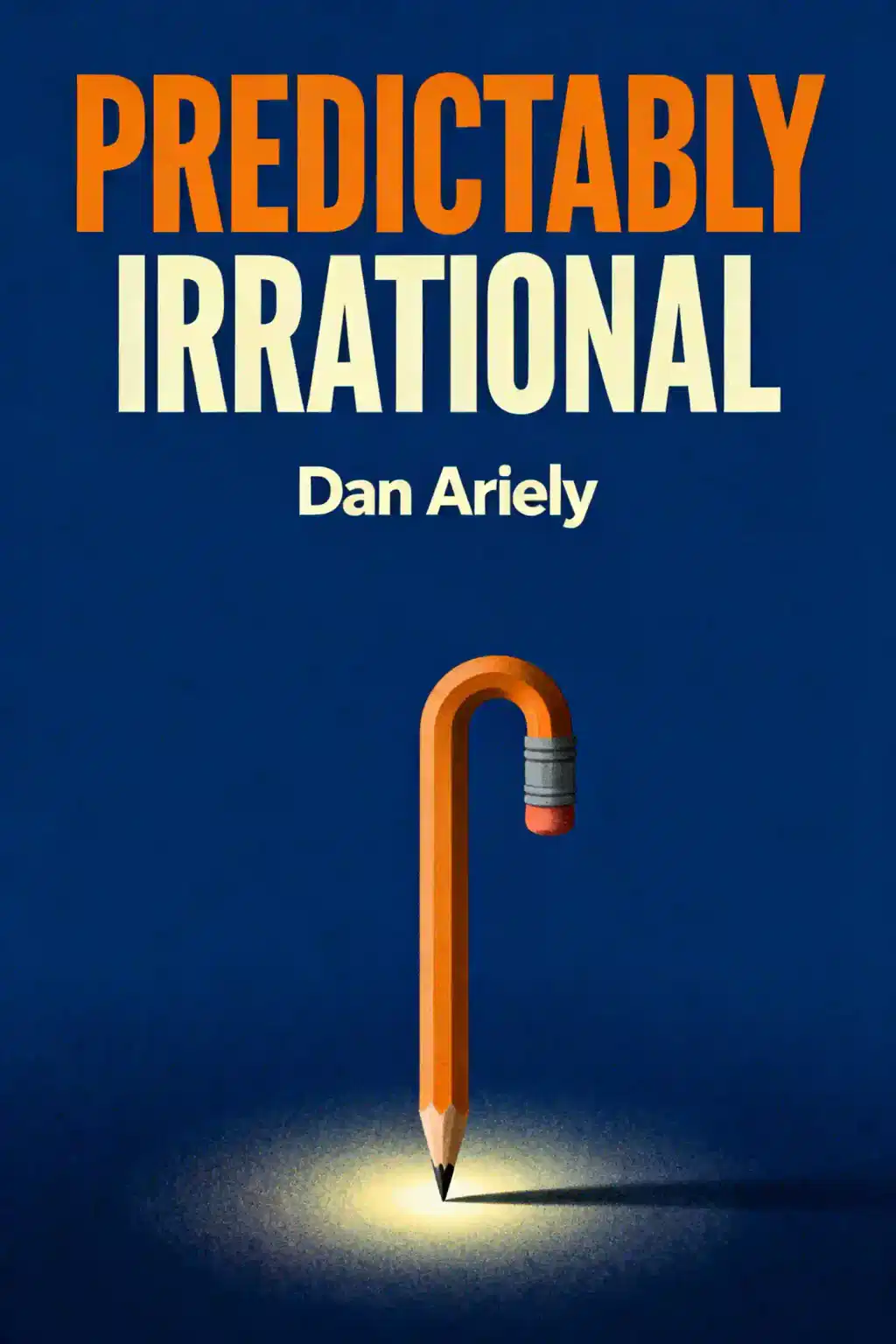
Have you ever wondered why you can't resist a "Buy One Get One Free" offer even when you don't need two items? Or why you'll drive across town to save $7 on a $25 pen but wouldn't do the same to save $7 on a $455 suit? These puzzling behaviors aren't random quirks-they're predictable patterns of irrationality that shape our decisions every day. Dan Ariely's groundbreaking book "Predictably Irrational" has transformed our understanding of human decision-making since its publication, becoming required reading in behavioral economics courses worldwide and influencing policy decisions from healthcare to retirement planning. The book's insights have been embraced by figures ranging from Nobel Prize-winning economists to tech industry leaders who apply its principles to product design. What began as Ariely's personal journey following a devastating accident has evolved into one of the most influential frameworks for understanding why smart people make irrational choices-and how we might design better systems that account for our predictable irrationality.
第 2 章
When Tragedy Sparks Scientific Discovery
My journey into understanding human irrationality began with a devastating accident when I was eighteen. A magnesium flare explosion left 70% of my body covered with third-degree burns, confining me to bandages and later a synthetic suit that made me feel separated from normal life. This outsider perspective made me question human motivations and behaviors I had previously taken for granted.
During my hospital years, I endured excruciating daily "bath" treatments where nurses would quickly rip off bandages, believing brief intense pain was better than prolonged discomfort. Their approach ignored factors like anticipatory fear and the benefits of knowing pain would decrease over time.
At Tel Aviv University, Professor Hanan Frenk's brain physiology class transformed my thinking by encouraging empirical testing of alternative theories. Despite my physical limitations, I conducted experiments on rats with my vegetarian friend's help, discovering the joy of scientific inquiry even when disproving my own theories.
I eventually conducted experiments on pain perception that proved the nurses' quick-bandage-removal approach actually increased suffering. When I presented these findings, my favorite nurse Etty acknowledged their error but noted they were also trying to minimize their own psychological distress from hearing patients scream.
This experience revealed how even well-intentioned experts can fundamentally misunderstand the consequences of their actions. If nurses with years of experience could be so wrong about something they witnessed daily, perhaps we all repeatedly make similar errors without learning from experience. This insight launched my exploration into behavioral economics - the study of systematic human irrationality.
Behavioral economics challenges the conventional economic view that humans are perfectly rational. While we are capable of amazing cognitive feats, we consistently make predictable errors in judgment. These aren't random mistakes but systematic, repeatable patterns of irrationality that shape our decisions as consumers, businesspeople, and policymakers. Understanding these patterns provides a starting point for improving our decision-making and changing how we live for the better.
My research uses experiments as microscopes or strobe lights to slow down human behavior, isolating individual forces to examine them carefully. These experiments reveal general principles about how we think and make decisions that extend far beyond the specific experimental contexts.
第 3 章
Everything Is Relative-Even When It Shouldn't Be
Have you ever noticed how a $25 meal seems reasonable at a casual restaurant but feels like a bargain at an upscale establishment? This is the principle of relativity at work-we rarely evaluate things in absolute terms, instead judging options by comparing them to alternatives.
I discovered this principle while browsing the Economist website, where I encountered a peculiar subscription offer: an Internet-only subscription for $59, a print-only subscription for $125, and a print-and-Internet combination for the same $125. This pricing strategy wasn't a mistake but a clever manipulation - the print-only option served as a "decoy" to make the combination package seem like an irresistible deal.
When I tested this on MIT students, 84% chose the combination package when all three options were presented. But when I removed the useless print-only option, only 32% chose the combination package, with 68% preferring the cheaper Internet-only option. Nothing rational changed, yet preferences dramatically shifted.
This irrationality mirrors how our minds are wired - we constantly evaluate things in relation to others. Like the visual illusion where a circle appears larger or smaller depending on surrounding circles, we can't help comparing jobs with jobs, vacations with vacations, and lovers with lovers.
What trips us up most is that we focus on comparing things that are easily comparable and avoid comparing things that aren't. When shopping for houses, we might choose between two colonials rather than considering a contemporary home, simply because the colonials can be directly compared to each other. The contemporary house, lacking a similar comparison point, gets sidelined in our decision process.
The decoy effect appears everywhere in our lives. In one experiment, I showed MIT students photographs of people and created slightly less attractive versions of each face using Photoshop. When presented with three options - person A, a slightly disfigured version of person A, and person B - 75% of participants chose the undistorted person A as their preferred date. The inferior decoy made the similar but superior option more attractive.
This principle works for products too. When Williams-Sonoma introduced a bread maker for $275, sales were poor until they added a larger, more expensive model. Suddenly the original model seemed like a bargain by comparison, and sales took off - even though few bought the expensive version.
The relativity trap extends beyond consumer choices to our very happiness. We constantly compare our salaries, possessions, and achievements to others. When companies began publishing executive compensation, CEO salaries skyrocketed as executives compared themselves to their peers. As one executive told me, if everyone knew everyone else's salary, it would be "a true catastrophe" with nearly everyone feeling underpaid.
We can fight this tendency by controlling our reference points - consciously choosing smaller "circles" that boost our relative happiness rather than comparing ourselves to those who have more. We can also shift from narrow to broad perspectives when making financial decisions.
第 4 章
How Arbitrary Anchors Shape What We're Willing to Pay
Have you ever wondered how the price of something completely new gets established? Consider the remarkable story of Salvador Assael, the "pearl king," who transformed worthless black pearls into coveted luxuries through brilliant marketing. By displaying them at Harry Winston with outrageous price tags and commissioning glossy magazine ads showing them among precious gems, he created demand from nothing. Soon Manhattan's elite were proudly wearing what had previously been ordinary oyster products.
This illustrates a phenomenon similar to what naturalist Konrad Lorenz discovered with goslings - they become attached to the first moving object they see after hatching, a process called "imprinting." Our human brains work similarly with prices.
When we encounter a new product, we accept the first price we see as an "anchor" that influences our willingness to pay forever after. To test this, my colleagues and I conducted experiments showing that arbitrary numbers (like social security digits) can dramatically influence what people will pay for products.
This anchoring affects all kinds of purchases. People moving between cities remain anchored to housing prices from their previous location - those moving from inexpensive markets to moderately priced ones don't increase their spending, while those from expensive cities maintain their higher spending habits. Only by renting for a year can people adjust to local market conditions.
I tested this further with a poetry reading experiment. I asked half my students if they would hypothetically pay me $10 for a 10-minute poetry reading, and the other half if they would accept $10 to listen to me. When they later bid on attending readings of different lengths, those anchored to paying me offered money ($1-$3 depending on length), while those anchored to being paid demanded compensation ($1.30-$4.80). The same ambiguous experience became either pleasurable or painful based solely on the initial anchor.
This "arbitrary coherence" raises profound questions about our lives. Have we built our existence on arbitrary first impressions? Are our careers, spouses, and lifestyles just the result of random initial anchors that have run wild? As Descartes said, "I think, therefore I am." But what if we're merely the sum of our first, naive behaviors?
We can improve our irrational behaviors by questioning our habits. How did they begin? Do they still provide pleasure? Could we better spend that money elsewhere? We should give special attention to first decisions in a sequence, as they create anchors that influence all subsequent choices.
These findings challenge traditional economics, which assumes that supply and demand are independent forces determining prices. Our experiments show that consumers' willingness to pay is easily manipulated, suggesting that market prices influence consumers rather than the reverse. Demand isn't separate from supply after all.
第 5 章
The Irresistible Allure of FREE!
Have you ever found yourself grabbing free samples you don't even want or standing in long lines for complimentary ice cream? There's something magical about the word "FREE!" that short-circuits our rational decision-making. Zero isn't just another price-it's an emotional hot button that creates irrational excitement.
Our experiments with chocolates proved this dramatically. When we offered Lindt truffles for 15 cents and Hershey's Kisses for 1 cent, 73% chose the superior truffle. But when we lowered both prices by just one cent - making the Kiss free and the truffle 14 cents - everything changed. Suddenly 69% chose the FREE! Kiss, abandoning the better value.
Why? Because FREE! eliminates the fear of loss. Most transactions involve potential downsides, but FREE! items appear to have none. This "zero price effect" creates an emotional surge that blinds us to rational calculation. We demonstrated this with Halloween trick-or-treaters and MIT students alike - most chose a smaller free candy bar over paying a tiny cost for a much larger one.
This irrational attraction to FREE! extends everywhere - from Amazon's free shipping offers dramatically boosting sales (except in France, where a one-franc shipping fee produced no effect until changed to FREE!), to AOL's unexpected system overload when switching to unlimited usage plans. We consistently overvalue free checking accounts, mortgages with no closing costs, and products bundled with free gifts - often paying more in the long run for the privilege of getting something for "nothing."
FREE! even warps our perception of time. We'll wait 45 minutes for a free ice cream sample or spend half an hour filling out forms for tiny rebates. I personally find museum free-entrance days irresistible, despite knowing they'll be overcrowded and unpleasant. With food, zero calories creates the same psychological effect as zero price - a calorie-free beer feels vastly superior to a three-calorie one, potentially making us feel so virtuous we order fries!
For businesses and policymakers, understanding zero's power offers tremendous leverage. Want to draw crowds? Make something FREE! Want to drive social policy? Don't just lower registration fees for electric cars - eliminate them entirely. Want to increase preventive healthcare? Make critical procedures like colonoscopies and mammograms FREE! The difference between one cent and zero isn't just another discount - it's an entirely different psychological place.
第 6 章
When Social Norms Collide With Market Norms
Imagine you're at your mother-in-law's Thanksgiving dinner. After an elaborate meal, you stand up, pull out your wallet, and ask, "How much do I owe you?" The horrified silence that follows illustrates the collision of two fundamentally different worlds: social norms and market norms.
We live simultaneously in these two different worlds - one governed by social norms and another by market norms. When these worlds collide, trouble ensues. Social norms involve friendly requests, community spirit, and warm connections without immediate payback requirements. Market norms involve sharp-edged exchanges: wages, prices, costs-and-benefits, and prompt payments.
To explore how these norms affect behavior, we designed an experiment where participants dragged circles across a computer screen. We divided them into three groups: one received $5 for participating, another received just 50 cents, and the third was simply asked to perform the task as a favor with no mention of payment.
The results were striking. Those paid $5 dragged 159 circles on average, while those paid 50 cents dragged only 101 circles. But participants asked as a favor (social norm) dragged 168 circles - more than either paid group! This demonstrates that people often work harder for social causes than for small amounts of money.
When we replaced money with gifts - Snickers bars (worth about 50 cents) or Godiva chocolates (worth about $5) - all three groups worked equally hard, dragging about 168 circles on average. This shows that gifts, regardless of value, keep us in the social exchange world.
But when we explicitly mentioned the monetary value - "50-cent Snickers bar" - participants worked as little as those who received 50 cents in cash. Simply mentioning money shifted the interaction from social to market norms. The same effect occurred when asking people to help unload a sofa - they'd help for free or for reasonable payment, but mentioning a small payment or the cost of a gift drove them away.
When social norms collide with market norms, the social norms often disappear - and they're extremely difficult to recover. Uri Gneezy and Aldo Rustichini demonstrated this in an Israeli daycare center. Initially, parents who were late picking up their children felt guilty (a social norm). When the center imposed a fine, parents began treating lateness as a service they could purchase (market norm), and late pickups actually increased.
Most tellingly, when the daycare center later removed the fine, the parents' behavior didn't revert to the original pattern - they continued coming late, now even more frequently. Once the social norm was replaced by a market norm, the social relationship couldn't be easily restored.
第 7 章
Why We Can't Predict Our Behavior Under Arousal
Have you ever wondered why people make promises they can't keep in the heat of passion? Or why carefully planned diets collapse at the sight of chocolate cake? The answer lies in what I call the "hot-cold empathy gap"-our inability to predict how we'll behave when emotions run high.
To understand this phenomenon, I conducted a study with Berkeley students that revealed a dramatic disconnect between how participants predicted their behavior when calm versus when aroused. The students answered questions about sexual preferences, immoral behaviors, and safe sex practices first in a "cold" state, then later while sexually aroused.
The results were striking: when aroused, participants predicted their desire for unusual sexual activities would be 72% higher than they had estimated when calm. Their willingness to engage in immoral activities jumped 136%, and they were 25% more likely to forgo condom use. Across all measures, participants dramatically underestimated how passion would transform their decision-making and moral boundaries.
Like Jekyll and Hyde, these students-including "Roy," the exemplary participant-failed to recognize how completely their aroused state would override their rational judgment. The experiment revealed not just the classic struggle between reason and passion, but that we systematically misjudge the magnitude of this effect. Even with familiar emotions like sexual arousal, we cannot accurately predict our behavior when in different emotional states.
This failure to understand ourselves has profound implications for decision-making. I suggest several protective strategies: ensuring condom availability rather than relying on "just say no" approaches; teaching teenagers to avoid temptation altogether rather than trying to resist it mid-arousal; and implementing technological safeguards for teen drivers that activate when risky behaviors occur. For better life decisions, I describe how my wife and I tested pain tolerance with ice water before deciding on epidural use during childbirth-acknowledging that cold-state decisions often fail to account for hot-state realities.
To bridge the gap between emotional states, we must somehow experience our future emotional state before making decisions. Just as we wouldn't move to a city without asking friends who live there, we should invest more in understanding both sides of ourselves. Perhaps we're not fully integrated beings but an agglomeration of multiple selves. While we can't make our Jekyll fully appreciate our Hyde, awareness of our emotional vulnerability might help us apply this knowledge to daily activities.
第 8 章
Why We Procrastinate and How to Overcome It
Why do we repeatedly fail to act in our long-term interests despite our best intentions? Americans now save less than ever-reaching negative one percent by 2006-while simultaneously accumulating consumer debt across six credit cards per family. We make promises to save, diet, and take care of our health, but routinely surrender to immediate gratification. This procrastination stems from the same emotional shift that occurs between our "cool" planning state and the "hot" emotional state when temptation arrives.
To understand procrastination, I conducted an experiment with my MIT students involving three paper assignments. One class could choose their own deadlines but couldn't change them once set; another had no intermediate deadlines; and a third had firm, evenly-spaced deadlines imposed by me. The results were revealing: students with dictated deadlines earned the highest grades, those with complete flexibility performed worst, and students who set their own deadlines finished in the middle. This showed that while most students recognized their procrastination problem and attempted to control it through self-imposed deadlines, they didn't always set optimal deadlines. The experiment demonstrates that precommitment mechanisms-tools that let us commit in advance to a course of action-can help us overcome procrastination, though external enforcement works even better. Such mechanisms could revolutionize areas like preventive healthcare, where procrastination leads to missed checkups and delayed diagnoses despite the clear long-term benefits.
Preventive medicine is far more cost-effective than remedial approaches, yet people consistently delay important health screenings because they're unpleasant. A middle-ground approach using self-imposed deadlines with penalties could provide the compromise between complete freedom (which often leads to failure) and strict enforcement. For example, doctors could charge an up-front deposit for tests, refundable only if patients show up on time. Another solution is to simplify and bundle medical procedures, as Ford did with their maintenance services after observing Honda's success. By grouping thousands of maintenance items into three simple service intervals, Ford eliminated customer confusion and procrastination. Similarly, healthcare could be reorganized to make preventive care as simple as ordering a Happy Meal, improving health quality while reducing costs.
To help people control spending, creative approaches are emerging. The "ice glass" method involves freezing credit cards in water to prevent impulsive purchases. Another trend is "debt blogging," where people publicly share their financial struggles online to create accountability. However, what's truly needed is intervention at the moment of temptation. I proposed a "self-control credit card" to banking executives that would allow users to set spending limits by category, store, and timeframe, with self-selected penalties for exceeding limits-from card rejection to automatic charitable donations or embarrassing notification emails. Despite initial interest from the bankers who recognized the personal finance struggles many Americans face, they never followed through (perhaps reluctant to jeopardize the $17 billion in interest charges their industry collects annually).
第 9 章
How Expectations Reshape Our Experiences
Have you ever noticed how wine tastes better when you believe it's expensive? Or how a pain reliever works faster when the packaging looks sophisticated? Our expectations powerfully shape how we perceive and experience the world around us, often overriding our actual sensory input.
To test this phenomenon, we conducted an experiment with MIT Brew-beer with a few drops of balsamic vinegar. We divided participants into three groups: those told about the vinegar before tasting the beer, those told after tasting but before rating it, and those never told at all.
The results were striking. Participants who learned about the vinegar after tasting liked the beer just as much as those who were never told about it. Only those informed beforehand developed negative perceptions. This suggests that expectations don't merely inform us-they fundamentally reshape our sensory experiences.
We pushed this experiment further by offering participants plain beer, vinegar, and the recipe to make their own MIT Brew. Those who tasted before knowing about the vinegar were twice as likely to voluntarily add vinegar to their beer compared to those informed beforehand.
This principle extends far beyond beer. Culinary experiences are dramatically enhanced by elaborate descriptions ("succulent organic breast of chicken drizzled with merlot demi-glace" versus simply "chicken"), proper presentation, and even the right glassware for wine-despite blind taste tests showing glass shape makes no difference.
Marketing leverages this phenomenon masterfully. Brain imaging studies of Coke versus Pepsi revealed that while both drinks activated pleasure centers similarly in blind tests, knowing they were drinking Coke activated additional higher-order brain regions associated with memory and associations. The brand itself, not just the liquid, created pleasure.
Expectations also power stereotypes, which serve as mental shortcuts. When Asian-American women were subtly reminded of their gender before a math test, they performed worse than when reminded of their Asian heritage-demonstrating how priming specific identities activates different expectations. Even more remarkably, people primed with words like "polite" waited longer to interrupt a conversation than those primed with words like "rude," and participants exposed to elderly-related words actually walked more slowly afterward.
These biased processes aren't just academic curiosities-they're at the heart of real-world conflicts. Whether Israeli-Palestinian, American-Iraqi, or other regional disputes, individuals from opposing sides read the same history books yet reach entirely different conclusions about who started the conflict or who should make concessions. As personal investment grows, the likelihood of agreement diminishes.
There's hope, however. Just as tasting beer without knowing about the vinegar allowed the true flavor to emerge, we might resolve conflicts by presenting perspectives without revealing which side took which actions. When this isn't possible, acknowledging our inherent biases might help us accept the need for neutral third parties to establish rules. Though difficult, accepting outside mediation can yield substantial benefits worth pursuing.



![[PDF] Toward a Theory of Behavioral Operations - Harvard Business School](/_next/image?url=https%3A%2F%2Fd1y2du6z1jfm9e.cloudfront.net%2Fassets%2Fpodcast%2Fblue.png&w=1024&q=50)