第 1 章
The Mind's Deceptive Dance: Why We're Not as Rational as We Think
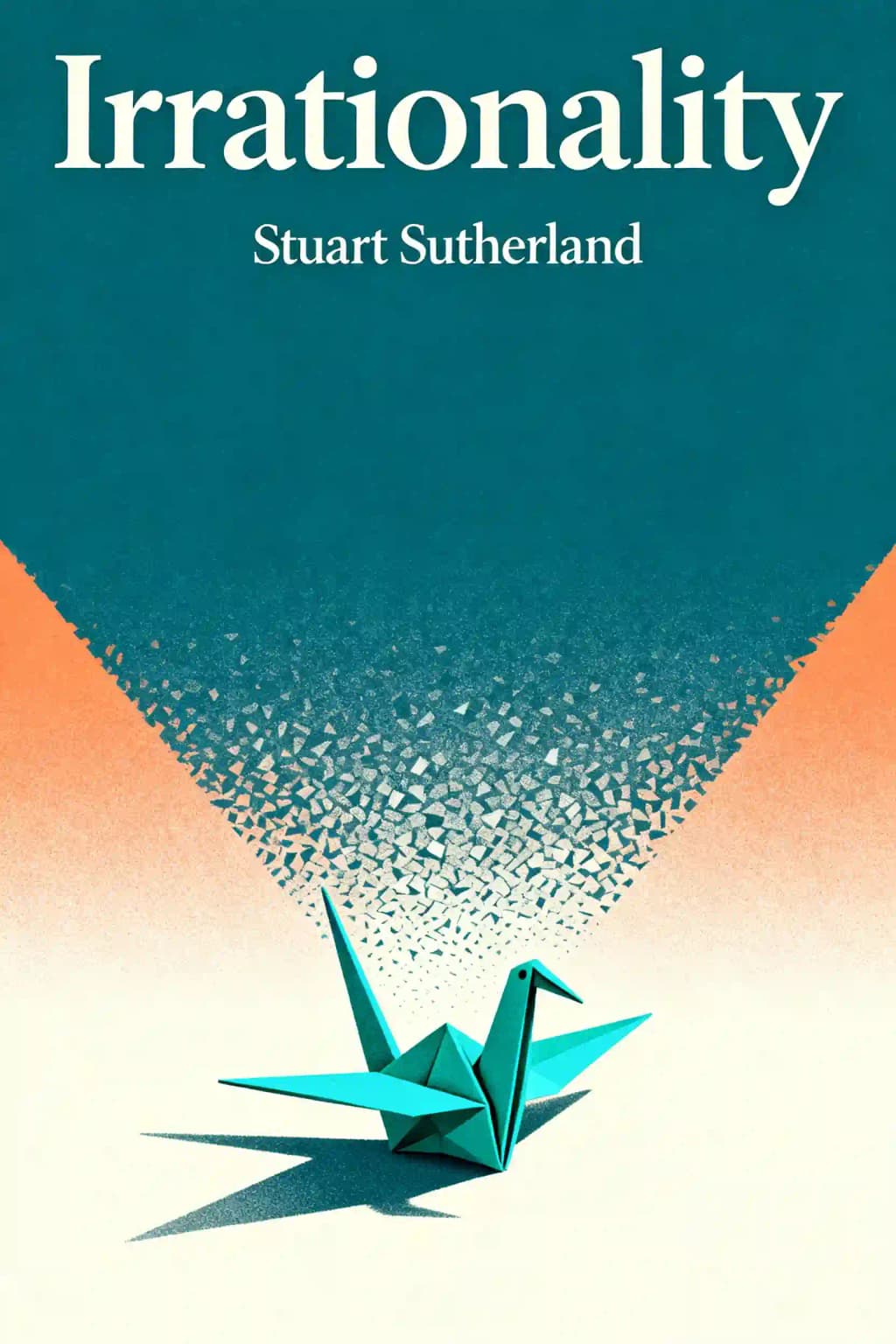
Imagine yourself confidently driving down a highway, certain you're a better driver than most. Now picture this: in a survey of British motorists, 95% claimed to be better-than-average drivers-a statistical impossibility. This fundamental disconnect between our perception and reality lies at the heart of human irrationality. Stuart Sutherland's groundbreaking exploration of our cognitive blind spots has become required reading for behavioral economists, psychologists, and decision-makers worldwide. Bill Gates called it "one of the most illuminating books on human behavior," while Nobel Prize winner Daniel Kahneman cited it as a major influence on his own work. Beyond academic circles, this book has transformed how organizations approach decision-making, from Google's interview processes to military strategic planning. What makes this exploration so compelling is not just its scholarly rigor, but how it reveals the everyday irrationality lurking in all of us-even those who pride themselves on their logical thinking.
第 2 章
The Rational Animal Myth: How Our Minds Deceive Us
Aristotle defined humans as "rational animals," a flattering notion that has persisted through centuries of philosophical thought. Classical economics built entire theories on the assumption that people make rational decisions to maximize utility and profit. Yet modern evidence reveals a far less flattering picture: human rationality is the exception, not the rule.
Rationality means reaching conclusions most likely to be correct given available knowledge and making decisions most likely to achieve one's ends. Irrational thinking isn't mere ignorance or error-it involves systematic patterns of flawed reasoning that persist despite evidence. While rational decisions don't guarantee good outcomes due to chance factors, they generally yield better results over time.
Our irrationality stems from several sources. Physical limitations like restricted working memory capacity make it difficult to juggle multiple factors simultaneously. We can overcome this by using tools like writing out pros and cons-a method Darwin employed when deciding whether to marry. Many irrational decisions also stem from ignorance of basic statistical concepts, while organizational structures often encourage self-serving behavior from otherwise rational members.
Perhaps most troublingly, self-deception and wishful thinking-while sometimes increasing happiness-remain fundamentally irrational thought processes. The definition becomes clear: irrationality is "any thought process that leads to a conclusion or decision that is not the best that could have been reached given the evidence and time constraints."
This understanding matters because irrationality isn't confined to everyday decisions. Doctors, generals, engineers, and business leaders make decisions no more rational than the average person, but often with far graver consequences. When a surgeon misdiagnoses based on recently seen cases or a general dismisses intelligence reports that contradict their battle plans, the cost of irrationality becomes measured in lives lost rather than mere inconvenience.
The recognition that we're fundamentally irrational creatures doesn't mean we should abandon hope for better decision-making. Rather, by understanding the specific patterns of our irrationality, we can develop strategies to counteract them-creating systems and habits that protect us from our own minds' deceptive tendencies.
第 3 章
When First Impressions Hijack Reason: The Availability Error
Have you ever avoided swimming in the ocean after watching "Jaws," despite knowing shark attacks are extraordinarily rare? This illustrates the availability error-judging based on what first comes to mind rather than actual facts-which permeates all reasoning and underlies many other thinking errors.
This cognitive bias manifests in countless ways. When asked whether more words begin with "r" or have "r" in the third position, most people incorrectly choose the former because initial letters are more mentally accessible. Similarly, people mistakenly believe words ending in "-ing" outnumber those ending in "-n-", failing to recognize that all "-ing" words contain "-n-".
The availability error drives everyday decisions too. We buy cars based on a friend's glowing review rather than consumer statistics. We judge people based on recently learned traits that color our interpretation. In psychological experiments, subjects who heard heartwarming stories collaborated more than those who heard about atrocities, despite the stories being completely irrelevant to the task at hand.
What makes information "available" to our minds? Material becomes mentally accessible when it's recent, emotionally charged, dramatic, concrete rather than abstract, or image-based. This explains our remarkable ability to remember pictures-we can recognize almost all of 10,000 photographs a week after viewing them once, vastly outperforming our memory for isolated words.
The consequences of availability errors can be serious. Most people consider fairground rides dangerous due to their dramatic, frightening appearance, yet statistically you're forty times more likely to die cycling on main roads and seven times safer on fairground rides than driving a car. American tourism to Europe plummeted in 1986 following a few publicized hijackings, despite Americans facing greater risk of violent crime by staying home. After earthquakes, insurance purchases spike then gradually decline until the next quake-though the actual risk remains unchanged.
Professionals aren't immune either. Doctors who've recently seen multiple cases of a particular disease become prone to misdiagnosing it in patients who don't have it-even for non-contagious conditions like appendicitis. Stockbrokers recommend buying when markets rise and selling when they fall, though statistically there's little connection between day-to-day movements.
A related phenomenon, the primacy error, shows how first impressions dominate our judgments. When watching someone solve anagrams, subjects believed more were solved when successes came early rather than late-even when the total number was identical. This explains why interviewers form impressions in the first minute and spend the rest confirming that impression.
The halo effect compounds these biases-one salient positive trait causes other characteristics to be judged more favorably than warranted. When researchers resubmitted previously published psychology articles under fictitious names from unknown institutions, eight of nine were rejected by the same journals that had originally accepted them. Similarly, Jerzy Kosinsky's National Book Award-winning novel "Steps" was rejected by fourteen publishers when resubmitted anonymously eight years after publication-including by its original publisher.
To counter these biases: avoid judgments based on single cases; evaluate qualities separately; suspend judgment until considering all information; avoid bias-inducing information when evaluating work; and check for redundancies before making decisions.
第 4 章
The Dangerous Pull of Authority and Conformity
Stanley Milgram's 1960s experiments revealed disturbing truths about human obedience to authority. Subjects told they were participating in a study on punishment and learning administered what they believed were increasingly painful electric shocks to "learners" (actually confederates) when instructed by experimenters. Despite hearing screams and pleas, a shocking 25 out of 40 subjects continued delivering shocks to the maximum 450-volt level when urged by the experimenter.
This wasn't limited to laboratory settings. When nurses received phone calls from unknown "doctors" ordering twice the maximum medication dose without proper authorization, 95% complied despite violating hospital rules. In aviation, co-pilots' reluctance to question pilots has caused crashes. Similarly, 72% of Senior House Officers wouldn't voice disagreement with senior doctors about treatments.
Conformity-behaving like one's equals rather than following authority figures-creates equally troubling patterns. In Solomon Asch's famous line-judgment experiments, when confederates unanimously chose obviously incorrect answers, 75% of subjects conformed at least once, with many becoming extremely anxious when resisting group pressure. Most subjects later denied being influenced by others, showing conformity often occurs unconsciously.
Public commitments dramatically increase follow-through compared to private decisions. Women who signed a public petition supporting birth control information reacted strongly against counter-arguments, becoming even more committed to their position. In contrast, women who hadn't signed were actually influenced by the counter-arguments. This "boomerang effect" occurs when people feel the need to justify commitments they've already made public.
Unthinking conformity to established customs can enable great evils. Nazi Germany's atrocities were partly enabled by conformity to appalling group norms. Religious persecutions like burning heretics were similarly fueled by conformity. While conformity to beneficial social customs can be positive, most people conform rather than critically evaluating which customs deserve following.
Crowds enable three extreme behaviors: panic, violence, and religious conversion. In emergencies like fires, panic spreads contagiously as people observe others pushing toward exits. Violence rarely occurs individually but flourishes in crowds where anonymity diminishes personal responsibility. Crowd anonymity diminishes personal responsibility, as shown in experiments where anonymous subjects administered more electric shocks than identifiable ones.
The bystander effect further demonstrates how groups undermine individual responsibility. When witnessing emergencies, people in groups feel less individual responsibility to help than those alone. In experiments, 85% of lone subjects reported an apparent epileptic seizure, but only 32% did so when four others were present. This occurs partly because people conform to others' inaction and partly because they assume someone else will take responsibility.
To resist these powerful social forces: think carefully before announcing decisions publicly; question whether you're doing something merely because others do; don't be overly impressed by advice from admired non-experts; don't be stampeded by crowds; and remember to help others even when bystanders are present.
第 5 章
The Tribal Mind: In-Groups, Out-Groups, and Irrational Divisions
People naturally form and join groups-from prestigious clubs to sports teams to minority identities. While group membership provides belonging, support, and mutual assistance, it also creates complex and often irrational effects on attitudes and behaviors.
Rather than moderating individual views, groups tend to make attitudes more extreme. Bennington College students became increasingly liberal the longer they stayed. In experiments, groups consistently made riskier decisions than individuals acting alone (the "risky shift"). This happens because members seek group approval by expressing extreme views in the favored direction, suppress contrary arguments, and feel less individual responsibility within the group.
Irving Janis identified "Groupthink" as the tendency for tightly-knit groups to develop extreme, unchallenged positions. Members develop illusions of invulnerability and moral righteousness, ignore inconvenient facts, stereotype outsiders as evil or weak, silence dissent, suppress doubts, create false impressions of unanimity, and withhold contradictory information. Kennedy's Bay of Pigs fiasco and Johnson's Vietnam escalation exemplify these dynamics.
Despite their potential to generate diverse perspectives, committees often make less rational decisions than individuals. Committee members typically overestimate their own contributions, partly because they're busy planning what to say rather than listening to others.
In-groups distinguish themselves through distinctive appearances-punks with green Mohicans, skinheads with shaven skulls, peers with ermine robes, or academics with mortar boards and gowns. Professional dress can distance people from others and encourage extreme behavior, as when judges make lenient rulings for rapists or blame victims-statements unlikely from someone not wearing a wig.
Muzifer Sherif's classic research with twelve-year-old boys at summer camp demonstrated how easily group hostility develops. When divided into two camps (the "Eagles" and "Rattlers"), the boys quickly abandoned previous friendships, developed group identities, and descended into antagonism during competitive games. This suggests international sporting competitions foster animosity rather than amity. As George Orwell noted, "Serious sport has nothing to do with fair play. It is bound up with hatred, jealousy, boastfulness, disregard of all rules, and sadistic pleasure in witnessing violence."
Group prejudice typically involves stereotypes-Jews as avaricious, blacks as lazy-often without factual foundation. Stereotypes persist because they're convenient shortcuts; we notice evidence supporting our opinions; minority group behavior stands out more; stereotypes become self-fulfilling; labels exaggerate differences; the halo effect transfers one trait to others; and prejudice continues privately even when publicly disavowed. While possibly rooted in tribal instincts, the prejudice causing immeasurable historical suffering remains unjustifiable and potentially controllable.
To counteract these tendencies: resist being carried away by prevailing views; ensure different viewpoints are represented in committees; don't be affected by sycophancy; be wary of forming stereotypes; and remember that uniforms can powerfully influence behavior.
第 6 章
Organizational Madness: When Systems Reward Waste
While previous sections examined individual irrationality, organizations often create systems that irrationally reward self-serving behavior rather than punishing it. Leslie Chapman's book "Your Disobedient Servant" documents his efforts to cut waste as Regional Director in the Ministry of Public Buildings and Works. His systematic approach reduced expenditure by one-third through measures like eliminating unnecessary stores, selling surplus equipment, and ending wasteful practices like heating empty warehouses. Despite sharing these methods with other regions, they saved only 8% on average, and when Chapman attempted broader reforms, he met institutional resistance.
After leaving the Civil Service, Chapman joined London Transport's Executive Board where he again found extensive waste-subsidized dining rooms for managers, excessive office space for executives, and inefficient maintenance practices. His proposals for 30% savings were dismissed, and he was removed from the board within two years.
Seven key reasons drive organizational waste: lack of individual accountability with decisions made by committees; promotion based on seniority rather than merit; organizational structures that reward overspending since promotion depends on staff numbers or budget size; budget allocation systems that penalize savings; fear of job loss for those attempting reforms; greed and prestige-seeking by managers; and ineffective oversight bodies that shield wasteful practices from public scrutiny.
Two key reforms could address these issues: make public services transparent to all citizens, and require everyone in public employment to use the public services they administer. If politicians and civil servants had to use public transport, national healthcare, and state schools, these services would rapidly improve.
Corporate irrationality extends beyond the public sector. Many takeovers appear driven by executive ambition rather than business sense, with acquiring companies' shares typically dropping and profits taking eight years to materialize. Examples include Staveley Industries acquiring a company making obsolete steam engine parts, Dimplex continuing to focus on electric heaters despite rising electricity costs (eventually going bankrupt), and Ferranti maintaining unprofitable transformer production for sentimental reasons. Over 50% of American businessmen reportedly value tradition over profits.
Geographic irrationality occurs too, like R.F.D. Group moving from Belfast without considering employee relocation, and a furniture company requiring maintenance staff to travel from Norwich to Dundee to change light bulbs. Financial advisers perform particularly poorly, consistently underperforming market averages whether using detailed company analysis or chartism, yet clients continue paying for their demonstrably ineffective advice.
The problem isn't individual irrationality but corporate irrationality-organizations failing to achieve their intended purposes due to poor structure and incentives.
第 7 章
The Consistency Trap: How Small Commitments Lead to Major Irrationality
People irrationally strive for consistency in their beliefs at truth's expense. After making decisions, we briefly experience regret before justifying our choices through self-deception. When decisions prove catastrophically wrong, we can no longer maintain this illusion. People who reverse decisions often exaggerate negative aspects of their abandoned choices-like Boswell who vilified his lover after contracting gonorrhea from her.
Many slide gradually into extreme behaviors through incremental steps that maintain consistency with previous actions-from minor crimes to major ones, or falling prey to sales techniques that exploit our reluctance to reverse course. Experiments show how small initial commitments lead to larger ones: Californian housewives who accepted small "Drive Safely" signs were far more likely to later accept huge ugly ones in their front yards.
People who voluntarily endure hardship for something value it more highly, as shown in studies where women who underwent unpleasant "initiation" rated boring discussions more favorably, and those who endured difficult weight-loss "therapy" actually lost more weight despite the therapy being worthless.
The "sunk cost fallacy" represents another manifestation of misplaced consistency. Rational decision-making considers only future costs and benefits, ignoring past investments. Yet people routinely continue failing projects because they've already invested heavily in them. The British and French governments persisted with the commercially disastrous Concorde project largely because they had already spent billions on development. Similarly, gamblers who've lost money often increase their bets rather than cutting losses, while investors hold onto falling stocks hoping to "break even."
Organizations fall into the same trap. When a British company spent 20 million developing a computer that proved commercially unviable, they invested another 30 million rather than abandoning it. The Vietnam War exemplified this error on a massive scale-each escalation justified by previous investments of American lives and money.
To avoid these traps: beware of overrating choices that cost you greatly; avoid moving by small steps toward actions you'd initially disapprove of; cut losses regardless of past investments; value possessions based on their current worth to you; don't minimize unpleasantness to justify your actions; and never allow insurance salesmen past your front door.
第 8 章
The Paradox of Rewards and the Power of Choice
Contrary to conventional wisdom, giving rewards for pleasant activities actually devalues them in the eyes of the recipient. When nursery children were rewarded with certificates for drawing, they later showed less interest in drawing than those who received no reward. Similarly, university students paid to write headlines produced fewer than unpaid students. For intrinsically pleasurable activities, rewards make people less likely to engage in them after the reward is withdrawn.
This contradicts the common belief that rewards always motivate better performance. Our education system and workplaces ignore these findings, relying heavily on grades, salaries and bonuses rather than fostering intrinsic motivation. The prize system in society creates unnecessary unhappiness both for winners, who often deteriorate after receiving recognition, and for losers who feel factitious failure.
With punishment, mild threats are more effective than severe ones in preventing undesirable behavior long-term. Studies show that less-punished children are actually more obedient both in parents' presence and when alone. People develop internal values that cannot be permanently controlled by external rewards or punishments.
Freedom of choice is crucial-people irrationally overvalue what they freely choose and devalue what is forced upon them, even if it's something they originally preferred. This explains why participatory management styles prove more effective than authoritarian approaches. When workers participate in decisions, they develop commitment to outcomes, while those merely following orders feel little investment in results.
Strong emotions drive irrational thought and action, from lovers overestimating their beloved's charms to paralyzing fear. Emotions cause irrationality by impairing concentration and distorting perception-as with sexual jealousy or depression creating vicious cycles of negative thoughts.
Contrary to behaviorist beliefs, experiments consistently show that higher incentives often worsen performance on complex tasks. While rewards facilitate performance on simple tasks, they impair it on difficult ones by reducing cognitive flexibility. When rewarded, people tend to persist with familiar approaches even when new problems require different solutions. This was demonstrated in water jar problems where rewarded subjects struggled to switch strategies, and in candle-mounting tasks where rewards increased solution time by over three minutes.
Any form of stress produces similar effects-stressed subjects solving anagrams examined fewer alternatives, scanned less systematically, and made twice as many errors. Stress impairs memory and reasoning, as demonstrated when servicemen who overheard alarming conversations about mechanical failures recalled emergency instructions poorly.
To make better decisions: avoid important choices under stress or strong emotion; practice impulse control; question whether health fads truly justify their associated misery; and recognize that emotions and rewards reduce thinking flexibility.
第 9 章
Evidence Blindness: How We Ignore What Contradicts Our Beliefs
People stubbornly resist changing decisions despite overwhelming contrary evidence, as illustrated by the Pearl Harbor disaster. Admiral Kimmel, commanding the Pacific Fleet in 1941, received multiple warnings about potential Japanese attacks but maintained peacetime shore leave, leaving sixty warships anchored in harbor and planes parked wing-to-wing. Despite Washington's warning of "surprise aggressive movement in any direction," Kimmel interpreted this as excluding Pearl Harbor. When cryptographers reported Japanese embassies destroying "most of their secret codes," Kimmel seized on the word "most" to justify inaction. Even after Japanese submarines were spotted near Pearl Harbor, Kimmel waited for confirmation rather than acting immediately, leading to the fleet's destruction.
This tendency persists across professions: doctors refuse to change incorrect diagnoses, Home Secretaries decline to review cases of wrongfully convicted people, and even Nobel Prize-winner Linus Pauling persisted in his belief about vitamin C's curative powers long after evidence disproved it. Business managers often follow tradition rather than evidence, illustrated by a gin company's managing director who dismissed research findings that contradicted his own views.
Two key mechanisms drive this irrationality: actively avoiding contradictory evidence and refusing to believe contradictory evidence when encountered. In Wason's "2, 4, 6" experiment, subjects had to determine the underlying rule by testing other triplets. Most only tested sequences that confirmed their hypothesis (like "even numbers ascending by two") rather than trying to disprove it. The actual rule-"any three numbers in ascending order"-remained elusive because people failed to test disconfirming cases.
Similarly, in Wason's card-turning experiment, subjects see four cards (A, D, 3, 7) and must determine which to turn over to test the rule "any card with an A on one side has a 3 on the other." Most incorrectly choose A and 3, when logically they should select A and 7. The A card must be checked because finding anything but a 3 would disprove the rule. The 7 card is crucial because finding an A on its reverse would invalidate the rule, yet few select it.
Even when we don't outright ignore contradictory evidence, we often distort it to maintain our beliefs. The Battle of Arnhem exemplifies how leaders distort evidence to support ill-conceived plans. General Montgomery, seeking personal glory, ordered a parachute drop near Arnhem to seize a Rhine bridge-ignoring crucial flaws in his plan. He dismissed intelligence reports of two Panzer divisions near the drop zone as "ridiculous," while his staff reinforced this denial, even suggesting an intelligence officer take leave for being "overtired" after showing photos of German tanks.
In a revealing experiment, researchers presented subjects with fabricated studies about capital punishment's effectiveness. Each subject read two studies-one supporting and one opposing the death penalty. Regardless of which study they read, subjects found the one supporting their pre-existing views "more convincing" and "better conducted," while readily spotting flaws in contradictory evidence. After reading both studies, subjects' original positions were actually strengthened rather than moderated.
To combat these tendencies: actively search for evidence against your own beliefs; entertain opposing hypotheses simultaneously; pay special attention to information that conflicts with your beliefs; and remember that nobody is always right, though some people are always wrong.
第 10 章
False Connections: How Our Minds Create Patterns That Don't Exist
Why do quack remedies and ineffective treatments persist despite scientific evidence against them? Practitioners maintain false beliefs through various mechanisms: justifying their expensive training, attributing natural recoveries to their treatment, ignoring dropouts, failing to keep proper records, lacking comparison groups, and blaming patients for non-improvement. These are all examples of "illusory correlation"-wrongly connecting unrelated events.
People consistently make errors in determining associations between events by ignoring negative cases. A physician might wrongly conclude a symptom indicates disease by noting 80 patients with the symptom developed the disease while only 20 didn't. But this conclusion is invalid without examining patients lacking the symptom. When all four possible combinations (symptom/disease, symptom/no disease, no symptom/disease, no symptom/no disease) are examined properly, the symptom often proves unrelated to the disease.
The Chapmans' experiments demonstrate that people bring preconceptions to observations that distort their interpretation. In their studies of projective tests like the Rorschach, they found clinicians believed certain responses indicated homosexuality despite evidence showing no such connection. When shown cards with random pairings of responses and traits, subjects falsely perceived correlations that matched their expectations while missing actual correlations.
We pay particular attention to people who stand out in groups-a woman among men or a black among whites-and subsequently evaluate these distinctive individuals in more extreme terms than others. This distorts our perception of correlations. In a more extreme form of irrationality, when each member of one set is paired with another set and each set has an unusual member, people wrongly believe the unusual members have been selectively paired together. This explains prejudicial stereotyping-minority groups are more conspicuous, and bad behavior is rarer than normal behavior, creating a tendency to associate negative traits with minorities even when no actual correlation exists.
Misinterpreting probabilities can have devastating consequences in medicine, particularly in breast cancer detection. Many doctors confuse conditional probabilities-specifically, they mistake the probability of a positive test given cancer (sensitivity) for the probability of having cancer given a positive test (positive predictive value). These are not the same. For women with symptoms, a positive mammogram indicates cancer about 40% of the time, while for women without symptoms being screened, a positive result indicates cancer only about 1% of the time. This massive difference stems from the different initial probabilities of cancer in these populations.
The same factors that produce errors in establishing connections between events also produce errors in inferring causes. People often falsely connect like with like, a fallacy that dominated medicine through "the doctrine of signatures" until the late eighteenth century. This primitive thinking persists today in homeopathy and psychoanalysis.
Even scientists make causal errors. The assumption that dietary cholesterol causes heart disease exemplifies the like-causes-like fallacy. Despite evidence that milk consumption and blood cholesterol levels aren't correlated, many Americans reduced dairy intake based on insufficient evidence. Medical journals initially publish positive findings while ignoring negative results, creating false impressions about causality, as happened with Type A personalities and heart disease.
To determine whether events are truly associated: never rely on memory-maintain a written tally of all four possibilities; remember that A is only associated with B if B occurs at a higher percentage when A is present than when it's absent; pay particular attention to negative cases; and be careful not to associate things merely because of expectations or unusualness.
第 11 章
The Triumph of Mathematics Over Intuition: Why Formulas Outperform Experts
Intuition is one of our most prized faculties, yet human intuition performs remarkably poorly when dealing with complex probabilistic information. When the same data used by people in making intuitive judgments are submitted to formal mathematical analysis, the resulting judgments are consistently much better.
Multiple regression analysis takes initial ratings on different pieces of evidence and systematically compares them with final outcomes. It calculates the reliability with which each piece of evidence predicts performance, assigning appropriate weights to each factor. In a study of graduate student admissions at Oregon University, this mathematical approach predicted student success with approximately four times greater accuracy than the admissions committee's intuitive judgments.
In over a hundred studies comparing actuarial and intuitive prediction, not once have people performed better than mathematical methods. The actuarial approach has proven superior in predicting parole violations, pilot performance, job satisfaction, criminal recidivism, psychiatric diagnoses, corporate growth, and even horse racing outcomes.
Remarkably, when a mathematical formula uses the implicit weights a judge assigns to predictors (calculated by analyzing their past judgments), this "bootstrapping" approach actually predicts better than the judge himself. This occurs because judges aren't consistent-they're affected by boredom, fatigue, illness and distractions. The mathematical model applies their average weights consistently without random variation.
Intuitive prediction fails for several reasons: judges don't attach optimal weights to predictors, they struggle to combine different pieces of information effectively, and their judgments are inconsistent due to mood fluctuations and personal factors. Rather than consciously assigning values to predictors, they resolve dilemmas through "intuition" not based on evidence but on misleading expectations.
Despite actuarial methods consistently outperforming human judgment, people resist using them for several reasons: we remember unusual successes but forget failures, professionals want to believe in their special skills, self-fulfilling prophecies create illusions of good judgment, people wrongly argue that imperfect actuarial prediction isn't worthwhile, and many believe intuition has magical qualities.
Interviewing has repeatedly been shown to lack reliability and validity in personnel selection. Interviewers fall prey to the halo effect, primacy effect, and contrast effect, where candidates are judged relative to previous applicants rather than objectively. Cognitive ability tests consistently outperform interviews as predictors of job performance. Despite overwhelming evidence of their ineffectiveness, firms irrationally continue using interviews, demonstrating overconfidence in their judgment.
Actuarial methods have proven superior in both medicine and business. Programs like MYCIN diagnose bacterial diseases more accurately than doctors, while banks use computer algorithms to assess loan applications with greater success than human officials. Ironically, businesses are more likely to use mathematical models when money is at stake than when human lives are at risk.
To make better decisions: suspect anyone claiming good intuition; use mathematical models when available; and recognize that intuition, while comforting, often leads us astray.