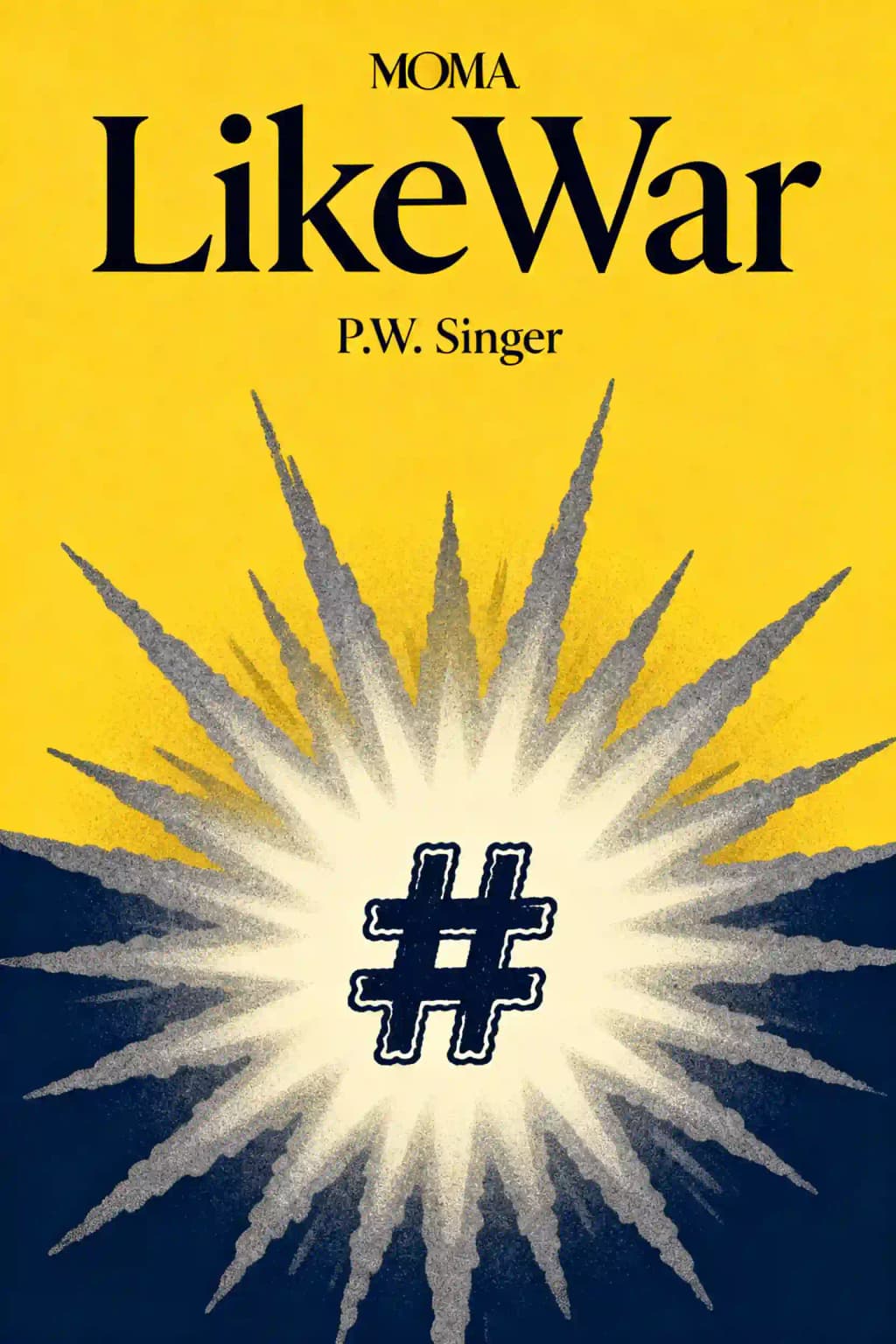
In "LikeWar," Singer and Brooking reveal how social media became today's battlefield. Briefed to the Pentagon, CIA, and Australian Parliament before publication, this Amazon Book of the Year exposes how terrorists and governments weaponize likes and shares to control what you believe.
Peter Warren Singer is the bestselling author of LikeWar and a leading strategist specializing in technology, warfare, and social media's impact on politics and conflict. As Strategist at New America and Professor of Practice at Arizona State University, Singer brings deep expertise in national security and emerging technologies to his exploration of how social platforms have fundamentally transformed modern warfare and democratic discourse.
Described by the Wall Street Journal as "the premier futurist in the national-security environment," Singer has authored multiple influential works including Wired for War, Cybersecurity and Cyberwar, and the technothriller Ghost Fleet. He has delivered keynote speeches at venues ranging from the White House to TED, and served as a consultant to the U.S. Military, Intelligence Community, and major entertainment studios including HBO and Warner Brothers.
LikeWar was named an Amazon and Foreign Affairs Book of the Year, with Booklist declaring it "should be required reading for everyone living in a democracy and all who aspire to." Remarkably, no author, living or dead, has more books on professional U.S. military reading lists than Singer.
LikeWar by P.W. Singer and Emerson T. Brooking explores how social media platforms have become weapons in modern warfare and politics. The book examines how both state and non-state actors use platforms like Twitter and Facebook to manipulate narratives, spread disinformation, and influence elections and armed conflicts. Singer and Brooking argue that the digital battlefield is no longer a metaphor—tweets can be as powerful as tanks in shaping real-world outcomes.
P.W. Singer is a New York Times bestselling author, strategist at New America, and Professor of Practice at Arizona State University. Described by the Wall Street Journal as "the premier futurist in the national-security environment," Singer has been named to Foreign Policy's Top 100 Global Thinkers list and has more books on US military reading lists than any other living author. Emerson T. Brooking is his co-author and collaborator on analyzing information warfare and digital policy in modern conflict.
LikeWar is essential reading for anyone living in a democracy, according to Booklist. The book is particularly valuable for policymakers, military strategists, journalists, cybersecurity professionals, and social media users who want to understand how digital platforms shape modern conflicts. It's also crucial for educators, students, and business leaders navigating misinformation campaigns and seeking to understand how information warfare affects politics, elections, and international relations in the digital age.
LikeWar was named an Amazon and Foreign Affairs book of the year and is considered essential reading for understanding modern warfare. The book provides timely, incisive analysis backed by Singer and Brooking's extensive expertise in military strategy and information warfare. Reviewers praise its accessible yet comprehensive approach, calling it "required reading" for anyone seeking to understand how social media has transformed conflict. The 416-page book balances entertainment with deep insights into psychology, sociology, and technology.
The term "LikeWar" describes how social media platforms have created a new form of conflict where engagement metrics—likes, shares, and retweets—become weapons of war. Singer and Brooking explain that digital battles for attention and influence now occur alongside physical warfare, with viral content shaping political outcomes and military strategies. The concept emphasizes that modern conflicts extend beyond traditional battlefields into digital spaces where narratives are crafted, contested, and consumed in real-time through social media platforms.
LikeWar presents five core principles explaining how social media functions as a weapon. Key ideas include how authoritarian regimes use censorship and disinformation to maintain power, how business models reward virality over veracity (what gets attention versus what's true), and how information warfare sows doubt rather than replacing truth with coherent lies. The book traces social media's evolution from a utopian vision of free information exchange toward a dystopian tool for manipulation, examining wars for attention and conflicts that drive both the web and world.
Singer and Brooking detail systematic ways state and non-state actors alter accepted narratives through social media. The book explains how manipulative actors exploit algorithmic amplification, psychological vulnerabilities, and viral content to control information ecosystems. Drawing from psychology, sociology, and technology history, the authors show how rapid information dissemination blurs lines between truth and falsehood. They examine how social media firms' business models—prioritizing engagement over accuracy—make platforms vulnerable to weaponization and create difficulties for democracies defending against disinformation campaigns.
According to Singer and Brooking in LikeWar, the goal of weaponized social media is not to replace truth with a single, coherent lie. Instead, the objective is to sow doubt in people's minds about all information, making them less likely to seek or trust any truth. This approach creates confusion and paralysis, allowing manipulative actors—whether authoritarian governments, terrorist groups, or political campaigns—to control narratives and shape reality in ways that serve their strategic interests during conflicts and political campaigns.
LikeWar contains nine chapters progressing from foundational concepts to solutions. The book begins by defining "LikeWar" and providing overviews of internet origins and social media's advent. Middle chapters examine how authoritarians use censorship and disinformation, how business rewards virality over veracity, and wars for attention and power across different contexts and conflicts. The final chapters define current rules and rulers of LikeWar and propose ideas for moving forward. Throughout, Singer and Brooking weave examples from diverse global conflicts in an entertaining yet informative fashion.
While LikeWar received widespread acclaim as an Amazon and Foreign Affairs book of the year, some critiques focus on the challenge of proposing concrete solutions to complex problems embedded in social media business models. The book acknowledges that social media firms' profit incentives—rewarding engagement over accuracy—make meaningful change difficult. Some readers may find the rapid pace of technological change means certain examples quickly become dated. However, the book's framework for understanding information warfare remains relevant for analyzing evolving social media manipulation tactics.
LikeWar remains critically relevant in 2025 as social media manipulation tactics have only intensified with advances in AI-generated content, deepfakes, and algorithmic targeting. The principles Singer and Brooking identified—virality over veracity, doubt-sowing strategies, and weaponized narratives—now apply to emerging platforms and technologies. Recent elections, geopolitical conflicts, and public health crises demonstrate how information warfare continues shaping global events. The book's framework helps readers understand contemporary disinformation campaigns, making it essential reading for navigating today's complex media landscape and digital conflicts.
Readers interested in LikeWar by P.W. Singer and Emerson T. Brooking should explore:
通过作者的声音感受这本书
将知识转化为引人入胜、富含实例的见解
快速捕捉核心观点,高效学习
以有趣互动的方式享受这本书
I was wrong about that.
Tweets become weapons.
War is politics by other means.
The internet was a social medium.
The first internet communication was a miscommunication.
将《LikeWar》的核心观点拆解为易于理解的要点,了解创新团队如何创造、协作和成长。
通过生动的故事体验《LikeWar》,将创新经验转化为令人难忘且可应用的精彩时刻。
随时提问,选择你的学习方式,共创真正适合你的洞察。

"Instead of endless scrolling, I just hit play on BeFreed. It saves me so much time."
"I never knew where to start with nonfiction—BeFreed’s book lists turned into podcasts gave me a clear path."
"Perfect balance between learning and entertainment. Finished ‘Thinking, Fast and Slow’ on my commute this week."
"Crazy how much I learned while walking the dog. BeFreed = small habits → big gains."
"Reading used to feel like a chore. Now it’s just part of my lifestyle."
"Feels effortless compared to reading. I’ve finished 6 books this month already."
"BeFreed turned my guilty doomscrolling into something that feels productive and inspiring."
"BeFreed turned my commute into learning time. 20-min podcasts are perfect for finishing books I never had time for."
"BeFreed replaced my podcast queue. Imagine Spotify for books — that’s it. 🙌"
"It is great for me to learn something from the book without reading it."
"The themed book list podcasts help me connect ideas across authors—like a guided audio journey."
"Makes me feel smarter every time before going to work"

免费获取《LikeWar》摘要的 PDF 或 EPUB 版本。可打印或随时离线阅读。
When Donald Trump fired off his first tweet in 2009, no one could have predicted it would become the opening shot in a new kind of global conflict. What began as celebrity musings evolved into a political weapon that helped propel him to the presidency. This transformation exemplifies how social media has evolved from entertainment to the central battlefield of modern warfare. "LikeWar" has become required reading in military academies worldwide, with its influence extending from General Stanley McChrystal to pop star Katy Perry and even Mark Zuckerberg, who admitted it prompted "difficult conversations" at Facebook headquarters. As information warfare reshapes everything from elections to terrorist recruitment, understanding how social media weaponizes information has never been more urgent.
In summer 2014, ISIS invaded northern Iraq behind a hashtag: #AllEyesOnISIS. This sophisticated campaign combined Instagram images, smartphone apps, and execution videos sent directly to defenders' phones. When 1,500 ISIS fighters reached Mosul, they found a city of 1.8 million largely abandoned by Iraqi forces who had fled after watching the terrorists' advance on their devices. This pattern repeats globally. Chicago gang violence erupts from online disrespect. Mexican cartels showcase gold-plated weapons on Instagram. Even Colombia's FARC guerrillas traded rifles for smartphones after ending their 54-year war. Throughout modern warfare, targeting enemy morale through bombing or propaganda leaflets rarely succeeded. Social media changed everything by allowing anyone with a smartphone to attack an adversary's spirit instantly. The internet, once a hopeful space for connection, has transformed into a weaponized battlefield where information itself is ammunition.
When Bryant Gumbel asked "What is Internet, anyway?" in 1994, he reflected widespread confusion about a technology poised to reshape civilization. The internet's evolution from academic project to global battlefield mirrors previous communication revolutions. On October 29, 1969, ARPANET connected UCLA to Stanford across 350 miles of telephone wire. The first attempted message, "LOGIN," crashed after just "LO" - fittingly, the first internet communication was a miscommunication. This culminated humanity's 5,000-year quest for better communication, from Mesopotamian tablets to Gutenberg's press. Mark Zuckerberg created Facebook in 2004 after his controversial "Facemash" experiment at Harvard. Within a month, 20,000 Harvard students were checking profiles multiple times daily and experiencing anxiety when unable to access it. Zuckerberg's genius wasn't inventing social networking but his timing and execution. By 2007, with 58 million users, he introduced the News Feed, transforming Facebook from a static directory to a "living, breathing world" of updates that kept users returning constantly.
In August 2006, Senator George Allen's political career collapsed when he called an Indian-American tracker "Macaca"-a racial slur-during a campaign stop. This moment, captured and uploaded to YouTube, spread rapidly, demonstrating how social media had transformed political accountability. Politicians could no longer contain gaffes through traditional media gatekeepers. Today's radical transparency world features nearly 9 billion internet-connected devices constantly gathering information. Every minute produces 500,000 Facebook comments, 400+ hours of YouTube content, and 300,000 tweets. This digital universe captures everything from classified military installations in tourist Instagram posts to CIA black sites exposed by agents' fitness tracking apps. The 2008 Mumbai terror attacks marked a turning point in crisis information flow. As terrorists killed 164 people in coordinated attacks, a spontaneous network of amateur reporters emerged on Twitter. Despite having only 6 million users globally, Twitter became the primary channel for real-time updates and warnings. This digital ecosystem included residents livestreaming from windows, citizen journalists photographing police movements, and Google Maps users plotting attack locations-all accessible to anyone online, including the terrorist commanders in Pakistan directing their operatives.
While the internet has exposed truth for anyone to find, it's also filled with "fool's gold" - lies that become powerful weapons. The early internet promised liberation from censorship, with Stewart Brand's 1984 declaration that "information wants to be free." This vision seemed validated when digital tools helped topple authoritarian regimes during the Arab Spring. Yet those revolutions marked not the beginning but the peak of internet liberation, as authoritarians learned to weaponize these same tools against democracy. China developed the world's most sophisticated digital censorship system. Their first international email in 1987 proudly declared "Across the Great Wall we can reach every corner in the world," yet few could have predicted how China would transform the internet within its borders. The government created a "Great Firewall" separating Chinese users from the global web, while establishing history's largest surveillance network through the Golden Shield Project. Russia's approach differs from Soviet-era propaganda. Instead of grave tones, it delivers a colorful cocktail tailored for digital consumption - mixing moral outrage, traditional values, and constant anxiety about Western threats. Unlike China's direct censorship, Russia allows political opposition within unspoken boundaries, creating what Peter Pomerantsev calls a "Potemkin village" of free speech where "Moscow can feel like an oligarchy in the morning and a democracy in the afternoon."
In Veles, Macedonia, teenagers discovered America's appetite for political misinformation was highly profitable. They purchased luxury goods with advertising revenue from fabricated news stories shared widely on social media. The pope's fictional Trump endorsement became the 2016 election's most-shared story, outperforming legitimate journalism. The internet's promise of unlimited information access has ironically trapped us in self-reinforcing bubbles. What MIT professor Negroponte optimistically called the "Daily Me" in 1995-personalized information exposing people to diverse viewpoints-instead became Harvard's Sunstein's "Daily We," where people seek only information confirming existing beliefs. Facebook's algorithmic newsfeeds accelerated this self-segregation, creating filter bubbles most users don't recognize. These bubbles connect like-minded people across distances, allowing even fringe beliefs to find community. The mechanism is simple: we believe what our friends share. Studies show familiarity, not accuracy, determines believability. Falsehoods spread six times faster than truth on social media. During the 2016 election, fake political headlines outperformed real ones on Facebook, creating what some call the "psychological equivalent of obesity."
Silicon Valley platforms conquered the globe with unprecedented speed, their creators focused on growth rather than societal impact. These platforms were engineered to maximize engagement-Facebook's red notification icon deliberately creates psychological arousal. As platforms scaled, founders gained immense power, with a small tweak by Zuckerberg instantly affecting over 2 billion users. Perhaps most concerning are "deep fakes"-synthetic media indistinguishable from reality. These systems can perfectly mimic a person's voice, generating phrases never actually spoken. Visual deep fakes allow users to control public figures' facial expressions in real time, creating videos nearly impossible to distinguish from authentic recordings. Information offensives target the most vulnerable but spread through entire networks via likes and shares. The solution isn't just "getting smart" but practicing "lateral thinking"-jumping across multiple websites for context rather than staying within a single perspective. Social media's unique power lies in its bidirectional connections, making every act simultaneously personal and global. We have responsibilities to protect others, like covering your mouth when coughing. Though we view reality through social media's cracked mirror, we retain the power to decide what to believe and share. In this new world: You are what you share-and through these choices, you reveal who you truly are.