第 1 章
The Calm Revolution: Escaping the Chaos of Modern Work
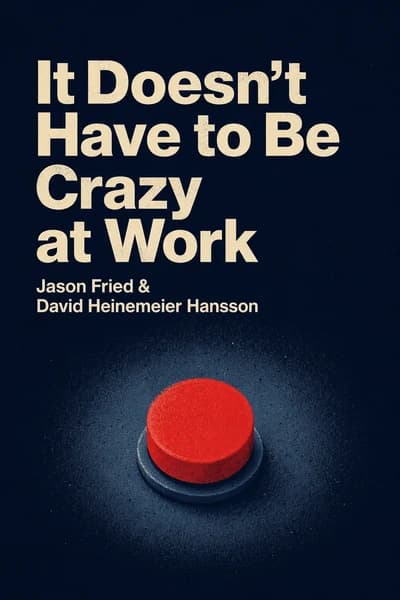
In a world where "crazy busy" has become a badge of honor, Jason Fried and David Heinemeier Hansson offer a radical alternative. Their book "It Doesn't Have to Be Crazy at Work" has sparked a quiet revolution among companies tired of the burnout culture. While tech giants promote sleep deprivation and 80-hour workweeks as prerequisites for success, Basecamp-the authors' company-has remained profitable for two decades while maintaining 40-hour workweeks (32 in summer), distributed teams across 30 cities, and exceptional employee retention. Even Arianna Huffington has praised their approach as "essential reading for anyone who leads, manages or participates in our hyper-connected workplace." The book isn't just a management guide-it's a manifesto for reclaiming sanity in professional life, challenging the very foundations of how modern businesses operate.
第 2 章
The Madness of Modern Work
Today's workplace suffers from two fundamental problems: fragmented attention and growth obsession. The typical workday has become a chaotic stream of interruptions-Slack messages, emails, impromptu meetings-leaving people working longer hours yet accomplishing less. Studies show the average worker is interrupted every 11 minutes and needs 23 minutes to regain focus. The second problem is the relentless pursuit of growth at any cost, creating artificial urgency and unsustainable expectations, with companies often demanding 20% year-over-year growth regardless of market conditions or human costs.
This madness manifests in people wearing exhaustion as a badge of honor. "I'm so busy" has become the standard response to "How are you?" Workers regularly boast about 60-hour weeks, sleeping under their desks, or missing their children's events for work. The irony is that we don't need more hours; we need fewer distractions. Research shows that knowledge workers are truly productive for only about 2.5 hours per day, yet most organizations demand 8+ hours of constant engagement. The problem isn't insufficient time-it's that we've normalized a work environment where focused attention is nearly impossible.
The symptoms are everywhere: the average employee spends 23 hours per week in meetings, with studies showing that 71% of these meetings are unproductive. Chat tools that demand constant attention generate over 200 notifications per day for the typical worker. The expectation of immediate responses to every communication has created a culture where 70% of employees check their work emails during non-work hours. People find themselves working nights and weekends not because there's more work but because the workday has become so inefficient that actual productivity happens only when the office quiets down.
What's most troubling is how we've normalized this dysfunction. Companies provide on-site meals, laundry services, and nap pods-not as genuine benefits but as ways to keep employees tethered to the office. Silicon Valley campuses offer luxury amenities while expecting 80-hour workweeks. The message is clear: your personal life is less important than your availability to work. These perks often mask deeper issues of work-life imbalance and psychological manipulation.
But this approach is fundamentally unsustainable. Humans aren't machines. We need rest, reflection, and boundaries. Research shows that working more than 50 hours per week actually decreases productivity and creativity. The constant state of emergency eventually leads to burnout, with 77% of professionals reporting they've experienced burnout at their current job. This results in poor decisions, increased healthcare costs, and a toxic culture where stress becomes contagious. The modern workplace isn't just uncomfortable-it's actively harmful to both people and long-term business success, costing companies an estimated $125-190 billion annually in healthcare spending.
The solution requires a fundamental rethinking of how we work, including implementing deep work periods, asynchronous communication protocols, and realistic growth expectations that don't sacrifice human wellbeing for quarterly profits.
第 3 章
Curbing Toxic Ambition
The business world suffers from severe ambition inflation, a phenomenon that has reached fever pitch in recent years. Everyone wants to "disrupt," "revolutionize," and "change the world." From Silicon Valley startups to traditional corporations, this grandiose language isn't just harmless marketing-it creates a dangerous justification for unhealthy work practices and unrealistic expectations. After all, if you're "changing the world," what's wrong with expecting employees to sacrifice their evenings, weekends, and personal lives for the greater good? This mentality has created a culture where overwork is not just accepted but celebrated.
The truth is that most businesses aren't changing the world-they're providing useful services that make life incrementally better. Basecamp doesn't claim to be revolutionizing human communication; they're simply making project management easier and more efficient. Companies like Slack improve workplace communication, grocery stores provide convenient access to food, and local restaurants offer enjoyable dining experiences. These services are valuable and worthwhile, but they don't justify treating work as a crusade that trumps all other life priorities or personal commitments.
When you let go of world-changing ambitions, you remove the psychological justification for all-consuming work. Without the convenient excuse that you're on a mission to reshape humanity, it becomes harder to justify 9 p.m. meetings, weekend work sprints, or missing important family events. This shift in perspective allows organizations to focus instead on doing good work, being fair in their dealings, and making a positive difference within their actual sphere of influence. It creates space for sustainable business practices that respect both the company's needs and employees' lives.
This more modest ambition extends to planning as well. At Basecamp, they've rejected traditional long-term planning approaches. They don't make five-year or even one-year plans, recognizing that such extended forecasts often become obsolete before they're implemented. Instead, they work in six-week cycles, deciding what to do next based on current circumstances, market conditions, and customer feedback rather than outdated projections. This approach allows them to remain agile, change direction quickly when needed, and avoid the sunk-cost fallacy of pursuing bad ideas simply because they were part of a grand plan.
Perhaps most counterintuitively, they reject the popular notion that growth requires constant discomfort and struggle. The idea that you must constantly push beyond your comfort zone - a concept borrowed from athletic training - is gym wisdom misapplied to professional life. While occasional challenges are important for development, sustained discomfort often signals burnout rather than growth. The biggest gains frequently come not from breadth but from depth-mastering your craft rather than constantly expanding your responsibilities. This might mean becoming an expert in your current role instead of always pushing for the next promotion, or deeply understanding your existing market rather than constantly seeking new ones. Discomfort is usually your body's response to something wrong, not a signal of productive growth, and successful businesses recognize the value of sustainable, measured progress over constant upheaval.
第 4 章
Protecting Time and Attention
Time and attention are your most precious resources, yet most companies fail to protect them. While organizations vigilantly guard their money, data, and brand, they allow employees' time to be constantly interrupted and fragmented.
At Basecamp, protecting time means establishing clear boundaries. They maintain a strict 40-hour workweek (32 hours during summer), with no expectation of overtime, weekend work, or after-hours availability. This isn't just a policy-it's a fundamental value. If projects don't fit within these parameters, they don't expand the hours; they reduce the scope.
The quality of time matters as much as the quantity. A fractured hour filled with interruptions isn't equivalent to an hour of focused work. The ideal is what they call a "quality hour"-60 uninterrupted minutes dedicated to a single task. This requires eliminating the constant pings, taps on the shoulder, and impromptu meetings that characterize most workplaces.
To protect these quality hours, Basecamp has implemented several unconventional practices. They've eliminated status meetings in favor of written updates that people can read when convenient. They've established "office hours" for experts rather than allowing questions at any time. And they've rejected shared calendars that make it too easy for others to claim chunks of your time without justification.
They've also developed a culture of "eventual response" rather than immediate response. The expectation that people will respond to messages within minutes creates a constant state of anxiety and distraction. By normalizing longer response times, they allow people to focus on deep work for extended periods without checking messages.
Perhaps most radically, they've embraced JOMO-the joy of missing out-rather than FOMO. In most organizations, people feel compelled to stay informed about everything happening in the company, leading to information overload. Basecamp encourages people to disconnect from the constant stream of updates, trusting that truly important information will reach them when needed.
第 5 章
Building a Calm Culture
A calm company isn't built on policies alone-it requires a supportive culture that values sustainable work practices. This starts with rejecting harmful metaphors like "We're a family here," which companies often use to manipulate employees into making unreasonable sacrifices. Families are unconditional; employment is a business relationship. The best companies don't pretend to be families-they support employees' actual families by providing reasonable hours, healthy boundaries, and clear expectations around work-life balance. This includes respecting weekend time, avoiding after-hours communications, and encouraging genuine disconnection during vacations.
Leaders must model the behavior they want to see. If executives send emails at midnight or work through vacations, employees will follow suit regardless of official policies. When leaders consistently demonstrate respect for boundaries by logging off at reasonable hours, taking proper breaks, and maintaining work-life separation, it gives employees implicit permission to do the same. Small actions matter - even delaying email delivery until business hours can help establish healthier norms.
The "trust battery" concept helps assess work relationships clearly-it starts at 50% charged when someone joins and charges or discharges with each interaction. This framework acknowledges that relationships have context and history, and recharging requires consistent positive actions over time. Trust can be depleted through missed commitments, poor communication, or disrespectful behavior, while it's strengthened through reliability, transparency, and following through on promises. Regular one-on-ones, clear feedback, and acknowledging mistakes all help maintain healthy trust levels.
Communication patterns significantly impact culture. At Basecamp, they've abandoned the pretense of the "open door policy," which puts the burden on employees to speak up. Instead, leaders actively seek feedback through specific questions: "What's something nobody dares talk about?" or "Are you afraid of anything at work?" They recognize that trust builds gradually-perhaps getting 20% of the story initially, then 50%, and eventually 80% if they've proven trustworthy. They create structured opportunities for feedback through regular surveys, anonymous suggestion boxes, and dedicated listening sessions.
They're also mindful of the outsized impact of leadership comments. There's no such thing as a casual suggestion from the owner-when the person signing paychecks mentions something, it inevitably becomes a priority. Leaders must exercise great restraint with their ideas, understanding that each one creates ripples throughout the organization. This means being intentional about when and how they share thoughts, clearly distinguishing between mandatory directives and optional suggestions, and creating space for pushback and discussion.
Sleep is treated as non-negotiable. The science is clear: sleep deprivation batters your IQ, saps creativity, and shortens your fuse. Research shows that just one night of poor sleep can reduce cognitive performance by 30% or more. Leaders need double the empathy, not half, making adequate rest even more crucial for them. All-nighters aren't badges of honor but red flags indicating poor planning or unreasonable expectations. Companies should actively discourage working while exhausted, just as they would discourage working while intoxicated, as the impact on decision-making and performance can be similarly detrimental.
第 6 章
Rethinking Hiring and Benefits
Traditional hiring practices focus on resumes, interviews, and credentials-none of which reliably predict job performance. At Basecamp, they've abandoned this approach in favor of evaluating candidates on actual work. For designers, they hire finalists for a week at $1,500 to complete a sample project. This approach prevents hiring "imaginary people" based on carefully crafted stories about past achievements rather than current abilities.
They've also rejected the "talent war" mentality that treats skilled employees as scarce resources to be fought over. Instead, they find talented people in unexpected places-a designer from an Oklahoma newspaper, a programmer from rural Toronto, a customer service representative from a Tennessee deli. They believe talent isn't fixed but can be grown and nurtured in the right environment.
Their compensation approach is equally unconventional. They've eliminated salary negotiations entirely, paying everyone in the same role at the same level identical compensation. They use San Francisco rates as their benchmark, despite having no employees there, ensuring location doesn't affect pay. Instead of traditional bonuses, they share 25 percent of year-over-year profit growth equally among employees.
Benefits are designed to help people get away from work rather than tethering them to the office. While many companies offer on-site perks that blur the line between work and personal time, Basecamp focuses on benefits that support life outside work: fully paid vacations up to $5,000 per person, three-day weekends all summer, 30-day paid sabbaticals every three years, and monthly massages at actual spas (not the office).
Their physical workspace follows "Library Rules"-treating the office like a library where focus is respected. If someone's at their desk, they're assumed to be deep in thought and shouldn't be interrupted. Conversations are kept to whispers, and small rooms are available for collaborative work or private calls. This simple mindset shift creates a calm, productive environment where deep work is possible.
第 7 章
Redesigning Work Processes
Most work processes evolved haphazardly rather than being deliberately designed for calm and effectiveness. At Basecamp, they've reimagined fundamental aspects of how work happens.
They've recognized that real-time communication tools like chat create an artificial sense of urgency. While useful for emergencies or social banter, chat puts conversations on conveyor belts moving away from you, creating FOMO if you're not constantly paying attention. Their rule is "Real-time sometimes, asynchronous most of the time." When something matters, they ask people to "write it up" instead of chatting about it, giving discussions permanent homes rather than letting them scroll away.
Deadlines are treated as budgets rather than estimates. The date remains fixed, but the scope is variable-projects can only get smaller over time, not larger. The team doing the work wields the "scope hammer," deciding what stays and what goes. This approach acknowledges that humans are bad at estimating but good at setting and spending budgets.
They've also transformed how ideas are presented and evaluated. Rather than holding meetings where people must react immediately, new ideas are written up as complete documents and posted for thoughtful consideration. This "forces the floor" since no one can interrupt a written presentation, allowing ideas to be shared whole and feedback to be equally thoughtful.
They've eliminated dependencies between teams whenever possible. Rather than coordinating web and mobile app releases, they ship things when they're ready. If a feature is ready for web, they release it, and iOS and Android will catch up when ready. This approach reduces bottlenecks and allows teams to work at their natural pace.
Decision-making doesn't require consensus-it requires commitment. After gathering input and considering perspectives, one person makes the final call, and everyone commits to the decision even if they initially disagreed. The key is that decisions are clearly explained to everyone involved. It's not just decide and go, it's decide, explain, and go.
第 8 章
Financial Foundations of Calm
A calm company requires financial stability. Basecamp has been profitable every month since starting in 1999-not by accident but by design. They've intentionally avoided getting ahead of themselves or making moves that would push them from black to red. Until you're running a profitable business, you're always almost out of business-racing the runway, fretting about takeoff, worrying about making payroll.
They take risks but won't put the company itself at risk. For example, when they tripled the entry price of Basecamp from $29/month to $99/month, they did so knowing they could walk it back if needed. That's managed, calculated risk with a safety rope attached. Taking a risk doesn't have to be reckless-the smart bet is one where you get to play again if it doesn't work out.
Their pricing model deliberately avoids creating customers they can't afford to lose. Basecamp charges a flat $99/month regardless of company size, rather than using per-seat pricing that would make large enterprise customers disproportionately valuable. This means no single customer can pay them an outsized amount, so no single customer's demands automatically rise to the top. They're free to build software for the "Fortune 5,000,000"-small businesses like themselves-rather than chasing the Fortune 500.
They launch products without extensive pre-release testing or customer feedback. If you want to know the truth about what you've built, you have to ship it. You can test, brainstorm, argue, and survey forever, but only shipping will tell you whether you'll sink or swim. They do their best work and launch it into the market, letting the market tell them the truth.
They're also cautious about making promises about future features or improvements. Promises pile up like debt and accrue interest-the longer you wait, the more they cost. Saying "Yes, later" is the easy way out, but promises are cheap to make while actual work is expensive.
第 9 章
Embracing Simplicity and Saying No
The path to calm requires eliminating unnecessary complexity, and few companies demonstrate this principle better than Basecamp. At its core, their approach centers on the power of three - almost all product work happens in teams of three people, typically two programmers and one designer. This isn't arbitrary; three is their magic number because it creates perfect team dynamics. With three, there's always a tiebreaker, discussions remain focused, and decision-making stays swift. The number is small enough to maintain clarity but large enough to generate diverse perspectives.
They practice ruthless elimination of unnecessary work, treating simplification as a strategic advantage. A prime example emerged when check processing became burdensome. Instead of following conventional wisdom - hiring staff or investing in automation - they made the bold choice to stop accepting checks entirely. This decision exemplifies their philosophy: trading some revenue for time and sanity is often worth it. They regularly audit their processes, asking "What can we eliminate?" rather than "How can we optimize this?"
The concept that "nothing" should always be on the table as a viable option has become a cornerstone of their decision-making process. During a major overhaul of their client-firm interaction system, they initially planned a complete platform transition. However, midway through, they challenged their assumptions and considered doing nothing for existing customers. This led to a hybrid approach where existing customers kept their familiar system while new customers received the updated version. The result was smoother transitions, happier customers, and significantly less organizational stress.
Their commitment to "enough" extends across all aspects of their business. A telling example occurred in their customer service department. Initially, they pushed for ultra-rapid email response times, reducing them from hours to mere minutes. However, this created unsustainable pressure on their team. Through customer feedback, they discovered that responses within 5-15 minutes weren't appreciably more satisfying than slightly longer times, since most customers expected responses within 24 hours. By settling for "fast enough" - around 10-15 minutes - they maintained excellent service while protecting their team's well-being.
The art of saying no has become perhaps their most powerful tool for maintaining simplicity. They view "no" as a precision instrument that preserves future possibilities, while "yes" acts as a blunt object that indiscriminately consumes resources and opportunities. Each "no" creates space for future choices and maintains focus on what truly matters. They've developed specific criteria for evaluating requests: Does this align with our core values? Will this meaningfully improve our product? Can we sustain this long-term? These questions help them say no to good ideas that aren't great, maintaining their focus on what's essential.
This approach extends to feature requests, partnership opportunities, and even internal initiatives. They've learned that saying no to 90% of opportunities often leads to better outcomes than trying to accommodate everything. This disciplined approach to decision-making has helped them maintain a clear vision and sustainable growth while avoiding the complexity that often plagues growing companies.
第 10 章
The Courage to Choose Calm
A business is a collection of choices, and every day offers new opportunities to choose differently. Will you protect people's time or let others chip away at it? Will you demand 60-hour weeks or make reasonable hours count for more? Will you force constant real-time conversations or give people the focus their best work requires?
The path to calm isn't mysterious-it's about making deliberate choices that value sustainability over artificial urgency. It requires the courage to question industry "best practices" that often lead to burnout and dysfunction. It means being willing to say no to opportunities that would compromise your values or exhaust your team.
This approach isn't just more humane-it's often more effective. Teams working at a sustainable pace make fewer mistakes. People with adequate rest make better decisions. Organizations that respect boundaries attract and retain top talent who appreciate a sane work environment.
The most powerful insight from Basecamp's experience is that calm is available to any company willing to choose it. You don't need to be in a particular industry or at a certain scale. You don't need venture funding or special circumstances. You simply need the clarity to see that many "requirements" of modern business are actually optional, and the courage to design work differently.
Every organization faces pressure to move faster, do more with less, and prioritize growth above all else. Resisting these pressures requires conviction that there's a better way-one that values sustainable success over spectacular burnout. It means trusting that protecting people's time and attention ultimately leads to better work, not less of it.
A calm company is built one decision at a time, one boundary at a time, one policy at a time. It's created through thousands of small choices that prioritize long-term health over short-term convenience. The cumulative effect of these choices is a workplace where people can do their best work without sacrificing their well-being-and that's something worth fighting for.