第 1 章
The Time Thieves of Modern Life
Ever feel like your days are being hijacked? You're not alone. In our hyper-connected world, two powerful forces conspire to steal our time: the "Busy Bandwagon" of endless tasks and meetings, and the "Infinity Pools" of endlessly refreshing content. These aren't just minor distractions-they're the default settings of modern life. Jake Knapp and John Zeratsky, former designers at Google Ventures who helped build services like Gmail and YouTube, discovered this firsthand. When Jake's eight-year-old son asked why he was always checking his phone during family time, it sparked a revelation. Despite considering himself a productivity master, Jake realized he was merely reacting faster to others' priorities rather than focusing on what truly mattered.
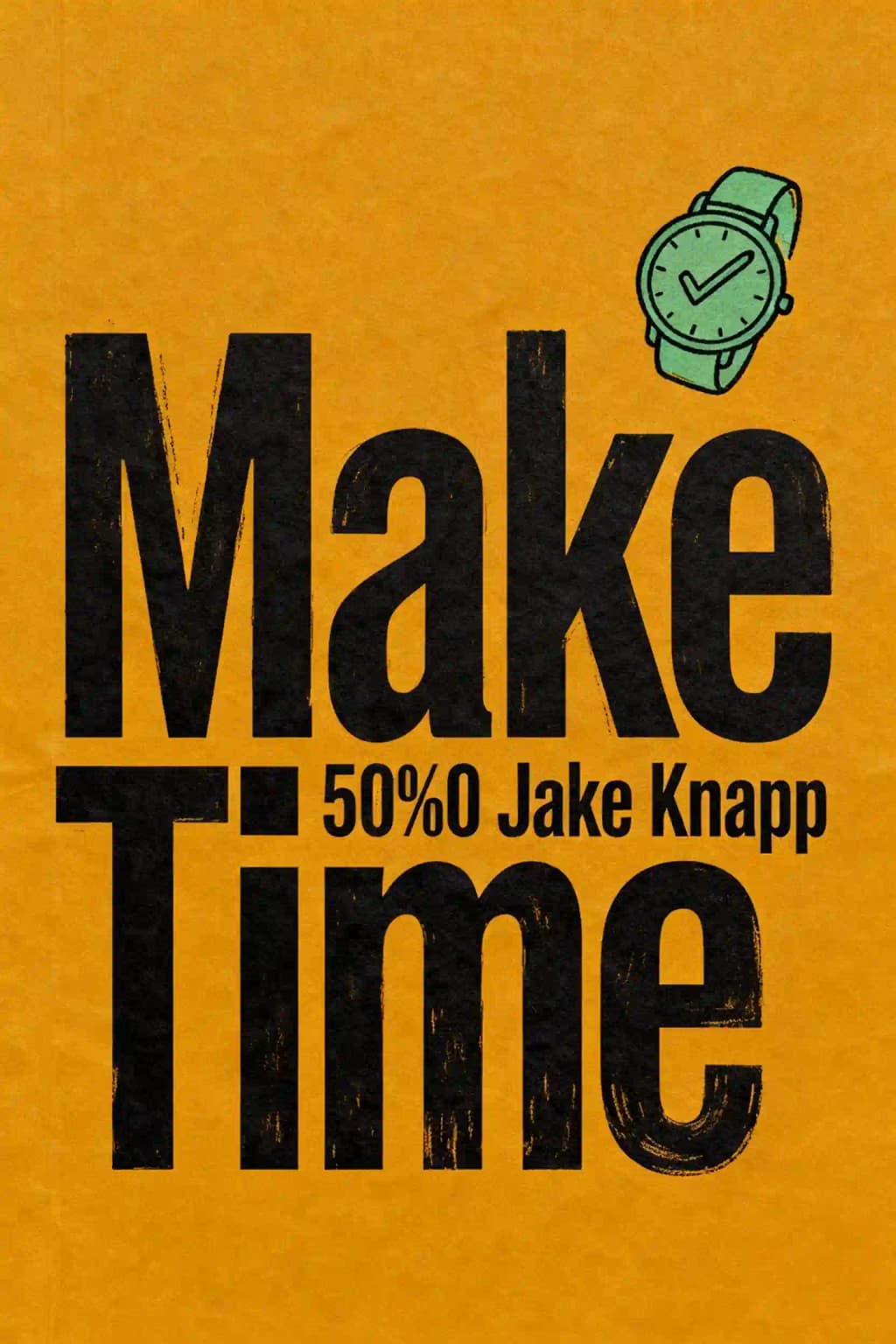
"Make Time" emerged from their obsessive quest to reclaim their attention. The book has become a quiet phenomenon among tech executives and creative professionals seeking to break free from digital overwhelm. Even celebrities like Arianna Huffington have praised its approach, calling it "essential reading for anyone feeling overwhelmed by the demands of modern life." Unlike traditional productivity systems that try to help you do more, Make Time offers something revolutionary: a framework for doing less, but better-creating space for what truly matters by questioning the defaults that govern our lives.
第 2 章
The Four-Step Framework: A Daily Cycle for Reclaiming Time
The Make Time framework consists of four simple steps repeated daily: Highlight, Laser, Energize, and Reflect. Rather than demanding radical lifestyle changes or perfect execution, this system offers practical tactics you can customize to your unique needs, acknowledging that different approaches work for different people in various contexts.
Your day begins with choosing a Highlight-one priority activity that will be the most meaningful part of your day. This isn't necessarily work-related; it could be a creative project, family time, or simply something you want to do for yourself. For instance, your Highlight might be writing the first draft of a presentation, spending quality time with your children, or finally starting that painting project you've been putting off. By asking "What do I want to be the highlight of my day?" you ensure you're spending time on what matters to you rather than just reacting to others' priorities. The key is to choose something that takes 60-90 minutes and can realistically be accomplished within your day.
The Laser step focuses on protecting your attention so you can actually make time for your Highlight. Instead of swearing off technology entirely, you learn to redesign your relationship with devices to stop the endless reaction cycle. Simple changes like logging out of social media apps, scheduling specific times to check email, or using website blockers during focused work periods can dramatically improve your focus. Other effective tactics include creating a "distraction-free" phone setup, implementing the "stack and rack" method for batch processing notifications, or designating specific zones in your home or office as device-free areas.
The Energize component recognizes that maintaining focus requires physical energy. Rather than demanding radical lifestyle changes, Make Time offers simple shifts that provide immediate rewards. These might include strategic caffeine use, implementing a "moving meeting" format, taking regular walking breaks, or following the "workout before work" principle. Even small changes like standing while taking phone calls or doing quick desk stretches can make a significant difference in your energy levels throughout the day.
Finally, before bed, you Reflect on what worked and what didn't. This brief note-taking practice helps you build a customized system tailored to your unique habits, brain, body, and priorities. The reflection can be as simple as jotting down three things: your highlight completion status, your energy level, and one tactic that was particularly effective that day. Over time, these notes become valuable data for fine-tuning your personal time management strategy.
What makes this approach different is its flexibility and emphasis on experimentation. You don't implement all tactics at once but start with just three-one for each of the first three steps-and gradually build your personalized system through daily trial and error. There's no perfectionism required; even the authors don't use all tactics all the time. The goal isn't monastic discipline but finding a workable set of habits that create space for what matters most in your life, whether that's deep work, creative pursuits, or meaningful connections with others.
第 3 章
The Power of a Daily Highlight: Making Each Day Meaningful
The Busy Bandwagon tells us that doing more is the answer to making time for what matters. But what if the opposite is true? What if slowing down to actually experience meaningful moments is more valuable than rushing through them to reach the next item on your to-do list?
JZ shares a personal story about his "missing months"-a period when, despite having a good job and relationships, time disappeared in a blur that left no memories. Through trial and error, he discovered that neither obsessive productivity systems nor distant long-term goals provided satisfaction. What did work was focusing on meaningful daily activities-a "Highlight"-that brought purpose to each day.
Your Highlight is the answer to "What do you want to be the highlight of your day?" and should take 60-90 minutes to complete. You might choose it based on urgency (what must get done today), satisfaction (what will bring accomplishment), or joy (what will bring happiness). The key is being intentional rather than letting your day unfold by default.
Several tactics can help you choose and make time for your Highlight. Start by physically writing it down-this simple act makes it more likely to happen. Consider repeating yesterday's Highlight if you didn't complete it or if you're working on an ongoing project. When choosing feels difficult, try "stack ranking" your life priorities to clarify what deserves your attention most.
For those struggling with endless to-do lists, JZ offers the "Might-Do List"-a collection of things you might do, with projects remaining there until you decide to make them your Highlight and schedule them on your calendar. Jake's alternative is the "Burner List"-an intentionally limited system that forces prioritization by dividing projects between "front burner" (most important) and "back burner" (second most important).
Once you've chosen your Highlight, protect it by putting it directly on your calendar. If your calendar is already full, try "bulldozing"-compressing meetings, moving appointments, or stacking meetings on certain days to create space. Sometimes you may even need to cancel existing commitments ("flake it till you make it") or simply decline new ones ("just say no").
The power of a daily Highlight isn't just about productivity-it's about ensuring each day contains something meaningful that matters to you, rather than merely responding to the demands of others.
第 4 章
Breaking Free from Digital Distraction: Becoming the Boss of Your Phone
Our relationship with technology has transformed from early fascination to modern addiction. Jake shares his journey from email enthusiast to Gmail designer, while JZ recounts his experience redesigning YouTube to keep users watching longer. Having worked inside the industry, they understand why digital distractions are so compelling and how to prevent them from taking over.
Four "secret ingredients" make Infinity Pools so addictive: passionate creators who build with love, sophisticated measurement enabling continuous improvement, fierce competition driving innovation, and technologies designed to exploit our brain's natural wiring. A fifth ingredient is the profit motive-tech companies make money when users spend time on their platforms.
The solution isn't waiting for technology to change but creating barriers to distraction. By making it harder to access addictive platforms, you can break the cycle of constant checking and regain control of your attention.
Start by transforming your smartphone into a distraction-free device. Remove social media apps, games, news, streaming video, email, and even your web browser. This may sound extreme, but the authors have been doing this since 2012 with remarkable results. If completely removing apps feels too drastic, try logging out after each use-this small friction is often enough to break mindless checking habits.
Next, silence the constant interruptions by turning off notifications. App makers are pushy with alerts to ensure you remember their apps exist, but you can reclaim your attention by allowing only truly critical notifications. Clear your homescreen of all icons to create a small pause-a speed bump-every time you unlock your phone, giving you a moment to question whether you really want to be distracted.
Protect your mornings by skipping the "morning check-in" of email, social media, or news. These early hours are a "golden moment" when you're rested and free from distraction-perfect for working on your Highlight. Identify your personal "distraction Kryptonite"-the one Infinity Pool you can't resist-and block it completely.
Consider changing your relationship with news consumption. The authors challenge the notion that responsible adults must follow breaking news, arguing that truly important information will find you regardless. Weekly rather than daily news consumption can help avoid the anxiety and fog that obscures important activities and relationships.
For those who find email particularly addictive, try dealing with it only at the end of the day. This reserves your prime hours for your Highlight and most important work. Schedule specific "email time" on your calendar, and consider emptying your inbox just once a week rather than constantly.
Television, which consumes an astonishing 4.3 hours of the average American's day, represents a "gold mine" of time ready to be reclaimed. Transform it from a daily default to a "sometimes treat" by rearranging furniture to make viewing awkward, replacing your TV with a projector and fold-up screen, or even going without TV entirely for a month as an experiment.
The goal isn't eliminating technology but using it intentionally. As Jake discovered when deleting Gmail from his phone, what follows isn't anxiety but relief and freedom-the feeling of having your mind back.
第 5 章
Finding Flow: Techniques for Deep Concentration
Once you've created space for your Highlight and reduced digital distractions, how do you actually achieve the deep focus necessary for meaningful work? The authors offer practical approaches to create conditions for what psychologists call "flow"-that state of complete absorption where time seems to disappear and work feels effortless.
Start by physically shutting yourself away from distractions. Stephen King advises that "The closed door is your way of telling the world and yourself that you mean business." If you don't have access to a private room, use headphones-even without music-as both a signal to others not to interrupt and a reminder to yourself that "Everything I need to pay attention to is right here."
Deadlines are powerful focus tools but typically apply only to dreaded tasks. Create artificial deadlines for activities you want to prioritize: register for a race before training, invite friends for dinner featuring a dish you haven't learned to make, or simply tell someone your daily Highlight and ask them to hold you accountable.
When uncertain where to begin, break your Highlight into small, specific, actionable steps. Each "bit" should include a verb, be highly specific, and feel easy to accomplish. For example, "Plan vacation" becomes multiple small tasks like "Check calendar for vacation dates" and "Research airfare online," making the overall project less overwhelming and easier to start.
Music can serve as a powerful cue to trigger focused work. Select specific songs or albums that you only play when working on particular activities. By reserving these soundtracks exclusively for focused work, your brain begins to associate the music with entering a state of concentration.
The authors enthusiastically recommend using a visible timer that shows time disappearing, creating an immediate sense of urgency that helps maintain focus. Unlike invisible digital time, seeing time physically diminish makes it more precious and present.
Avoid the lure of fancy productivity tools, which often become a distraction that prevents actual work. Researching and setting up complex software feels productive but usually isn't. Simple, readily available tools-text files, basic notes apps, Post-its-prove more reliable and less likely to interrupt your focus.
Consider starting projects on paper instead of digitally. Paper improves focus by eliminating distractions like font selection or web browsing. Unlike software that guides you through predetermined steps, paper is less intimidating and opens up possibilities-you can write, draw, or organize information however you want.
Once you've entered a focused state, specific techniques can help you stay there. When the urge to check your phone or browser strikes, write down your questions on paper instead of immediately giving in to distraction. A single mindful breath can reset your attention when focus wavers. Rather than fleeing from boredom by seeking distraction, embrace it as valuable space for your mind to wander creatively.
Sometimes the best approach is giving yourself permission to take it easy. Energy-especially creative energy-naturally fluctuates, and occasionally you need time to replenish it. Other times, complete commitment to the task at hand-going "all in" and holding nothing back-can restore energy when you feel depleted.
第 6 章
The Secret Sauce: Building Physical Energy for Mental Focus
While choosing Highlights and entering Laser mode form the core of Make Time, maintaining physical energy is the "secret sauce" that makes everything else possible. When your internal "battery" is full, you're better equipped to resist distractions and stay present with what matters.
Our modern lifestyle is fundamentally misaligned with our evolutionary design. Humans evolved for constant movement, natural foods, face-to-face interaction, and sleep aligned with natural rhythms. The shift to our current sedentary, screen-focused lifestyle happened accidentally through technological advances, creating a disconnect between our bodies' needs and our daily habits.
Rather than pursuing heroic workout regimens that are unsustainable, aim for just twenty minutes of daily movement. The cognitive and mood benefits of exercise can be achieved in this short time, and daily habits stick better than occasional ones. Give yourself partial credit for imperfect efforts-even ten minutes is better than nothing.
Walking is our evolutionary birthright and a powerful way to energize. It delivers remarkable health benefits-from weight management and heart disease prevention to mood improvement through endorphin release. Walking also creates valuable thinking time that can be used for planning your Highlight, daydreaming, or listening to podcasts.
Choose inconvenience strategically to incorporate more movement into daily life. Cook dinner instead of ordering in, take the stairs instead of elevators, or consider carrying luggage instead of rolling it. These small inconveniences aren't about rejecting modern conveniences entirely, but making them conscious choices rather than defaults.
For nutrition, follow Michael Pollan's simple advice: "Eat food. Not too much. Mostly plants." Our bodies evolved to process real, unprocessed foods that our ancestors would recognize. A simple technique for lighter, more energizing meals: put salad on your plate first, then add everything else around it-like New York's Central Park, reserve prime real estate for greens.
Caffeine is a powerful tool for energy management, but most people consume it on autopilot rather than strategically. Wait until around 9:30am for your first coffee to maximize its impact after your body's natural cortisol peak. Time your caffeine intake strategically-use your boost when it matters most, particularly right before working on your Highlight. Most people don't realize caffeine has a half-life of five to six hours, so that 4pm coffee still has half its caffeine in your system at 9-10pm, potentially disrupting sleep.
Since 1982, Japan has promoted "shinrin-yoku" or "forest bathing," which studies show lowers stress, heart rate, and blood pressure. Nature recharges your mental battery because it provides interesting stimuli without requiring directed attention, allowing your brain to replenish. Even brief exposure to parks or natural settings can provide these benefits.
Meditation reduces stress, increases happiness, and boosts focus, but can feel difficult to start. Think of it as both rest and exercise for your brain-it gives your mind a break while also building mental strength. Start with guided meditation apps, aim for just 3-10 minutes, and don't worry about becoming an expert.
For better sleep, keep all electronic devices out of your bedroom. When you check social media, email or news before bed, you rev up your brain instead of winding down. Start dimming lights hours before bed, using table lamps instead of overhead lights, and enable night mode on devices to shift colors from blue to red.
Harvard's 75-year Study of Adult Development found people with strong relationships live longer, healthier lives. Real face-to-face conversations (or at least voice conversations) are more energizing than screen-based communication like texts or social media. Identify your "energy givers"-people who boost your spirits-and make time for actual conversations with them, even just once a week.
第 7 章
The Experimental Mindset: Customizing Your System
The final step of Make Time transforms personal productivity into a scientific endeavor, employing the rigorous methodology of hypothesis testing to create a uniquely tailored system. This approach mirrors the scientific method: careful observation, hypothesis formation, controlled experimentation, and systematic measurement of results. This methodical process ensures that your productivity system evolves based on concrete evidence rather than assumptions.
Daily tracking forms the foundation of this experimental approach. Each evening, take 5-10 minutes to answer four key questions: Did you complete your Highlight? How was your focus throughout the day? How were your energy levels? Which tactics did you employ and how effective were they? These reflections create a personal database of productivity insights. For instance, you might notice that you consistently achieve your Highlight when scheduled before 11 AM, or that your focus dramatically improves after a midday walk.
The power of personal data collection extends far beyond academic research studies. Jake's meticulous daily notes revealed surprising patterns: morning exercise sessions before 8 AM consistently led to higher energy levels throughout the day, while afternoon sugar indulgences triggered productivity crashes around 3 PM. These insights prompted specific adjustments - establishing a 7 AM workout routine and restructuring lunch breaks to include protein-rich meals earlier in the day. The simple act of self-monitoring created accountability: "I'm always more diligent when somebody's watching, even when that somebody is me."
Make Time's experimental approach often catalyzes profound personal transformations, similar to successful startup pivots. As practitioners become more attuned to their true priorities through daily Highlights and experience enhanced focus through Laser mode, they often discover hidden passions and untapped potential. Jake's journey illustrates this evolution - his evening writing sessions, initially a small experiment, revealed such satisfaction and productivity that it led to his departure from Google to pursue writing full-time. Similarly, JZ's weekend sailing experiments gradually expanded, eventually inspiring a complete lifestyle transformation - leaving his tech job, minimizing possessions, and embarking on a Pacific Coast sailing adventure.
For those new to Make Time, begin with three fundamental tactics that form a solid experimental foundation:
1. Schedule Your Highlight first thing each morning, allocating 60-90 minutes of protected time
2. Block Distraction Kryptonite by identifying and eliminating your most problematic Infinity Pool (often social media or email)
3. Pound the Pavement with daily walks, starting with 15 minutes and gradually increasing duration
Commit to these core tactics for just three days while maintaining evening reflection notes. This short timeframe provides enough data to identify patterns while remaining manageable for beginners. After the three-day period, review your notes to determine which elements worked well and which need adjustment. Remember that adaptation is essential - what works perfectly for others may need modification to fit your unique circumstances and preferences.
第 8 章
The Life-Changing Magic of Making Time
Howard Thurman once said, "Don't ask yourself what the world needs. Ask yourself what makes you come alive, and then go do that. Because what the world needs is people who have come alive." This perfectly captures the essence of Make Time.
The framework isn't really about productivity in the traditional sense-it's about reclaiming agency over your life. By questioning defaults, creating barriers to distraction, and caring for your physical energy, you create space to discover what truly matters to you.
This approach stands in stark contrast to our culture's obsession with busyness and distraction. We've been conditioned to believe that constant availability and information consumption are necessary for success, but they often lead to what psychologists call "continuous partial attention"-a state where we're never fully present for anything.
Make Time offers a different path. By choosing a daily Highlight, you ensure each day contains something meaningful. By entering Laser mode, you experience the deep satisfaction that comes from complete absorption in a task. By building physical energy, you create the foundation for mental clarity and emotional resilience.
The most powerful aspect of this system is how it grows with you. What begins as simple daily tactics-scheduling a Highlight, blocking distractions, taking a walk-can evolve into profound life changes. As you become more aware of what energizes you and what drains you, what brings satisfaction and what feels empty, you naturally begin to reshape your life around these insights.
In a world designed to capture our attention and dictate our priorities, Make Time offers something revolutionary: the tools to take back control, one day at a time. It's not about doing more-it's about ensuring that what you do actually matters. Because in the end, we don't remember the emails we answered or the social media we scrolled through. We remember the highlights-the moments when we were fully alive, engaged in something meaningful, and present for our own lives.