第 1 章
Bridging the Unbridgeable: How Curiosity Transforms Divides
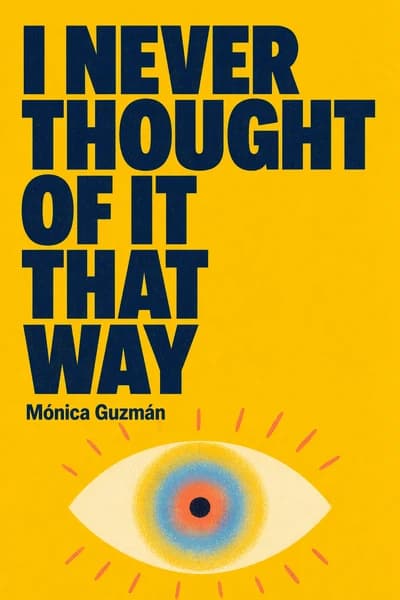
In a world where political tensions have reached fever pitch, Monica Guzman's "I Never Thought of It That Way" arrives as a refreshing antidote to our polarized discourse. The book has earned praise from figures across the political spectrum, with Braver Angels co-founder John Wood Jr. calling it "a masterclass in the art of engaging across difference." As America's political divide deepens, Guzman's work has become required reading in conflict resolution programs at universities nationwide and has been featured on NPR's "Hidden Brain" for its practical approach to healing partisan divides. What makes this book particularly compelling is Guzman's unique position as a politically liberal journalist raised by conservative Mexican immigrant parents who voted for Trump-a personal divide she navigates with remarkable grace and insight. Her approach isn't about winning arguments but about genuine understanding-a skill increasingly rare in our combative cultural landscape.
第 2 章
The SOS of Modern Division: Sorting, Othering, and Siloing
We're living through the most politically divided era in recent American history. A 2021 survey revealed most Americans saw "other people in America" as the biggest threat to our way of life-not economic collapse, foreign adversaries, or natural disasters, but each other. This division stems from three powerful patterns that Guzman calls SOS: sorting, othering, and siloing.
Sorting happens naturally as we gravitate toward people similar to ourselves-what sociologists call "homophily" (the love of sameness). This tendency has reshaped America's political geography, with urban areas leaning Democratic and rural areas Republican. In some neighborhoods, only one in ten neighbors belongs to the opposing political party. Our political identities have become "mega-identities" where party affiliation aligns with religion, race, and lifestyle preferences. This wasn't always the case-in the 1970s, there were liberal Republicans and conservative Democrats. By 2020, 55% of U.S. counties were political "landslides" (voting 20+ points more partisan than national averages), up from just 12% in 1980.
Othering takes sorting further by actively pushing away those different from us. While it feels good to bond against a common enemy (think Independence Day aliens), in our politically anxious times, othering makes monsters of good people. Two landmark studies reveal how easily this happens. In the 1954 Robbers Cave experiment, similar 11-year-old boys divided into groups quickly developed hostility-burning flags and fighting simply because they were separated. Even more disturbing, Henri Tajfel's research showed subjects would accept less money for themselves if it meant the other group got even less-proving how quickly othering warps rational thinking.
Siloing occurs when we sink deeper into carved-out spaces that sculpt our thinking. Like black holes, silos don't just contain us-they pull us in. Our digital worlds make siloing efficient as information streams toward us in feeds we sculpt with our preferences. When we share opinions only with like-minded people, those opinions become more extreme. Cass Sunstein's research found that people discussing issues in ideologically sorted groups intensified their positions and wanted bolder action. Our silos don't just pull us in and intensify beliefs-they depose us as rulers of our own attention, as platforms eliminate moments of choice that might allow us to disengage.
The solution? Bridging-stepping out of comfortable spaces to understand different perspectives. Research consistently shows personal interaction with out-group members reduces prejudice 94 percent of the time. As john powell of UC Berkeley's Othering and Belonging Institute suggests, we should start by building "short bridges" with those less different from us before tackling larger divides.
第 3 章
Curiosity: The Bridge Across Our Divides
If there's one question we should ask more often, it's "What am I missing?" This isn't just any question-it's THE question that keeps possibilities open and prevents harmful assumptions. Our vision is warped by echo chambers that transform diverse groups into a singular enemy. Sorting, othering, and siloing narrow our perspective while convincing us we see enough.
How we see the world fundamentally shapes how we talk about it. We don't see with just our eyes but with our entire biographies, and we can't truly know what we aren't close to. The Scottish concept of "ken"-originally describing a sailor's visible horizon-perfectly captures this: our knowledge has obvious bounds and limits. Beyond our ken, we either see nothing, vague shapes we dismiss, or threats we manufacture certainty about.
The clearest signal that you're stepping outside your silo is what Guzman calls an "I never thought of it that way" (INTOIT) moment. Hers came when struggling with Seattle's constant rain. At a bar, a local named Loren described sitting in his car, closing his eyes, and listening to the rain's gentle rhythm on the roof: "Rain has an aural beauty." Instantly, her perception shifted-the idea that rain was awful vanished, replaced by appreciation for its musical quality. INTOIT moments create mental space, like opening a door in a stuffy room you didn't know was stuffy.
To spark these insights, you must first find friction-spaces where you can interact with people outside your silos-and then get curious. Curiosity activates when you see a gap between what you know and what you want to know. According to information-gap theory, curiosity is most intense when you know just enough about a topic-not too little, not too much. The more knowledge you acquire, the more questions it generates, creating a virtuous cycle that counters the vicious cycle of sorting, othering, and siloing.
第 4 章
Conversation: The Vehicle for Bridging Understanding
Conversation is the most powerful tool for understanding people across divides. The Spanish word "sobremesa"-the conversation that follows a meal while everyone remains at the table-captures this special dynamic. Conversation only needs willing minds and time to generate its own momentum.
Early in her journalism career, Guzman relied heavily on prepared question lists for interviews. During a workshop with Pulitzer Prize winner Jacqui Banaszynski, she learned to follow up based solely on the previous response rather than sticking to a script. This approach takes conversations in surprising directions, creates space for deeper sharing, and produces truer stories.
As conversations generate fuel, they also create connection. When we share knowledge and fill gaps, we discover commonalities that stitch us together. These connections build trust, which encourages deeper sharing and braver questions. Columnist Connie Schultz demonstrates this through her Facebook page, where she hosts thoughtful cross-partisan dialogues. She intentionally posts seemingly trivial content-like photos of her dog Franklin-inviting followers to share their own pet pictures. These light interactions aren't distractions but practice, building camaraderie that helps participants navigate tougher issues later.
Think about your favorite long conversations-the ones where you closed down the bar without meaning to. These weren't just exchanges of information; you wanted to know not just what people thought, but why and how they thought it. You moved from discussing ideas to being curious about each other. This shift from curiosity about ideas to curiosity about people matters because people are the ultimate experts on themselves, providing a bottomless supply of fascinating questions.
For bridging conversations to work effectively, Guzman offers five "dials" to consider: time (conversations need duration to develop), attention (full engagement rather than multitasking), parity (equal ground between participants), containment (smaller audiences allow more honesty), and embodiment (in-person interaction allows full expression). The Traction LOOP framework provides four essential conversational skills: Listen for meaning, Observe non-verbal cues, Offer elements that build shared meaning, and Pull others deeper through thoughtful engagement.
第 5 章
People: The Mystery Behind Perspectives
Our assumptions about people consistently fail because we treat them like puzzles with definitive solutions rather than mysteries requiring ongoing exploration and understanding. The New York Times powerfully illustrated this cognitive bias through an innovative quiz showing refrigerator contents of Trump and Biden voters - readers guessed correctly only 52% of the time, barely better than random chance. This experiment revealed how our preconceptions about political affiliations often have little basis in everyday reality.
In 2017, Guzman organized "Melting Mountains" - a groundbreaking gathering where fifteen Seattle residents met with sixteen residents of Sherman County, Oregon (population 353) to bridge the seemingly insurmountable political divide. Among the urban travelers was Laura Caspi, whose experience proved particularly enlightening. She discovered she had "dehumanized" Trump voters through what seemed like a logical progression: her vote against Trump supported good things like equality and justice; therefore, votes for Trump must oppose these good things; therefore, Trump voters must be fundamentally bad people. This revelation showed how even well-intentioned reasoning can lead to harmful oversimplification.
The Sherman County residents shared perspectives that revealed urban-rural divides far deeper than mere politics. Rural America faces devastating economic challenges, with grain prices barely ahead of 1980 levels despite massive increases in production costs. Small family farmers are "nearing extinction," squeezed between corporate agriculture and rising operational expenses. Ron Holmes, a local farmer, made a particularly striking observation: rural residents frequently visit cities for shopping, entertainment, and business, developing a nuanced understanding of urban life. However, urbanites rarely venture into rural areas, leaving their views of rural life shaped largely by media and stereotypes.
The farmers articulated specific policy concerns that highlighted this knowledge gap. They detailed how regulations like the Waters of the United States rule threatened their livelihoods by potentially classifying seasonal rain puddles as protected wetlands - technical details that urban participants, despite their education and engagement in politics, had never considered. These discussions revealed how policies crafted primarily through an urban lens could have unintended consequences for rural communities.
We can't completely avoid making assumptions - they're essential cognitive shortcuts for navigating our complex world - but we can develop the habit of noticing them and questioning why we make them. Unexamined assumptions tend to harden into personal truths and lies, while turning them into questions opens paths toward genuine understanding. Our mental "assumption assistants" constantly whisper introductions about people we don't know, but we can choose to treat these assumptions as starting points for curiosity rather than ending points for judgment. This shift from assumption to inquiry creates space for genuine connection and understanding across divides.
第 6 章
Beyond Reason: The Role of Intuition in Understanding
Exploring different perspectives becomes increasingly difficult when we're deeply devoted to our own viewpoints. The ancient Buddhist parable of blind people examining different parts of an elephant powerfully illustrates this challenge - one feels the trunk and declares it's like a snake, another touches the leg and insists it's like a tree, while a third feels the side and claims it's like a wall. Each person holds a piece of truth, yet none grasps the complete picture. This teaches us that perspectives aren't merely interpretations of information-they are valuable pieces of information themselves. By gathering and synthesizing multiple viewpoints, we can approach a more nuanced and complex understanding of reality.
Jonathan Haidt's research reveals our dual approach to processing ideas: When encountering information that aligns with our existing beliefs, we ask "Can I believe it?" and evaluate evidence with relative objectivity. However, when confronting challenging or contradictory ideas, we shift to asking "Must I believe it?"-our intuition immediately resists and our rational mind actively searches for any reason, however small, to dismiss the entire concept. This psychological asymmetry creates a significant barrier to genuine understanding and dialogue.
The digital age has transformed how we interact, turning us into what Guzman calls "nonpeople" in online spaces-reduced to mere text without the crucial human elements of body language, facial expressions, tone of voice, or physical presence. This dehumanization makes it dangerously easy to judge others without accountability, to dismiss and mock with what she describes as "ghostly, secret abandon." We become pattern-seeking machines, quick to draw conclusions and categorize others based on minimal information, often constructing elaborate assumptions about their entire worldview from a single comment or post.
To combat these natural tendencies and avoid getting trapped in purely rational arguments, Guzman offers several practical strategies. First, she suggests consciously prying your mind back open when you notice it closing-actively challenging your initial reactions and resistance. Second, carefully examine the links in your mental chains, paying attention to moments when you automatically connect someone's stated views to more extreme positions or assumptions. Third, practice naming what you keep coming back to in discussions, identifying your own recurring themes and potential biases. Fourth, observe what others consistently return to, as these patterns often reveal their core concerns and values. Finally, treat talking points as starting points for exploration rather than foregone conclusions, using them to open up discussions rather than shut them down.
This approach acknowledges that while reason is valuable, it must be balanced with intuition and emotional intelligence to achieve genuine understanding. The goal isn't to abandon logic but to recognize its limitations and complement it with other ways of knowing and understanding.
第 7 章
Opinions: Holding Beliefs Loosely
Our assumptions about opinions may be fundamentally flawed. Philosopher David Smith challenges the notion that we choose our opinions, suggesting instead that "beliefs form naturally over the course of our lives." This raises questions about why we try to talk each other out of opinions and how we judge each other by them.
The pursuit of "winning" arguments, especially online, rarely changes minds and often leaves scorched earth. Elizabeth Saunders notes that online victories make you "the triumphant king of a lonely land" where opponents are less likely than ever to listen. You can't get traction with a mind you're trying to defeat.
Our opinions serve us best not as fixed positions to defend but as flexible perspectives in curious conversation with others. Politics shouldn't just be about stopping the other side but about how we coexist wisely through ongoing negotiations that both honor and transform our views. Curiosity requires uncertainty, which requires flexibility.
Changing deeply held beliefs rarely happens in a single conversation. It takes time not just for our reasoning and intuitive minds to consider evidence, but because beliefs feel like part of our identity. David Smith's journey from fundamentalist Christianity took fifteen years, leading him to walk away from tenure at a Christian university when he could no longer affirm its theology.
To approach opinions flexibly, Guzman suggests sharing opinions as changeable "snapshots" of your current thinking rather than fixed positions, changing the question from "whose perspective wins" to "what makes each perspective understandable," listening longer before responding, acknowledging points of agreement, untying "thought knots" when conversation becomes circular, hitting reset when stuck, acknowledging the other side's good points, and being willing to say "I don't know" when appropriate.
第 8 章
Paths: The Stories That Shape Our Views
Our paths-our experiences, values, and attachments-tell our stories and explain why we do what we do. These elements form the second frequency of who we really are, beyond the social signals we broadcast asking "Are you with me, or against me?" These paths are not just linear progressions but complex webs of moments, relationships, and revelations that shape our worldview in ways we often don't fully recognize.
Experiences give context to perspectives, carry mystery that logic alone cannot capture, and help shape new stories about ourselves. They create emotional anchors that influence our beliefs far more powerfully than abstract reasoning or statistical data. The author shares her mother's transformative experience seeing two men share a tender kiss in Boston. Though raised Mexican Catholic with traditional views on homosexuality, her mother had an unexpected reaction-seeing not something strange or wrong, but something familiar and beautiful: "Era tan normal, Monica. It was so normal." This moment changed her mother's story about same-sex marriage from one that "pollutes love" to one that "celebrates it." The power of this singular moment illustrates how direct experiences can bypass years of cultural conditioning and religious doctrine.
Personal stories like these carry unique power because they combine emotional resonance with lived truth. Research shows people respect moral beliefs more when supported by personal experiences rather than facts, especially when they hear about each other's pain. This is particularly evident in conversations about contentious topics like immigration, religion, or politics, where personal narratives often succeed where debates and arguments fail.
To transform divisive conversations into meaningful exchanges, Guzman recommends several specific strategies: First, turn everyone into storytellers of their own experiences by asking "How did you come to believe X?" rather than why. This open-ended approach invites reflection rather than defensiveness. Second, explain yourself with story, pulling on examples and details from your life that illustrate your perspective. Third, acknowledge intersections with your own experience, finding common ground even in seemingly opposing viewpoints. Fourth, speak only for yourself, avoiding generalizations about groups or assumptions about others' motivations. Finally, ensure everyone has opportunities to share their stories, creating a balanced dialogue where all voices are heard.
These narrative exchanges build bridges of understanding by revealing the human context behind different beliefs. When we understand someone's path - their formative experiences, cultural background, and personal struggles - their positions, even when different from our own, become more comprehensible and worthy of respect.
第 9 章
Values: What We Hold Dear
When people engage in political disagreements, they frequently make a fundamental error in assuming their opponents simply don't share their values, rather than understanding that people prioritize universal values differently. This misunderstanding leads to deeper polarization and prevents meaningful dialogue. Social psychologist Shalom Schwartz's groundbreaking research identified ten universal human values that exist across cultures and societies, arranged in a circular structure. In this arrangement, adjacent values like security and tradition are compatible and mutually reinforcing, while opposite values like stimulation and security create natural tension. These universal values include self-direction, stimulation, hedonism, achievement, power, security, tradition, conformity, benevolence, and universalism.
During a particularly heated pre-election debate about Donald Trump with her father, Guzman found herself trapped in circular arguments until she asked the pivotal question, "Is that your version of strength?" This simple reframing transformed their conversation by revealing how differently they interpreted the same actions. Her father saw Trump's refusal to concede as a demonstration of unwavering strength and conviction, while she interpreted it as dangerous obstinance that undermined democratic norms. Despite significant differences in their value hierarchies - her father prioritizing tradition, conformity, and security (which ranked among her lowest values) - they discovered shared ground in valuing self-direction. Surprisingly, her father scored higher on universalism, showing how our assumptions about others' values are often incorrect.
When navigating conversations across different value systems, Guzman recommends specific questioning techniques that reveal underlying priorities. Instead of asking confrontational questions like "How can you support this?", she suggests open-ended inquiries such as "What concerns you about X?" or "What do you hope can happen with X?" These questions help uncover the core values driving someone's position. Paying attention to emotional cues is equally important - when someone shows anxiety, passion, or strong reaction about a topic, it often signals a core value being challenged or defended.
The key shift in understanding values lies in changing the nature of our questions. Rather than asking "Why don't you care about climate change/immigration/healthcare?" which implies a moral failing, asking "What do you care about more?" acknowledges that people must often make difficult choices between competing values. This approach recognizes that most people hold similar basic values but must prioritize them differently based on their experiences, circumstances, and beliefs. For example, someone might care deeply about environmental protection but prioritize economic security for their community, leading to seemingly contradictory positions on specific policies.
Understanding this framework of universal values and their relative prioritization helps bridge divides by moving conversations from accusatory debates about who cares about what, to more productive discussions about how different people balance competing priorities. This insight provides a practical tool for more constructive dialogue across political and ideological differences.
第 10 章
Honesty: The Foundation of Understanding
Curiosity without honesty is worthless. If people hold back, put on masks, or aren't genuine in conversation, no real learning happens. Getting clarity isn't about advanced vocabulary-it's about recognizing that meaning resides in people, not words. True listening means staying with someone's thoughts until their meaning is completely clear, an experience that's surprisingly rare in human interaction.
Like the follow-through in tennis that's essential for proper ball control, conversations require follow-through to ensure we're grasping each other's meaning. This means restating what we've heard and giving the other person a chance to correct misunderstandings. When communicating across divides, we must ensure our meaning gets through by actively inviting feedback. Asking "Does that make sense?" should be genuine, not just a perfunctory checkpoint.
When navigating politically charged language, the key question isn't "What does that mean?" but "What does that person mean?" Different terms for the same concept (like "undocumented immigrant" versus "illegal") reflect different underlying values. Rather than reacting defensively to terminology that makes you cringe, use it as an opportunity to explore the other person's perspective.
Openness requires recognizing the natural barriers to complete honesty while creating conditions where people feel safe to share their true thoughts. Revealing more of your thinking-saying "let me think out loud for a bit"-sets the expectation that messy, unpolished thoughts are welcome. This transparency invites others to reciprocate, allowing you to think together rather than just exchange prepared positions.
Good questions aren't scripted but are measured by whether they lead to better understanding between people. The CARE framework helps ensure questions build understanding: they should be Curious (aiming to fill knowledge gaps), Answerable (possible to respond to in the moment), Raw (free from assumptions, opinions, or accusations), and Exploring (allowing for honest, complicated responses).
Monica closes with her second-favorite untranslatable Spanish word, "convivir" (to live together), which aims higher than merely coexisting. Building bridges across divides isn't as difficult as we fear, and maintaining these bridges matters more than crossing them. She challenges readers to "surprise yourself" by taking one step closer to someone who disagrees-exploring what you're missing rather than why they're wrong, learning what they care about rather than demanding they care about your concerns, and asking one more curious question when you want to judge.