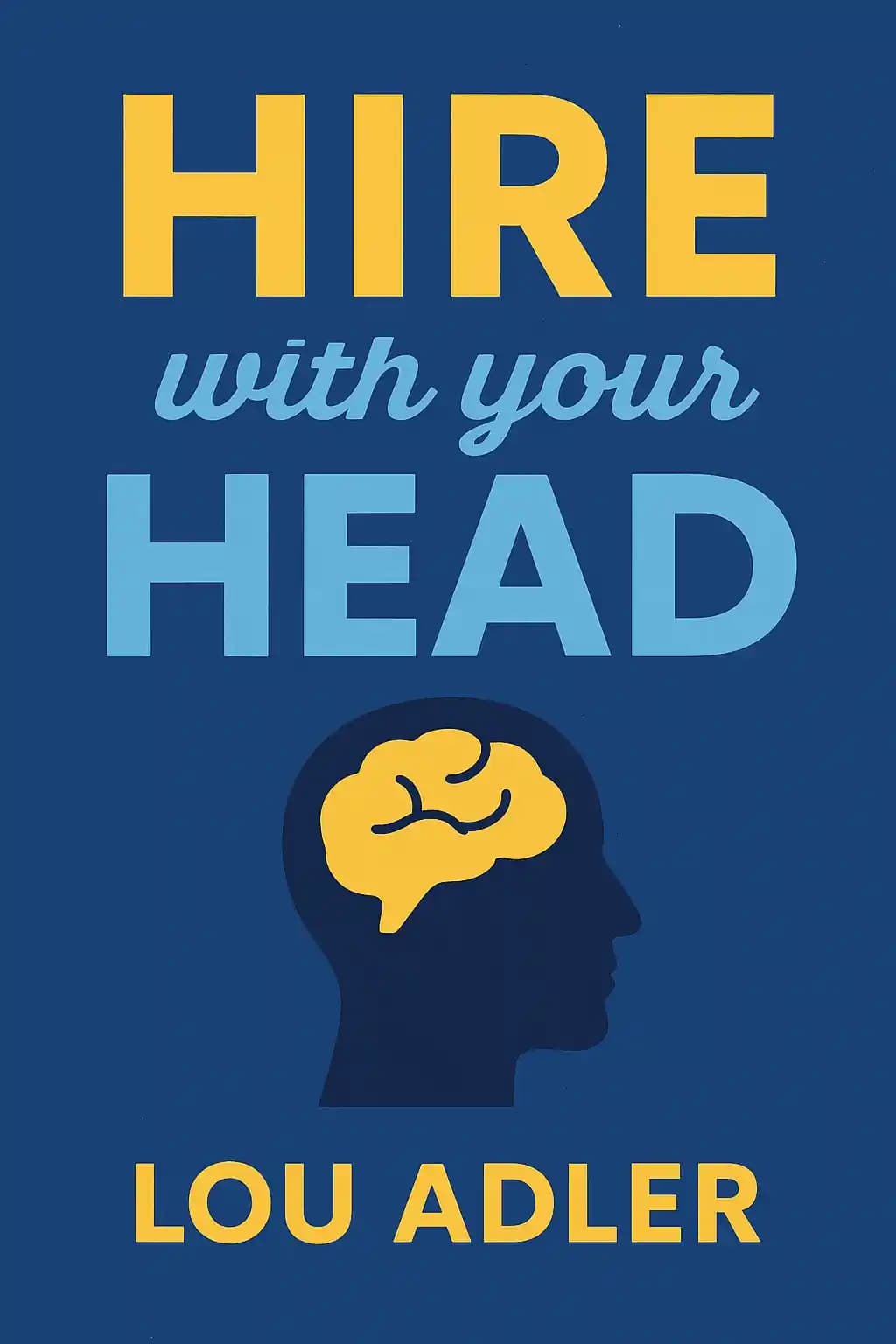
Revolutionize your hiring with Lou Adler's game-changing methodology. Endorsed by entrepreneur Derek Sivers, this continuously updated classic shifts focus from resumes to performance, asking the question: What if traditional interviews are sabotaging your talent acquisition? Transform gut feelings into strategic decisions.
Lou Adler is the bestselling author of Hire With Your Head and CEO of Performance-based Hiring Learning Systems, a global consulting firm revolutionizing talent acquisition.
A former engineer and recruiter, Adler combines 40+ years of experience to address modern hiring challenges, emphasizing performance-based assessments over traditional resume evaluations. His work focuses on eliminating bias through methodologies like "Diversity Hiring Without Compromise," ensuring candidates are judged solely on their ability to deliver results.
Adler’s other influential works include The Essential Guide for Hiring & Getting Hired and the Lynda.com Performance-based Hiring video series. As a top LinkedIn Influencer and contributor to The Wall Street Journal, Bloomberg, and Inc. Magazine, he shapes corporate hiring practices worldwide.
The fourth edition of Hire With Your Head (2021) remains an Amazon top-10 business bestseller, underpinned by Adler’s mobile-ready Win-Win Hiring Learning Systems platform used by Fortune 500 companies and startups alike.
Hire With Your Head by Lou Adler outlines Performance-based Hiring, a methodology focusing on evaluating candidates based on measurable outcomes rather than resumes or arbitrary qualifications. The book provides tools like performance profiles and structured interviewing techniques to minimize bias, improve hiring accuracy, and attract top talent. Updated case studies and insights into digital recruitment strategies make this 4th edition (2021) relevant for modern hiring challenges.
This book is essential for HR professionals, recruiters, hiring managers, and business leaders aiming to build high-performing teams. It’s particularly valuable for organizations struggling with high turnover, diversity gaps, or inefficient hiring processes. Startups and scaling companies will benefit from its scalable frameworks for talent acquisition.
Yes—it’s an Amazon top-10 bestseller praised for transforming hiring practices across industries. Readers gain actionable strategies like creating outcome-focused job descriptions and conducting evidence-based interviews. The updated edition addresses remote hiring and AI tools, making it a practical guide for 2025’s recruitment landscape.
Performance-based Hiring evaluates candidates based on future job performance rather than past experience. It replaces traditional job descriptions with performance profiles detailing specific deliverables (e.g., “Increase client retention by 20% in 6 months”). This approach reduces bias and helps identify candidates who can solve real business problems.
The book advocates structured interviews using fact-finding questions to assess problem-solving abilities. For example, instead of asking “Do you know Python?”, hiring managers might say, “Walk me through how you’d automate our monthly sales report.” This method surfaces candidates’ thought processes and alignment with role-specific challenges.
Common pitfalls include overemphasizing credentials, rushing decisions due to “gut feelings,” and using vague job descriptions. Adler shows how these lead to mismatched hires and provides checklists to standardize evaluations. A case study highlights a tech firm that reduced mis-hires by 60% using performance profiles.
Adler’s “Diversity Hiring Without Compromise” framework eliminates biases by prioritizing objective performance metrics. For instance, a financial services company cited in the book increased underrepresented hires by 45% by defining success criteria upfront and assessing candidates through work-sample tests.
Top performers are attracted through opportunity-centric job ads rather than generic postings. The book suggests highlighting challenges like “Lead a cross-functional team to launch our AI analytics platform” and using LinkedIn to engage passive candidates with tailored messages about growth potential.
Unlike Who by Geoff Smart (focusing on scorecards), Adler’s method emphasizes collaborative hiring and long-term potential. While Topgrading prioritizes career history, Adler’s performance profiles assess problem-solving skills applicable to future challenges, making it more adaptable for dynamic industries.
Some reviewers note the methodology requires significant time investment to implement fully, particularly for small teams. However, Adler provides modular tools—like simplified interview templates—for gradual adoption. A 2023 survey showed 78% of users saw ROI within three months.
Yes—the 4th edition includes strategies for virtual assessments, such as assigning task-based projects (e.g., “Audit our onboarding process and present improvements”). A case study details a remote-first company that cut time-to-hire by 30% using Adler’s structured video interviews.
Key metrics include Quality of Hire (e.g., first-year performance ratings), Time-to-Contribution (how quickly hires meet objectives), and Diversity of Pipeline. The book provides templates to quantify these, like tracking the percentage of candidates from underrepresented groups advancing to final interviews.
通过作者的声音感受这本书
将知识转化为引人入胜、富含实例的见解
快速捕捉核心观点,高效学习
以有趣互动的方式享受这本书
We hire people based on their ability to get a job rather than their ability to do the job.
Performance-based Hiring offers a solution by shifting focus from a candidate's interview skills to their ability to deliver results.
The foundation of effective hiring is defining superior performance rather than listing qualifications.
Performance profiles support diversity by broadening criteria without compromising quality.
将《Hire with Your Head》的核心观点拆解为易于理解的要点,了解创新团队如何创造、协作和成长。
通过生动的故事体验《Hire with Your Head》,将创新经验转化为令人难忘且可应用的精彩时刻。
随时提问,选择你的学习方式,共创真正适合你的洞察。

"Instead of endless scrolling, I just hit play on BeFreed. It saves me so much time."
"I never knew where to start with nonfiction—BeFreed’s book lists turned into podcasts gave me a clear path."
"Perfect balance between learning and entertainment. Finished ‘Thinking, Fast and Slow’ on my commute this week."
"Crazy how much I learned while walking the dog. BeFreed = small habits → big gains."
"Reading used to feel like a chore. Now it’s just part of my lifestyle."
"Feels effortless compared to reading. I’ve finished 6 books this month already."
"BeFreed turned my guilty doomscrolling into something that feels productive and inspiring."
"BeFreed turned my commute into learning time. 20-min podcasts are perfect for finishing books I never had time for."
"BeFreed replaced my podcast queue. Imagine Spotify for books — that’s it. 🙌"
"It is great for me to learn something from the book without reading it."
"The themed book list podcasts help me connect ideas across authors—like a guided audio journey."
"Makes me feel smarter every time before going to work"

免费获取《Hire with Your Head》摘要的 PDF 或 EPUB 版本。可打印或随时离线阅读。
Imagine receiving an urgent call from your boss while preparing for a critical presentation. When you protest about interviewing candidates, they respond: "There is nothing more important to your success than hiring great people! Nothing." This wisdom became the foundation of Lou Adler's revolutionary approach to hiring. The traditional hiring process is fundamentally flawed - we hire people based on their ability to get a job rather than their ability to do the job. Studies show interviewers typically form opinions within the first 90 seconds of meeting candidates, with 75% of decisions influenced by these initial impressions. The remainder becomes an exercise in confirmation bias, seeking information that validates our gut feelings rather than objectively assessing capability. This flawed approach leads to two critical errors: hiring articulate candidates who interview well but deliver mediocre results, and rejecting candidates who interview poorly but would excel in the actual role. The correlation between interviewing skills and job competency is virtually non-existent, with studies showing less than a 0.2 correlation coefficient. Top performers in technical fields often struggle with self-promotion, while natural communicators may lack technical depth. The solution? Wait at least 30 minutes before making any decision about a candidate - a simple rule that can reduce snap judgments by 40%.
Traditional job descriptions focus on what candidates must have (degrees, experience, skills), while performance profiles describe what candidates need to accomplish. This shift transforms hiring from a matching exercise to a performance prediction process. Rather than requiring "five years of accounting experience and a CPA," a performance profile specifies "Complete Sarbanes-Oxley reporting by Q2" or "Reduce month-end closing time from five to three days while maintaining 99.9% accuracy." Organizations implementing this approach see significant results. HealthEast Care System reduced turnover and saved over $2 million annually, while Atlassian saw a 50% reduction in time-to-hire and improved retention. The final profile should contain 6-8 prioritized SMARTe objectives (Specific, Measurable, Action-oriented, Results-based, Time-bound, and exciting) that guide the entire hiring process. Performance profiles also support diversity by broadening criteria without compromising quality. Instead of requiring specific credentials, profiles focus on deliverables like "Lead a strategic transformation initiative that increases department efficiency by 30%." This approach reduces unconscious bias by centering discussions on concrete results rather than subjective assessments of experience or background.
Top performers evaluate opportunities based on long-term growth rather than immediate benefits like salary or location. Their five key decision criteria, in order of importance: 1. Job match: Challenging work that enables growth 2. Hiring manager: Leaders who can mentor toward goals 3. Team quality: Strong potential colleagues 4. Company: Connection between the job and important company initiatives 5. Compensation: Only primary when exceptionally high or low Employee referral programs should be the core of every sourcing strategy, consistently outperforming all other methods. Make these programs proactive by asking employees to identify the best people they've worked with. For effective job ads, ensure they're findable through search-engine optimization and feature compelling content focused on career growth rather than requirements.
Four common characteristics define top performers: strong self-motivation through hard work, ability to motivate others including peers and superiors, achievement of comparable results to what's needed, and real-time problem-solving skills for job-relevant challenges. The most revealing interview approach combines two questions. First: "Of all the things you've accomplished in your career, what stands out as most significant? Now could you tell me all about it?" Through detailed fact-finding about this accomplishment, an interviewer can learn 65-75% of everything needed for an accurate hiring decision. The key is peeling back layers through specific questions about challenges overcome, results obtained, and team dynamics. The second question assesses thinking abilities: "If you were to get this job, how would you solve [describe a typical problem]?" This creates a realistic work discussion revealing how candidates approach challenges. Top performers demonstrate ability to anticipate job needs, identify problems quickly, develop implementation plans, and determine necessary resources.
Most hiring decisions suffer from confirmation bias-collecting evidence to support preconceived judgments rather than objectively evaluating candidates. To overcome this, implement a systematic assessment process: evaluate candidates against performance profiles, limit complete yes/no voting rights, assess candidates using formal tools across key success predictors, conduct team debriefings, and require specific examples rather than gut feelings. The performance-based interviewing process uses a 10-Factor Candidate Assessment template rating candidates on a 1-5 scale across five competency levels. A crucial aspect is avoiding Level 2 candidates-those who interview well but underperform once hired. These candidates may be technically competent but lack motivation or change their attitudes after joining. During debriefings, all hiring team members discuss candidates using completed assessment templates. The process begins by soliciting only positive information, starting with the lowest-ranking team member. Each factor is discussed individually, with interviewers providing evidence-based justification for their rankings. Superficial evaluations are disregarded, and "no" votes require stronger justification than "yes" votes to prevent dismissal of qualified candidates.
Effective recruiting is crucial-without it, previous hiring efforts are wasted when top candidates decline. Two key principles apply: never make a formal offer until verbally accepted (preventing candidates from shopping around), and provide a compelling future vision that overshadows the past (preventing counteroffers). To attract top talent, offer a 30% total increase distributed across job stretch (15% - a bigger role now), job growth (5-10% - future opportunities), and compensation (5-10%). This approach shifts focus from money to opportunity. End first interviews with promising candidates positively: "Although we're seeing other fine candidates, I'm very impressed with your background. What are your thoughts now about this position?" This creates perceived competition, provides affirmation, and reveals their interest level while surfacing concerns. Never present formal offers until all aspects have been agreed upon. Once extended, the power dynamic shifts-the candidate becomes the buyer and the company the seller. Stay vigilant even after acceptance, as the best candidates always have multiple opportunities.
Despite technological advances, most companies struggle with talent acquisition. A USA Today/Gallup poll found 59% of managers cite finding and training good people as their top challenge. While executives claim hiring top talent is essential, few match rhetoric with action. Being truly talent-centric means managers meet candidates at inconvenient times (as they would customers), conduct exploratory meetings with promising candidates without excessive approvals, and invest as much in recruitment materials as in product marketing. Reactive hiring leads to compromise. Instead, forecast needs 6-12 months ahead with rolling quarterly workforce plans accounting for growth, internal movements, turnover, and retirements. The hiring system requires four essential rules: prepare performance profiles before approving requisitions; use performance-based interviewing techniques; complete group assessments during formal debriefings; and never hire Level 2s. The key shift is from evaluating a candidate's ability to get the job to assessing their ability to do the job. Remember: hire smart, or manage tough - because no amount of management can overcome a preventable hiring mistake. Your organization's future depends not just on who you hire, but how you hire them.