第 1 章
The Sales Revolution You've Been Waiting For
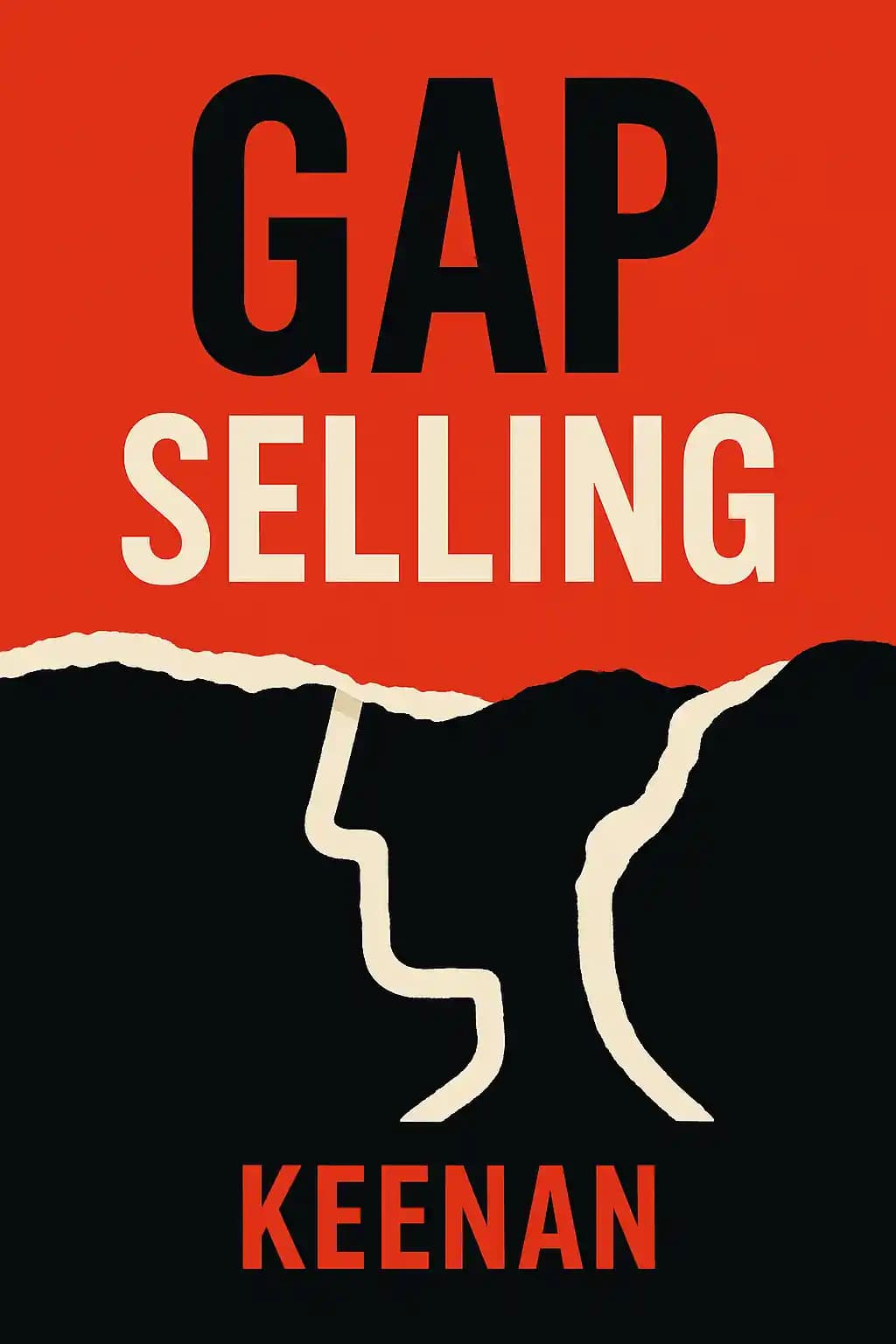
Imagine you're a football player who's just cost your team the game. Not because you couldn't tackle, but because you didn't understand a fundamental rule of the game. This is exactly what happened to Keenan, author of "Gap Selling," in a pivotal childhood football moment-and it's what happens to countless salespeople every day. They're not failing because they can't sell; they're failing because they don't understand the true game they're playing. Gap Selling has become a sensation in sales circles, with industry leaders like Salesforce and HubSpot incorporating its principles into their methodologies. Even celebrities like Mark Cuban have praised its approach, noting that "sales isn't about pushing products, it's about solving problems." With over 100,000 copies sold and translation into 12 languages, this revolutionary approach is transforming how companies close deals in today's challenging business environment.
第 2 章
The Problem Isn't You-It's Your Approach to Sales
The sales landscape today is troubling. Salespeople depend heavily on tools while facing unrealistic quotas and poor management. When deals fall through, they blame external factors: "The prospect went dark," "Our price was too high," or "The leads are bad." But these are excuses, not reasons. The truth is blunt but necessary: many salespeople simply aren't good at selling-not because they lack natural talent, but because they don't understand the rules of the game.
Gap Selling transforms the entire sales process by identifying and leveraging the gap between where buyers are now and where they want to be. This approach isn't about pitching products; it's about solving problems. When you understand this fundamental shift, everything changes-from how you negotiate price to how you overcome objections.
I entered sales not because I love selling, but because I love helping people solve problems. Everyone I've taught this method to has been astonished by the improvement in their close rates. Losing deals is painful-it affects your morale, quota, and bank account. But losing deals you should have won because you didn't understand the sale? That's devastating.
You're not failing because you don't work hard or don't care-you're failing because you don't know what you don't know. You're operating with an outdated concept of selling. The gap-selling methodology ensures you understand the complete game of sales by focusing on one simple truth: your product doesn't drive the sale-the problem does. Most salespeople fail because they can't properly diagnose customer problems. Cold emails go unanswered because they don't highlight relevant problems. Deals are lost because buyers determine problems aren't worth solving. Price battles occur when the problem's value doesn't justify the cost.
Think about it: Would you pay fifty cents for a pill to cure a headache? How about five dollars? A million dollars? Your answer changes dramatically when you discover your headache is actually a symptom of a brain tumor. This scenario perfectly illustrates the fundamental truths that govern every sales transaction.
第 3 章
The Nine TruthBombs That Will Transform Your Sales Approach
Every sale begins with a problem. Without a problem, there is no sale-period. Sales are initiated when someone experiences negative emotions about a situation that's affecting them. This frustration becomes the catalyst for change. Yet amazingly, many salespeople don't truly understand the problem their buyer is trying to solve.
Understanding both the problem and its impact is critical because the impact defines the problem's significance. A seemingly minor issue like a headache could have devastating consequences depending on its cause. Problems lead to impact, and impact is where urgency, value, and need converge to create sales opportunities.
Every sales transaction involves identifying the gap between the customer's current state and desired future state. The value of filling this gap varies dramatically based on impact. A minor headache represents a small gap with little value, while a migraine that could prevent meeting a critical deadline on a $500K project represents an enormous, valuable gap. Often gaps only appear small until deeper investigation reveals their true magnitude.
Customers buy because they want change. Whether fixing problems, seeking improvements, or pursuing opportunities, the fundamental motivation is always change. Gap selling requires understanding that you're not selling products or services-you're selling transformation. Never sell to perceived need; instead, tactfully challenge buyers' assumptions to expose their true problems and assess the real impact. The larger the gap between current and desired state, the more valuable your solution becomes.
Humans naturally resist change, even when they claim otherwise. Research shows we instinctively prefer tradition, consistency, and familiarity over what's new and unfamiliar. Studies demonstrate "longevity bias"-people unconsciously rate identical products more favorably when told they've existed longer. At the University of Arkansas, students gave higher ratings to the exact same chocolate when told it was from a 73-year-old brand versus a 3-year-old one. This presents a fundamental challenge in sales: even customers who initiate contact seeking change will experience subconscious resistance as closing approaches.
Every sale is emotional because all sales involve change, and change triggers complex emotions. Most salespeople fail by focusing solely on products or solutions without addressing customers' emotional states. Rosabeth Moss Kanter identifies ten emotional threats that cause resistance: loss of control, excess uncertainty, surprises, too much change at once, loss of face, insecurity, extra work, ripple effects, past resentments, and real danger. Understanding these emotional barriers is essential to closing sales.
While people naturally resist change, they embrace it when they believe the outcome justifies any discomfort. Humans crave control of their surroundings, so when salespeople pitch and push, customers feel defensive. Successful selling means helping customers feel safe enough to share problems and confident enough to accept change. Change only happens when customers envision an improved future state AND believe the benefits outweigh the costs of getting there.
Asking "why" reveals customers' intrinsic motivations-the real reasons they're considering change. Without understanding these deeper drives, you'll rarely close sales successfully. Customers may articulate surface problems without recognizing their underlying motivations. When you truly understand why customers need change, they stop caring about your credentials and start seeing how you'll improve their future.
Customers buy when they envision a compelling future state-competitive advantages, new market opportunities, increased profits, faster production, investor interest, cost savings, streamlined processes, generational appeal, improved communication, engaged employees, better retention, enhanced service, more leads, or increased revenue.
Finally, no one gives a shit about you. Today's customers research you online before meeting and don't want time wasted with self-promotion. Despite salespeople thinking customers care about longevity, awards, and company history, they only care about what you can do for them. Selling must focus on giving-industry information, insights, solutions-never self-centered promotion. Remember: sales are about them, not you.
第 4 章
Mastering the Current State: The Foundation of Effective Selling
Like a baby refusing food without being able to explain why, customers operate from an invisible backdrop of events, feelings, and biases that shape their perception and reactions. Understanding this "current state"-their world and perceived reality-is crucial for effective communication and problem-solving. The deeper you comprehend their current state, the better you can influence change and close deals.
To effectively apply gap selling, you must gain deep comprehension of your customers' current state-the anchor for change. The more you learn about their world today, the better you understand necessary changes and gather information to close deals. A direct correlation exists between how much a salesperson knows about their buyer's current state and their probability of winning.
Gap selling demands understanding more about your customer's world than what's visible on their websites. You need comprehensive knowledge of their organization as it relates to your offering-the literal, physical daily operations. Focus your investigation on areas your product could actually affect, gathering specific, relevant information. Every customer's environment is unique, with different processes, measurements, structures, and pain points. By understanding these unique conditions, you can develop customized selling strategies for each prospect.
People don't buy products-they buy solutions to problems. Without a clearly defined, measurable problem, buyers won't purchase. Problems exist embedded in every prospect's current state-outcomes of current processes, structures, software, employees, regulations, economic climate, leadership, and culture. As a salesperson, your job is to uncover these problems and understand their impact on your prospects.
All your fact-finding and problem hunting reveals both good and bad elements in the customer's current state. When you identify problems like cumbersome change order processes, you must trace their full impact: high cost overruns reduce available capital for new projects, limiting product introductions, hurting competitive position and growth. This chain reaction is what truly drives sales-not the problem itself, but its painful consequences. Problems only matter when their impact creates discomfort. Remember: You're never selling a product; you're selling the impact your solution will have on the customer's environment. You're selling change.
Problems exist because something isn't working correctly-these are the root causes your product will eliminate. Like a car that won't start could have three different root causes (no gas, dead battery, broken starter) requiring three different solutions, your customer's problems stem from specific causes you must identify. Understanding why problems exist is how you demonstrate you can solve them. The doctor who takes time to diagnose arterial blockage rather than just treating heartburn symptoms earns lasting loyalty. Be that expert who knows how to solve the problem because you know why it exists.
As you explore your customers' current state, remain attuned to their emotional responses. Are they frustrated? Angry? Afraid? This awareness helps you avoid triggering fears and deliver solutions in ways customers can properly absorb. Learning to deconstruct your customer's current state is a skill that differentiates you from other salespeople. Though it requires concentration and patience, analyzing the factors causing your customer's situation gives you the key to demonstrating how your product can propel them toward their desired future.
第 5 章
The Future State: Creating a Vision Worth Buying
The future state is where customers want to be-a place where your product has solved their problems and they're reaping benefits. It's what draws them toward change, representing pleasure while the current state represents pain. Once you understand current problems, you can help customers envision what life looks like when those problems are addressed, revealing opportunities.
Understanding how customers will feel once their problems are solved is crucial. Getting them to imagine their emotions in the future anchors them in that better place-where they'll feel relief and see the fruits of their efforts. You want them to taste what could be, motivating them to make necessary changes. The more concrete this future feels, the more willing they'll be to listen to your solutions. Once customers believe the benefits outweigh the costs of change, the deal is done. Establishing their pain while anchoring them in future pleasure primes them to cross the gap. This creates higher perceived value than if you'd simply exposed problems and left them wallowing.
Challenging the sales dogma that "people buy from people they like," gap selling argues that expertise trumps likability. While relationships matter, they're not why people buy. Buyers want value from those who can solve their problems, even if they don't particularly like them personally. Research confirms this: Matthew Dixon and Adamson's study of 6,000 B2B reps found that "Challengers"-salespeople knowledgeable enough about customers' businesses to speak their minds and challenge their thinking-held 40% of top sales positions, while Relationship Builders represented only 7%. Dave Kurlan's research revealed that salespeople with a strong need to be liked actually hurt their selling efficacy, with 82% of bottom-quartile performers reporting this need. Among top 5% performers, 89% did not feel a need to be liked, and only 1% believed relationships were key to closing business. The winning formula is simple: Be an expert, not a friend.
The gap is the space between the current state and the future state-where the value of the sale lives. The larger the distance between where customers are and where they want to go, the more valuable change becomes and the more urgent the need to buy. While a minor headache easily remedied with over-the-counter medication represents a small gap, a life-threatening infection creates a massive one. Salespeople can manipulate the size of the gap by helping buyers see things they didn't see before, expanding their perception of both their problem and the potential outcome of solving it.
第 6 章
Discovery: The Art of Knowing Your Clients Better Than They Know Themselves
Your primary job in selling is getting customers to let you help them. Without establishing trust and credibility, customers won't be vulnerable enough to share information about their current state or ask for your help. Every customer interaction should be measured by whether they're truly letting you in-saying "yes" to sharing their numbers, issues, and concerns. If they're not being forthright, the sale is dead. This requires demonstrating empathy, authenticity, expertise, and credibility that convinces customers you understand their world and pain.
Gap selling discovery differs fundamentally from traditional approaches by rejecting B.A.N.T. (Budget, Authority, Need, Timing) qualification. This outdated, self-centered framework wrongly puts prospects in the position of having to prove they're worthy of the salesperson's time-a completely backward approach. When prospects see enough value, they'll find budget. Authority is now distributed across 5.4 decision makers per B2B sale. Need is irrelevant since gap sellers don't sell to need but to problems customers may not recognize. And timing becomes irrelevant when you demonstrate the cost of inaction.
Forget "Always Be Closing"-it's garbage. Your focus during discovery should be entirely on understanding customers and their problems, not your product. The sale is won or lost during discovery, not at the end. Research by Gong.Io analyzing over a million sales calls revealed that successful salespeople spend more than half their time listening during discovery calls, while unsuccessful ones talk 80% of the time. There's a direct correlation between the number of questions asked early in the sales cycle and deal closure rates.
Before approaching prospects, you must create a Problem Identification Chart listing all potential problems you can solve, their business impacts, and root causes. This preparation ensures you ask targeted questions about issues you can actually address. The chart serves as your roadmap through customer discovery, establishing credibility by helping customers recognize problems they might not know they have.
Start discovery by asking probing questions to gather literal, physical facts about the business. Use "command statement starter words" like "Tell me about..." or "Walk me through..." to create friendly conversations rather than interrogations. Follow with process questions that dig into the tactical details of how customers execute their work. This deeper understanding reveals where your product can bring value. The goal is comprehensive understanding of their current state, which naturally exposes problems.
After gathering facts, problems begin revealing themselves through continued questioning. Each answer provides an opportunity to dig deeper, uncovering additional issues the customer may face. Through strategic questioning, you can even help customers realize problems they didn't know they had. The discovery process should uncover holes in business processes and missed opportunities, positioning you to later suggest better alternatives based on your expertise and experience with similar customers.
Never accept vague responses like "We're not growing fast enough." Always press for specifics: "What does 'fast enough' mean to you?" Quantified answers provide the precise information needed to develop solutions. Without specificity, you can't properly understand the problem or measure success.
When exploring impact, don't just gather facts-help customers recognize the urgency of their problems. The goal is to reveal how issues affect their business without using scare tactics. Use command statements like "Tell me how this issue is affecting you" or "Describe the impact on your department." Always push for specificity-when a customer says revenue is down "by a lot," ask what "a lot" means to get concrete figures like "$500,000 in lost revenue." This quantification transforms vague concerns into measurable business problems that demand action.
第 7 章
Turning Discovery into Deals: The Gap-Selling Execution Plan
There are two distinct problem types: technical problems (like outdated databases or inefficient systems) and business problems (the financial and operational impacts of those technical issues). While most salespeople focus on solving technical problems, it's the business problems that drive sales. A technical problem might be "disparate systems that don't share information," but the business problem is "$20K monthly in extra staffing costs" or "millions in wasted inventory." No two prospects ever have identical business problems, even when their technical problems match. The business problem provides the motivation for change-you're looking for the "holy shit" realization that reveals the gap between current state and desired future state.
Problems don't materialize from nothing-you must understand why they occur. Use provoking questions like "Why do you think this problem is happening?" or "How have your current processes affected this?" to help customers think differently about what's gone wrong. By understanding technical problems, business problems, and existential problems, you position yourself as an expert who can create tailored solutions.
How you communicate is as important as what you say. Two critical elements beyond question selection are tone and timing. Tone dramatically changes meaning-the same word can express delight, surprise, or sarcasm depending on delivery. When asking sensitive questions, adjust your tone to show humility and openness. Timing is equally crucial-questions must be strategically placed to create a natural flow that takes buyers on a journey. The goal isn't just asking questions but extracting valuable information.
After completing the four discovery steps-understanding facts, identifying problems, assessing impact, and pinpointing root causes-you can qualify the opportunity by answering four simple questions: Does the prospect have a problem you can fix? Do they agree they have a problem? Do they want to fix it? Will they go on a journey with you to fix it? If all answers are affirmative, you have a qualified opportunity.
While uncovering your customers' current state, you must simultaneously discover their desired future state-that place where all their problems are solved. Ask specific questions like "How would this system ideally work?" or "How many more tickets would you like to sell?" Refuse to accept vague answers; push for quantifiable outcomes. "Better efficiency" isn't specific enough; "reducing turnaround by 20% and increasing production by 50%" is. Remember: you're not selling a product or service; you're selling their desired outcome-positive, exciting change.
Discovering your customers' current and future states takes time-rarely can you gather all necessary information in a single interaction. Get as much data as possible during initial discovery, then continue gathering information throughout the sales process. Document everything in your CRM-no matter how good your memory, you'll never recall all the details from a proper gap-selling discovery.
Once you've identified both current and future states, calculate the gap between them. This quantification reveals what you're truly selling. For example, if a customer wants 20% growth but currently achieves only 10%, the gap is 10%. Translating this to dollars: $110M desired revenue minus $100M current revenue equals a $10M gap. You're not selling consulting services-you're selling $10M in additional revenue! The critical question becomes whether this gap justifies the cost and effort of change. Would a customer pay $100K to gain $10M? Absolutely. But would they pay $100K for just $1M? That's less certain, as implementation costs, process changes, politics, and comfort with the status quo might make a $900K improvement seem insufficient.
第 8 章
From Discovery to Demonstration: Crafting the Perfect Demo
For many salespeople, a product demo can make or break a sale. Gap selling ensures you crush your demo by following four essential elements that transform a standard presentation into a compelling case for change.
Never combine discovery and demo-they serve completely different purposes and require separate meetings on different days. A proper demo depends entirely on thorough discovery that answers: Does the prospect have a problem you can fix? Do they agree they have a problem? Do they want to fix it? Will they work with you to fix it? Even if customers are eager to see your product, explain that without discovery, you can't deliver a properly customized demo. Schedule them as connected events with 3-4 days between to process the discovery findings.
After thorough discovery, you should never say "if" during a demo. Phrases like "If you have this problem..." reveal you don't actually know your customer's challenges. Even if your product solves multiple problems, presenting every possible scenario overwhelms and irritates customers. It's like offering a teenager cargo shorts and a wool sweater when they need a prom dress-technically useful someday, but completely irrelevant to their current needs.
Products may have dozens of features, but buyers only care about the ones that solve their specific problems. Your demo shouldn't showcase everything your product can do-it should demonstrate how well it solves your buyer's particular challenges. Since most customers only have a handful of serious business problems and demos should last an hour max, limit yourself to six key features. It's better to thoroughly demonstrate the business value of one relevant feature than briefly mention many features that may not matter to the buyer. Quality trumps quantity.
Anchoring exploits the cognitive bias where people rely heavily on the first piece of information they receive when making decisions. Your goal is to make your solution the baseline against which customers judge all alternatives. Do this by focusing on their future state and asking affirming questions after each feature demonstration: "Can you see how this feature will improve your churn rate?" These questions not only anchor your solution as the standard but also validate that you're addressing their actual needs.
Use your Problem Identification Chart (PIC) as a demo map, organizing problems from greatest to least impact. Only demonstrate features that address problems on this list, prioritizing those with the biggest business impact. This creates a perfectly tailored presentation showing customers exactly how your product will look on them-like a mirror in a dressing room.
Get it out of your head that demos are about showing off product features. Customers don't care about your product's capabilities-they care only about how it solves their specific problems. Unless a feature directly addresses their stated issues, don't waste time discussing it. The more value you create through your targeted demo, the greater your probability of closing the deal.
第 9 章
Navigating Obstacles: Troubleshooting the Sales Process
Even the most promising sales process can hit unexpected obstacles just when you think you're cruising toward closure. As customers approach final decisions, they often second-guess themselves, get cold feet, or review their thinking for overlooked complications. This critical moment tests how thoroughly you've conducted discovery and understood their current and desired future states.
Sometimes a prospect who seemed enthusiastic suddenly disappears-not answering calls or emails despite previous excitement about moving forward. This isn't about lost messages; prospects know when they owe a response and usually feel bad about not replying. Something unexpected has likely happened on their end. Rather than desperately "checking in" with multiple messages, effective gap sellers remain direct and use their accumulated knowledge to hold prospects accountable. The key approach is using "I'm confused. You said..." to highlight the gap between their words and actions, reminding them of their current state and how avoiding you prevents reaching their desired future state.
When a deal stalls-meetings get postponed, specs aren't delivered, and progress crawls despite the prospect maintaining interest-apply the same gap selling principles. Remind customers of their current state, desired future state, and the impact of delaying their outcomes: "I'm happy to push the meeting, but I'm confused. You said every month without the new system costs you money, yet you hoped to increase profits by 4% next year. It's getting harder to reach that goal at this rate, isn't it?" This approach either prompts them to defend the delay or motivates them to re-engage, giving you clarity on how to proceed.
Rather than using traditional clarifying questions when facing objections, gap sellers focus on the prospect's desired outcome. When a prospect raises an objection, hold it against their future state-would resolving this concern get them closer to their desired outcome? Lead with "I'm confused" to challenge without creating defensiveness, then remind them of their current state and goals. This approach shifts the conversation from defending your product to making the buyer defend their objection.
Price objections require shifting the conversation's focus. Customers aren't buying products or services; they're buying outcomes and change. When price objections arise, remind prospects of their desired outcomes and make them defend their objection against the value of achieving their goals. For "It's too expensive," respond with "I'm confused" followed by a reminder of how your solution enables their specific goals, then remain silent and listen. For "We don't have the budget" or "We can't afford it," determine if it's truly an affordability issue (no money available) or a budget allocation issue. If it's the latter, help them realize the cost of waiting by calculating the financial impact of delay against their stated goals.
Gap selling provides comprehensive customer understanding that prevents surprises. When you clearly understand a customer's current state, future state, desired outcomes, and have properly calculated the gap, you know before they do whether your solution truly provides value. Like pulling someone back from walking into traffic, gap selling sometimes requires confronting customers with erroneous thinking for their own benefit. It also empowers you to walk away from poor-fit opportunities, freeing you to focus on customers who will genuinely benefit from your solutions.
第 10 章
Building a Gap-Selling Organization: Leadership and Culture
Quarter-end panic is common among sales leaders when pipelines collapse and forecasts prove inaccurate. Studies show salespeople close three times as many deals at month-end but lose 11 times as many, costing companies millions annually. Gap-selling pipeline management differs fundamentally from traditional approaches by requiring concrete information rather than vague status updates.
Traditional pipeline reviews are often meaningless exchanges where salespeople offer vague assurances without demonstrating any control over the sales process. In contrast, gap-selling pipeline reviews verify that CRM numbers are accurate, evaluate how much salespeople know about their customers, and confirm they have enough influence to ensure deals close when predicted. Without this verification process, sales managers simply cannot do their jobs effectively.
Gap-selling managers must counter salespeople's natural optimism by verifying they truly understand their customers' current state, future state, gap, intrinsic motivations, and decision criteria. The pipeline review essentially administers the CRM Challenge to the team, ensuring salespeople have gathered all critical information needed to close sales and have genuine influence over their deals. This verification process helps create accurate forecasts rather than hopeful stories.
Predictions are only as good as their underlying data. Gap-selling managers must push beyond vague statements like "the customer wants to grow faster" to specific, quantifiable facts. How much growth? By what date? What's the current growth rate? If salespeople can't provide these details, they must return to the customer for clarification. Trust details, not generalities.
While gap-selling pipeline reviews may initially seem time-consuming, they quickly become efficient as the team adapts. Be skeptical of salespeople who give long-winded explanations-those who truly understand their deals can explain them succinctly with specific facts. People who lack good data tend to talk more and in circles. Focus on brevity and specificity rather than storytelling. Don't let people off the hook-demand specific answers, not vague "I think" responses. The best sales managers confront reality early, as it gives them power to address problems proactively.
A commit culture improves predictability by requiring salespeople to own their numbers within 15% accuracy. This creates trust throughout the organization and eliminates surprises-the enemy of sales leaders. Traditional sales teams often rely on gut feelings rather than data, resulting in wildly inaccurate projections. In contrast, gap selling requires understanding all elements: current state, future state, gap, motivations, desired outcomes, and decision criteria. Salespeople must commit to numbers based on data, not intuition. The beauty of this approach is early warning-knowing on day one if you're tracking $200K below quota gives you 90 days to address the shortfall rather than discovering it too late.
Hiring for gap selling requires completely rethinking traditional sales recruitment criteria. Rather than prioritizing industry experience, years selling, quota attainment, or charm, gap-selling organizations should seek candidates embodying nine specific traits: curiosity, critical thinking, empathy, problem-solving, leadership, creativity, deliberate learning, coachability, and business acumen. Gap selling demands a fundamentally different type of seller than traditional aggressive pitching or persuasion-focused approaches.
To excel as a gap sales leader, focus outward rather than inward. Just as gap selling centers on customers, sales leadership should provide what your team needs-guidance, feedback, direction and inspiration. Think like a coach who teaches, trains, and motivates but steps aside on game day. This coaching approach extends to how your salespeople should treat customers: gathering information, educating clients, analyzing their current state, and suggesting future-state strategies. Research shows 53% of customer loyalty comes from the sales experience itself, not product, service, or price. Successfully implementing gap selling depends entirely on leadership consistently reinforcing these principles through pipeline meetings, coaching sessions, hiring processes, and reviews.
The selling game is hard, especially when you don't know the rules. Now you do. You understand sales is about facilitating change, not just selling stuff. You have tools to understand customers' problems deeply, maximize your value, build credibility, overcome objections, and develop partnerships built on mutual respect. Gap selling transforms you from a pitch-slinging clown to a trusted influencer with a full, predictable pipeline. This methodology gives you everything needed to play the game of sales well and win at every level.