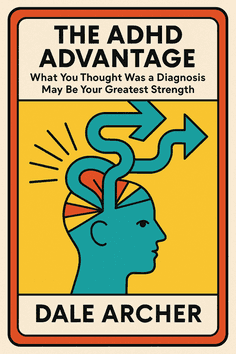
The ADHD Advantage
How to Use Your ADHD to Succeed at Work and in Life
Overview of The ADHD Advantage
What if ADHD isn't a disorder but your secret superpower? Dr. Dale Archer's bestseller reveals how JetBlue founder David Neeleman and Virgin's Richard Branson leveraged their ADHD traits for extraordinary success. Embrace your unique brain - the world needs your hyperfocus.

Key Themes in The ADHD Advantage
- neurodiversity strengths
- evolutionary psychology
- nonlinear thinking
- thriving in chaos
- reframing disability
Quotes from The ADHD Advantage
What if ADHD isn't a disorder at all, but an evolutionary advantage?
We overlook the nuanced spectrum of ADHD, forcing diverse individuals into the same diagnostic box.
Psychiatry has taken on the troubling role of defining "normal" in society.
We've become overzealous in treating every ADHD child, leading to diagnoses based on flimsy evidence.
Characters in The ADHD Advantage
- Dr. Dale ArcherAuthor and psychiatrist reframing ADHD
- Ty PenningtonTV host who leveraged ADHD traits for success
- David NeelemanJetBlue founder who credits ADHD for his success
- Howie MandelComedian whose impulsivity fueled his career
- Benjamin BlanchardResilient entrepreneur with three businesses
About the Author
About the Author of The ADHD Advantage
Dale Archer, M.D., psychiatrist and New York Times bestselling author of The ADHD Advantage: What You Thought Was a Diagnosis May Be Your Greatest Strength, redefines neurodiversity through his clinical expertise and media influence. A board-certified psychiatrist and Distinguished Fellow of the American Psychiatric Association, Archer founded Louisiana’s Archer Outpatient Services and spent decades advocating for reframing ADHD as a strength rather than a limitation. His work blends psychiatric research with real-world insights from hosting NBC news segments, call-in radio shows, and his TV program The Dr. Dale Archer Show.
Archer’s psychology-focused works, including Better Than Normal—a manifesto on embracing individuality—position him as a leader in transformative mental health advocacy.
The ADHD Advantage synthesizes his clinical experience with case studies of entrepreneurs and innovators, arguing ADHD traits like hyperfocus and risk-taking fuel success. The book has been cited in major outlets like ADDitude and endorsed for its paradigm-shifting approach to neurodivergence. His 25+ years of private practice and media reach—including frequent national news commentary—establish him as a trusted voice.
The ADHD Advantage continues Archer’s mission to destigmatize mental health differences, building on his prior New York Times bestseller status and global influence in psychiatric discourse.
Download Summary of The ADHD Advantage
Get the The ADHD Advantage summary as a free PDF or EPUB. Print it or read offline anytime.
FAQs About This Book
The ADHD Advantage redefines ADHD as a potential strength rather than a disorder, highlighting traits like creativity, resilience, and hyperfocus as assets. Dr. Dale Archer combines scientific research, success stories, and practical strategies to help readers reframe their diagnosis and leverage ADHD traits in careers, education, and personal growth. The book critiques outdated stigmas and promotes self-acceptance.
This book is ideal for adults with ADHD, parents of ADHD children, educators, and professionals seeking to understand neurodiversity. It’s also valuable for anyone interested in mindset shifts around mental health. Archer’s actionable advice on harnessing ADHD traits makes it a resource for personal development and workplace success.
Yes, particularly for its empowering perspective on ADHD. The book blends scientific insights, real-world success stories (e.g., JetBlue founder David Neeleman), and strategies like mindfulness and task prioritization. It’s praised for challenging stereotypes and offering hope, though some note it emphasizes strengths over addressing severe symptoms.
Archer frames ADHD traits—like impulsivity and distractibility—as evolutionary advantages, such as multitasking ability and creative problem-solving. He argues these traits helped early humans survive and can drive innovation in modern careers. The book contrasts this with societal labels of ADHD as a "deficit".
Key methods include the "Top 3" task-prioritization technique, mindfulness for focus, and regular exercise to boost dopamine. Archer also advocates for tailored organizational systems and environments that align with ADHD energy patterns, rather than forcing conventional productivity models.
Yes, notable examples include entrepreneur David Neeleman (JetBlue), TV host Ty Pennington, and comedian Howie Mandel. The book illustrates how their ADHD traits—like risk-taking and hyperfocus—fueled creativity and resilience in their careers.
Archer criticizes rigid educational systems for failing ADHD learners and proposes flexible, hands-on approaches. He emphasizes the role of teachers in identifying strengths (e.g., curiosity) and creating adaptive learning environments rather than punishing atypical behaviors.
- ADHD as an asset: Traits like creativity and adaptability are competitive advantages.
- Individualized strategies: No one-size-fits-all solutions; focus on personal strengths.
- Stigma reduction: Success stories normalize ADHD and combat negative stereotypes.
By reframing symptoms as strengths (e.g., impulsivity as spontaneity) and showcasing high achievers with ADHD, Archer normalizes neurodiversity. He argues societal labels pathologize natural cognitive variations, urging readers to embrace their unique wiring.
Yes, it links ADHD traits to evolutionary survival mechanisms, such as heightened alertness for hunting. The book also explains dopamine’s role in focus and motivation, advocating exercise and stimulating tasks to manage symptoms.
Absolutely. Archer cites ADHD-friendly careers in entrepreneurship, arts, and tech, where traits like risk-taking and idea generation thrive. He advises leveraging hyperfocus for passion projects and using tools like time-blocking to structure tasks.
Some reviewers note the book minimizes the challenges of severe ADHD symptoms, potentially oversimplifying management. However, most praise its uplifting message and practical advice for reframing diagnosis as a starting point for growth.