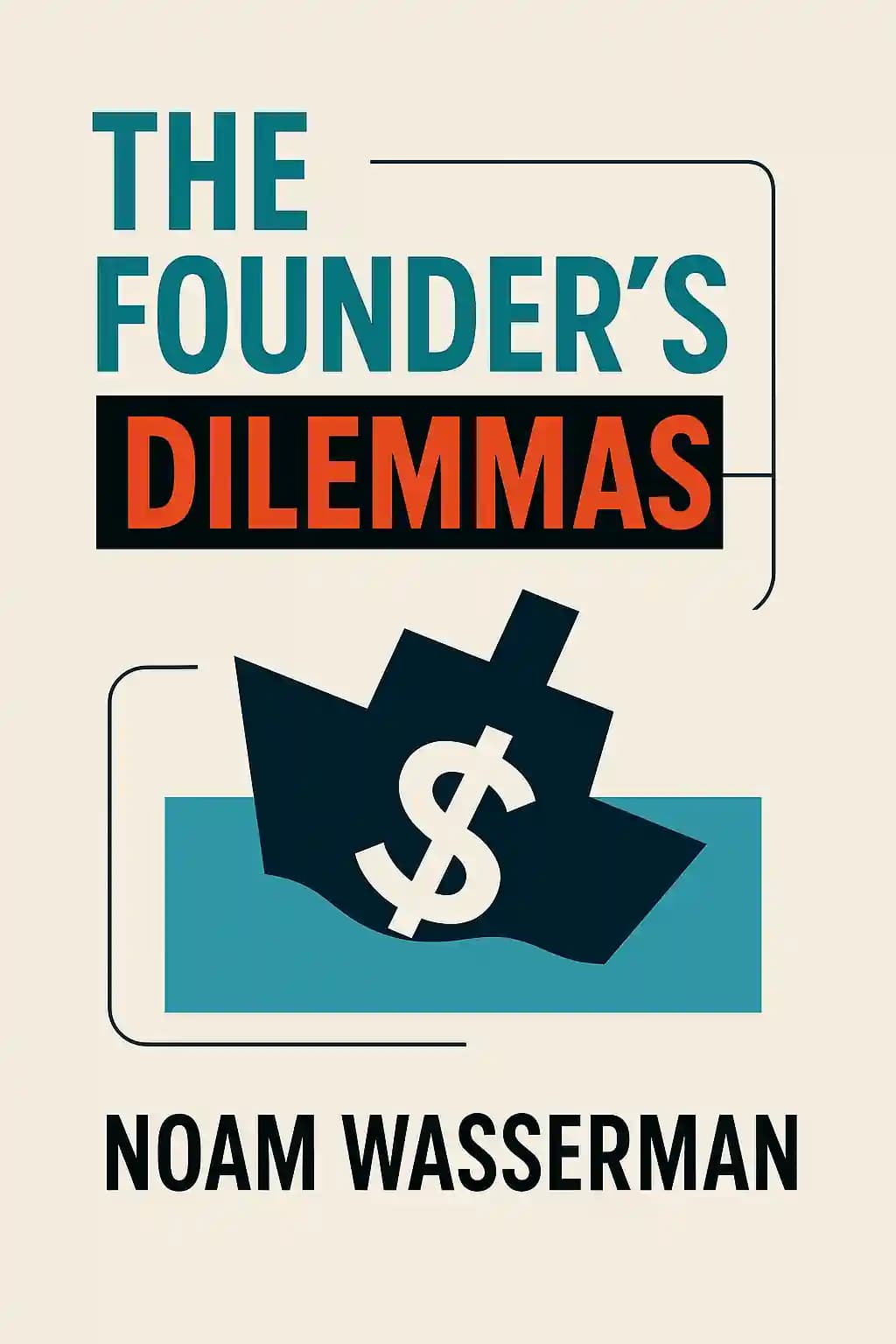
The Founder's Dilemmas
Anticipating and Avoiding the Pitfalls That Can Sink a Startup
Overview of The Founder's Dilemmas
The definitive startup playbook built on 10,000 founder stories. Endorsed by Apple's Guy Kawasaki and YouTube's Chad Hurley, Wasserman's research reveals the hidden "people problems" that sink 65% of ventures. What early decision are you about to get catastrophically wrong?

Key Themes in The Founder's Dilemmas
- cofounder conflict
- equity split
- founder succession
- team building dynamics
- entrepreneurial decision making
Quotes from The Founder's Dilemmas
Complexity increases exponentially with more cofounders.
Leadership is all about taking in information and making a decision.
Most casualties come from 'friendly fire' - internal conflicts.
Excessive optimism blinds many founders to their startup's critical needs.
I've never entered Madison Square Garden in my life.
Characters in The Founder's Dilemmas
- Noam WassermanAuthor and researcher of startup failure patterns
- Barry NallsFounder of Mastery and successful solo founder
- Evan WilliamsFounder whose early startups faced team challenges
- Tim WestergrenFounder of Pandora Radio who prioritized cofounders
- Genevieve ThiersSittercity founder who managed cofounder conflict
About the Author
About the Author of The Founder's Dilemmas
Noam Wasserman is the bestselling author of The Founder’s Dilemmas: Anticipating and Avoiding the Pitfalls That Can Sink a Startup and a leading expert in entrepreneurship and organizational behavior. A former Harvard Business School professor and current dean of Yeshiva University’s Sy Syms School of Business, Wasserman combines academic rigor with real-world insights to explore critical early decisions in startups, such as equity splits, leadership transitions, and team dynamics.
His groundbreaking research, drawn from a decade-long study of 10,000 founders, earned the Academy of Management’s Impact on Practice Award and shaped his acclaimed HBS course “Founder’s Dilemmas,” which received perfect teaching ratings at Stanford and Columbia.
Wasserman’s follow-up book, Life Is a Startup, extends his frameworks to personal and professional decision-making. Recognized among Poets&Quants’ “Favorite Professors of Business Majors,” he holds a PhD from Harvard and a Wharton BSE. The Founder’s Dilemmas has spent over five years on Amazon’s Strategy bestseller list, is translated into 12 languages, and is required reading in top MBA programs worldwide.
Download Summary of The Founder's Dilemmas: Anticipating and Avoiding the Pitfalls That Can Sink a Startup
Get the The Founder's Dilemmas: Anticipating and Avoiding the Pitfalls That Can Sink a Startup summary as a free PDF or EPUB. Print it or read offline anytime.
FAQs About This Book
The Founder's Dilemmas analyzes critical early decisions by startup founders that determine a company’s survival, using data from 10,000 founders and case studies like Twitter’s Evan Williams. It explores trade-offs between wealth and control ("rich vs. king"), equity splits, team dynamics, and investor relationships, offering frameworks to navigate high-stakes choices.
Aspiring entrepreneurs, startup founders, and venture capitalists will gain actionable insights from this book. It’s particularly valuable for those facing co-founder conflicts, equity negotiations, or investor pressures, providing evidence-based strategies to avoid common pitfalls.
Yes—it’s a research-backed guide praised by thought leaders like Eric Ries and YouTube’s Chad Hurley. The book combines academic rigor with real-world examples, offering tools to balance control and financial success while avoiding catastrophic missteps.
The "rich vs. king" framework highlights founders’ choice between maximizing wealth (rich) or retaining control (king). For example, Evan Williams prioritized control at Blogger but shifted toward wealth-seeking at Odeo, later reverting to regain authority—a tension central to startup scalability.
Wasserman warns against equal splits without considering roles or contributions, citing data showing uneven splits correlate with higher success rates. He advises aligning equity with long-term responsibilities and using vesting schedules to mitigate fallout.
Some argue the book prioritizes awareness over clear solutions, leaving founders to weigh trade-offs subjectively. Critics note its focus on high-tech startups may limit applicability to other industries, though core principles remain widely relevant.
Case studies like Pandora’s Tim Westergren and Blogger’s Evan Williams illustrate dilemmas in hiring, fundraising, and leadership transitions. These stories contextualize data, showing how control-oriented vs. wealth-oriented decisions impact outcomes.
Motivation dictates critical choices: control-driven founders often reject investor funding, while wealth-seekers may cede authority for growth. Wasserman emphasizes self-awareness to align decisions with core goals.
With rising remote work and AI-driven ventures, Wasserman’s frameworks help navigate distributed teams and rapid scaling. Early decisions about equity, leadership, and investor partnerships remain pivotal amid evolving tech landscapes.
While Eric Ries’ The Lean Startup focuses on product validation, Wasserman tackles interpersonal and structural challenges. Together, they provide complementary strategies: Ries’s "build-measure-learn" loop and Wasserman’s "rich vs. king" decision-making.
Key quotes include:
- “Founders’ early decisions create lasting ripple effects”—underscoring irreversible choices like equity splits.
- “You can’t have your cake and eat it too”—emphasizing the necessity of trade-offs between control and wealth.
Wasserman’s tools include:
- The Founder’s Timeline: Mapping decision points like team assembly and funding rounds.
- Equity Allocation Grids: Balancing roles, contributions, and risk tolerance.
- Pre-Mortem Analysis: Anticipating failure scenarios during high-stakes choices.