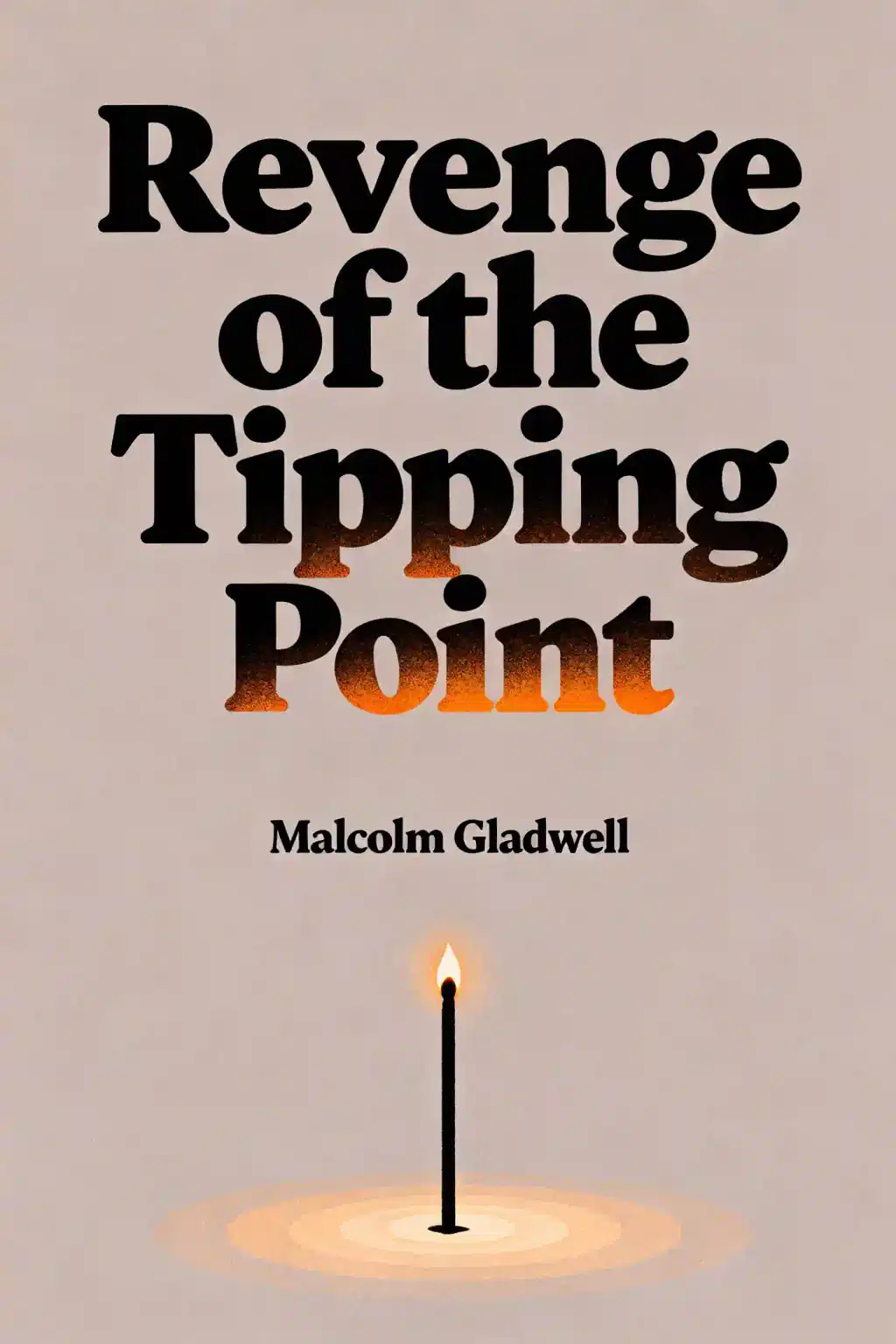
Revenge of the Tipping Point: Overstories, Superspreaders, and the Rise of Social Engineering by Malcolm Gladwell Summary

Overview of Revenge of the Tipping Point
In "Revenge of the Tipping Point," Gladwell revisits his viral theory through modern crises like COVID-19. What if the mechanisms behind social epidemics have evolved? Praised by The Guardian as "addictive and provocative," this 2024 follow-up redefines how ideas - and consequences - spread.
- Malcolm Gladwell's "tipping point" defines sudden epidemic spread through small triggers
- Three rules drive social epidemics: Law of the Few, Stickiness Factor, Power of Context
- Connectors, Mavens, and Salesmen disproportionately influence viral trends through specialized social roles
- Hush Puppies resurgence proves unexpected "stickiness" can tip obscure products into cultural phenomena
- Crime rate drops occur at tipping points through broken windows theory environmental shifts
- Sesame Street's "stickiness factor" blueprint makes educational content irresistibly memorable for children
- Context shapes behavior more than personality—epidemics tip through environmental tweaks not persuasion
- 150-person "Rule of 150" determines maximum group size for effective idea transmission
- Suicide clusters demonstrate dangerous social epidemics' dependency on vulnerable personality types
- Syphilis outbreaks reveal how small environmental changes accelerate negative social contagions
- Word-of-mouth epidemics rely on 20% influencers creating 80% of transmission impact
- Six Degrees of Separation theory underpins Gladwell's Law of the Few connectors
About the Author of Revenge of the Tipping Point
Malcolm Timothy Gladwell, bestselling author of Revenge of the Tipping Point and renowned cultural analyst, has reshaped modern discourse on societal change through his exploration of psychology and social dynamics. A staff writer for The New Yorker since 1996, Gladwell’s work bridges academic research and pop culture, dissecting how subtle forces drive transformative trends—a theme central to this book’s examination of unintended consequences in human behavior. His expertise stems from decades of investigative journalism and bestselling titles like Blink: The Power of Thinking Without Thinking and Outliers: The Story of Success, which have collectively sold millions of copies worldwide.
Gladwell hosts the acclaimed podcast Revisionist History and co-founded Pushkin Industries, further solidifying his role as a leading voice in narrative-driven analysis.
A recipient of the Order of Canada and named among Time’s 100 Most Influential People, his ideas are taught in universities and applied by organizations ranging from tech startups to professional sports teams. Revenge of the Tipping Point builds on his legacy of reframing conventional wisdom, a practice that has translated his works into over 40 languages and sustained their relevance across global audiences.
FAQs About Revenge of the Tipping Point
What is Revenge of the Tipping Point by Malcolm Gladwell about?
Revenge of the Tipping Point examines how social epidemics—ideas, trends, and behaviors—spread and are manipulated, building on Gladwell’s earlier work. The book explores both successful and destructive applications of these principles, such as viral misinformation campaigns or public health interventions, while reevaluating concepts from his 2000 bestseller The Tipping Point.
Who should read Revenge of the Tipping Point?
Marketers, sociologists, policymakers, and fans of Gladwell’s earlier works like The Tipping Point or Outliers will find value. It’s ideal for readers interested in social dynamics, behavioral psychology, or strategies for influencing large-scale change.
Is Revenge of the Tipping Point worth reading?
Yes—Gladwell combines rigorous research with narrative flair to dissect modern social phenomena. The book offers fresh perspectives on leveraging (or resisting) “tipping point” strategies in an era of viral misinformation and algorithmic amplification.
What are the key concepts in Revenge of the Tipping Point?
- Social engineering: How deliberate manipulation accelerates or stalls trends.
- Superspreaders: Individuals or entities disproportionately influencing outcomes.
- Epidemic trade-offs: Unintended consequences of well-intentioned interventions.
How does Revenge of the Tipping Point differ from Gladwell’s original The Tipping Point?
While the 2000 book focused on harnessing social epidemics positively, Revenge analyzes their weaponization, such as misinformation campaigns or exploitative marketing. Gladwell also addresses critiques of oversimplification from his earlier work.
What real-world examples does Gladwell use in Revenge of the Tipping Point?
Case studies include viral conspiracy theories, public health failures during pandemics, and corporate campaigns that backfired. Gladwell revisits historical examples like crime reduction strategies, contrasting past successes with modern challenges.
What criticisms does Revenge of the Tipping Point address?
Gladwell acknowledges critiques of his earlier “tipping point” framework, such as oversimplifying complex social systems. He addresses these by examining scenarios where simple interventions fail and emphasizing contextual adaptability.
How does Malcolm Gladwell’s background influence Revenge of the Tipping Point?
His career as a New Yorker writer and podcast host (Revisionist History) informs the book’s blend of academic research and storytelling. His focus on counterintuitive insights reflects his trademark style.
Can Revenge of the Tipping Point help with career or business strategies?
Yes—the book offers frameworks for identifying social leverage points, managing organizational change, and avoiding viral backlash. It’s particularly relevant for roles in marketing, PR, or leadership.
What quotes highlight the themes of Revenge of the Tipping Point?
- “The same tools that cure can also poison.”
- “Virality is no longer accidental—it’s architected.”
These emphasize dual-use ethics in social influence.
How does Revenge of the Tipping Point relate to current events?
It analyzes 2020s challenges like polarized online ecosystems, AI-driven content algorithms, and trust erosion in institutions—making it a timely read for understanding modern disinformation cycles.
Are there audiobook or podcast supplements for Revenge of the Tipping Point?
Gladwell’s podcast Revisionist History explores overlapping themes, and the audiobook version features his narration. These formats highlight his emphasis on oral storytelling to convey complex ideas.
What books pair well with Revenge of the Tipping Point?
- The Tipping Point (Gladwell’s foundational work)
- Atomic Habits by James Clear (behavioral change)
- Trust Me by John C. Maxwell (modern leadership)
Feel the book through the author's voice
Turn knowledge into engaging, example-rich insights
Capture key ideas in a flash for fast learning
Enjoy the book in a fun and engaging way
Key Themes in Revenge of the Tipping Point
Quotes from Revenge of the Tipping Point
Communities have their own "overstories" that powerfully shape behavior.
"gives you a little bit of a superhero complex."
Normal rules didn't apply.
The Waldorf environment gradually changed parents' perspectives.
The takeover method spread like wildfire.
Characters in Revenge of the Tipping Point
Quick Summary Mode - Read or listen to Revenge of the Tipping Point Summary in 6 Minutes

Break down key ideas from Revenge of the Tipping Point into bite-sized takeaways to understand how innovative teams create, collaborate, and grow.

Flash Card Mode - Top 10 Insights from Revenge of the Tipping Point in a Nutshell

Distill Revenge of the Tipping Point into rapid-fire memory cues that highlight key principles of candor, teamwork, and creative resilience.

Fun Mode - Revenge of the Tipping Point Lessons Told Through 23-Min Stories

Experience Revenge of the Tipping Point through vivid storytelling that turns innovation lessons into moments you'll remember and apply.
Personalize Mode - Read or listen to Revenge of the Tipping Point Summary in 0 Minutes

Ask anything, pick the voice, and co-create insights that truly resonate with you.

From Columbia University alumni built in San Francisco
"Instead of endless scrolling, I just hit play on BeFreed. It saves me so much time."


"I never knew where to start with nonfiction—BeFreed’s book lists turned into podcasts gave me a clear path."


"Perfect balance between learning and entertainment. Finished ‘Thinking, Fast and Slow’ on my commute this week."
"Crazy how much I learned while walking the dog. BeFreed = small habits → big gains."
"Reading used to feel like a chore. Now it’s just part of my lifestyle."

"Feels effortless compared to reading. I’ve finished 6 books this month already."
"BeFreed turned my guilty doomscrolling into something that feels productive and inspiring."

"BeFreed turned my commute into learning time. 20-min podcasts are perfect for finishing books I never had time for."
"BeFreed replaced my podcast queue. Imagine Spotify for books — that’s it. 🙌"

"It is great for me to learn something from the book without reading it."
"The themed book list podcasts help me connect ideas across authors—like a guided audio journey."
"Makes me feel smarter every time before going to work"
From Columbia University alumni built in San Francisco
"Instead of endless scrolling, I just hit play on BeFreed. It saves me so much time."
"I never knew where to start with nonfiction—BeFreed’s book lists turned into podcasts gave me a clear path."
"Perfect balance between learning and entertainment. Finished ‘Thinking, Fast and Slow’ on my commute this week."
"Crazy how much I learned while walking the dog. BeFreed = small habits → big gains."
"Reading used to feel like a chore. Now it’s just part of my lifestyle."
"Feels effortless compared to reading. I’ve finished 6 books this month already."
"BeFreed turned my guilty doomscrolling into something that feels productive and inspiring."
"BeFreed turned my commute into learning time. 20-min podcasts are perfect for finishing books I never had time for."
"BeFreed replaced my podcast queue. Imagine Spotify for books — that’s it. 🙌"
"It is great for me to learn something from the book without reading it."
"The themed book list podcasts help me connect ideas across authors—like a guided audio journey."
"Makes me feel smarter every time before going to work"
"Instead of endless scrolling, I just hit play on BeFreed. It saves me so much time."
"I never knew where to start with nonfiction—BeFreed’s book lists turned into podcasts gave me a clear path."
"Perfect balance between learning and entertainment. Finished ‘Thinking, Fast and Slow’ on my commute this week."
"Crazy how much I learned while walking the dog. BeFreed = small habits → big gains."
"Reading used to feel like a chore. Now it’s just part of my lifestyle."
"Feels effortless compared to reading. I’ve finished 6 books this month already."
"BeFreed turned my guilty doomscrolling into something that feels productive and inspiring."
"BeFreed turned my commute into learning time. 20-min podcasts are perfect for finishing books I never had time for."
"BeFreed replaced my podcast queue. Imagine Spotify for books — that’s it. 🙌"
"It is great for me to learn something from the book without reading it."
"The themed book list podcasts help me connect ideas across authors—like a guided audio journey."
"Makes me feel smarter every time before going to work"
"Instead of endless scrolling, I just hit play on BeFreed. It saves me so much time."
"I never knew where to start with nonfiction—BeFreed’s book lists turned into podcasts gave me a clear path."
"Perfect balance between learning and entertainment. Finished ‘Thinking, Fast and Slow’ on my commute this week."
"Crazy how much I learned while walking the dog. BeFreed = small habits → big gains."
"Reading used to feel like a chore. Now it’s just part of my lifestyle."
"Feels effortless compared to reading. I’ve finished 6 books this month already."
"BeFreed turned my guilty doomscrolling into something that feels productive and inspiring."
"BeFreed turned my commute into learning time. 20-min podcasts are perfect for finishing books I never had time for."
"BeFreed replaced my podcast queue. Imagine Spotify for books — that’s it. 🙌"
"It is great for me to learn something from the book without reading it."
"The themed book list podcasts help me connect ideas across authors—like a guided audio journey."
"Makes me feel smarter every time before going to work"

Get the Revenge of the Tipping Point summary as a free PDF or EPUB. Print it or read offline anytime.