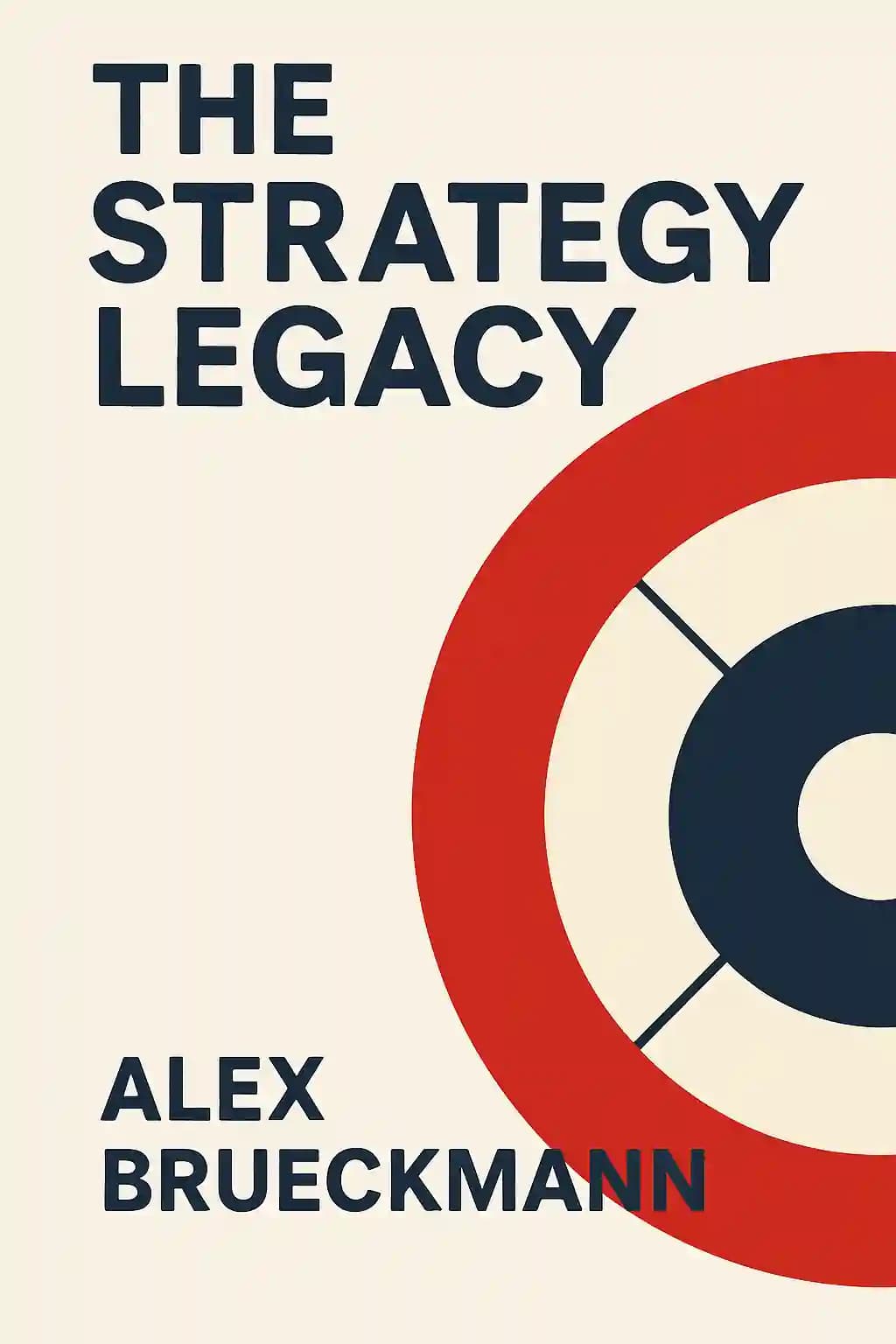
The Strategy Legacy
Growing Revenues, Building Value
Overview of The Strategy Legacy
"The Strategy Legacy" reveals how to future-proof your business beyond profits. This Wall Street Journal bestseller offers a revolutionary nine-element framework that's changing how leaders think. Ever wondered why purpose-driven companies outperform others? Brueckmann's insights are transforming boardrooms worldwide.

Key Themes in The Strategy Legacy
- organizational identity
- purpose-driven strategy
- mission alignment
- values-based leadership
- strategic execution framework
Quotes from The Strategy Legacy
No one cares about purpose.
Workers increasingly prioritize purpose over paycheck.
Organizations lacking clear purpose face turnover rates up to 3 times higher.
Today's consumers, employees, and investors demand authenticity.
The Legacy Trident-the threefold responsibility leaders have.
Characters in The Strategy Legacy
- Alex BrueckmannAuthor and creator of the Nine Elements framework
- Yvon ChouinardPatagonia founder who built a values-based business
About the Author
About the Author of The Strategy Legacy
Alex Brueckmann, Wall Street Journal bestselling author of The Strategy Legacy, is a globally recognized strategist and board advisor specializing in organizational identity and sustainable business growth.
A German-Canadian entrepreneur, Brueckmann founded Brueckmann Executive Consulting, guiding Fortune 500 firms like BMW, Roche, and Alphabet through strategy design and human-centric leadership development. His expertise stems from advanced studies at Harvard Business School, INSEAD, and EBS University, and over two decades of transforming organizations across 15+ countries.
Brueckmann’s The Strategy Legacy distills his proven Nine Elements of Organizational Identity (9EOI) framework, merging strategy, culture, and execution into actionable insights for leaders. His earlier work, Secrets of Next Level Entrepreneurs, further cements his reputation for bridging theoretical rigor with practical implementation.
A sought-after speaker featured in CEOWORLD Magazine and leadership podcasts, Brueckmann advocates for purpose-driven strategies that balance profits with societal impact. The Strategy Legacy has become a critical resource for Inc 5000 startups and multinational executives alike, praised for its clarity in navigating complex business challenges.
Download Summary of The Strategy Legacy
Get the The Strategy Legacy summary as a free PDF or EPUB. Print it or read offline anytime.
FAQs About This Book
The Strategy Legacy provides a framework for future-proofing businesses by aligning strategy with organizational identity. It introduces the Nine Elements of Organizational Identity (9EOI) to help leaders build sustainable legacies through purpose-driven practices, ethical cultures, and strategic habits. The book combines actionable tools, real-world examples, and humorous illustrations to address modern challenges like stakeholder expectations and societal impact.
This book is ideal for executives, entrepreneurs, and managers seeking to design resilient strategies without over-reliance on consultants. It’s particularly valuable for leaders focused on creating purpose-driven workplaces, improving organizational health, and leaving a lasting societal legacy. Practitioners in strategy, HR, and leadership development will find its frameworks directly applicable.
Yes—ranked a Wall Street Journal bestseller, it offers practical tools like the 9EOI framework and habit-building exercises for leaders. Brueckmann’s blend of academic rigor (INSEAD, Harvard) and real-world consulting experience (clients include BMW, Roche) ensures actionable insights. The inclusion of case studies and self-assessment templates adds immediate value for strategic planning.
Alex Brueckmann is a globally recognized strategist, board advisor, and bestselling author. With degrees from EBS University and Harvard, he’s advised Fortune 500 companies like Alphabet and Bertelsmann. His work focuses on creating human-centric growth strategies, and he advocates for businesses to prioritize societal impact alongside profitability.
The 9EOI framework covers core aspects like purpose, vision, values, and processes. It helps leaders align strategy with organizational DNA, ensuring cohesive decision-making. Brueckmann emphasizes that companies mastering these elements outperform competitors by fostering authenticity and stakeholder trust.
The book argues that purpose must translate into measurable actions, not just mission statements. Brueckmann provides tools to embed purpose in daily operations, from HR policies to client interactions. Examples include redefining success metrics beyond profits and aligning teams around shared ethical goals.
Three key habits are highlighted:
- Strategic acumen: Regular analysis of market shifts.
- Saying “no” by default: Prioritizing initiatives that align with core identity.
- Organizational health checks: Auditing culture and processes biennially.
Brueckmann uses Nobel’s legacy (redefining his reputation through the Nobel Prize) to illustrate how leaders can actively shape their impact. The parallel emphasizes balancing personal leadership, cultural influence, and societal contributions—a triad central to the book’s thesis.
This principle asserts that a company’s structure (teams, workflows) must reflect its strategic goals. For example, a sustainability-focused firm might integrate environmental metrics into all departments. Brueckmann provides checklists to audit alignment between identity and operations.
It advocates for “identity-first” transformations, where leaders co-create strategies with employees to reduce friction. Tactics include linking changes to legacy-building narratives and using the 9EOI framework to identify misalignments causing resistance.
Brueckmann urges businesses to address climate action, equity, and community well-being. Case studies show how companies like Fiege Logistics rebuilt supply chains for carbon neutrality while boosting profitability—proving ethical practices and financial success aren’t mutually exclusive.
Unlike theoretical guides, Brueckmann’s work offers a step-by-step process (via 9EOI) validated by Fortune 500 implementations. It uniquely merges strategy with legacy-building, whereas classics like Good Strategy/Bad Strategy focus narrowly on decision-making frameworks.