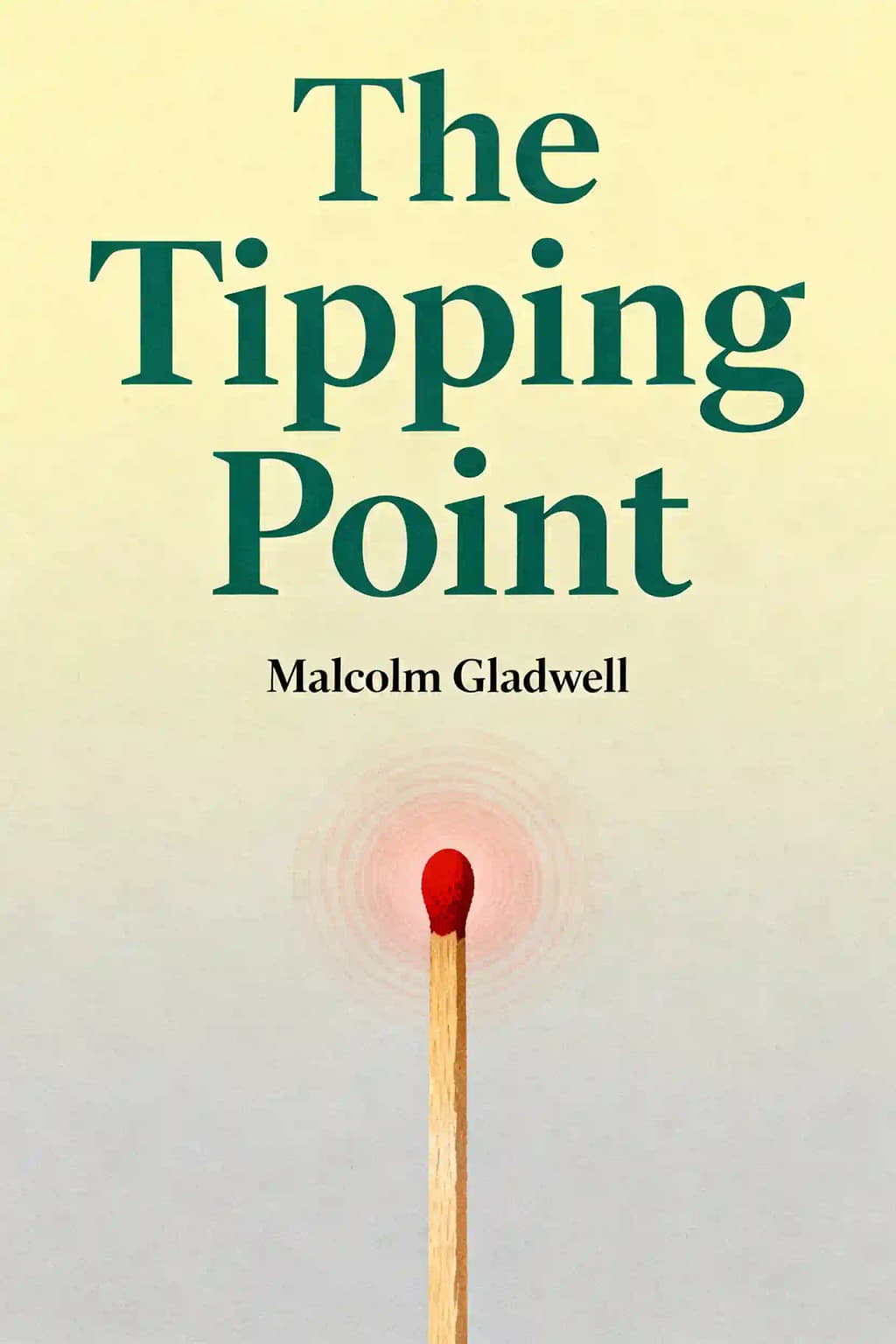
The Tipping Point
How Little Things Can Make a Big Difference
Overview of The Tipping Point
Discover why one book explaining social epidemics transformed marketing forever. "The Tipping Point" reveals how tiny changes create massive shifts - a concept Seth Godin champions and NYC used to dramatically reduce crime through the revolutionary "Broken Windows Theory."

Key Themes in The Tipping Point
- social epidemics
- word of mouth
- critical mass
- influence networks
- behavioral contagion
Quotes from The Tipping Point
Ideas can be as infectious as viruses.
Little causes can produce big effects.
Change happens dramatically, not gradually.
Mavens ensure that information is accurate and trustworthy.
Creating stickiness often requires counterintuitive approaches.
Characters in The Tipping Point
- Malcolm GladwellAuthor and social commentator
- Paul RevereHistorical figure and example of a Connector
- Mark AlpertInformation specialist and example of a Maven
- Tom GauFinancial planner and example of a Salesman
- William DawesHistorical figure who failed to spark an epidemic
About the Author
About the Author of The Tipping Point
Malcolm Timothy Gladwell is the bestselling author of The Tipping Point and a renowned journalist known for blending sociology, psychology, and pop culture to decode human behavior. The book, a landmark in behavioral science, explores how small actions trigger societal transformations—a theme Gladwell amplifies through his signature storytelling in works like Blink (decision-making) and Outliers (success patterns).
A staff writer at The New Yorker since 1996, he has shaped public discourse with award-winning articles and the podcast Revisionist History. Born in England to a Jamaican mother and British father, his multicultural perspective informs his analysis of cultural epidemics.
Gladwell’s career began at The Washington Post, where he covered business and science before rising to New York bureau chief. His books have collectively sold millions worldwide, with The Tipping Point alone surpassing 2.5 million copies and translated into over 40 languages. Recognized in Time’s “100 Most Influential People,” Gladwell’s insights are cited in academia and applied by leaders from Silicon Valley to the United Nations.
Download Summary of The Tipping Point
Get the The Tipping Point summary as a free PDF or EPUB. Print it or read offline anytime.
FAQs About This Book
The Tipping Point explores how small actions or ideas can trigger widespread social change, termed "social epidemics." Gladwell identifies three key factors: the Law of the Few (influential people driving trends), the Stickiness Factor (memorable messaging), and the Power of Context (environment shaping behavior). Examples range from viral fashion trends to crime reduction, illustrating how minor shifts create major impacts.
Marketers, entrepreneurs, sociologists, and anyone interested in understanding cultural shifts will benefit. The book offers actionable frameworks for creating viral campaigns, managing organizational change, or amplifying social movements. Its blend of storytelling and research appeals to both professionals and casual readers seeking insights into human behavior.
Yes—it’s a foundational text for understanding social dynamics and has sold over 2.5 million copies. Gladwell’s accessible writing and case studies (e.g., Hush Puppies resurgence, NYC crime decline) make complex ideas engaging. Critics note its reliance on anecdotes, but its core principles remain influential in marketing, public health, and activism.
- Law of the Few: Trends depend on Connectors (networkers), Mavens (experts), and Salesmen (persuaders).
- Stickiness Factor: Messages must be memorable (e.g., Sesame Street’s educational hooks).
- Power of Context: Environments shape behavior (e.g., fixing broken windows reduced crime).
This rule identifies three pivotal roles in spreading ideas:
- Connectors: Individuals with vast social networks.
- Mavens: Knowledgeable experts who share insights.
- Salesmen: Charismatic persuaders who drive adoption.
Together, they act as catalysts for tipping points.
The Stickiness Factor refers to content’s ability to “stick” in memory and inspire action. Gladwell highlights techniques like repetition (e.g., Blue’s Clues) or subtle tweaks (e.g., adding a map to a health pamphlet), which dramatically increase engagement and retention.
Gladwell argues that environment shapes behavior more than personality. For example, NYC’s 1990s crime drop correlated with cleaning graffiti and fixing broken windows. Small contextual changes (e.g., group size, physical space) can tip social norms.
- Marketing: Targeting Connectors for viral campaigns.
- Public Health: Designing sticky messaging for behavior change (e.g., anti-smoking ads).
- Policy: Reducing crime via environmental tweaks (e.g., improved street lighting).
Some scholars argue Gladwell oversimplifies social dynamics, relying heavily on anecdotes over rigorous data. Others note exceptions to his rules, such as trends without clear Connectors. Despite this, the book remains a staple for its conceptual framework.
- “The tipping point is that magic moment when an idea, trend, or social behavior crosses a threshold, tips, and spreads like wildfire.”
- “Emotion is contagious.”
While Blink focuses on rapid cognition and Outliers on success drivers, The Tipping Point uniquely examines collective behavior. All three use narrative-driven research but target different facets of human psychology.
Marketers use its principles to engineer virality: identifying influencers (Connectors), A/B testing sticky messages, and optimizing platforms (Context). For example, LinkedIn’s early growth leveraged Connectors to onboard networks rapidly.