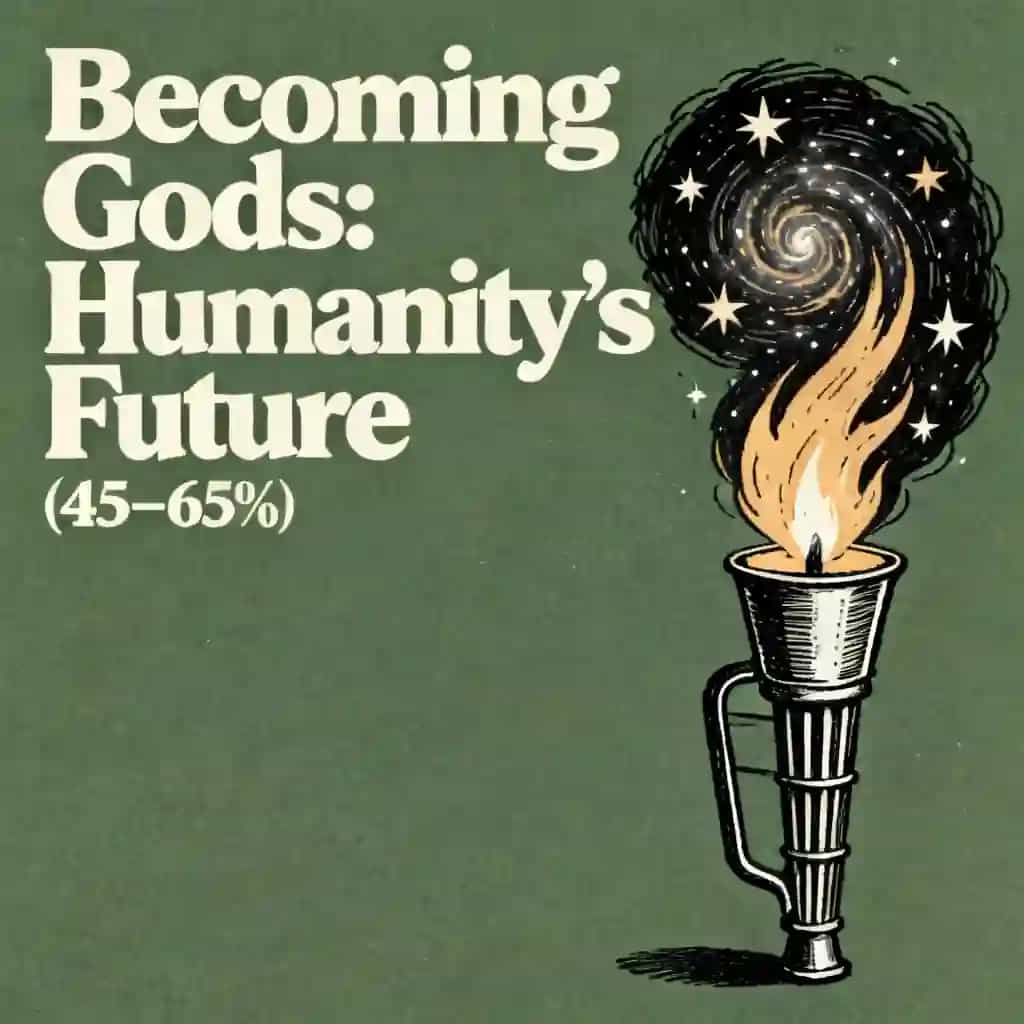
Overview of The Future of Humanity
Michio Kaku's NYT bestseller explores humanity's cosmic destiny - from terraforming Mars to achieving immortality. Praised by Kirkus Reviews for its optimistic yet scientifically grounded vision, this mind-bending roadmap to our interstellar future has inspired SpaceX's boldest initiatives. What if extinction isn't inevitable?
- Michio Kaku argues humanity must become multiplanetary to avoid extinction events
- Terraforming Mars requires robotic pioneers and nanotechnology to create breathable atmospheres
- Type I civilizations harness planetary energy while Type II control entire stars
- Genetic engineering and cybernetics could make humans immortal within this century
- Laser-propelled nanoships may reach Alpha Centauri within our lifetimes at light speed
- Multigenerational starships could preserve humanity during 100,000-year interstellar journeys
- Cosmic radiation and low gravity will force rapid human evolution off-world
- Asteroid mining promises unlimited rare metals through robotic space extraction systems
- Advanced aliens might share technology if we achieve peaceful global unification first
- Surviving universe collapse requires accessing alternate dimensions through quantum physics mastery
- Space elevators using carbon nanotubes could slash orbital launch costs dramatically
- Becoming a Type II civilization demands solving climate change destabilizing Earth first
About the Author of The Future of Humanity
Michio Kaku, theoretical physicist and bestselling author of The Future of Humanity, is a renowned futurist and science communicator known for making complex concepts accessible. Born in 1947 in San Jose, California, Kaku holds a PhD from the University of California, Berkeley, and serves as a professor at the City College of New York. His work explores themes of space colonization, advanced technologies, and humanity’s cosmic destiny, informed by his groundbreaking research in string field theory and decades of academic leadership.
A frequent guest on major networks like BBC, Discovery Channel, and The Daily Show, Kaku has hosted science programs such as Science Channel’s Physics of the Impossible and Futurescape. His other bestselling books, including Physics of the Impossible, Physics of the Future, and The God Equation, blend speculative science with rigorous analysis, cementing his reputation as a bridge between academia and popular culture.
The Future of Humanity reflects Kaku’s lifelong mission to democratize scientific knowledge, offering a visionary roadmap for interplanetary civilization. A 2021 Sir Arthur Clarke Lifetime Achievement Award recipient, his works have been translated into multiple languages and consistently rank as New York Times bestsellers.
FAQs About The Future of Humanity
What is The Future of Humanity by Michio Kaku about?
The Future of Humanity explores humanity’s potential to become a multi-planetary species, addressing space colonization, interstellar travel, and advanced technologies. Michio Kaku discusses terraforming Mars, laser-propelled nanoships, and immortality through mind-uploading, framing these concepts as necessary for survival amid climate change, resource depletion, or cosmic disasters. The book blends astrophysics, AI, and futurism to outline a roadmap for escaping Earth and thriving across the galaxy.
Who is Michio Kaku?
Michio Kaku is a theoretical physicist, futurist, and bestselling author known for popularizing complex science. A professor at City College of New York, he co-founded string field theory and authored Physics of the Impossible and The God Equation. His work often bridges speculative science and mainstream audiences, earning him a Sir Arthur Clarke Lifetime Achievement Award.
Who should read The Future of Humanity?
This book suits sci-fi enthusiasts, STEM students, and anyone curious about humanity’s cosmic trajectory. Kaku’s accessible explanations of astrophysics, robotics, and genetic engineering make it ideal for readers seeking a scientifically grounded vision of space colonization, interstellar travel, and post-human evolution.
Is The Future of Humanity worth reading?
Yes, for its sweeping synthesis of cutting-edge science and speculative futurism. Kaku translates complex physics into engaging narratives, though some critiques argue his predictions about minimal human evolution over 100,000 years underestimate environmental and genetic pressures.
What are the main themes in The Future of Humanity?
Key themes include:
- Terraforming Mars: Using nanotechnology and bioengineered microbes to create habitable environments.
- Interstellar Travel: Near-light-speed nanoships and multigenerational ark ships.
- Post-Humanism: Merging with AI or achieving digital immortality via laser-porting consciousness.
How does Michio Kaku propose colonizing Mars?
Kaku outlines a stepwise approach: deploying robots to construct infrastructure, using nanotechnology to process Martian soil, and modifying human genetics to adapt to lower gravity and radiation. These efforts would pave the way for self-sustaining cities.
What technologies enable interstellar travel in the book?
Two primary methods are highlighted:
- Laser Sails: Tiny probes propelled by ground-based lasers at near-light speed.
- Generation Ships: Massive vessels housing ecosystems for multi-century journeys.
Does Kaku address human evolution in space?
Kaku argues that human “core personality and basic shape” will remain stable over millennia in space—a claim critiqued for underestimating genetic engineering and environmental adaptation’s role in accelerating divergence.
What is laser porting in The Future of Humanity?
Laser porting involves transmitting human consciousness via laser beams to synthetic bodies or virtual realities, enabling near-instant travel across galaxies and digital immortality.
How does Kaku’s string theory work connect to the book?
As a string theory pioneer, Kaku frames humanity’s cosmic destiny through advanced physics, suggesting future civilizations might harness hyperdimensional concepts to escape dying universes.
What criticisms exist about The Future of Humanity?
Critics challenge Kaku’s assumption that humans won’t diverge significantly physiologically or culturally in space, given environmental stressors and genetic engineering’s potential.
What key technologies does Kaku emphasize for space exploration?
- AI and Robotics: For constructing off-world habitats.
- Nanotechnology: To transform hostile environments.
- Biotechnology: To enhance human resilience.
How does The Future of Humanity compare to Kaku’s earlier works?
While Physics of the Impossible explores feasibility, this book focuses on urgency—positioning space colonization as critical for survival. It merges futurism with practical steps, reflecting Kaku’s deepened engagement with existential risks.
Why is The Future of Humanity relevant in 2025?
With rising private space ventures and AI breakthroughs, Kaku’s predictions about Mars missions and AI-driven robotics align with current trends, offering a timely framework for understanding humanity’s next steps.
Feel the book through the author's voice
Turn knowledge into engaging, example-rich insights
Capture key ideas in a flash for fast learning
Enjoy the book in a fun and engaging way
Characters in The Future of Humanity
- Michio KakuAuthor and theoretical physicist
- Yuval Noah HarariHistorian questioning the use of progress
Key Themes in The Future of Humanity
- space colonization
- existential risk
- multiplanetary species
- interstellar travel
- planetary defense
Quotes from The Future of Humanity
Kaku's work reminds us that our destiny lies not on Earth, but in the cosmos.
The dinosaurs became extinct because they didn't have a space program.
We need to go to space to save Earth.
Mars is where the future is.
I don't think the human race will survive unless we spread into space.
Explore Your Way of Learning
 Quick Summary Mode
Read or listen to The Future of Humanity Summary in 11 Minutes
Break down key ideas from The Future of Humanity into bite-sized takeaways to understand how innovative teams create, collaborate, and grow.

 Fun Mode
The Future of Humanity Lessons Told Through 25-Min Stories
Experience The Future of Humanity through vivid storytelling that turns innovation lessons into moments you'll remember and apply.
 Personalize Mode
Experience The Future of Humanity in your own learning style
Ask anything, choose your learning style, and co-create insights that truly resonate with you.
From Columbia University alumni built in San Francisco
"Instead of endless scrolling, I just hit play on BeFreed. It saves me so much time."


"I never knew where to start with nonfiction—BeFreed’s book lists turned into podcasts gave me a clear path."


"Perfect balance between learning and entertainment. Finished ‘Thinking, Fast and Slow’ on my commute this week."
"Crazy how much I learned while walking the dog. BeFreed = small habits → big gains."
"Reading used to feel like a chore. Now it’s just part of my lifestyle."

"Feels effortless compared to reading. I’ve finished 6 books this month already."
"BeFreed turned my guilty doomscrolling into something that feels productive and inspiring."

"BeFreed turned my commute into learning time. 20-min podcasts are perfect for finishing books I never had time for."
"BeFreed replaced my podcast queue. Imagine Spotify for books — that’s it. 🙌"

"It is great for me to learn something from the book without reading it."
"The themed book list podcasts help me connect ideas across authors—like a guided audio journey."
"Makes me feel smarter every time before going to work"
From Columbia University alumni built in San Francisco
"Instead of endless scrolling, I just hit play on BeFreed. It saves me so much time."
"I never knew where to start with nonfiction—BeFreed’s book lists turned into podcasts gave me a clear path."
"Perfect balance between learning and entertainment. Finished ‘Thinking, Fast and Slow’ on my commute this week."
"Crazy how much I learned while walking the dog. BeFreed = small habits → big gains."
"Reading used to feel like a chore. Now it’s just part of my lifestyle."
"Feels effortless compared to reading. I’ve finished 6 books this month already."
"BeFreed turned my guilty doomscrolling into something that feels productive and inspiring."
"BeFreed turned my commute into learning time. 20-min podcasts are perfect for finishing books I never had time for."
"BeFreed replaced my podcast queue. Imagine Spotify for books — that’s it. 🙌"
"It is great for me to learn something from the book without reading it."
"The themed book list podcasts help me connect ideas across authors—like a guided audio journey."
"Makes me feel smarter every time before going to work"
"Instead of endless scrolling, I just hit play on BeFreed. It saves me so much time."
"I never knew where to start with nonfiction—BeFreed’s book lists turned into podcasts gave me a clear path."
"Perfect balance between learning and entertainment. Finished ‘Thinking, Fast and Slow’ on my commute this week."
"Crazy how much I learned while walking the dog. BeFreed = small habits → big gains."
"Reading used to feel like a chore. Now it’s just part of my lifestyle."
"Feels effortless compared to reading. I’ve finished 6 books this month already."
"BeFreed turned my guilty doomscrolling into something that feels productive and inspiring."
"BeFreed turned my commute into learning time. 20-min podcasts are perfect for finishing books I never had time for."
"BeFreed replaced my podcast queue. Imagine Spotify for books — that’s it. 🙌"
"It is great for me to learn something from the book without reading it."
"The themed book list podcasts help me connect ideas across authors—like a guided audio journey."
"Makes me feel smarter every time before going to work"
"Instead of endless scrolling, I just hit play on BeFreed. It saves me so much time."
"I never knew where to start with nonfiction—BeFreed’s book lists turned into podcasts gave me a clear path."
"Perfect balance between learning and entertainment. Finished ‘Thinking, Fast and Slow’ on my commute this week."
"Crazy how much I learned while walking the dog. BeFreed = small habits → big gains."
"Reading used to feel like a chore. Now it’s just part of my lifestyle."
"Feels effortless compared to reading. I’ve finished 6 books this month already."
"BeFreed turned my guilty doomscrolling into something that feels productive and inspiring."
"BeFreed turned my commute into learning time. 20-min podcasts are perfect for finishing books I never had time for."
"BeFreed replaced my podcast queue. Imagine Spotify for books — that’s it. 🙌"
"It is great for me to learn something from the book without reading it."
"The themed book list podcasts help me connect ideas across authors—like a guided audio journey."
"Makes me feel smarter every time before going to work"

Download Summary of The Future of Humanity
Get the The Future of Humanity summary as a free PDF or EPUB. Print it or read offline anytime.