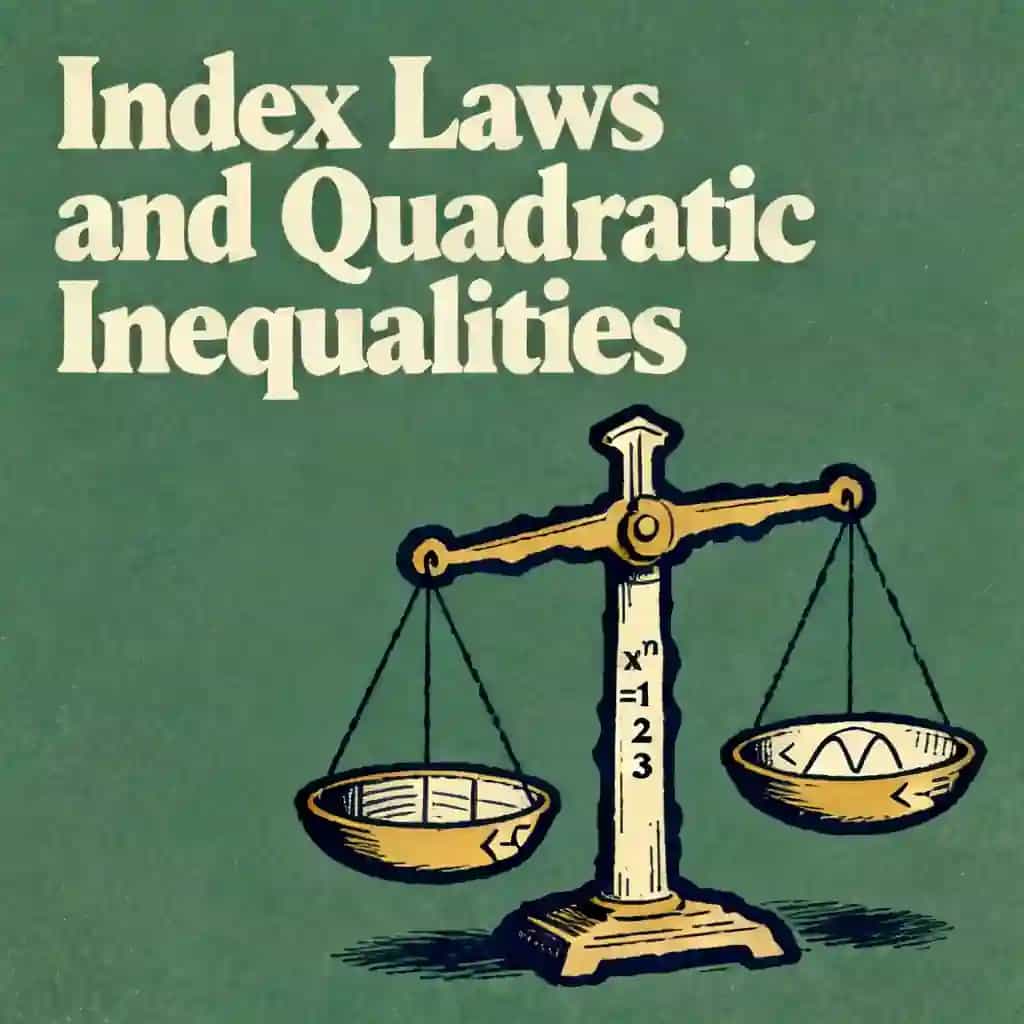
Mastering Indices and Equations for Your A+
Unlock the secrets of the Cambridge 3rd Edition to conquer index laws, fractional roots, and complex inequalities. This guide simplifies algebraic techniques to help you move from surviving class to exam success.

Лучшая цитата из Mastering Indices and Equations for Your A+
The beauty of these laws is that they provide a shortcut through what would otherwise be a mountain of tedious arithmetic. They want to see that you aren't just a human calculator, but a strategist who understands the underlying logic of the system.
Generated by Jennie
teach me because I need to pass my maths class I better get an A+ or just good enough to pass please thankyouCambridge 3rd Edition Textbook: Topic 1:Algebraic techniques and index laws Topic 2: Equations and inequalities (up to and including 7D)


Часто задаваемые вопросы
Anything raised to the power of zero is always exactly one, regardless of how large or complex the base is. This is a fundamental property of the number system because as you divide a number by itself, the powers subtract down to zero, and any number divided by itself equals one. The only mathematical exception to this rule is zero itself.
A negative sign in an index is a directional instruction to take the reciprocal of the base. To simplify an expression like $a^{-n}$, you flip the base into the denominator of a fraction to make the power positive, resulting in $1/a^n$. If you are dealing with a fraction raised to a negative power, you flip the entire fraction and then apply the positive exponent to both the numerator and the denominator.
The product rule applies when you are multiplying two terms with the same base, such as $a^m \times a^n$, in which case you add the indices to get $a^{m+n}$. The power of a power rule applies when a single base already has an index and is then raised to another power, such as $(e^3)^2$. In this specific scenario, you multiply the indices together, resulting in $e^6$.
A fractional index is a different way of writing a mathematical root, where the denominator of the fraction indicates the "index" of the root. For example, a power of $1/2$ is a square root, and a power of $1/3$ is a cube root. When a fraction has a numerator other than one, such as $8^{2/3}$, it is most efficient to take the root first (the cube root of 8 is 2) and then apply the power (2 squared is 4).
While solving an inequality is very similar to solving a standard equation, there is one critical difference: if you multiply or divide both sides by a negative number, you must flip the direction of the inequality sign. This is necessary because multiplying by a negative reverses the relative order of numbers on a number line; for instance, while 5 is greater than 3, -5 is less than -3.
Создано выпускниками Колумбийского университета в Сан-Франциско
BeFreed объединяет глобальное сообщество любознательных людей


"Instead of endless scrolling, I just hit play on BeFreed. It saves me so much time."


"I never knew where to start with nonfiction—BeFreed’s book lists turned into podcasts gave me a clear path."


"Perfect balance between learning and entertainment. Finished ‘Thinking, Fast and Slow’ on my commute this week."
"Crazy how much I learned while walking the dog. BeFreed = small habits → big gains."
"Reading used to feel like a chore. Now it’s just part of my lifestyle."

"Feels effortless compared to reading. I’ve finished 6 books this month already."
"BeFreed turned my guilty doomscrolling into something that feels productive and inspiring."

"BeFreed turned my commute into learning time. 20-min podcasts are perfect for finishing books I never had time for."
"BeFreed replaced my podcast queue. Imagine Spotify for books — that’s it. 🙌"

"It is great for me to learn something from the book without reading it."
"The themed book list podcasts help me connect ideas across authors—like a guided audio journey."
"Makes me feel smarter every time before going to work"
Создано выпускниками Колумбийского университета в Сан-Франциско
BeFreed объединяет глобальное сообщество любознательных людей
"Instead of endless scrolling, I just hit play on BeFreed. It saves me so much time."
"I never knew where to start with nonfiction—BeFreed’s book lists turned into podcasts gave me a clear path."
"Perfect balance between learning and entertainment. Finished ‘Thinking, Fast and Slow’ on my commute this week."
"Crazy how much I learned while walking the dog. BeFreed = small habits → big gains."
"Reading used to feel like a chore. Now it’s just part of my lifestyle."
"Feels effortless compared to reading. I’ve finished 6 books this month already."
"BeFreed turned my guilty doomscrolling into something that feels productive and inspiring."
"BeFreed turned my commute into learning time. 20-min podcasts are perfect for finishing books I never had time for."
"BeFreed replaced my podcast queue. Imagine Spotify for books — that’s it. 🙌"
"It is great for me to learn something from the book without reading it."
"The themed book list podcasts help me connect ideas across authors—like a guided audio journey."
"Makes me feel smarter every time before going to work"
"Instead of endless scrolling, I just hit play on BeFreed. It saves me so much time."
"I never knew where to start with nonfiction—BeFreed’s book lists turned into podcasts gave me a clear path."
"Perfect balance between learning and entertainment. Finished ‘Thinking, Fast and Slow’ on my commute this week."
"Crazy how much I learned while walking the dog. BeFreed = small habits → big gains."
"Reading used to feel like a chore. Now it’s just part of my lifestyle."
"Feels effortless compared to reading. I’ve finished 6 books this month already."
"BeFreed turned my guilty doomscrolling into something that feels productive and inspiring."
"BeFreed turned my commute into learning time. 20-min podcasts are perfect for finishing books I never had time for."
"BeFreed replaced my podcast queue. Imagine Spotify for books — that’s it. 🙌"
"It is great for me to learn something from the book without reading it."
"The themed book list podcasts help me connect ideas across authors—like a guided audio journey."
"Makes me feel smarter every time before going to work"
"Instead of endless scrolling, I just hit play on BeFreed. It saves me so much time."
"I never knew where to start with nonfiction—BeFreed’s book lists turned into podcasts gave me a clear path."
"Perfect balance between learning and entertainment. Finished ‘Thinking, Fast and Slow’ on my commute this week."
"Crazy how much I learned while walking the dog. BeFreed = small habits → big gains."
"Reading used to feel like a chore. Now it’s just part of my lifestyle."
"Feels effortless compared to reading. I’ve finished 6 books this month already."
"BeFreed turned my guilty doomscrolling into something that feels productive and inspiring."
"BeFreed turned my commute into learning time. 20-min podcasts are perfect for finishing books I never had time for."
"BeFreed replaced my podcast queue. Imagine Spotify for books — that’s it. 🙌"
"It is great for me to learn something from the book without reading it."
"The themed book list podcasts help me connect ideas across authors—like a guided audio journey."
"Makes me feel smarter every time before going to work"